

Cho Hee-dae Reviewing Request to Renominate Son Bong-gi…Submits Notice of Nonattendance for 31 Judiciary Committee Hearing
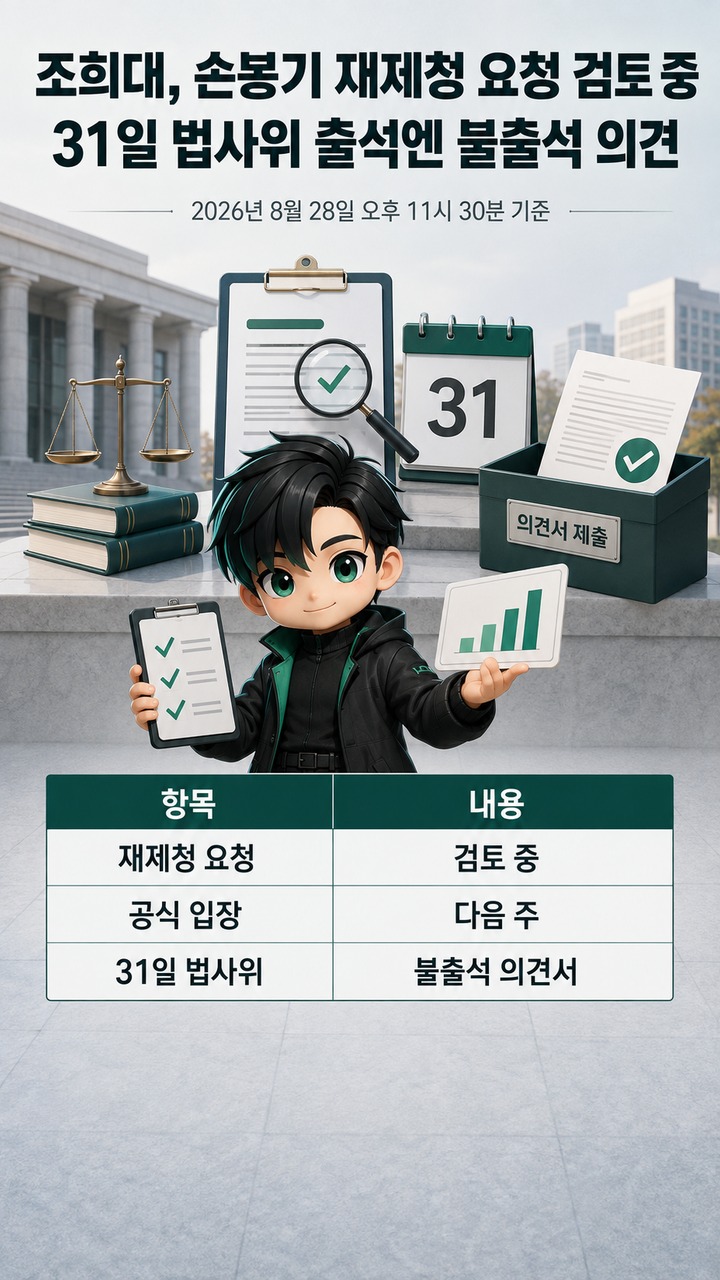
2026-08-28, as of 11:30 p.m. Korea Standard Time, Supreme Court Chief Justice Cho Hee-dae had not yet announced a final position on the presidential office's request to renominate Supreme Court justice nominee Son Bong-gi. Cho said he would review the relevant details and announce his official position next week. On the same day, he also submitted a written notice stating that he would not attend the National Assembly Legislation and Judiciary Committee's questioning session scheduled for 31.

Although the two matters may appear separate, both concern the extent of the Supreme Court chief justice's authority to nominate justices, the president's appointment authority, the National Assembly's power to consent to appointments, and its authority to require attendance. What has been confirmed so far is the presidential office's decision not to submit Son Bong-gi's appointment consent motion to the National Assembly, its request for a new nomination, Cho's decision to review that request, and his submission of a notice of nonattendance in response to the committee's request. How another Supreme Court justice nomination will proceed has not yet been decided.
What Happened to Supreme Court Chief Justice Cho Hee-dae?
The immediate trigger was the nomination of Son Bong-gi, a presiding judge at the Daegu District Court, to serve as a Supreme Court justice. Chief Justice Cho Hee-dae nominated Son to succeed former Justice Noh Tae-ak on August 18 and Kim Sung-soo, a presiding judge at the Seoul High Court, to succeed Justice Lee Heung-gu. Ten days later, on 28, the presidential office announced that it would not submit an appointment consent motion for Son to the National Assembly and asked Cho to nominate another candidate. It also announced its intention to submit an appointment consent motion for Kim Sung-soo.

Cho's statement that evening was neither an immediate acceptance nor a rejection of the request. He said he was reviewing the details of the request for a new nomination and would announce an official position once the matter had been整理ed next week. He gave a similar response when asked whether the Supreme Court Justice Candidate Recommendation Committee would be formed again. Therefore, as of the night of 28, it would be premature to conclude that a new candidate had been selected or that a decision had been made to restart the recommendation process from the beginning.
Why Did the Presidential Office Request a New Nomination for Son Bong-gi?

The main reason officially presented by the presidential office was its assessment that the nomination process lacked sufficient procedural completeness. This does not mean that Son Bong-gi was found to be legally disqualified. Rather, it reflects the presidential office's assessment of the process through which the nomination was made.
During a briefing on 28, presidential office senior spokesperson Kang Yu-jung noted that previous presidents and Supreme Court chief justices had engaged in prior consultations before Supreme Court justice nominations. She said the nomination of Son had been conducted in writing without substantive consultation. She also requested that the new nomination process proceed promptly while respecting the recommendations of the Supreme Court Justice Candidate Recommendation Committee.
An important distinction here is between the presidential office's explanation and the procedure prescribed by the Constitution itself. Article 104, Paragraph 2 of the Constitution provides that Supreme Court justices are appointed by the president with the consent of the National Assembly upon the recommendation of the Chief Justice of the Supreme Court. In other words, the chief justice, National Assembly, and president are responsible for the respective stages of nomination, consent, and appointment.
The Court Organization Act requires the Supreme Court Justice Candidate Recommendation Committee to recommend at least 3 times the number of candidates to be nominated. It also requires the chief justice to respect the committee's recommendations when making nominations. The committee is deemed dissolved once it completes its recommendations.
The next issue is precisely what procedure should be followed when, as in this case, the president does not forward an already nominated candidate's appointment consent motion to the National Assembly and instead requests another nomination. As of the night of 28, Chief Justice Cho had not officially announced how he would proceed.
Why Did Chief Justice Cho Hee-dae Submit a Notice of Nonattendance for the 31 Judiciary Committee Hearing?
On 28, Chief Justice Cho Hee-dae submitted a written notice of nonattendance in response to a request to appear at the National Assembly Legislation and Judiciary Committee's questioning session scheduled for August 31. Cho argued that requiring the Supreme Court chief justice to testify before the National Assembly about the exercise of his authority to nominate Supreme Court justices and matters related to judicial proceedings would be inconsistent with the separation of powers and judicial independence.
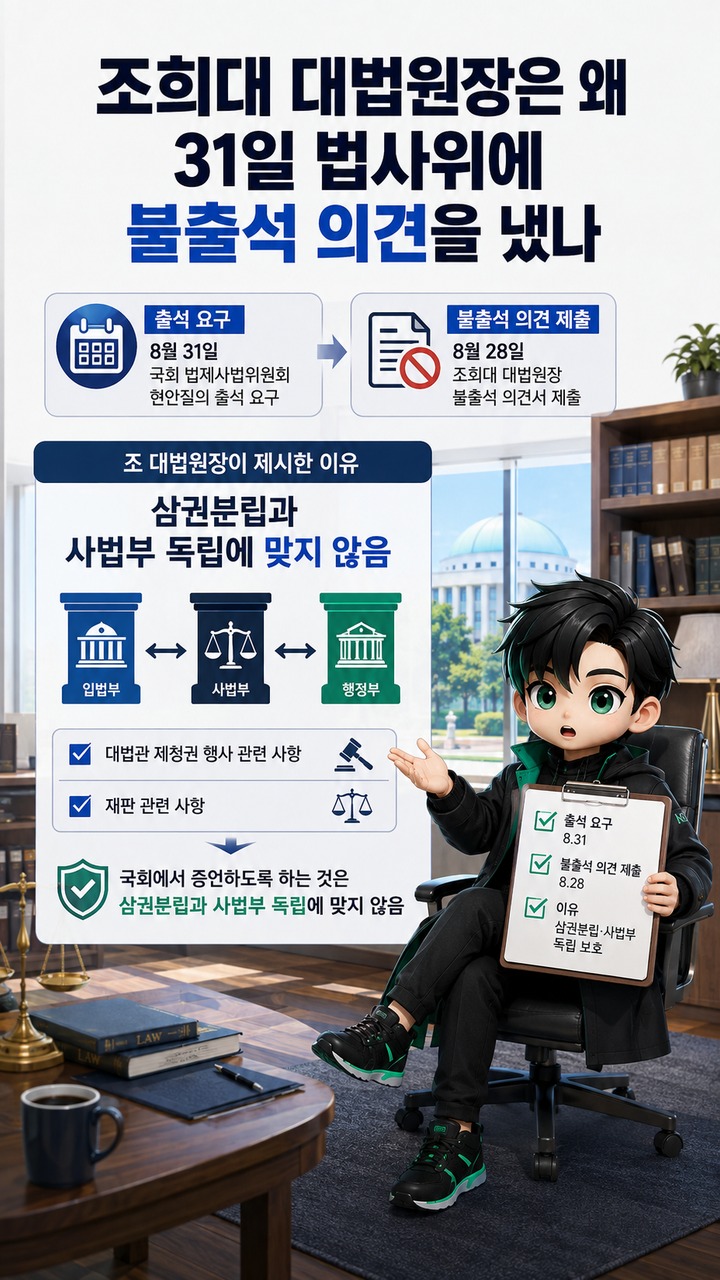
The matters the committee intended to examine included not only the written nomination of Supreme Court justices but also issues related to referring the appeals involving former Prime Minister Han Duck-soo and former Minister of the Interior and Safety Lee Sang-min to the Supreme Court's full bench. Cho maintained that it would be inappropriate to disclose details of an ongoing appointment process or specific personal information about a nominee. He also argued that testifying about the reasons for referring cases to the full bench would raise concerns about judicial independence.
Here, too, it would be difficult to explain the current dispute accurately by simply asserting either that anyone requested to appear before the National Assembly must attend without exception or that the Supreme Court chief justice has no obligation to appear under any circumstances.
Article 121, Paragraph 5 of the current National Assembly Act provides that a plenary session or committee may request the attendance of the Supreme Court chief justice or a representative to answer questions on a specific matter. However, the earlier part of the same article explicitly imposes duties to attend and answer questions on the prime minister, members of the State Council, and government officials. Cho cited this statutory structure as one of the grounds for his notice of nonattendance.
However, Article 2 of the Act on Testimony, Appraisal, etc. Before the National Assembly provides that anyone requested to appear before the National Assembly as a witness or reference witness must comply unless a specific exception applies. Ruling-party lawmakers on the Legislation and Judiciary Committee have cited this provision in arguing that Cho must attend. Accordingly, the most accurate description of the publicly confirmed situation is that the chief justice's side and the committee hold different interpretations of the relationship between applicable laws and constitutional authority.
Does This Mean Son Bong-gi Can No Longer Become a Supreme Court Justice?
As of August 28, the confirmed fact is the presidential office's decision not to submit Son Bong-gi's appointment consent motion to the National Assembly. This alone does not establish that every subsequent procedure has ended or that another candidate has already been finalized.
The appointment of a Supreme Court justice is not completed solely through a nomination by the chief justice. Under the Constitution, the chief justice nominates a candidate, the National Assembly gives its consent, and the president makes the appointment. Son has not yet advanced to the National Assembly's appointment consent stage.
At the Supreme Court Justice Candidate Recommendation Committee convened on January 21 to select a successor to former Justice Noh Tae-ak, 4 candidates were recommended for nomination. The Supreme Court also conducted a process to collect outside opinions on those candidates. Under the Court Organization Act, the chief justice must respect the recommendation committee's recommendations when nominating a candidate.
However, there has been no definitive announcement on whether Chief Justice Cho will nominate another person from the existing list of recommended candidates or make a different decision regarding the recommendation process. Since Cho has announced that he will present an official position next week, this question should be assessed after that announcement.
What Dates and Developments Should Be Watched Next?
The nearest scheduled event is the National Assembly Legislation and Judiciary Committee's questioning session on August 31. Because Chief Justice Cho has already submitted a notice of nonattendance, the first points to watch are whether he actually appears and what follow-up measures the committee takes.
The second is the official position Cho has promised to announce next week. That announcement may clarify how he intends to handle the presidential office's request for a new nomination and what procedure will be used to select a Supreme Court justice candidate. However, the outcome should not be treated as predetermined. Cho's publicly stated position remains that the matter is 'under review.'
It is easier to understand this situation by separating three issues: the presidential office's decision not to send Son Bong-gi's appointment consent motion to the National Assembly, the new nomination procedure that Chief Justice Cho may choose, and the dispute over his attendance at the Judiciary Committee on 31. These issues are connected, but they are not the same procedure.
In particular, it is important not to interpret the request for a new nomination as confirmation that a new Supreme Court justice has already been selected, or to assume that submitting a notice of nonattendance has resolved the legal questions surrounding the National Assembly's attendance request. As of the night of August 28, the clearest developments to watch are the Judiciary Committee proceedings on 31 and Chief Justice Cho Hee-dae's official position next week.