

Noh Woong-rae Acquitted in 2nd Trial: Evidence Issues Reexamined by the Court in the KRW 60,000,000 Case and Remaining Legal Procedures
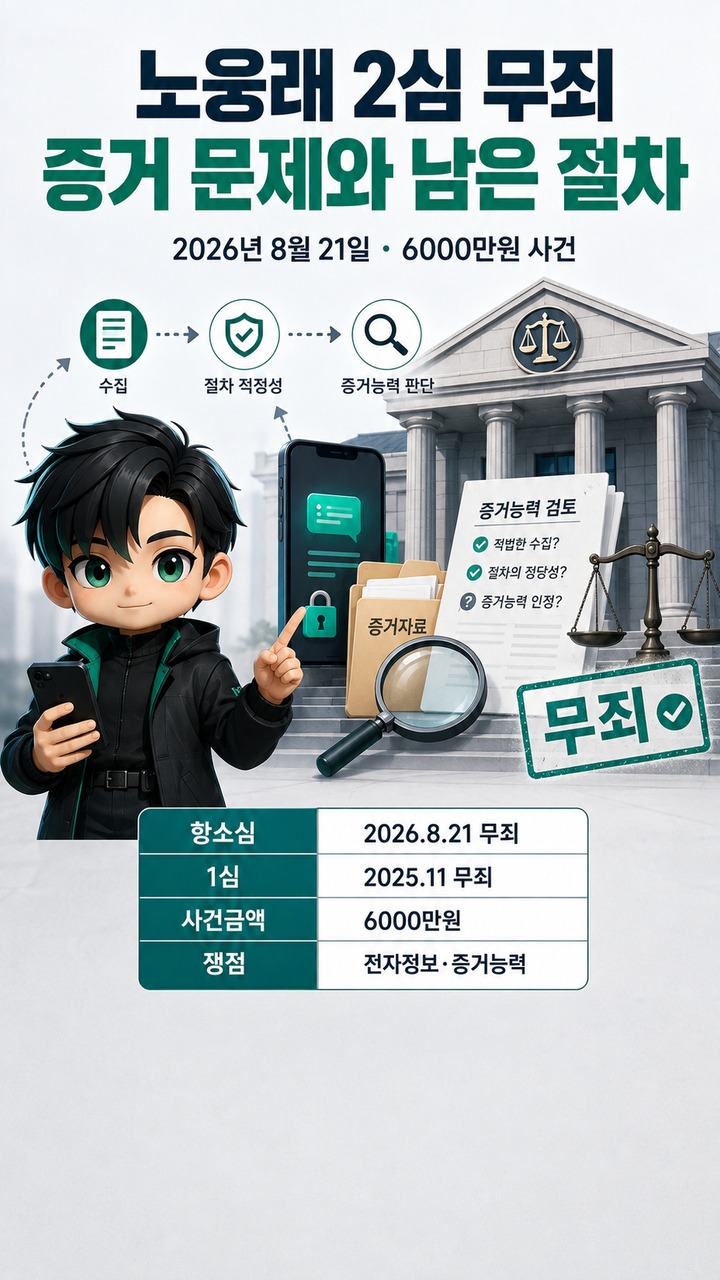
Former Democratic Party of Korea lawmaker Noh Woong-rae was acquitted again on appeal on 2026-08-21. This was his second acquittal, following the 1st trial verdict on November 2025. The central issues were the procedures used by prosecutors to collect electronic information from a mobile phone obtained as an investigative lead and the admissibility of that evidence. Although the appellate court differed from the 1st trial court on certain evidence, it ultimately concluded that the prosecution had not sufficiently proved the charges. As of 2026-08-22 at 9:1 a.m., the case had not reached the stage of a final Supreme Court ruling.
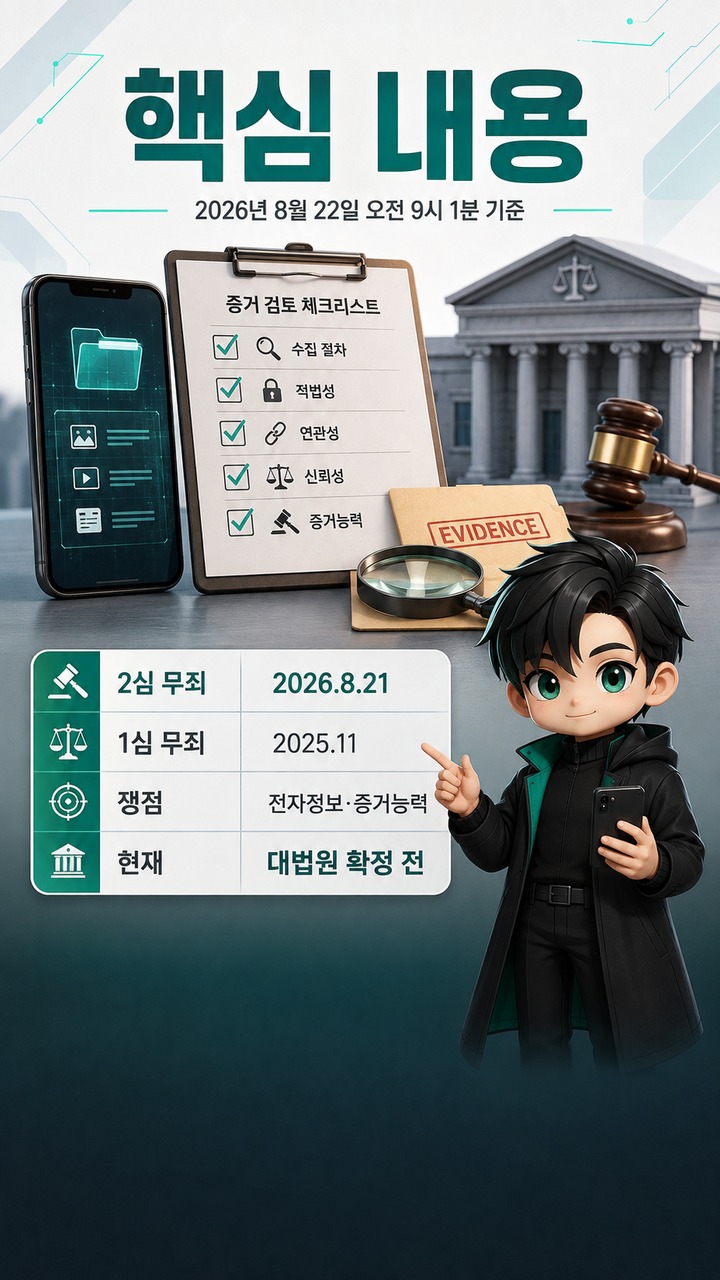
What Did the Court Decide in Noh Woong-rae's 2nd Trial?
The 5-2 Criminal Appeals Division of the Seoul Central District Court upheld the 1st trial acquittal in the case involving former lawmaker Noh Woong-rae, who faced charges including violations of the Political Funds Act, on August 21. Although prosecutors appealed, the appellate panel likewise found that the charges had not been proved sufficiently to convict Noh.

The most important issue in this ruling was electronic information stored on a mobile phone. While investigating a case involving Lee Jeong-geun, a former deputy secretary-general of the Democratic Party of Korea, prosecutors searched and seized the mobile phone of the spouse of a businessman identified by the surname Park. During that process, they obtained materials that led to the investigation of Noh.
The appellate panel ruled that the search and seizure of the phone, along with the examination and selection of its electronic information, constituted unlawful evidence collection procedures that violated warrant requirements. It therefore upheld the 1st trial court's finding that the materials could not be used as evidence to establish Noh's guilt.
However, the appellate court did not accept every evidentiary determination made by the 1st trial court. It found that some electronic information from businessman Park's own mobile phone, which had been excluded at the 1st trial, could be deemed admissible. Even after considering that evidence, however, the court concluded that there was insufficient proof to establish the charges against Noh.
For this reason, it would be inaccurate to describe the ruling simply as an acquittal resulting from the exclusion of a single piece of evidence. A more accurate account of the appellate court's conclusion is that the key mobile phone materials that prompted the investigation were ruled inadmissible, and even after the court recognized the admissibility of certain other electronic information, the remaining evidence was insufficient to establish guilt.
What Allegations Led to the KRW 60,000,000 Case?
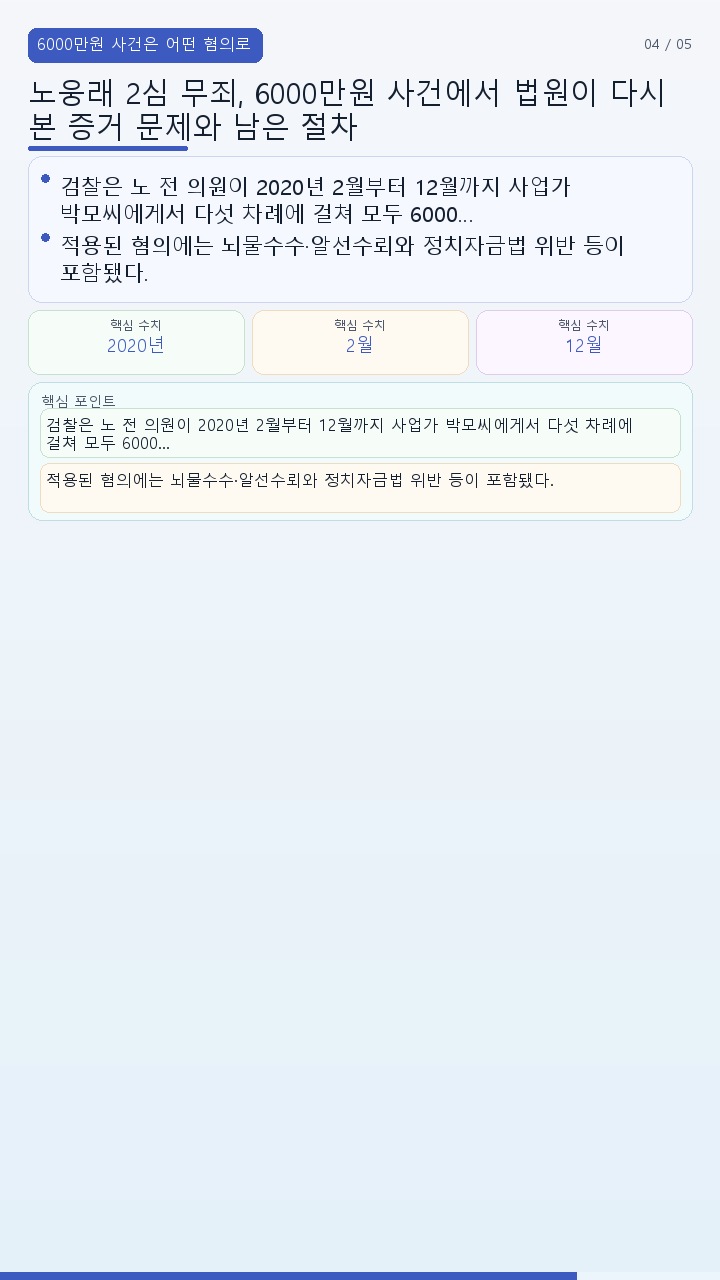
Prosecutors alleged that Noh had received a total of KRW 60,000,000 from businessman Park on five occasions between February 2020 and December and indicted him without detention on March 2023. The charges included bribery, acceptance of bribes for influence-peddling, and violations of the Political Funds Act.
The prosecution's allegations included payments purportedly made in exchange for arranging permits and approvals for a logistics center, facilitating power plant supply contracts, and providing assistance with solar power projects. Prosecutors also alleged that part of KRW 60,000,000 had been provided as campaign funding ahead of a general election and to cover expenses related to a party leadership election. These were allegations brought by prosecutors and must be distinguished from criminal facts established by a court.
The Seoul Central District Court heard the case under case number 2023godan107 and related proceedings. Official court attendance notices also identify Noh Woong-rae as the defendant in a case involving alleged violations of the Political Funds Act and other charges.
At the 1st trial, prosecutors sought a prison sentence of 4 years, a fine of KRW 200,000,000, and forfeiture of KRW 50,000,000. They requested a sentence at the same level during the appeal following the 1st trial acquittal, but the appellate court rejected their position.
What Was the Same and What Changed Between the 1st and 2nd Trials?
The verdict in Noh's 1st trial was delivered on 2025-11-26. The Seoul Central District Court's Criminal 4 Single-Judge Division acquitted Noh, ruling that the key electronic information from the mobile phone submitted by prosecutors had been unlawfully obtained. The court also refused to recognize the admissibility of testimonial evidence and other materials derived from that electronic information.
The most important conclusion remained unchanged on appeal. The appellate court upheld the finding that the search and seizure of the mobile phone belonging to Park's spouse, which had provided the initial investigative leads, and the examination of its electronic information had not been conducted lawfully.
The difference concerned electronic information separately obtained from Park's own mobile phone. The appellate court ruled that the 1st trial court had erred in excluding some of this information from evidence. Nevertheless, even after admitting those materials into the evidentiary record, the appellate court found that the prosecution had not sufficiently proved the charges as a whole.
| Category | 1st Trial | 2nd Trial |
|---|---|---|
| Verdict date | 2025-11-26 | 2026-08-21 |
| Outcome for former lawmaker Noh Woong-rae | Not guilty | Not guilty |
| Key mobile phone evidence | Ruled unlawfully obtained | Finding of unlawful collection upheld |
| Certain separately obtained electronic information | Excluded from evidence | Some information deemed potentially admissible |
| Final determination | Insufficient proof of guilt | Insufficient proof even after considering the additional materials |
The 2nd trial therefore did not simply repeat the 1st trial ruling. The appellate court revised certain evidentiary determinations, reassessed the charges in their entirety, and nevertheless reached the same verdict of not guilty.
Why Was Illegally Obtained Evidence Central to This Trial?
In a criminal trial, the mere fact that information is relevant to an alleged offense does not automatically make it admissible evidence of guilt. Investigators must also comply with the scope specified in a warrant and follow lawful procedures when obtaining evidence.
A key issue in this case was that the investigation expanded after investigators discovered information related to Noh in electronic data obtained from a mobile phone during an investigation into a different case. Both the 1st trial court and the appellate court found problems with the search, seizure, and examination of the key mobile phone materials. As a result, they ruled that the information was inadmissible.
Searching and seizing electronic devices is fundamentally different from obtaining a single paper document. A mobile phone can contain enormous quantities of conversations, photographs, documents, and personal information. Consequently, determining how far investigators may search and select materials related to the crime under investigation can become a major issue at trial.
In Noh's case, the courts did not merely consider whether there had been an allegation that he received KRW 60,000,000. They examined, step by step, whether the materials submitted to support that allegation constituted lawfully obtained evidence that could be used in court, and whether the remaining evidence was sufficient to prove the charges.
It is particularly significant that the appellate court upheld the acquittal despite newly recognizing the admissibility of certain electronic information. This demonstrates that the court assessed the admissibility of evidence separately from whether the prosecution had actually proved the alleged offenses.
How Should the Verdict in Businessman Park's Trial Be Viewed Alongside Noh Woong-rae's Case?
The appellate court also upheld the 1st trial outcome for businessman Park, who was tried in related proceedings. The not-guilty verdict concerning allegations that Park had provided money to Noh remained unchanged. However, Park's conviction on charges including providing KRW 330,000,000 to former Democratic Party deputy secretary-general Lee Jeong-geun for election expenses and other purposes was upheld, along with a prison sentence of 1 years and 5 months.
A conviction involving the same defendant in a different case concerning money or valuables does not automatically establish the allegations in Noh's case. Each charge requires separate evidence and proof.
Park again failed to appear at the appellate sentencing hearing, and the court revoked his bail. That decision concerned Park's attendance at his trial and was separate from the determination that Noh was not guilty.
Is Noh Woong-rae's 2nd Trial Acquittal Now Final?
As of August 22 at 9:1 a.m., the 2nd trial acquittal had been confirmed, but it would be incorrect to say that the Supreme Court had issued a final ruling upholding his acquittal. Under the Criminal Procedure Act, a party dissatisfied with a 2nd trial ruling may appeal to the Supreme Court. The deadline for filing such an appeal is 7 days.
The reports on the August 21 ruling and subsequently published materials reviewed so far do not confirm that prosecutors have already filed an appeal with the Supreme Court. Accordingly, the most accurate description at this stage is 'Former lawmaker Noh Woong-rae was acquitted in the 2nd trial following his acquittal in the 1st trial.'
The next development to monitor is whether prosecutors file an appeal with the Supreme Court. If they do, the case will be reviewed by the Supreme Court. If they do not appeal and the statutory deadline expires, it will be possible to confirm whether the appellate judgment has become final.
When assessing this ruling, it is more accurate to distinguish two findings actually made by the court before considering political reactions. First, the key mobile phone materials were unlawfully collected and could not be used as evidence. Second, even after the appellate court admitted certain additional electronic information, it found that the evidence remained insufficient to prove the charges against Noh.