

Chief Justice Cho Hee-dae Submits Supreme Court Justice Nominations in Writing: Candidates Son Bong-gi and Kim Sung-soo—How Did This Differ From the Customary Face-to-Face Process?
이 포스팅은 쿠팡 파트너스 활동의 일환으로, 이에 따른 일정액의 수수료를 제공받습니다.
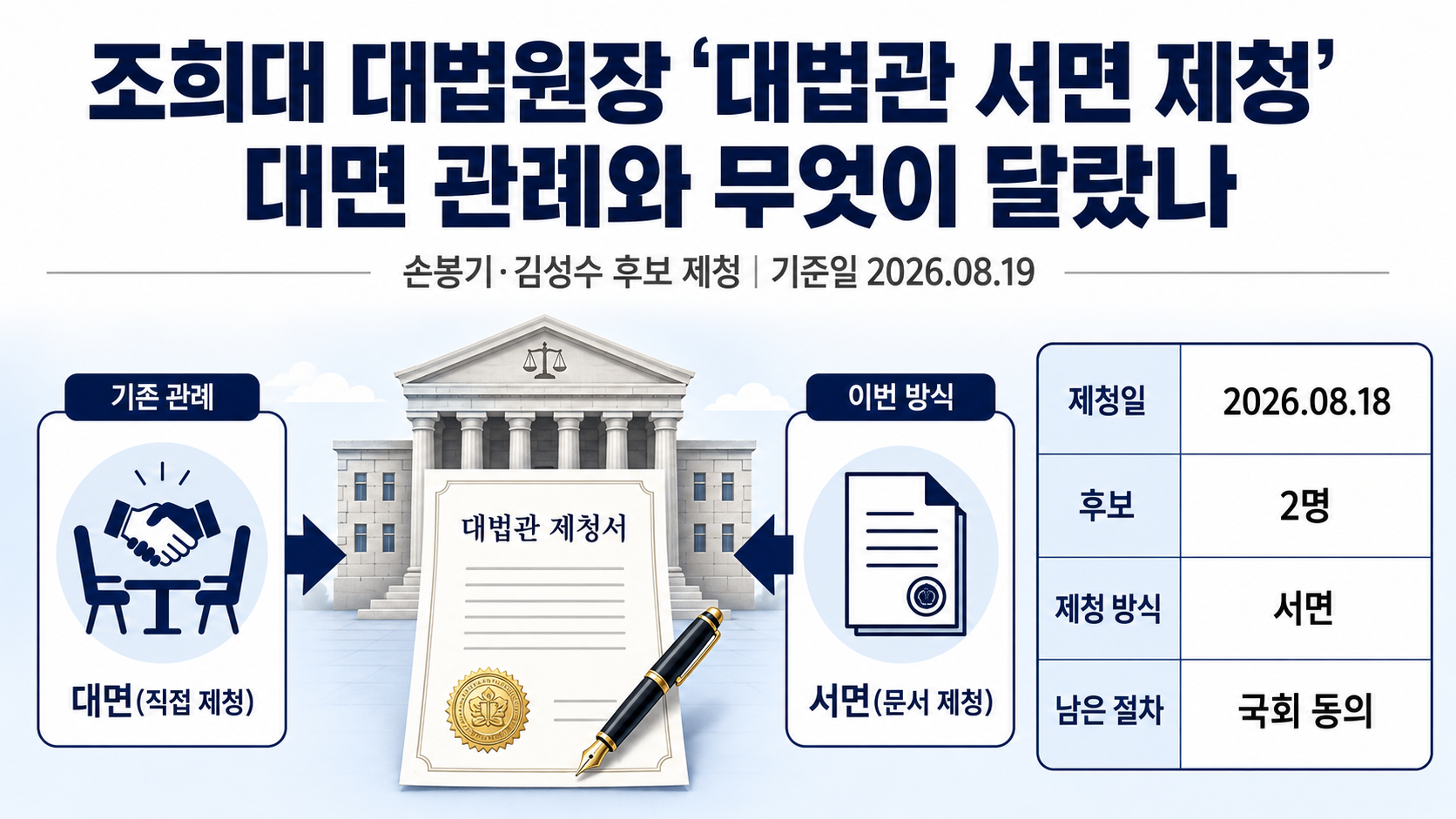
Chief Justice Cho Hee-dae recommended Daegu District Court Presiding Judge Son Bong-gi and Seoul High Court Presiding Judge Kim Sung-soo to President Lee Jae-myung for appointment as Supreme Court justices on 2026-08-18. The nominations have sparked controversy because they were submitted in writing, departing from the established practice of the chief justice meeting the president in person to present nominees. However, the nominations alone do not complete the appointment process. The National Assembly must still give its consent, and the president must formally appoint the justices.
The information was verified as of 2026-08-19 at 1:1 p.m. Korea Standard Time.
Who Are the Supreme Court Justice Candidates Actually Nominated by Chief Justice Cho Hee-dae?
The two nominees are Daegu District Court Presiding Judge Son Bong-gi and Seoul High Court Presiding Judge Kim Sung-soo. Son was nominated to succeed former Supreme Court Justice Noh Tae-ak, whose term ended on March, while Kim was nominated to succeed Supreme Court Justice Lee Heung-gu, who is retiring upon the expiration of his term.
According to the Supreme Court's nomination materials released on August 18, Chief Justice Cho recommended both candidates to President Lee Jae-myung pursuant to Article 104, Paragraph 2 of the Constitution.
The selection process did not involve immediately choosing just two individuals. The Supreme Court explained that it first accepted public recommendations, disclosed information about individuals who consented to screening, and invited public comments before presenting candidates to the Supreme Court Justice Candidate Recommendation Committee. Each recommendation committee then recommended 4 candidates. The court subsequently disclosed information about the candidates' major rulings and professional records, collected additional opinions, and selected the final nominees.
The Supreme Court stated that its final selections took into account not only legal knowledge and judicial decision-making ability but also commitment to judicial independence, protection of fundamental rights, awareness of the need to protect socially vulnerable groups and minorities, integrity, character, and diversity in the composition of the Supreme Court.
How Did the Written Nominations Differ From Previous Supreme Court Justice Nominations?
The central controversy concerns the method of nomination, rather than the fact that two candidates were nominated. Traditionally, when finalizing Supreme Court justice nominations, the chief justice and the president's office coordinated their views before the chief justice met the president in person to formally present the nominees. This time, Chief Justice Cho did not visit the presidential office on August 18 to meet President Lee Jae-myung. Instead, he submitted the nominations in writing.
In particular, reports indicated that coordination between the presidential office and the judiciary had not been completed regarding the nomination of Son Bong-gi to succeed former Justice Noh Tae-ak. By contrast, the two sides reportedly had relatively few disagreements concerning Kim Sung-soo. As a result, the controversy has focused more heavily on the process surrounding Son's nomination than on both nominees equally.
The selection of a successor to former Justice Noh Tae-ak had already been delayed for a considerable period. On January 2026, the Supreme Court Justice Candidate Recommendation Committee recommended 4 candidates, including Son Bong-gi, but no final nomination followed. Noh retired on March without a successor, leaving a Supreme Court seat vacant for more than 5 months.
With Justice Lee Heung-gu also approaching retirement on September, Chief Justice Cho submitted both successor nominations together on August 18. Therefore, understanding this case requires looking beyond the simple question of whether the nominations were made in person or in writing. It is also important to consider the prolonged Supreme Court vacancy and the simultaneous nominations made as a second vacancy approached.
Does Submitting Nominations in Writing Create a Constitutional Problem?
Article 104, Paragraph 2 of the Constitution provides that Supreme Court justices are appointed by the president with the consent of the National Assembly upon the recommendation of the chief justice. The provision does not separately require the chief justice to meet the president in person or to submit nominations through a face-to-face procedure.
Therefore, based solely on the constitutional provision currently confirmed, it would be inaccurate to state that written nominations have automatically been determined to be unconstitutional or illegal.
The controversy centers on how to interpret the nomination authority established by law and the longstanding practice of consultation between the president and the chief justice.
Democratic Party leader Kim Min-seok strongly criticized the nomination method and the prolonged delays in filling judicial vacancies on August 19, calling for Chief Justice Cho's resignation. In contrast, the People Power Party argued that nominating Supreme Court justices is a constitutional authority granted to the chief justice and that the nominations themselves should not be challenged simply because prior coordination did not take place.
Cho Kuk, head of the Rebuilding Korea Party's Innovation Policy Institute, also publicly expressed the view that day that Son Bong-gi's nomination should not be accepted and that renewed consultations should be requested. This was a position expressed in the political sphere, and the procedure the president will actually choose must be verified separately.
In other words, the facts currently established are that the chief justice holds the constitutional authority to nominate Supreme Court justices, consultation with the president and face-to-face nominations have traditionally been customary, and the latest nominations were submitted in writing without a direct meeting with the president. Political assessments describing the nominations as 'illegal,' an 'infringement of presidential authority,' or, conversely, a 'lawful exercise of independent constitutional authority' should be distinguished from the underlying facts and treated as separate political and legal arguments.
Do Son Bong-gi and Kim Sung-soo Become Supreme Court Justices Immediately After Being Nominated?
No. A nomination is only one stage of the Supreme Court justice appointment process and does not constitute a final appointment.
Under the Constitution, the chief justice's nomination must be followed by the National Assembly's consent, after which the president appoints the justice. Accordingly, both individuals should currently be described as 'candidates nominated for appointment as Supreme Court justices.'
If the president submits motions seeking consent to their appointments to the National Assembly, the Assembly will initiate proceedings through a Special Committee on Personnel Hearings to review the proposed appointments. The National Assembly Act provides for the establishment of such a committee to examine appointment consent motions for public officials, including Supreme Court justices, whose appointments require parliamentary approval.
Under the Personnel Hearing Act, the National Assembly must complete its examination or personnel hearing within 20 days of the submission of an appointment consent motion or related request. The committee may summon candidates for questioning and hear their responses. Where necessary, it may also assess their qualifications through witness or reference-witness testimony and the submission of relevant materials.
Supreme Court justices differ from certain other public officials whom the president may appoint based solely on a personnel hearing report, even without parliamentary consent. Because the Constitution expressly requires the National Assembly's consent, the appointment consent motion must pass a plenary session before the process can advance to final appointment. For the motion to pass, a majority of all National Assembly members must be present, and a majority of those present must vote in favor.
The first development to watch is therefore whether the president submits appointment consent motions for both candidates to the National Assembly. The formation of the Special Committee on Personnel Hearings, the hearing schedule, and the results of the plenary vote will then become important in sequence.
Why Is the Issue of Vacant Supreme Court Seats Also Being Discussed?
Former Supreme Court Justice Noh Tae-ak retired on March without a successor having been appointed. With Justice Lee Heung-gu's retirement also approaching, a failure to complete the successor appointment process could leave two Supreme Court seats vacant simultaneously.
The nomination of candidates does not immediately resolve this problem. The president must still submit appointment consent motions, the National Assembly must conduct personnel hearings and grant consent in a plenary vote, and the president must formally appoint the justices.
The Personnel Hearing Act itself establishes a procedure requiring the National Assembly to complete its examination or personnel hearing within 20 days of the submission of an appointment consent motion. Consequently, additional time is needed between the nomination of a candidate and that person's actual assumption of office as a Supreme Court justice.
At this stage, it would be premature to say either that 'the two candidates have been confirmed as Supreme Court justices' or that 'their parliamentary approval has failed.' The accurate status is that Chief Justice Cho Hee-dae nominated Son Bong-gi and Kim Sung-soo to the president for appointment on August 18, while the subsequent constitutional and parliamentary procedures remain pending.
What Has Been Confirmed as of August 19?
As of 2026-08-19 at 1:1 p.m., four points can be established most clearly.
The Supreme Court officially announced that Chief Justice Cho Hee-dae had nominated Presiding Judges Son Bong-gi and Kim Sung-soo for appointment as Supreme Court justices. The nomination date was August 18.
Unlike the established practice of presenting nominations to the president in person, these nominations were submitted in writing. On his way to work on 19, Chief Justice Cho did not provide a detailed explanation when asked why he had submitted the nominations in writing and whether coordination had taken place with the presidential office.
The Constitution establishes the appointment process as nomination by the chief justice → consent of the National Assembly → appointment by the president. Article 104, Paragraph 2 does not separately specify whether nominations must be submitted in writing or in person.
Although opposing political arguments have emerged over these nominations, those political assessments are separate from whether the two candidates will actually be appointed. The final outcome of these Supreme Court appointments will become clear only after determining whether the president submits appointment consent motions and whether the National Assembly proceeds with personnel hearings and a plenary vote.
이 포스팅은 쿠팡 파트너스 활동의 일환으로, 이에 따른 일정액의 수수료를 제공받습니다.