

Former 707 Unit Commander Kim Hyun-tae Sentenced to 12 Years in 1 Trial: How Did the Court Assess the National Assembly Entry and Blockade?
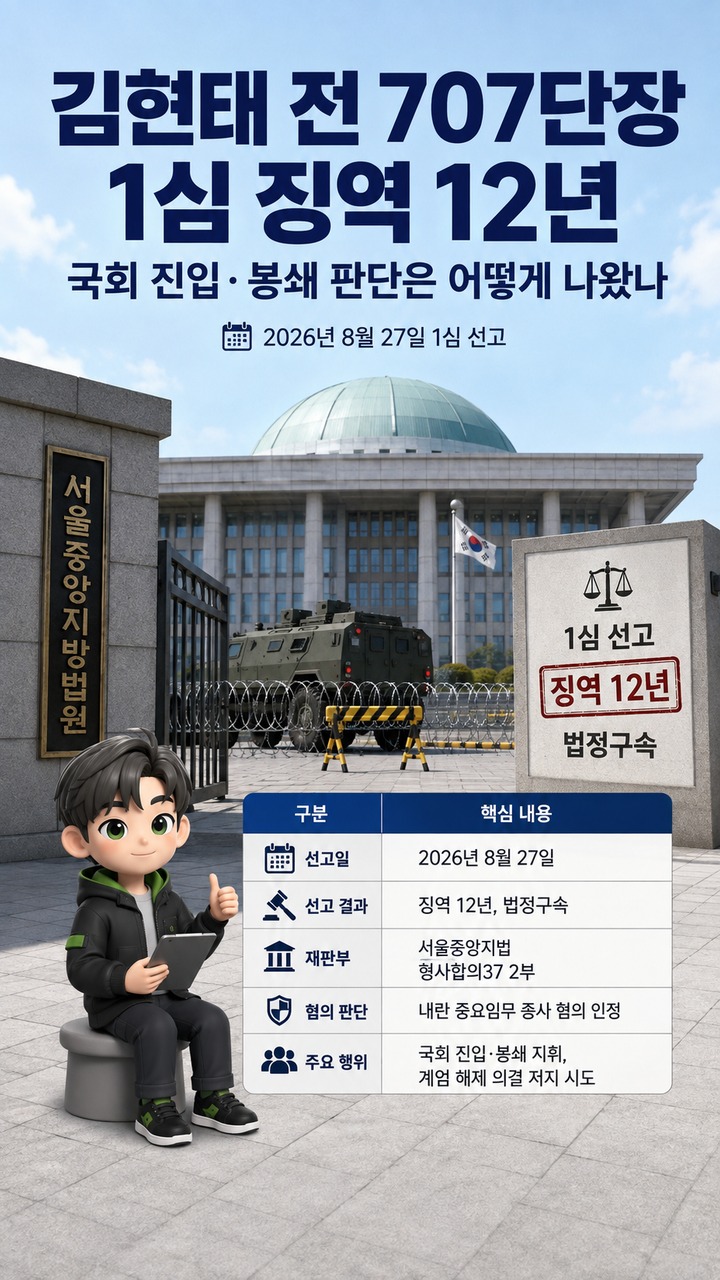
Former Army Special Warfare Command 707 Special Mission Unit commander Kim Hyun-tae was sentenced to 12 years in prison in his 1 trial on 2026-08-27 and taken into custody in court. The Seoul Central District Court's Criminal Division 37-2 found him guilty of performing a key role in an insurrection for actions including leading troops into the National Assembly, directing its blockade, and attempting to prevent a vote to lift martial law during the 12·3 martial law declaration. Because this was a 1 trial ruling, the case could be reviewed by a higher court if an appeal is filed.
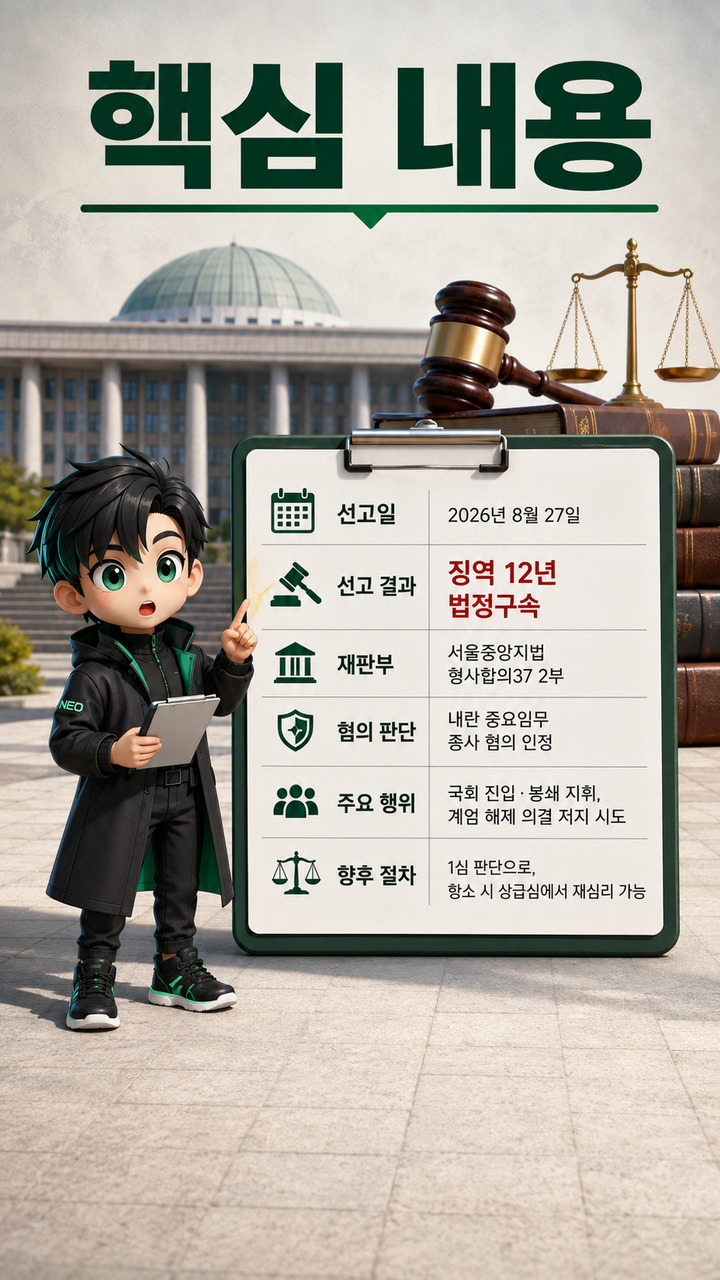
Former 707 Special Mission Unit Commander Kim Hyun-tae Sentenced to 12 Years in Prison
The Seoul Central District Court's Criminal Division 37-2 sentenced former 707 Special Mission Unit commander Kim Hyun-tae to 12 years in prison on August 27. Kim had been standing trial without detention, but he was taken into custody in court that day after receiving a prison sentence.

At an earlier hearing where the prosecution presented its sentencing recommendation, the special prosecutor's team investigating the insurrection had requested 18 years in prison for Kim. A sentencing recommendation made by prosecutors or special prosecutors is the punishment they ask the court to impose; the actual sentence is determined by the court in its judgment.
Therefore, the figures confirmed in this case are the prosecution's requested sentence of 18 years and the 1 trial sentence of 12 years. These two figures should not be treated as having the same meaning.
The court found that Kim, as commander of the 707 Special Mission Unit, deployed troops to the National Assembly and personally directed the blockade at the scene. The court also considered actions including breaking windows at the National Assembly building to send troops inside, attempting to enter the main assembly chamber, and turning off power switches.
The court concluded that these actions constituted an attempt to prevent the National Assembly from voting to lift martial law. The 12-year prison sentence was not based solely on the fact that military personnel had been dispatched to the vicinity of the National Assembly. It also reflected the court's assessment of Kim's command position and the specific actions he directed at the time.
What Mattered Most to the Court Was What Happened After Troops Were Sent to the National Assembly

A particularly important aspect of this ruling is Kim Hyun-tae's role as a commander and the specific actions carried out inside the National Assembly.
According to the court's findings, Kim commanded the 707 Special Mission Unit, which handles counterterrorism operations and other missions. The court determined that he transported troops by helicopter into the National Assembly grounds and directed the blockade on site.
The court regarded the breaking of windows at the National Assembly building to allow troops to enter, the attempted entry into the main assembly chamber, and actions such as turning off power switches as attempts to prevent the vote to lift martial law.
In other words, the court's assessment went beyond the question of whether Kim had received orders from his superiors. It also examined the orders he gave and the actions he took as a commander at the scene.
During the trial, Kim maintained that he had acted in accordance with lawful orders from his superiors. However, the court rejected that argument, found him guilty, and imposed a prison sentence.
His conduct after the offense was also mentioned during sentencing. The court noted that Kim had continued to maintain that martial law was justified and that he had merely followed lawful orders from his superiors. It also raised concerns about statements he made through YouTube and other platforms.
It is important to distinguish between the factors used to determine criminal guilt and those considered when deciding the sentence. The findings concerning the entry into and blockade of the National Assembly, along with attempts to prevent the vote to lift martial law, formed the core of the guilty verdict. Kim's attitude during the proceedings was a factor the court mentioned when determining his punishment.
Kim Hyun-tae Was Not the Only Defendant Sentenced
The rulings delivered on August 27 also covered several former military commanders who had been indicted alongside Kim Hyun-tae.
Lee Sang-hyun, former commander of the Special Warfare Command's 1 Airborne Special Forces Brigade, was sentenced to 10 years in prison over allegations that he was involved in deploying troops to the National Assembly and enforcing its blockade.
Kim Dae-woo, former head of the Counterintelligence Investigation Unit under the Defense Counterintelligence Command, was sentenced to 5 years in prison over allegations of involvement in operating teams tasked with arresting politicians.
Kim Bong-gyu, former head of the Defense Intelligence Command's Central Interrogation Unit, and Jeong Seong-uk, former head of the 2 Operations Unit of the Defense Intelligence Command's 100 Brigade, were each sentenced to 7 years in prison in connection with plans to occupy the National Election Commission and arrest its employees.
The court ordered Kim Hyun-tae, former brigade commander Lee Sang-hyun, and former unit chief Kim Dae-woo taken into custody in court, citing concerns that they might flee or destroy evidence.
However, not every defendant was found guilty.
Park Heon-su, former head of the Ministry of National Defense Investigation Headquarters, and Ko Dong-hee, former head of the Defense Intelligence Command's Planning Division, were acquitted. The court found it difficult to establish that they had intended to participate in an insurrectionary uprising or had the objective of subverting the constitutional order.
Even among defendants tried in connection with the same martial law declaration, the outcomes differed depending on their respective roles, specific actions, and the court's assessment of their intent.
This is also why the ruling should not be interpreted as a single judgment covering every soldier deployed during martial law. The court assessed each defendant's role and actual conduct separately, imposing prison sentences on some while acquitting others.
Why Did the Court Impose 12 Years After Prosecutors Requested 18 Years?
Based on the publicly available details of the 1 trial judgment, what can be clearly confirmed is that the special prosecutor requested 18 years in prison, while the court imposed 12 years.
The difference between the requested sentence and the actual sentence does not, by itself, establish that the court rejected some of the charges. Prosecutors recommend the punishment they consider appropriate, while judges determine the sentence after evaluating guilt or innocence and the relevant sentencing factors.
The court in this case did not treat Kim's actions as minor.
It found that the defendants convicted in the case had improperly used military forces entrusted with national security and territorial defense. In explaining its sentencing decisions, the court emphasized the need for punishment proportionate to the seriousness of the offenses.
In Kim's case, the court considered not only his direct command of the National Assembly blockade but also his attitude during the trial.
It would therefore be inaccurate to conclude either that the charges had been substantially weakened simply because the court imposed 12 years instead of the requested 18 years, or that the prosecution's requested 18-year sentence had effectively been a final punishment.
The court's ruling that can currently be stated with certainty is 12 years in prison in the 1 trial.
Being Taken Into Custody in Court Does Not Mean the Sentence Is Final
Although Kim Hyun-tae was taken into custody in court, this does not mean that the 12-year prison sentence has become final and binding. The decision issued on 2026-08-27 was the Seoul Central District Court's 1 trial judgment.
Being taken into custody in court means that a defendant who had been standing trial without detention is detained by the court when a prison sentence is imposed.
Kim had remained free during the proceedings until the sentencing hearing. However, when the court sentenced him to 12 years in prison, it ordered his detention, citing concerns including the risk of flight and destruction of evidence.
If Kim or the special prosecutor appeals the 1 trial judgment in accordance with the procedures established by law, appellate proceedings may take place at the Seoul High Court. At this stage, therefore, the accurate description is not 'a final 12-year prison sentence' but 'sentenced to 12 years in prison in the 1 trial and taken into custody in court.'
Immediately after the sentencing, the special prosecutor's team also stated that it would review the written judgment before deciding whether to appeal. As of 5:1 p.m. on August 27, neither the decision on whether to appeal nor the outcome of any 2 trial proceedings had been finalized.
When following subsequent developments in this case, it is important to look beyond the figure of '12 years in prison for Kim Hyun-tae' and check whether an appeal has been filed, whether 2 trial proceedings have begun, and whether the sentence or findings of guilt or innocence have changed.
Three Distinctions to Keep in Mind About This Ruling
To understand this case, it is essential to distinguish among the charges, the 1 trial judgment, and a final judgment.
Before the trial, the allegations discussed were the charges and facts presented in the indictment by prosecutors or the special prosecutor's team. Through the ruling on August 27, the court determined which allegations it found proven and established the sentences for the individual defendants at the 1 trial level.
However, because an appeal remains possible, the 1 trial judgment is not equivalent to a final, binding judgment.
The most accurate summary of the current status of former commander Kim Hyun-tae's case is as follows.
On 2026-08-27, the Seoul Central District Court's Criminal Division 37-2 sentenced former 707 Special Mission Unit commander Kim Hyun-tae to 12 years in prison.
Kim was taken into custody in court when the prison sentence was imposed.
The special prosecutor's team had previously requested 18 years in prison.
The court assessed his deployment of troops to the National Assembly, his direct command of the blockade, and actions intended to prevent a vote to lift martial law.
Former 1 Airborne Special Forces Brigade commander Lee Sang-hyun was sentenced to 10 years, former counterintelligence investigation unit chief Kim Dae-woo to 5 years, and former Defense Intelligence Command officers Kim Bong-gyu and Jeong Seong-uk to 7 years each.
Former Ministry of National Defense Investigation Headquarters chief Park Heon-su and former Defense Intelligence Command Planning Division chief Ko Dong-hee were acquitted.
The current outcome is a 1 trial judgment and may change through the appeals process.
Therefore, the first developments to watch in this case are whether former commander Kim Hyun-tae or the special prosecutor files an appeal and how any subsequent appellate proceedings unfold.
Related Articles
What Do Jin, Seon, Mi, Ye, and Jae Mean in Miss Korea? Do Ye and Jae Represent 4 and 5 Places?