

What Happens When the Credit Loan Collateral Ratio Falls Below 140%? How to Calculate the Remaining Stock Value Before Forced Selling

A credit loan account falling below a collateral ratio of 140% does not mean every account will be subject to immediate forced selling in the same way. What you need to check is the securities firm’s required maintenance ratio, the deadline for providing additional collateral, which assets qualify as collateral, and the conditions for executing forced sales. In particular, to calculate how much further the share price would have to fall before a forced sale occurs, you must check the account’s collateral value as well as the loan amount.
Why Can the Stocks Subject to Forced Selling Exceed the Collateral Shortfall?
Forced selling does not mean selling only enough stock to cover the collateral shortfall. Taking into account the possibility that prices may fall further or that sell orders may be executed at lower-than-expected prices, a securities firm may calculate the number of shares to sell using the forced-sale reference price and maintenance ratio specified in its terms.
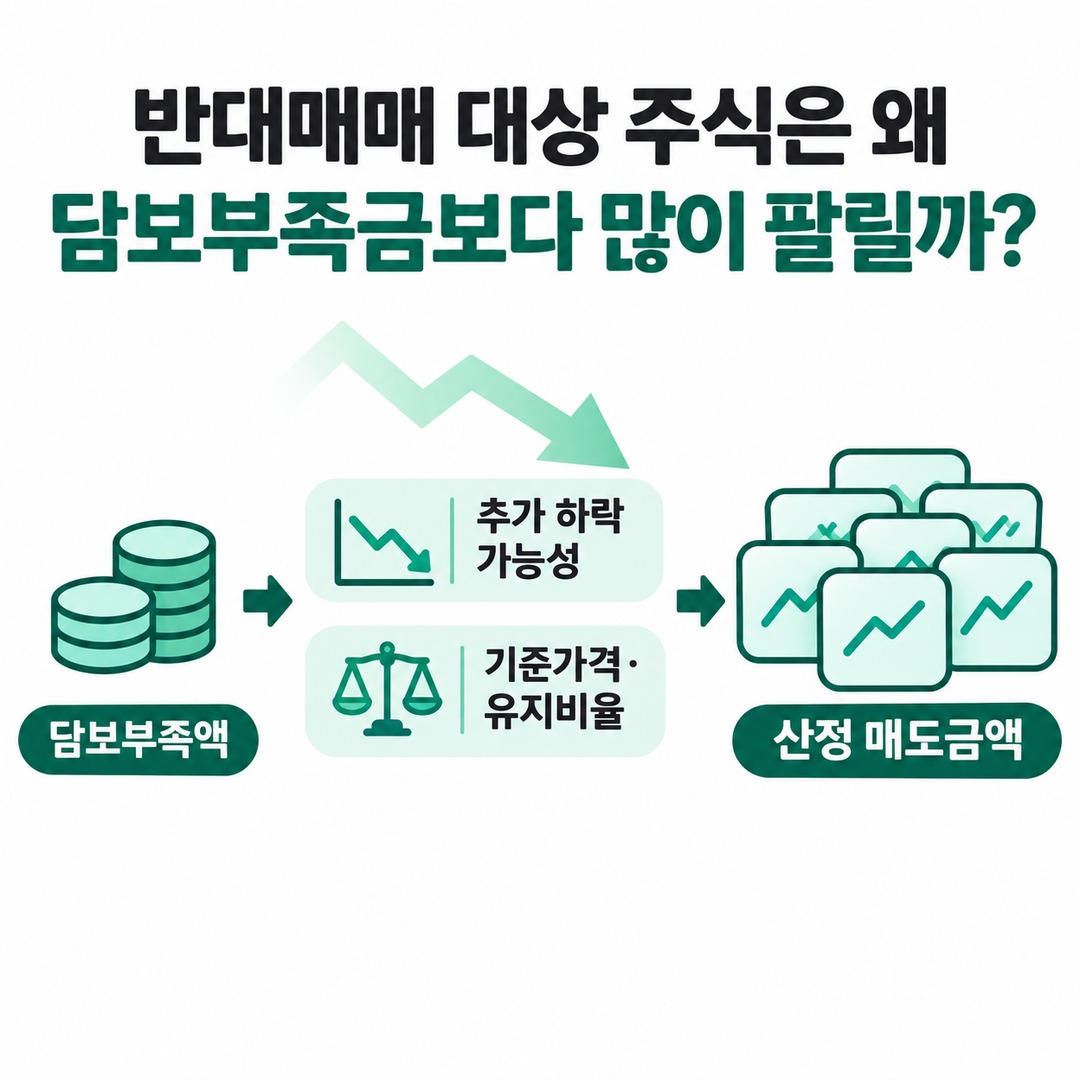
An example in the Korea Financial Investment Association’s credit transaction guide also explains that assets may be liquidated for more than the collateral shortfall. Therefore, estimating the number of shares that will actually be sold based only on the amount shown in a collateral shortfall alert may lead to a different result. Regulatory details+1
1. The Collateral Shortfall and Forced-Sale Amount Are Different
The two amounts differ in their calculation purpose.
Collateral shortfall: The additional amount needed for the account to meet the securities firm’s collateral maintenance ratio
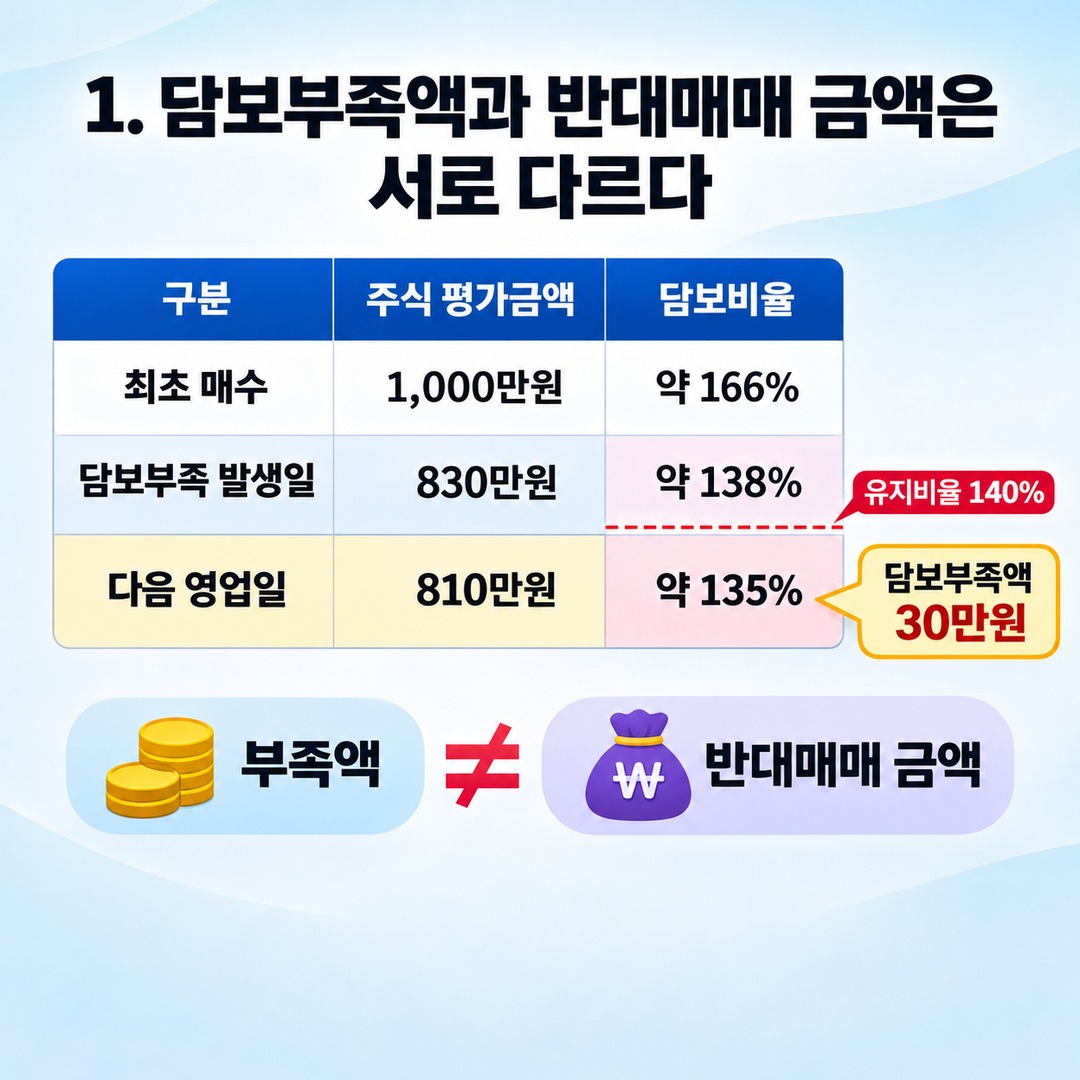
Forced-sale amount: The value of the shares calculated for liquidation to recover the credit loan and restore the collateral ratio
An example in the Korea Financial Investment Association’s guide assumes an account that bought KRW 10,000,000 worth of shares using investment capital of KRW 4,000,000 and a credit loan of KRW 6,000,000.
| Category | Stock valuation | Collateral ratio |
|---|---|---|
| Initial purchase | KRW 10,000,000 | Approx. 166% |
| Date collateral shortfall occurs | KRW 8,300,000 | Approx. 138% |
| Next business day | KRW 8,100,000 | Approx. 135% |
This example assumes a collateral maintenance ratio of 140%. It shows a collateral shortfall of KRW 300,000 occurring on the next business day, followed by the execution of a forced sale. Regulatory details
2. The Forced-Sale Reference Price Matters in the Actual Calculation
In the Korea Financial Investment Association’s guide example, the number of shares subject to forced selling is calculated as follows.
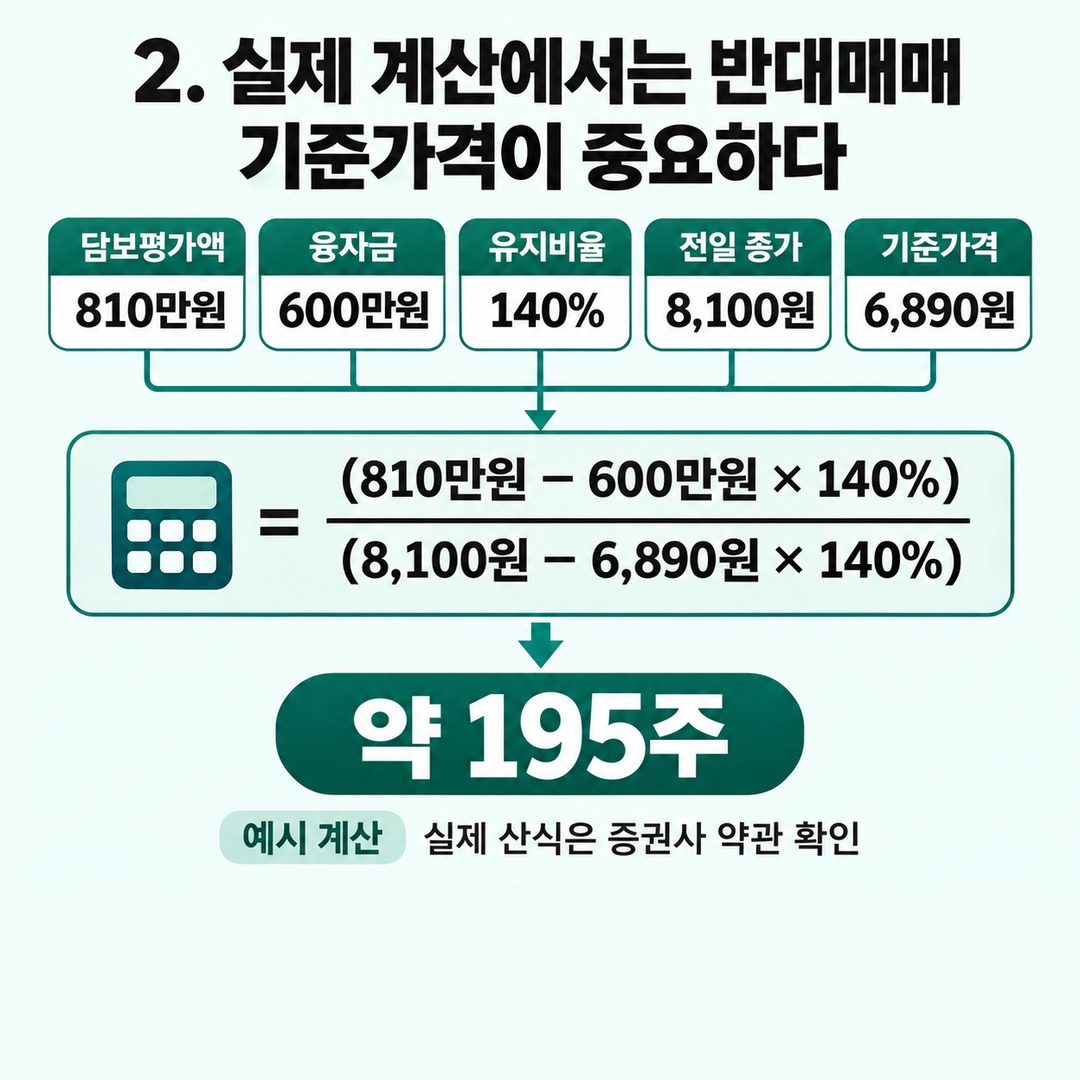
Number of shares subject to forced selling = collateral value − (loan amount × maintenance ratio) previous day's closing price − (forced-sale reference price × maintenance ratio). Check the securities firm's terms for the formula and forced-sale reference price that actually apply.
Let’s plug in the conditions from the Korea Financial Investment Association’s example.
Credit loan amount: KRW 6,000,000
Collateral maintenance ratio: 140%
Stock valuation before forced selling: KRW 8,100,000
Number of shares: 1,000 shares
Previous day's closing price: KRW 8,100
Forced-sale reference price: KRW 6,890
The calculation by the author gives the following result.
8,100,000 − 8,400,0008,100 − 6,890 × 1.4 ≈ 194. Depending on rounding and the method used to determine the actual order quantity, the result is approximately 195 shares.
In other words, a collateral shortfall of KRW 300,000 does not mean that only KRW 300,000 worth of shares will be sold.
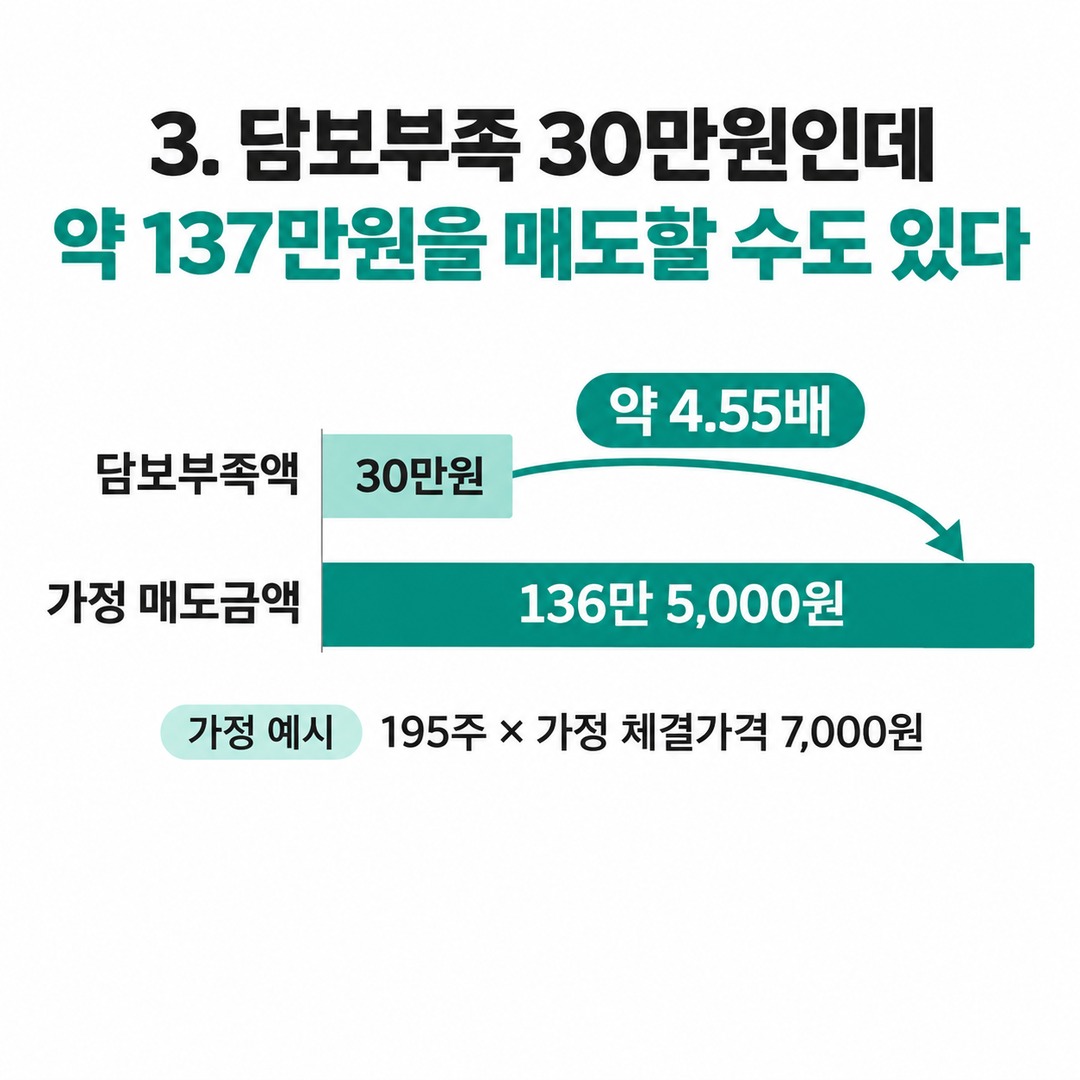
3. With a Collateral Shortfall of KRW 300,000, Approximately KRW 1,370,000 May Be Sold
In the example provided in the Korea Financial Investment Association’s guide, the forced-sale quantity is calculated as 195 shares.
Assuming an actual execution price of KRW 7,000 per share, the calculation is as follows.
| Item | Calculation result |
|---|---|
| Collateral shortfall | KRW 300,000 |
| Forced-sale quantity | 195 shares |
| Assumed execution price | KRW 7,000 |
| Sale amount | KRW 1,365,000 |
| Sale amount relative to the shortfall | Approx. 4.55 times |
Author’s calculation. This figure applies the example quantity and assumed execution price from the Korea Financial Investment Association’s guide.
There is an even more important scenario to consider.
In an example that sets the forced-sale reference price 30% below the previous day's closing price, all 1,000 shares may be classified for forced selling.
This means that even when the collateral shortfall is small, the quantity to be liquidated can vary substantially depending on the reference price, which assumes a drop in the share price. Regulatory details+1
4. For November 2026, Check the 140% Threshold Itself Too
The conditions for applying the collateral maintenance ratio have also changed this time.
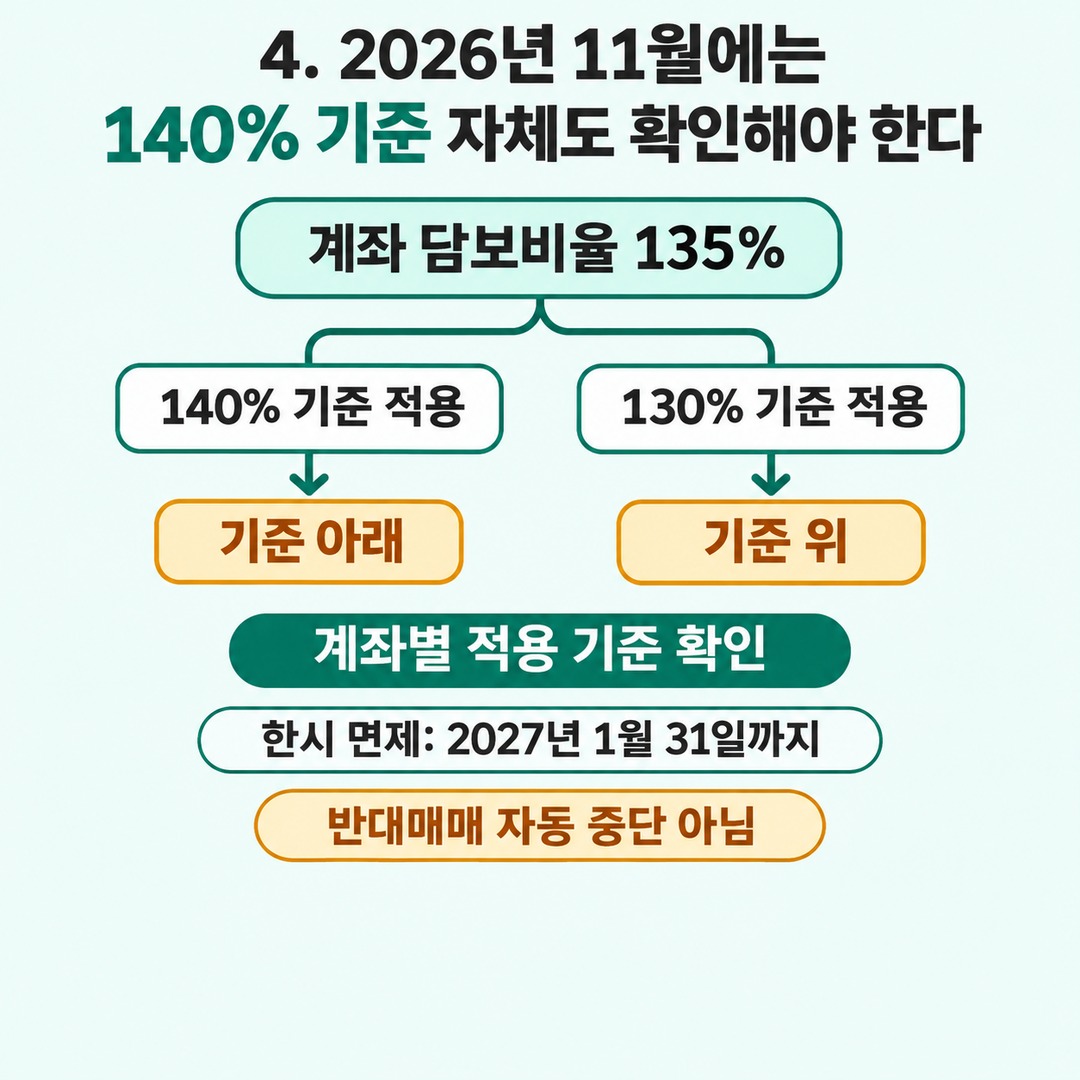
According to reporting dated 2026-11-09, financial authorities implemented a measure temporarily exempting securities firms from the obligation to maintain collateral ratios for credit extensions until 2027-01-31.
Securities firms are responding in two main ways.
| Response | How it applies |
|---|---|
| Reduction in the maintenance margin requirement | For domestic stocks at some brokerages, 140%→130% |
| Deferral of forced selling | Forced sale postponed for a set period for customers who apply |
Mirae Asset Securities and NH Investment & Securities, among others, chose to lower their collateral maintenance ratios. Korea Investment & Securities and Kiwoom Securities, among others, operate a deferral process for customers who apply and meet certain conditions. Edaily+2
One point here should not be misunderstood.
Exemption from the obligation to maintain 140% does not mean that forced selling is automatically suspended for all investors.
Whether the securities firm actually lowered its collateral maintenance ratio
Whether the revised threshold applies to existing accounts as well
Whether separate consent or an application is required
Which collateral ratio range qualifies for a deferral
How many deferrals are allowed and how long they last
Each item must be checked separately.
For example, even among accounts with a collateral ratio of 135%, the outcome may differ between accounts subject to the 130% requirement and those subject to the 140% requirement.
5. How to check your account's actual forced-sale risk
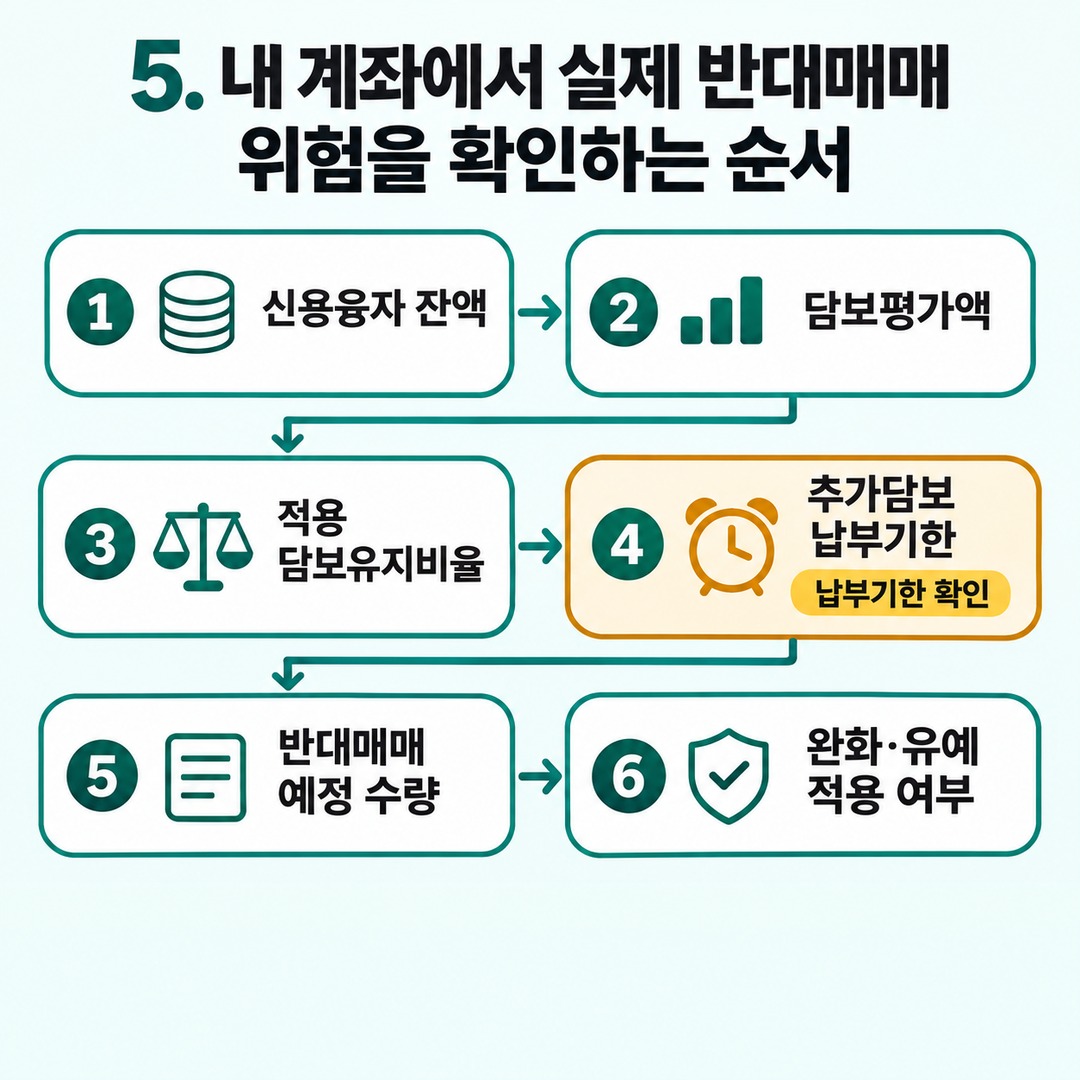
If you receive a collateral shortfall notice, check the following in order.
1. Check the margin loan balance: Confirm the outstanding loan principal.
2. Check the account's collateral value: Distinguish the simple market value of your stocks from the collateral value recognized by the brokerage.
3. Check the applicable maintenance margin requirement: Confirm the ratio based on the stock's rating or account-specific terms.
4. Check the deadline for depositing additional collateral: Confirm whether it is due that day or the next business day.
5. Check the scheduled forced-sale quantity: Use the brokerage app or contact customer service to confirm which stocks are affected and how the quantity is calculated.
6. Check whether relief or a deferral applies: Confirm whether a separate application or customer consent is required.
In particular, do not check only the maintenance margin requirement and miss the deposit deadline.
In a general example in a Korea Financial Investment Association guide, the additional collateral period is given as within 1 business days for the range below 140~160%, and by the end of the day for the range below 120%. However, these are not definitive deadlines that apply uniformly across all brokerages. Regulatory details
6. Frequently asked questions about forced sales
Q. If the collateral ratio falls below 140%, will my stocks be sold immediately?

Not necessarily. There may still be time to deposit additional collateral and follow the procedures set out in the brokerage's terms. However, if a separate contractual condition applies, such as a sharp market fluctuation, the stocks may be sold without a request for additional collateral.
Q. Will depositing cash equal to the collateral shortfall resolve the issue?
Depositing enough to meet the maintenance margin requirement may clear the shortfall. However, the time it takes for the deposit to be reflected and the types of collateral accepted vary by brokerage, so check the collateral ratio again after making the deposit.
Q. If a forced sale takes place, will all my stocks be sold?
Not always. The brokerage may calculate the quantity needed and sell only part of your holdings, but depending on the reference price and the number of shares held, the sale could include all of them.
Q. Can I stop worrying about a forced sale up to 2027-01-31?
No. A temporary exemption from the 140% maintenance margin requirement is separate from each brokerage's conditions for executing a forced sale. Forced sales may still be possible for other reasons, such as an unpaid maturity balance or overdue interest.
Conclusion: Check the actual number of shares slated for sale before focusing on the collateral shortfall
One of the most dangerous misconceptions about margin loan accounts is that the collateral shortfall and the forced-sale amount are the same.
In practice, depending on the forced-sale reference price, maintenance margin requirement, and stock-specific valuation rules, stocks worth far more than the shortfall may be sold.
Especially during the temporary regulatory easing under November 2026, you should also check each brokerage's eligibility criteria and application requirements.
Rather than waiting solely in the hope that the stock price will rebound, first check the current collateral value, the deadline for depositing additional collateral, and the quantity of shares subject to a forced sale.
The calculations in this article are examples intended to aid understanding. Actual forced-sale quantities and execution prices may vary depending on the brokerage's terms and market conditions. Margin loans are high-risk transactions that can result in losses exceeding the principal.
※ This article is for reference to help readers understand market trends and is not an investment recommendation for any specific stock or asset. You are responsible for your own final decisions and investments.