

Should You Wait When CAN SLIM Stocks Appear but the Market Is Weak? Confirming the Trend and Setting Entry Criteria in Stages

Even when stocks that meet CAN SLIM criteria are identified, it is reasonable not to rush into new purchases if selling pressure across the market is strong. The key is to treat finding good stocks and confirming that the market is favorable for buying as separate steps. When the market is weak, keep watching potential buy candidates, but check for evidence that the market trend is improving and whether the stocks themselves are showing buy signals.
As of: 2026-11-09
One distinction matters here. Permanently stopping all purchases because the market is weak is a different decision from holding off on putting new money to work until the market is confirmed.
1. Why should identifying CAN SLIM stocks and actually buying them be treated separately?
CAN SLIM is not a trading method built solely on criteria for finding good companies. You need to consider the market’s direction, a company’s earnings and growth, its stock chart, trading volume, and institutional activity together.

2026-11-05 Investor's Business Daily (IBD) Live materials also distinguish between stocks on the Ready List, which are candidates that meet fundamental and technical criteria, and the actual timing of a purchase, which should be determined from each stock’s individual chart.
Three judgments need to be kept separate here.
Stock selection: Does the company meet CAN SLIM criteria?
Market confirmation: Are buying forces returning to the indexes and market leaders?
Entry decision: Is the stock trading at an appropriate buy point?
Meeting the first condition does not automatically mean the second and third conditions have also been met.
Why Even Stocks Stronger Than the Market Can Fail as Buys
Individual stocks can rise even when the market is weak. But relative strength in an individual stock and an upward trend in the market as a whole are not the same signal.
So be cautious about buying immediately just because one stock is strong while the market is falling.
In particular, distinguish between these situations.
| Market conditions | Stock conditions | Assessment |
|---|---|---|
| Weak market | Strong stock | Prioritize monitoring |
| Weak market | Weak stock | Hold off on new entries |
| Market attempting a rebound | Stock leading the way | Prepare to buy |
| Uptrend confirmed | Stock breaks out normally | Consider entering in stages |
| Uptrend weakening again | Stock breakout fails | Stop adding to the position |
This table distinguishes conditions for investment decisions; it does not show statistical probabilities of successful purchases in each situation.
2. What signals can confirm the market trend?
One important market confirmation criterion in the CAN SLIM approach is Follow-Through Day (FTD), a subsequent up day that confirms a potential trend reversal.
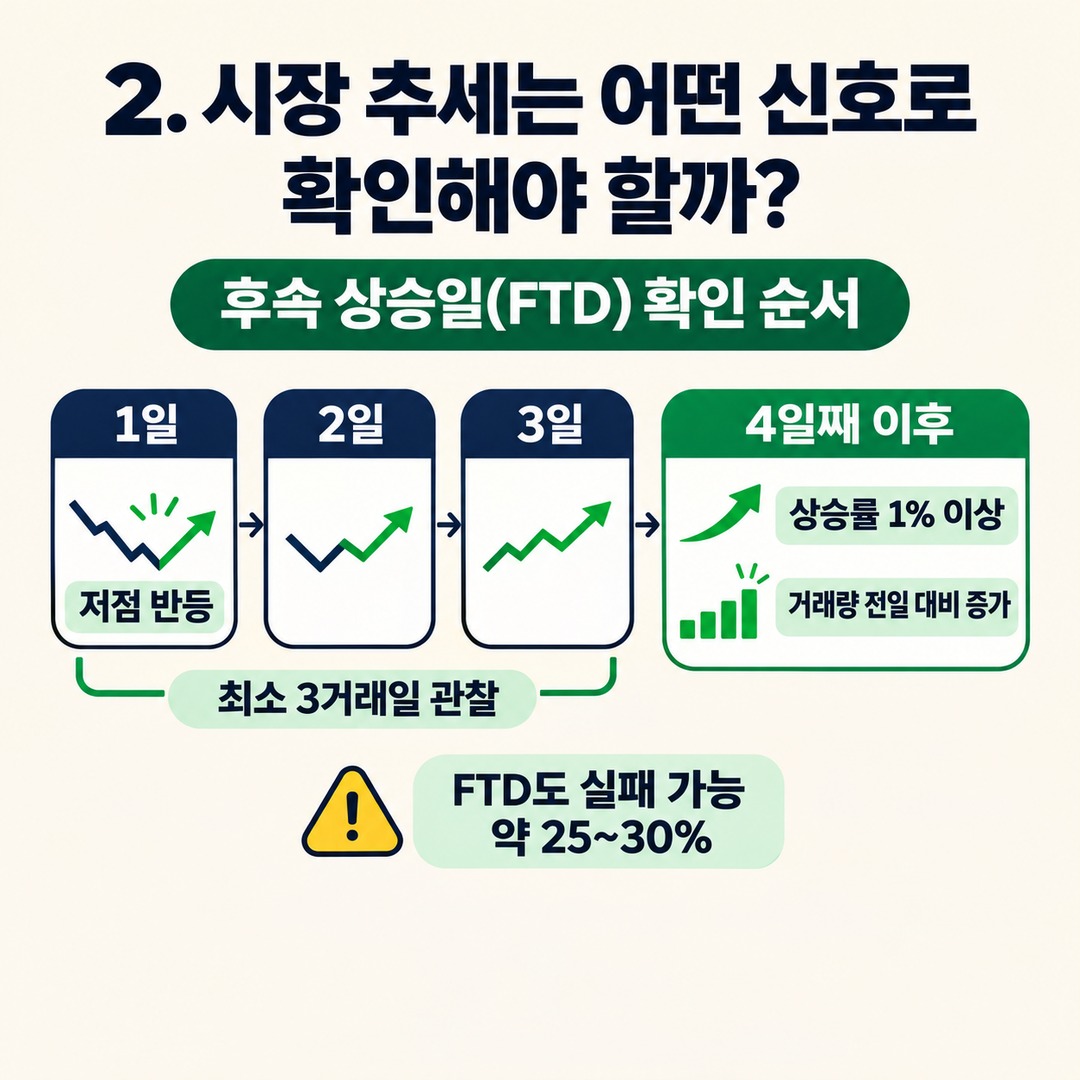
A sharp one-day rebound in an index alone is not enough to conclude that an uptrend has begun.
IBD describes the core FTD conditions as follows.
1. A major index begins to rebound from a low.
2. After the rebound attempt begins, observe the market for at least 3 trading days.
3. On 4 or a subsequent trading day, the index rises.
4. The gain generally needs to be at least 1%.
5. Trading volume must be higher than on the previous trading day.
These conditions are intended to confirm both an index’s price increase and a rise in trading volume.
For details, see IBD’s explanation of market lows and Follow-Through Days.
A one-day rebound is different from trend confirmation
A one-day rise in an index of 2~3% does not, by itself, justify immediately increasing new purchases.
That is because an index can fall again even after a sharp rise.
An FTD can fail. IBD’s explanation of market trends says that about 25~30% of Follow-Through Days may fail.
It is therefore better to understand an FTD as a market confirmation signal that can prompt consideration of buying, not as a signal that guarantees an uptrend.
Why should you also watch for distribution days?
You should not stop after confirming an FTD. Also watch whether institutional selling pressure builds again afterward.
In IBD terminology, a Distribution Day is a day when a major index falls by at least 0.2% while trading volume is higher than on the previous trading day.
Volume does not need to be above average; it needs to be higher than on the previous trading day.
A single Distribution Day does not prove that the trend has ended. However, if Distribution Days cluster within a short period and declines deepen, this can be interpreted as a sign of rising market risk.
In practice, check these three things together.
Price and volume in the Nasdaq and S&P500
How often Distribution Days occur and whether they are clustering
Whether market leaders continue rising after breaking out
If the indexes rebound but market leaders fail to follow, there may not yet be enough reason to enter aggressively.
3. How much should you cut back on new purchases when the market is weak?
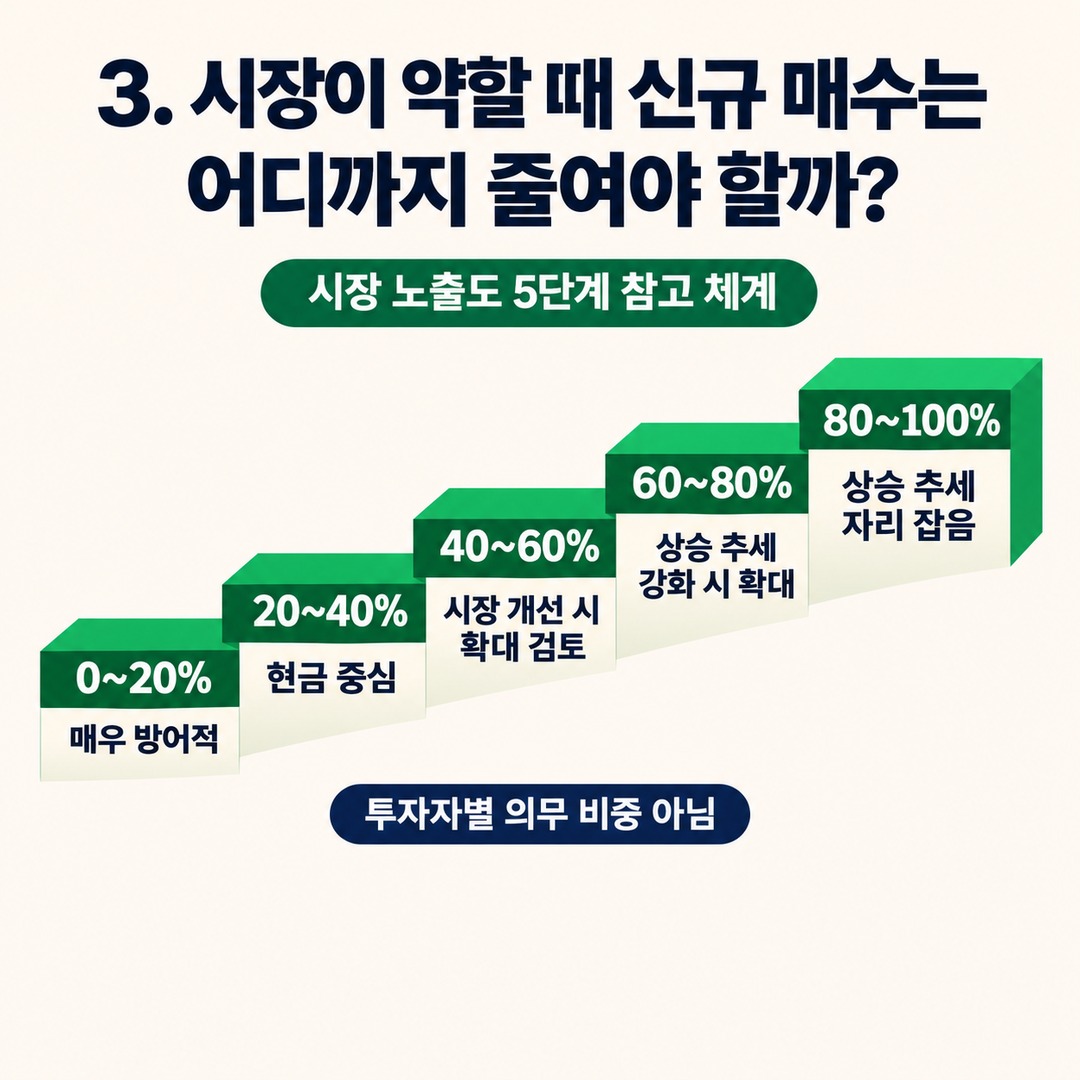
IBD’s Portfolio Exposure Level is a reference framework for adjusting the portion of a portfolio invested in stocks according to market conditions.
The five stages presented in the 2024 edition of MarketSurge Stock Guide are as follows.
| Stock market exposure | Market response |
|---|---|
| 0~20% | Highly defensive |
| 20~40% | Focus on cash; consider small entries if the market improves |
| 40~60% | Consider increasing exposure in response to signs of market improvement |
| 60~80% | Increase exposure as the uptrend strengthens |
| 80~100% | The uptrend is established |
There is an important caveat.
The percentages above are part of IBD’s market exposure framework; they are not mandatory asset allocation percentages for every investor. Actual investment levels may vary depending on an investor’s risk tolerance and investment objectives.
Understand what the 20~40% range means in a weak market
IBD describes the 20~40% range as a cautious, cash-focused position. It explains that when the market begins to improve, investors may make small, tentative purchases in some stocks, but that more defensive positioning is needed if the market retreats from its highs.
Conversely, if exposure falls toward 40~60% as conditions weaken, the recommended response is to avoid new purchases and increase the cash allocation.
So when the market is weak, you can think about it this way.
Hold off on new purchases if the market continues to weaken.
Narrow down your buy candidates if a rebound attempt begins.
Consider starting with a small test position if an FTD is confirmed.
Increase exposure in stages if the indexes and market leaders improve together.
The key is not to rush because you are afraid of missing a buying opportunity.
4. When can you buy an individual stock?
Even if the market trend improves, there is no need to buy if the stock itself has not met the entry criteria.
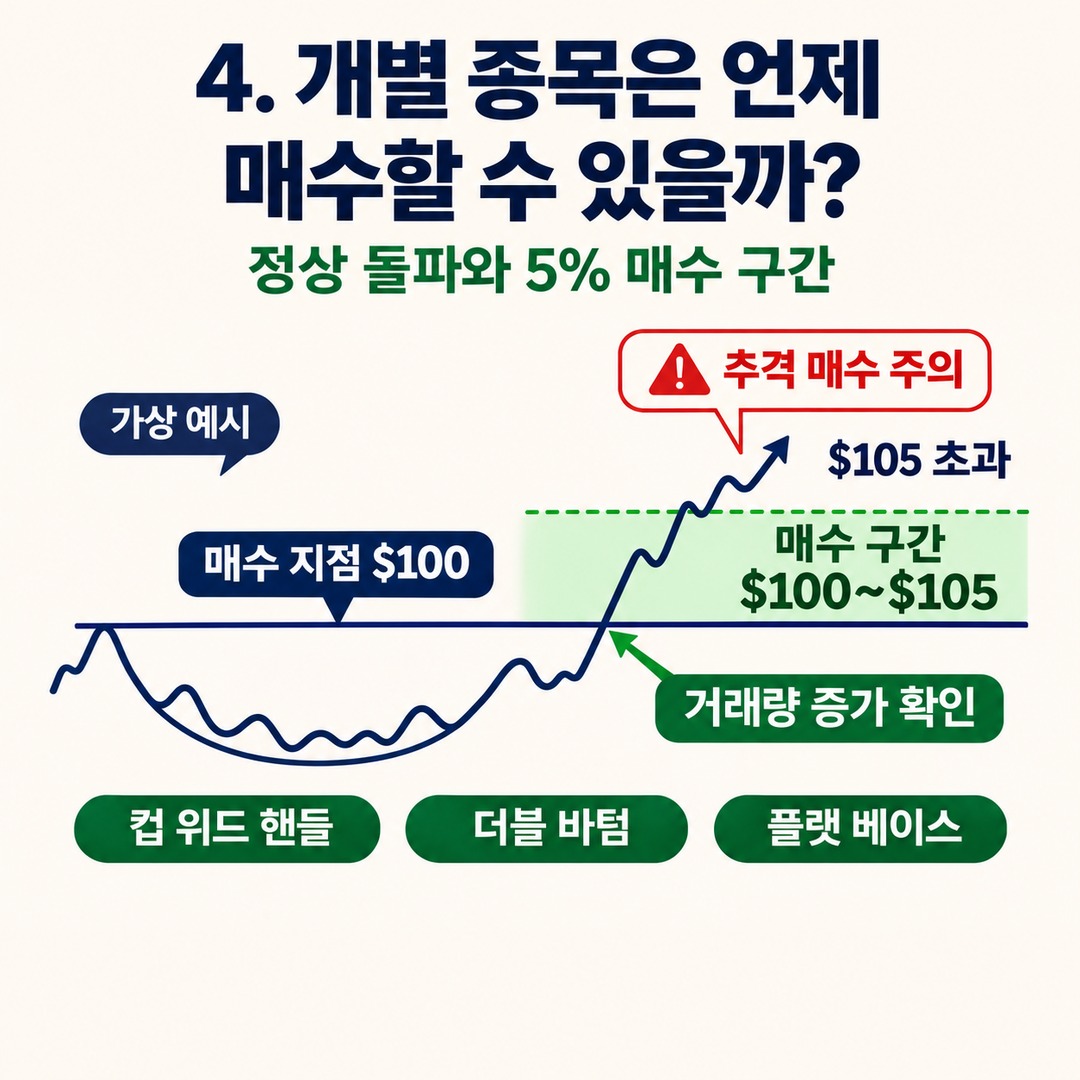
IBD’s buying checklist calls for separate checks of fundamentals, a breakout from a chart pattern, and market exposure.
In particular, first identify an appropriate Buy Point on the chart.
The basic criterion is a normal breakout from a base
A base is a price pattern that forms when a stock consolidates or moves sideways for a period after rising.
Three common patterns are:
Cup with Handle
This pattern attempts a breakout after a handle forms following a cup-shaped correction.
Double Bottom
This pattern forms two lows before breaking above the high between them.
Flat Base
This pattern moves sideways within a relatively narrow price range before breaking through resistance.
IBD’s buying guidance recommends checking whether a stock breaks out from a chart pattern on increased volume and identifies a price range within 5% of the buy point as the buy zone.
How is the 5% buy zone calculated?
Suppose a stock has a buy point of USD 100.
The author’s calculation is as follows.
100×1.05=105| Category | Stock price |
| Buy point | $100 |
|---|---|
| Upper end of buy zone | $105 |
| Above $105 | Caution: avoid chasing the stock |
In other words, if the buy point is USD 100, the basic 5% buy zone is USD 100 – USD 105.
These figures are a hypothetical example for calculation purposes, not the current price of an actual stock.
Do not arbitrarily widen the buy zone just because the market is weak. Market confirmation and a stock’s entry price are separate criteria.
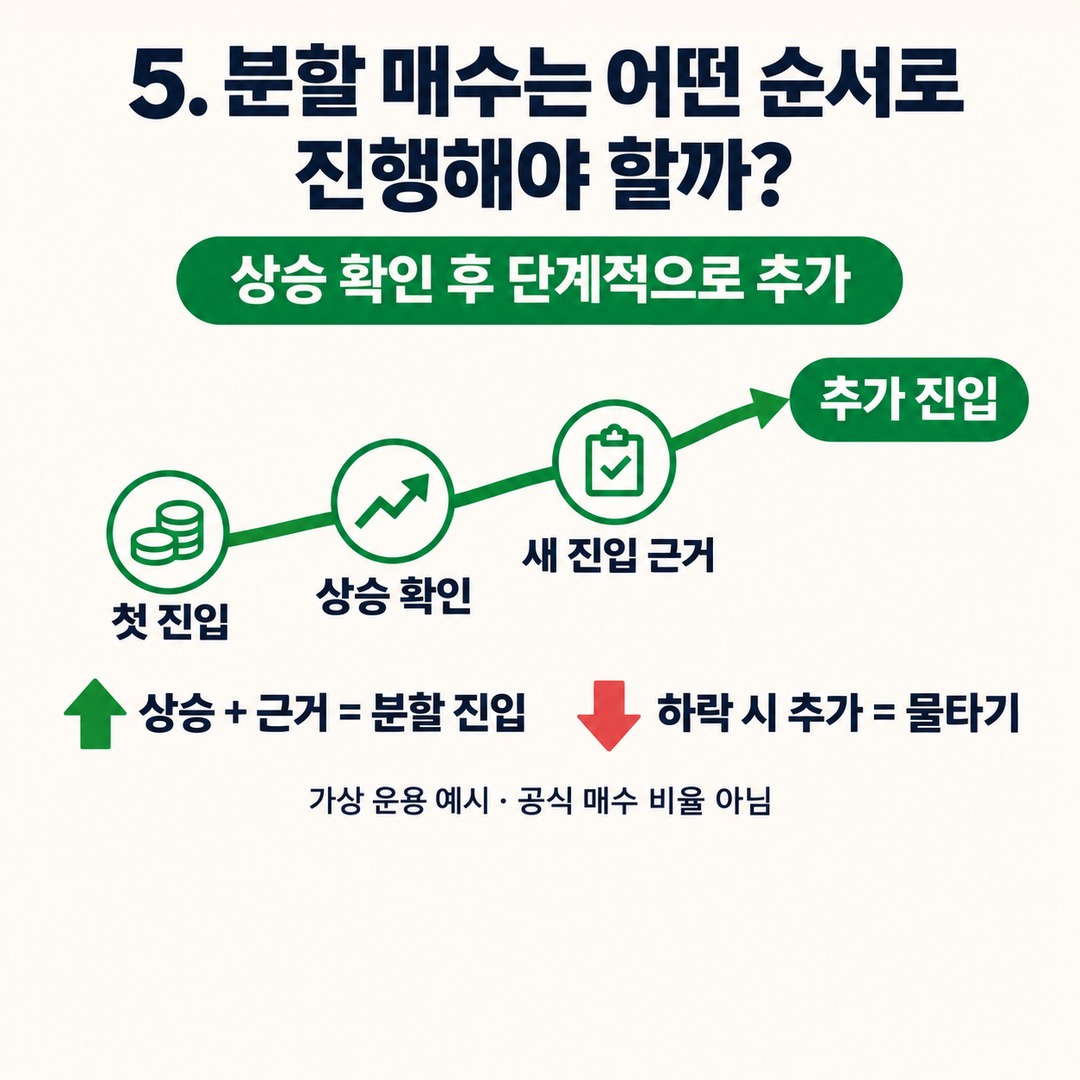
5. In what order should you make staged purchases?
After a market decline, it is more appropriate to enter in stages by checking whether the initial purchase is working and then increasing the position, rather than investing the full planned amount at the outset.
However, staged buying and averaging down are different.
Staged entry: Add to the position when the stock you bought is rising and a new basis for entry is confirmed.
Averaging down: Add to the position when the stock you bought falls, with the aim of lowering the average purchase price.
CAN SLIM-style pyramiding generally means adding to a high-quality stock that is already rising.
IBD’s materials on 2026-10-09 additional purchases also describe the Shelf pattern as an opportunity to add to a stock that was initially bought from a proper base. It is important to distinguish an initial purchase from adding to an existing profitable position.
A hypothetical example of 3-stage entries
The following is the author’s proposal for dividing the planned investment amount for one stock into three purchases after market confirmation. These are not official buying percentages set by IBD.
Staged Entry Structure
1nd entry
Initial test entry# 1/3
FTD confirmed + a normal breakout from an individual stock’s base + volume confirmation
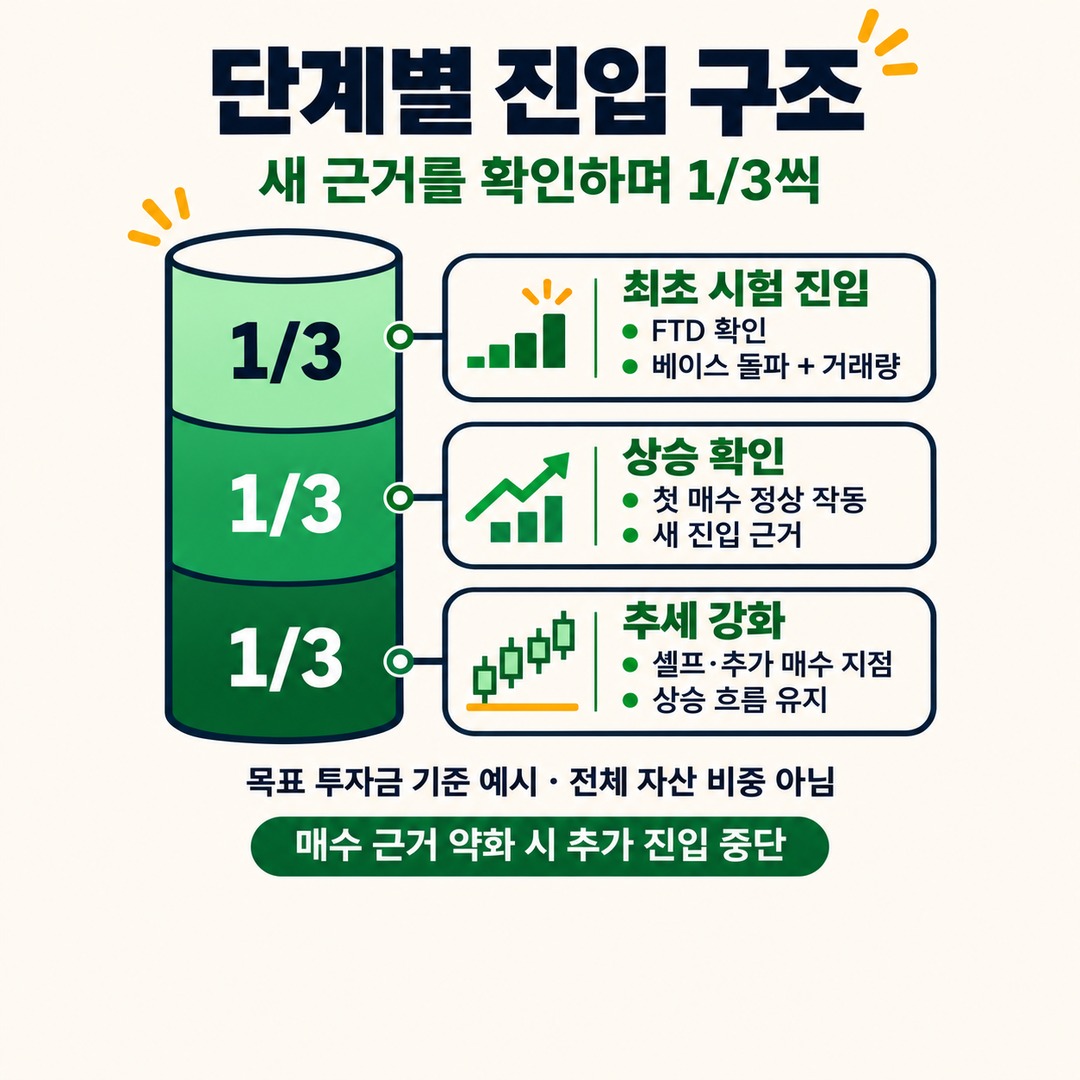
2th entry
After the rise is confirmed# 1/3
When the initial purchase is working and the stock remains within the buy zone or forms a new basis for entry
3th entry
As the trend strengthens# 1/3
A new shelf or appropriate add-on buy point forms + the market and stock continue to trend upward
Each percentage is an example based on the planned target investment amount for that particular stock. It does not represent a share of total assets or an appropriate actual purchase amount. The most important point in this approach is not to decide on the next entry based only on the passage of time.
The fact that the stock price has risen is not, by itself, enough reason to add to the position. There needs to be a new price pattern or another basis for buying.
What if the stock price falls after the 1nd purchase?
Stop adding to the position in the following situations.
The stock falls back below its buy point soon after breaking out
Volume on the breakout day was insufficient
Major indexes repeatedly decline on heavy volume
The stock’s relative strength weakens
The stock reaches the pre-set loss limit
In particular, do not automatically use the planned 2th and 3th purchase amounts to add to a losing position.
Consider adding to a position only when new evidence shows that the original buying rationale remains valid.
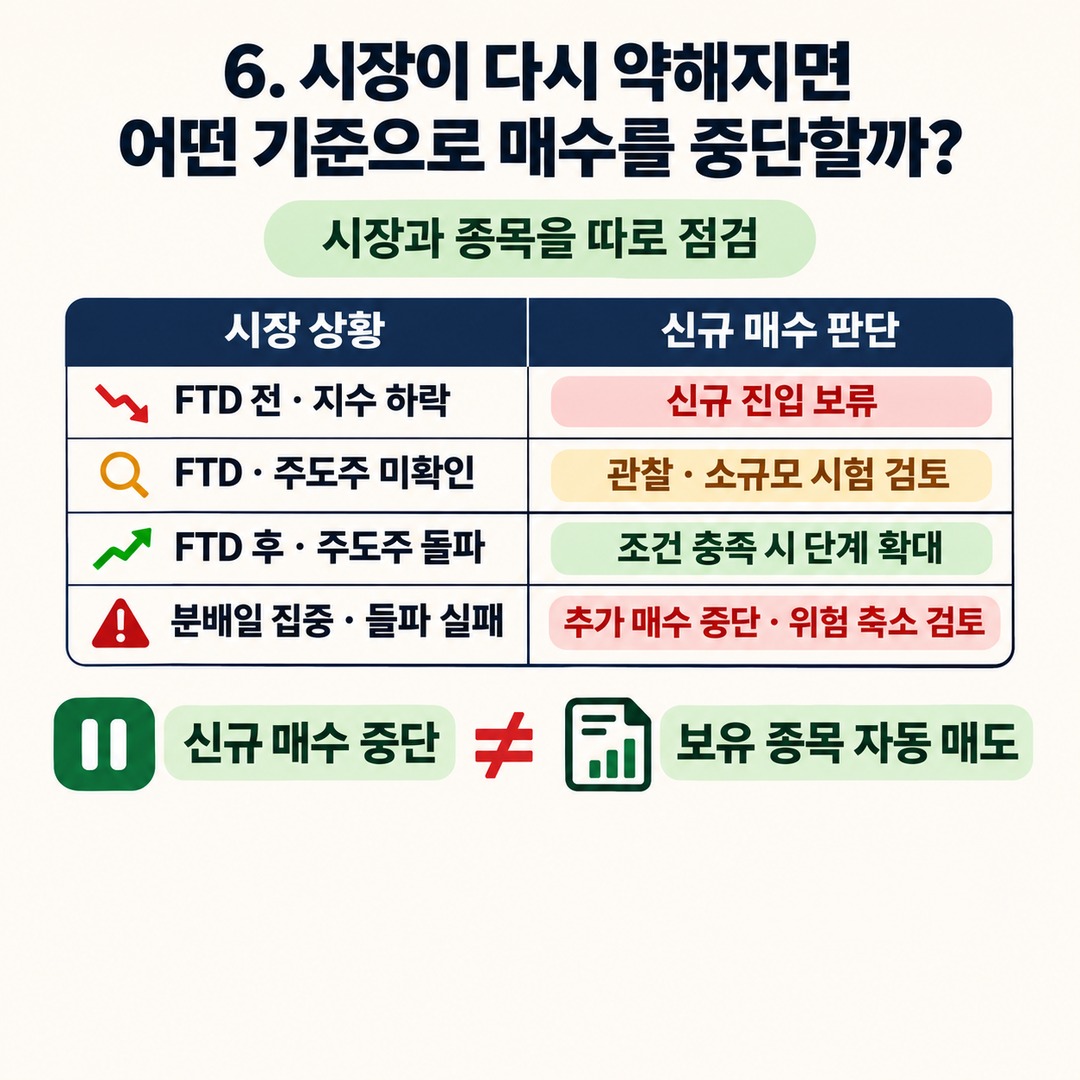
6. What criteria should you use to stop buying if the market weakens again?
An FTD does not mean that market risk has disappeared. You still need to check whether the uptrend is holding.
It helps to distinguish among these four situations.
| What you observe | Decision on new purchases |
|---|---|
| Before an FTD, indexes continue to fall | Hold off on new entries |
| FTD occurs, but market leaders are not yet confirmed | Keep watching and consider a small test entry |
| After an FTD, more market leaders break out | Increase exposure in stages if the criteria are met |
| After an FTD, Distribution Days cluster and breakouts fail | Stop adding to positions and consider reducing risk |
At this point, assess the market and individual stocks separately.
For example, even if a market index is correcting, a stock that is rising on volume while trading above its 50-day moving average may be worth watching for relative strength.
But the fact that the stock is strong does not eliminate risk across the market as a whole.
Stopping new purchases and selling a stock are different decisions
Stopping new purchases does not mean you must sell stocks you already own.
Assess existing holdings separately based on each stock’s buying rationale, loss limit, key moving averages, changes in earnings, and other factors.
Conversely, avoid holding a stock that has breached your loss limit based only on the hope that the market will recover.
The U.S. Securities and Exchange Commission (SEC) explains in its guidance on asset allocation and diversification that investors should consider their time horizon and risk tolerance when making investment decisions. Risks concentrated in individual stocks should also be managed separately from overall portfolio risk.
7. A pre-purchase checklist with 7 items
Review the following items in order to help avoid confusing market conditions with a stock’s own setup.
Pre-purchase checklist
0/7 Complete. I checked price and volume trends in the Nasdaq and S&P500.
I checked whether Distribution Days have been clustering recently.
If an FTD occurred, I checked its date and volume conditions.
I rechecked the CAN SLIM stocks’ earnings and growth criteria.
I identified each stock’s base and precise buy point.
I checked whether the purchase price is within the normal 5% buy zone.
I set a loss limit and conditions for stopping additional entries in advance.
Completing every item on the checklist does not, by itself, justify a purchase. What matters is whether the market and stock criteria have actually been met.
In particular, even if you find a good stock, you can choose to wait if an FTD has not yet occurred or selling pressure on the indexes continues to build.
Conclusion: Enter when the market allows, not simply when you find a good stock
Seeing a CAN SLIM stock does not mean you have to buy it.
In a weak market, continue identifying and monitoring stocks, but as a basic approach, hold off on new entries until there is evidence that the market trend is improving.
The process can be summarized as follows.
1. Check the market indexes and Distribution Days.
2. Use the FTD to assess the strength of the market rebound.
3. Find CAN SLIM stocks that are actually showing leadership.
4. Check the base breakout, volume, and 5% buy zone.
5. Start with a small initial position and add only after the rise is confirmed.
6. Stop adding to the position if the market weakens again or the buying rationale breaks down.
There is one principle to remember: the ability to find good stocks and the ability to buy at the right time are separate skills.
Holding cash when the market is weak is also an investment decision. To avoid missing the next opportunity, it is important to decide in advance when you will not buy.
※ This article is for informational purposes to help readers understand market trends; it is not a recommendation to invest in any specific stock or asset. You are responsible for your own final decisions and investments.