

How Heavy Is 50mm of Rain per Hour? Driving and Underpass Risks and Heavy Rain Warning Criteria
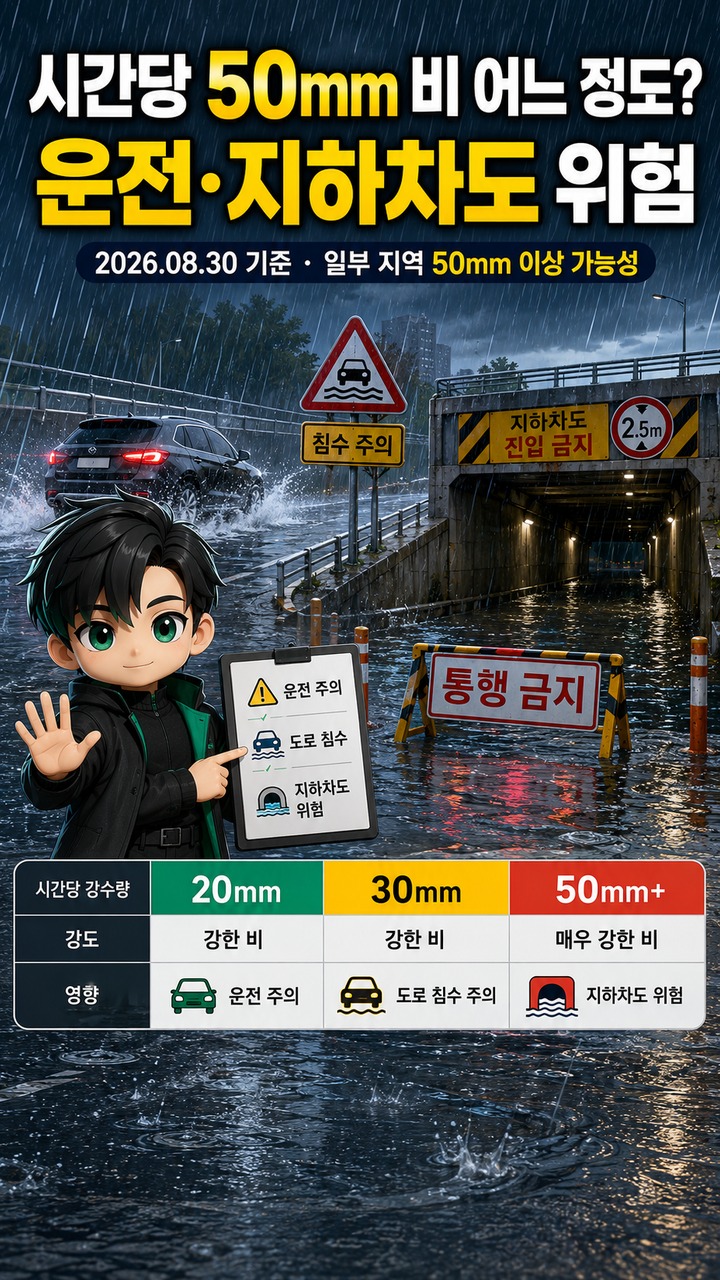
Rainfall of 50mm per hour is more than simply 'heavy rain.' It is extremely intense rainfall that can flood roads and make normal driving and walking difficult. On 2026-08-30, the Korea Meteorological Administration (KMA) forecast possible rainfall of 20–30mm per hour, mainly in the Chungcheong region and surrounding areas, with some locations potentially experiencing intense rainfall exceeding 50mm per hour.
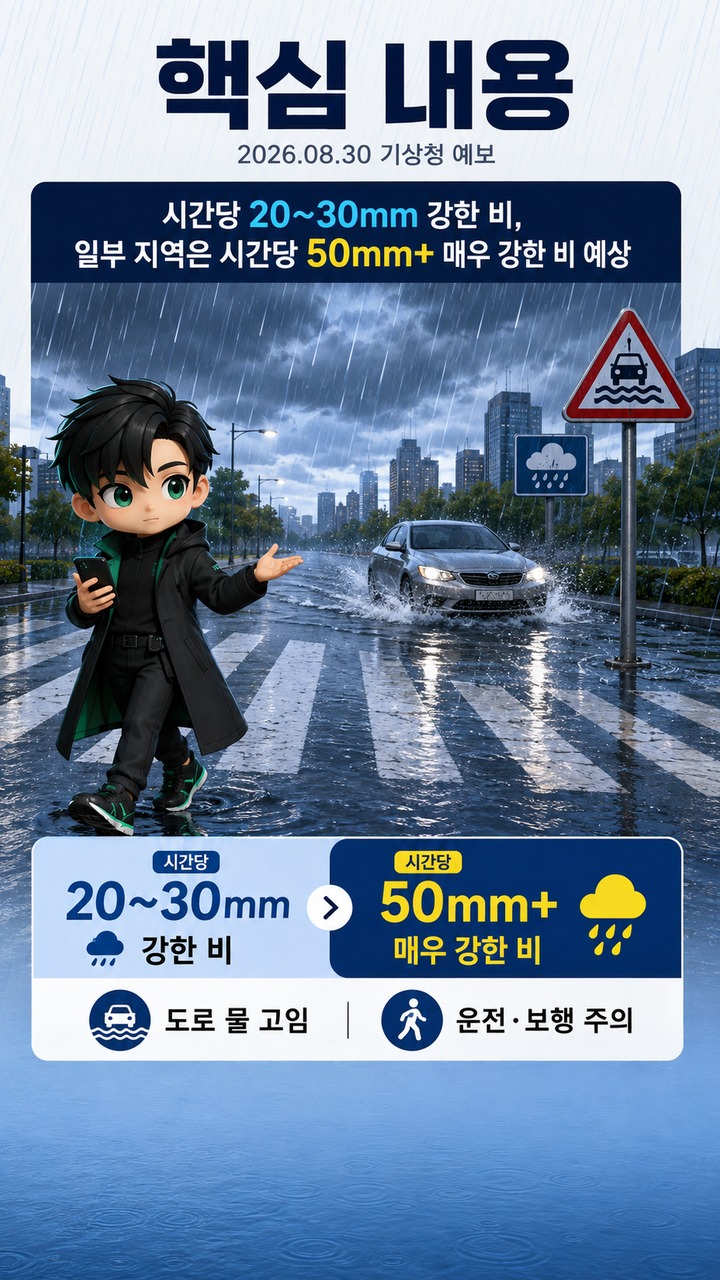
In particular, hourly rainfall and the total rainfall forecast for a day mean different things. Compared with 100mm of rain falling gradually over an entire day, 50mm falling within a short period can create dangerous conditions much more quickly on roads, in underpasses, and in low-lying areas.
What Does 50mm of Rain per Hour Actually Look Like?
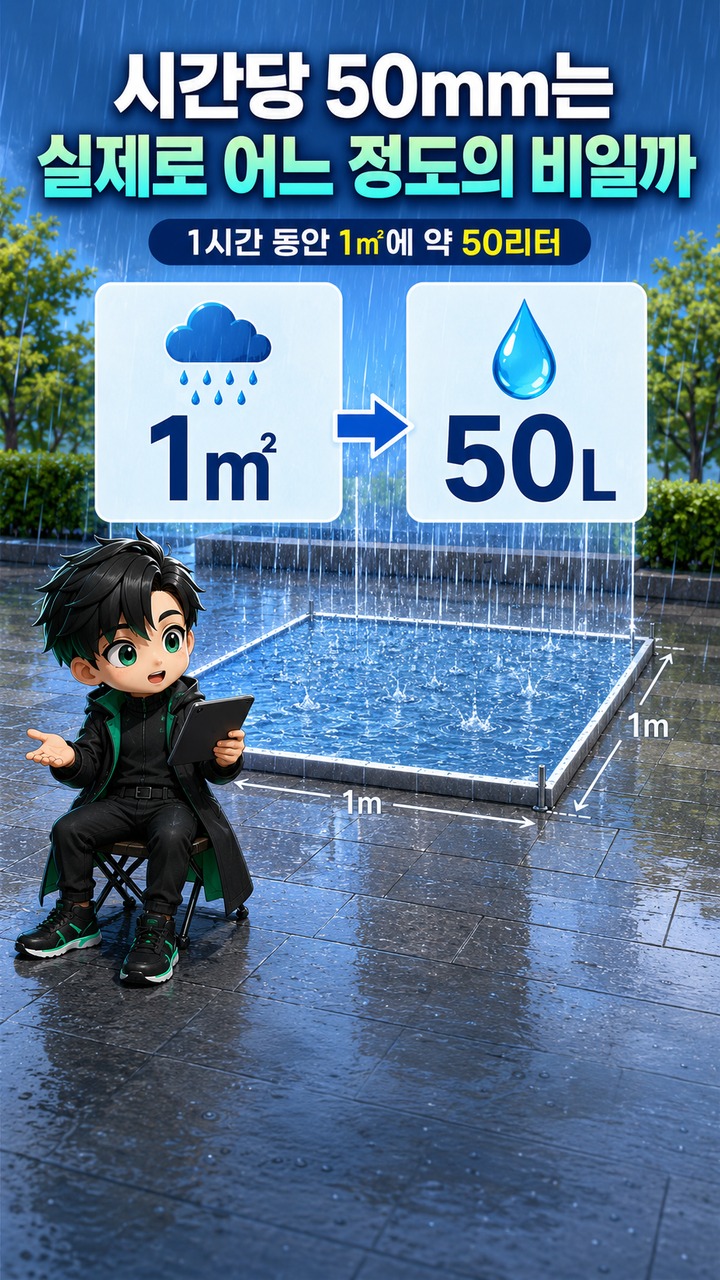
50mm of rainfall over 1 hour means that approximately 50 liters of water fall on an area of 1㎡ within one hour.
According to the KMA's rainfall intensity reference materials, water can begin accumulating in areas with poor drainage at rainfall rates of 30mm per hour, while low-lying locations such as underpasses may start flooding.
At 50mm per hour, conditions become even more severe. The KMA explains that flooding can occur across roads, making normal driving difficult and causing more vehicles to stop. Walking may also become difficult.
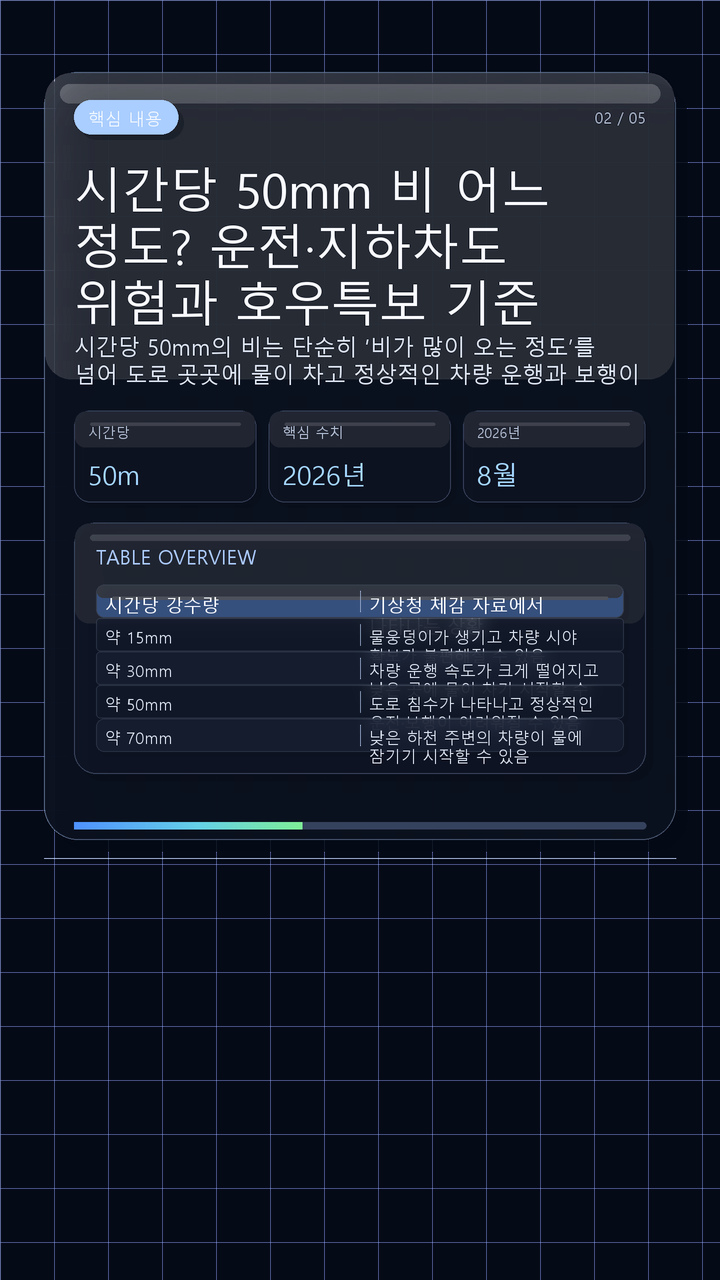
Rainfall intensity can be understood in simplified terms as follows.
| Hourly Rainfall | Conditions Described in KMA Rainfall Intensity Reference Materials |
|---|---|
| Approximately 15mm | Puddles may form, and drivers may have difficulty maintaining clear visibility. |
| Approximately 30mm | Vehicle speeds may decrease significantly, and water may begin accumulating in low-lying areas. |
| Approximately 50mm | Roads may become flooded, making normal driving and walking difficult. |
| Approximately 70mm | Vehicles near low-lying rivers may begin to become submerged. |
| Approximately 100mm | Conditions may become severe enough for vehicles on roads to begin floating. |
However, the KMA also explains that these reference descriptions are based on experimental conditions and that actual flooding severity can vary depending on drainage infrastructure, terrain, and the amount of rain that has already fallen.
Does 50mm of Rain per Hour Automatically Trigger a Heavy Rain Warning?
Not necessarily. A single hourly rainfall figure of 50mm does not automatically determine whether a heavy rain advisory or warning will be issued.
As of 2026, the KMA's criteria for heavy rain alerts are as follows.
Heavy Rain Advisory: Issued when accumulated rainfall of at least 60mm is expected over 3 hours, or at least 110mm is expected over 12 hours.
Heavy Rain Warning: Issued when accumulated rainfall of at least 90mm is expected over 3 hours, or at least 180mm is expected over 12 hours.
Therefore, it would be inaccurate to assume that a forecast of 50mm per hour automatically means an immediate heavy rain warning.
For example, there can be a substantial difference in accumulated rainfall between a brief period of 50mm per hour followed by a sharp decrease in intensity and several consecutive hours of heavy rain at 30–50mm per hour.
Emergency Heavy Rain Alerts Have Different Criteria from Heavy Rain Warnings
Another distinction that can easily cause confusion is the difference between official heavy rain advisories and warnings and emergency heavy rain text alerts.
The KMA operates a system that sends emergency text alerts to areas where extremely heavy rainfall has actually been observed. According to KMA guidance, one of the main criteria for issuing these alerts is when rainfall of 50mm over 1 hour and accumulated rainfall of 90mm over 3 hours are observed simultaneously. The criteria also include cases where extremely heavy rainfall of at least 72mm is observed within 1 hour.
In other words,
Heavy rain advisories and warnings are official weather alerts primarily determined by forecast accumulated rainfall, while emergency heavy rain text alerts are a system for notifying areas at risk based on extremely heavy rainfall that has actually been observed.
If you receive such an emergency alert on your phone, it is important not to dismiss it as an ordinary weather notification. Instead, first check whether there are rivers, underpasses, or low-lying areas near your current location.
What Should You Do If You Encounter 50mm of Rain per Hour While Driving?
The most important rule is not to enter flooded roads or underpasses.
The National Safety 24 advises drivers never to enter an underpass where flooding has begun, even slightly. If water starts rising after a vehicle has already entered, drivers should leave the vehicle behind and evacuate outside as quickly as possible.
Even on ordinary roads, following another vehicle simply because it managed to pass through does not guarantee safety. From the driver's seat, it is difficult to accurately assess the actual water depth, the location of drains, the strength of the current, or whether the road surface has been damaged.
If your vehicle has already begun to flood, the National Safety 24 advises moving to a safe location before the water rises above 3/2 of the tire height. If water rises so rapidly that moving the vehicle becomes difficult, escaping should take priority over protecting the vehicle.
How Much Water Makes an Underpass Dangerous?
The rule is not to wait until the water rises further before leaving. You should avoid entering an underpass from the moment water begins accumulating.
The Ministry of the Interior and Safety's public safety guidelines explicitly advise people never to enter an underpass where flooding has begun. If already inside, they should leave their vehicles behind and evacuate outside immediately.
The same applies to underground parking garages. If water is flowing into the garage, people should avoid going back underground to retrieve parked vehicles. The National Safety 24 advises immediate evacuation when rainwater enters underground spaces and warns against reentering to move vehicles.
During particularly intense rainfall, water levels in rivers and underpasses can rise suddenly because of rain falling upstream or in nearby areas, even if rainfall is relatively light at your current location.
Which Matters More: 150mm of Rain in a Day or 50mm per Hour?
Both matter, but when deciding whether it is safe to travel immediately, it is important to check hourly rainfall intensity together with current local hazard information.
For example, a forecast of 80–150mm of rain in the Chungcheong region over 30–31 refers to the total amount of rainfall that may fall over two days. In contrast, 50mm per hour indicates how intensely rain may be concentrated during a particular period. Regarding this rainfall event, the KMA warned of risks including people becoming stranded on riverside walking paths or in underpasses, flooding in low-lying areas, and overflowing rivers.
Rather than checking only the forecast rainfall total for your area, it is better to consider the following three factors together.
1. Current hourly rainfall and expected rainfall intensity in the coming hours
2. Current weather alerts, including heavy rain advisories and warnings
3. Potential hazards along your route, including underpasses, rivers, and low-lying areas
In particular, when intense rainfall of around 50mm per hour is forecast, it is safer to check whether you can avoid potentially flooded sections of your route before considering whether you can reach your destination as usual.