

August 30 Weather: 80–150mm of Rain Expected in Chungcheong, with Temporary Lulls in Parts of the Seoul Metropolitan Area
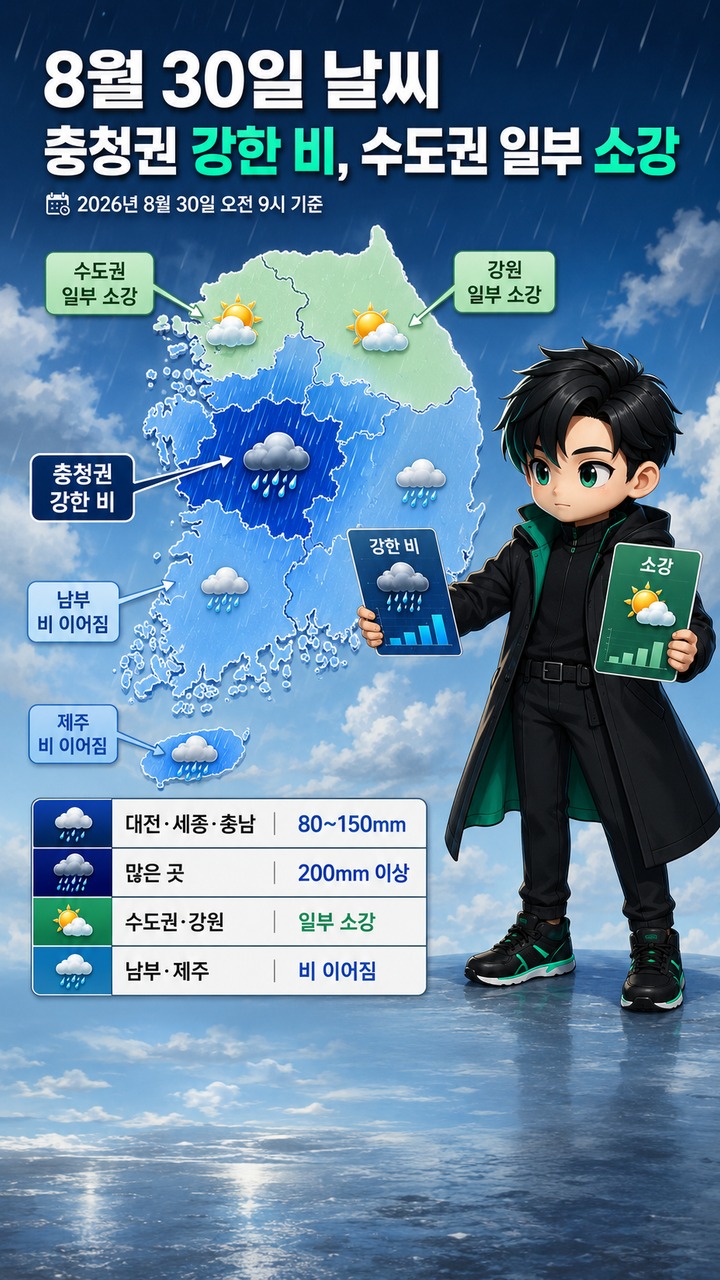
As of 9 a.m. on 2026-08-30, rain is expected to continue across most of the country today, but rainfall intensity and duration will vary significantly by region. Daejeon, Sejong, and South Chungcheong are forecast to receive 80–150mm of rain during 30–31, with 200mm or more in some areas. Meanwhile, parts of the Seoul metropolitan area and Gangwon Province may experience temporary breaks in the rain today. In southern regions and Jeju Island, apparent temperatures could rise to around 33℃ despite the rain, making heat another concern.
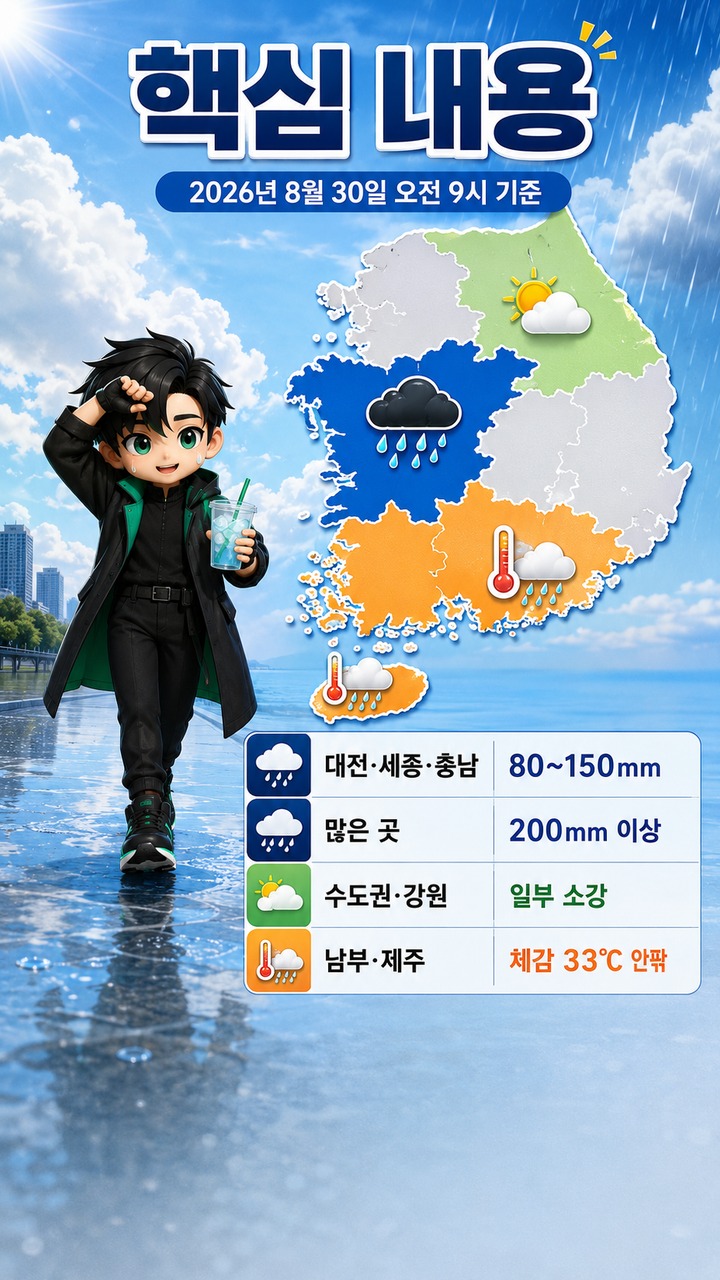
Where Will the Heaviest Rain Fall Today?
Based on cumulative rainfall expected during 30–31, the Chungcheong region is forecast to receive the most rain. Daejeon, Sejong, and South Chungcheong are expected to receive 80–150mm, with totals potentially exceeding 200mm in some locations. North Chungcheong is forecast to receive 50–100mm, with 150mm or more in areas experiencing heavier rainfall.

Comparing expected rainfall across regions using the same criteria makes the differences clearer.
| Region | August 30–31 Forecast Rainfall | Areas with Heavier Rainfall |
|---|---|---|
| Seoul, Incheon, and northern Gyeonggi | 20–60mm | No separate higher estimate |
| Southern Gyeonggi | 30–80mm | 100mm or more |
| Southern Gangwon inland areas and mountains | 30–80mm | 100mm or more |
| Daejeon, Sejong, and South Chungcheong | 80–150mm | 200mm or more |
| North Chungcheong | 50–100mm | 150mm or more |
| Western North Jeolla | 50–100mm | 150mm or more in northwestern North Jeolla |
| Gwangju, South Jeolla, and eastern North Jeolla | 30–80mm | 100mm or more in eastern North Jeolla |
| Daegu, North Gyeongsang, Busan, Ulsan, and South Gyeongsang | 30–80mm | 100mm or more in Daegu and North Gyeongsang |
| Jeju Island | 5–60mm | — |
Even when the forecast calls for rain nationwide, the level of preparation needed varies by region. In Chungcheong, the general forecast rainfall range is higher than in other regions, and cumulative rainfall could reach 200mm or more in some areas. This means residents should consider the possibility of flooding rather than simply bringing an umbrella.
Forecast rainfall totals do not mean that every location within a region will receive the same amount of rain. The position and timing of intense rain clouds can create differences even within the same city or county. Rather than assuming your area will receive only the minimum forecast amount, it is safer to check real-time weather radar and official weather alerts.
Areas Experiencing Heavy Rain Will Differ Between Morning and Afternoon
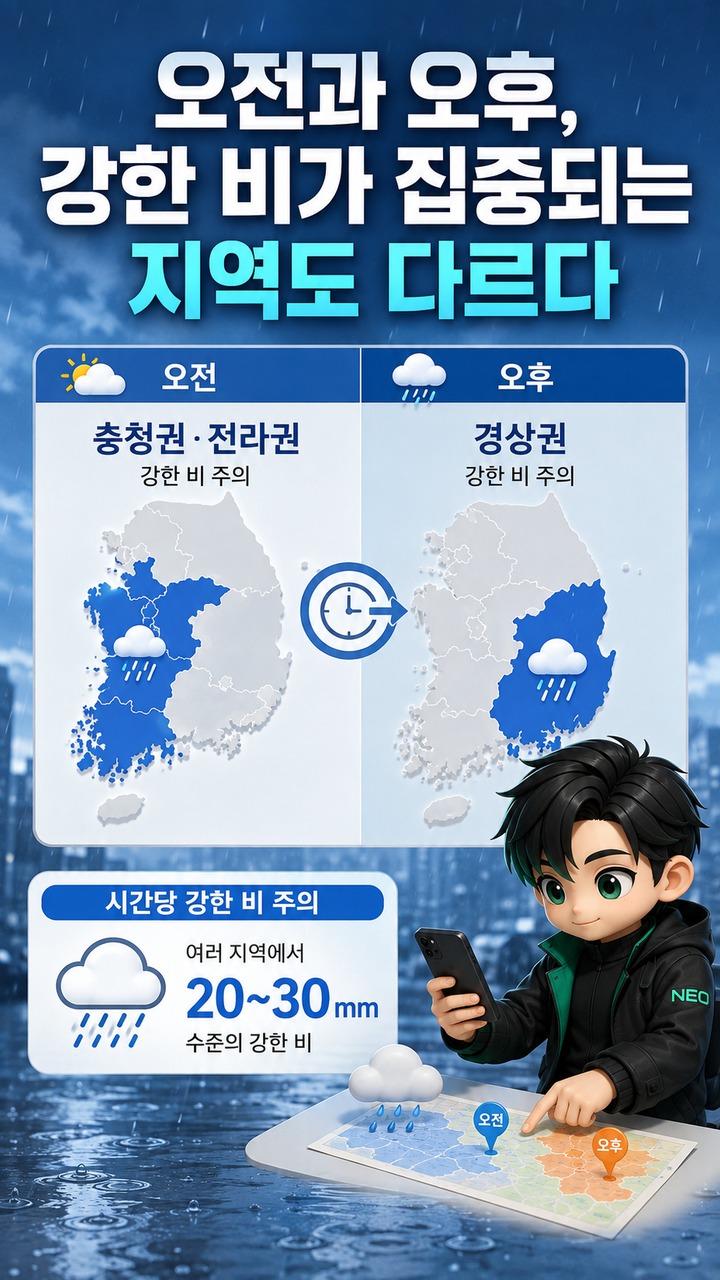
Particular attention should be paid to heavy rainfall in Chungcheong and Jeolla this morning, followed by the Gyeongsang region this afternoon. The latest short-term weather briefing identifies specific periods when several regions could experience heavy rainfall of 20–30mm per hour.
Daejeon, Sejong, and South Chungcheong are forecast to experience possible heavy rainfall of 20–30mm per hour from 9 to 12 a.m. today. North Chungcheong could experience heavy rain until 12 a.m., beginning at 6 a.m., while North Jeolla could see heavy rainfall from 9 to 12 a.m. Heavy rain is also possible during the morning along the western coast of South Jeolla and across most of Gwangju and South Jeolla.
Daegu and North Gyeongsang could receive rainfall of 20–30mm per hour until 6 p.m. today. Similar rainfall intensity is possible in Busan, Ulsan, and South Gyeongsang until 6 p.m. Therefore, light rain or a temporary break in the morning does not necessarily mean the risk of heavy rain has passed for the day.
Another period of concentrated rainfall could develop on 31. Parts of southern Gyeonggi, southern Gangwon, and Chungcheong could experience 20–30mm of rain per hour, with 50mm or more in some areas, between early morning and morning. If this period overlaps with the morning commute in your area, it is advisable to check the forecast again tonight.
Will It Rain Continuously All Day in Seoul and the Metropolitan Area?
Some parts of the Seoul metropolitan area may experience temporary breaks in the rain today. In particular, Seoul, Incheon, and northern Gyeonggi could see frequent lulls between morning and evening. However, southern Gyeonggi is forecast to receive cumulative rainfall of 30–80mm during 30–31, with 100mm or more in some locations. The entire metropolitan area should therefore not be treated as having identical weather conditions.
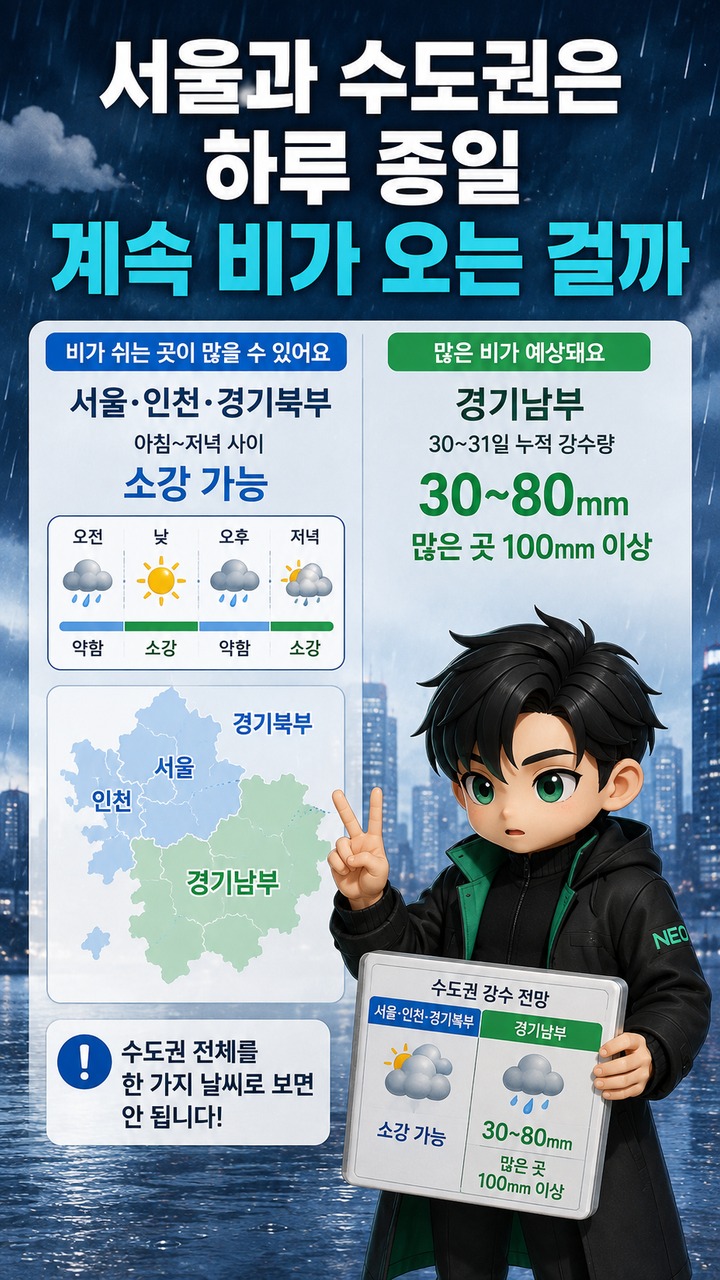
Forecast rainfall for Seoul, Incheon, and northern Gyeonggi during 30–31 is 20–60mm. Going outdoors may be possible during temporary breaks, but those breaks do not mean the rain has ended across the metropolitan area for the day.
In fact, heavy rainfall could intensify again in southern Gyeonggi between early morning and morning on 31. The Korea Meteorological Administration has identified a period when southern Gyeonggi could experience 20–30mm of rain per hour, with 50mm or more in some locations.
The possibility of rain will remain across the Seoul metropolitan area, including Seoul, until the morning of September 1. Forecast rainfall for Seoul, Incheon, and Gyeonggi on September 1 is 10–60mm. This is why a temporary break in the rain on Sunday does not necessarily mean the same conditions will continue through Monday and Tuesday morning.
Exactly When Will the Rain End?
Rain is expected to continue across most of the country until 31. In southern regions and Jeju Island, it is forecast to stop in most areas around 6–9 p.m. on 31. However, some central regions may continue experiencing rain until the morning of September 1.
Precipitation patterns will also diverge again on September 1. Rain is possible until morning in Seoul, Incheon, Gyeonggi, Gangwon, and Chungcheong, while showers are expected from afternoon through evening in southern regions and Jeju Island.
Additional rainfall on September 1 is forecast at 10–60mm for both Seoul, Incheon, and Gyeonggi and the inland and mountainous areas of Gangwon. Daejeon, Sejong, South Chungcheong, and North Chungcheong are expected to receive 10–50mm. The eastern coast of Gangwon is forecast to receive 5–20mm.
Showers on September 1 are forecast to bring 5–40mm to North Jeolla, Gwangju, South Jeolla, Busan, Ulsan, South Gyeongsang, Daegu, and North Gyeongsang. Jeju Island is expected to receive 5–30mm. In other words, even after most rain associated with the stationary front ends on the evening of 31, showers may return in some regions.
When making plans, it is more practical to check when heavy rain will be concentrated along your travel route than to focus solely on when the rain will stop completely.
Why Will Southern Regions and Jeju Remain Hot Despite the Rain?
Rain today does not mean that the heat will end simultaneously across the country. Apparent temperatures could rise to around 33℃, particularly in southern regions and Jeju Island where heatwave advisories or warnings have been issued.
Daytime temperatures nationwide are generally forecast at 27–32℃ today, but air temperature alone does not fully indicate how hot conditions will feel. When humidity is high, the perceived heat can be greater than the actual air temperature suggests.
Tropical nights, when temperatures remain at or above 25℃ overnight, are also expected in some areas, particularly along the southern coast and on Jeju Island. Indoors, where windows may be kept closed to protect against rain, both humidity and room temperature need to be managed.
Therefore, people in southern regions and Jeju Island should prepare not only umbrellas or raincoats but also protection against heat during prolonged outdoor activities. Checking the apparent temperature is particularly advisable when temperatures rise after a temporary break in the rain.
What Should You Check First Before Going Out or Driving Today?
Rather than checking rainfall totals alone, it is advisable to review conditions in this order: current heavy-rain alerts → real-time weather radar → whether your travel route passes through underpasses or areas near rivers. Heavy rainfall can be concentrated in small areas and fluctuate in intensity, making it difficult to assess actual travel conditions based only on forecasts issued several hours earlier.
When intense rain falls over a short period, rainfall upstream can cause water levels in downstream valleys and rivers to rise suddenly. Even when the rain temporarily weakens, water levels in the surrounding area should be checked before using riverside walking paths, underpasses, or low-lying roads.
On roads, heavy rain can suddenly reduce visibility and make surfaces slippery. Because it is difficult to determine the depth of water on flooded roads or in underpasses, drivers should avoid attempting to enter flooded areas.
On days like today, when rainfall intensity and timing differ by region, checking hourly forecasts separately for your departure point and destination is more accurate than relying on a single nationwide weather icon. Even if the rain is light when leaving the Seoul metropolitan area, rainfall conditions at your arrival time could be entirely different if you are traveling to Chungcheong or Gyeongsang.