

KOSPI Outlook for August 25 Based on Wall Street: Key Factors to Watch Beyond the Nasdaq's 0.76% Decline
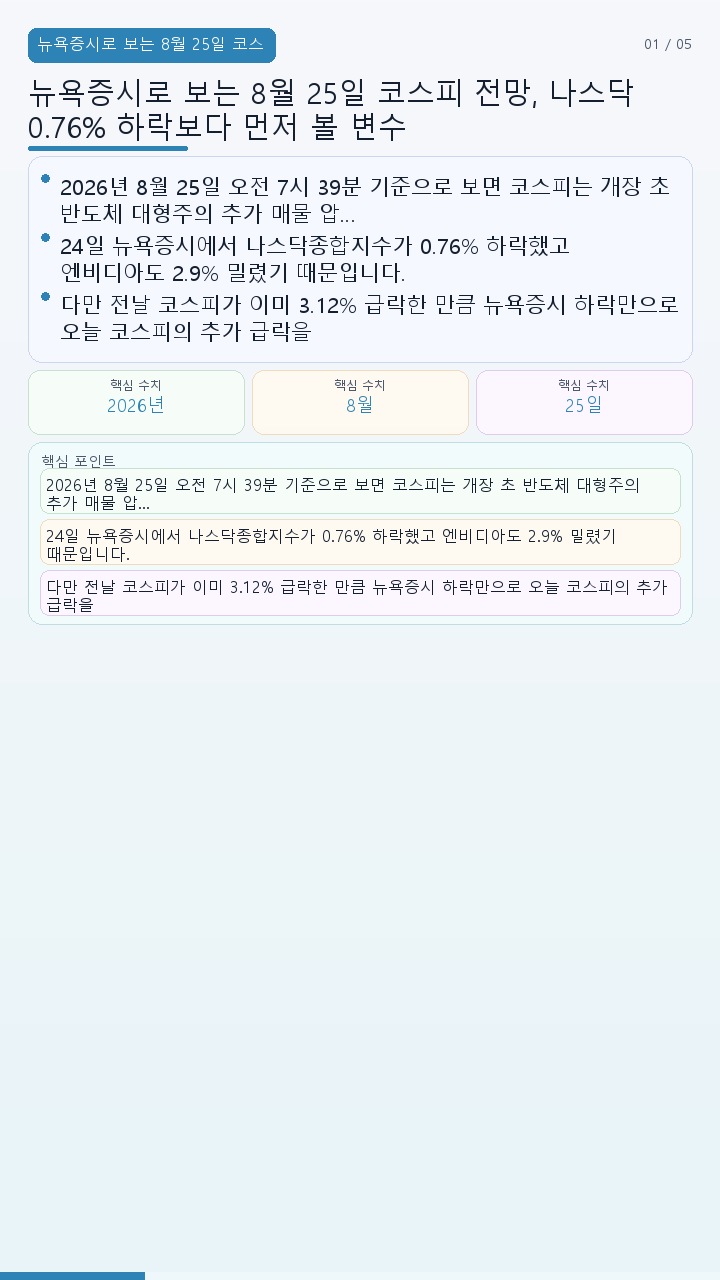
2026-08-25, as of 7:39 a.m., investors should remain cautious about additional selling pressure on major semiconductor stocks during the KOSPI's opening session. The Nasdaq Composite fell 0.76% in New York trading on 24, while Nvidia also declined 2.9%. However, given that the KOSPI had already plunged 3.12% the previous day, the decline on Wall Street alone is not enough to conclude that the Korean market will suffer another sharp drop today.
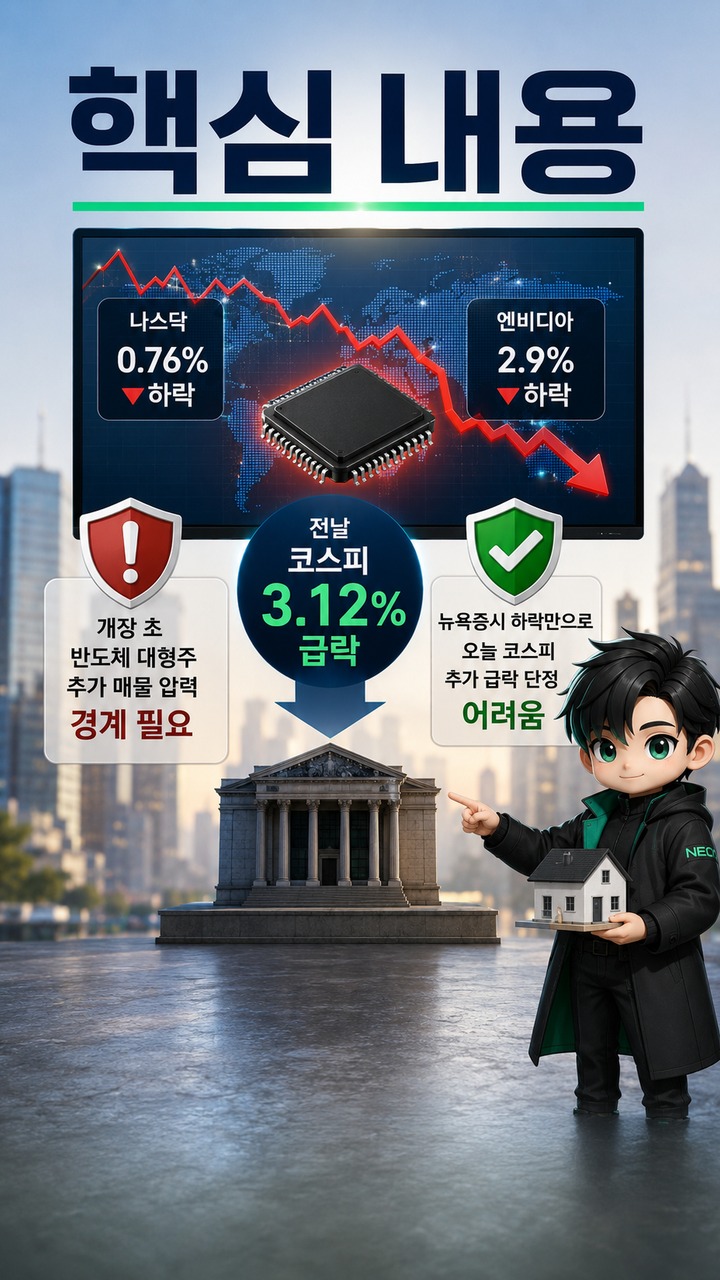
What matters more for the Korean stock market today is not simply the direction of the 3 major U.S. stock indexes, but the price levels at which Samsung Electronics and SK Hynix regain buying interest following the previous day's sharp declines. Continued weakness in U.S. technology stocks is a concern, but the KOSPI had already priced in significant selling pressure related to company-specific issues affecting major Korean stocks the previous day.
Why Is Wall Street's Performance on August 24 a Concern for the KOSPI?
U.S. stocks showed considerable differences across sectors. The Dow Jones Industrial Average closed at 53,417.16, up 0.26%, while the S&P500 declined 0.28% to 7,652.86 and the Nasdaq Composite fell 0.76% to 25,980.19.
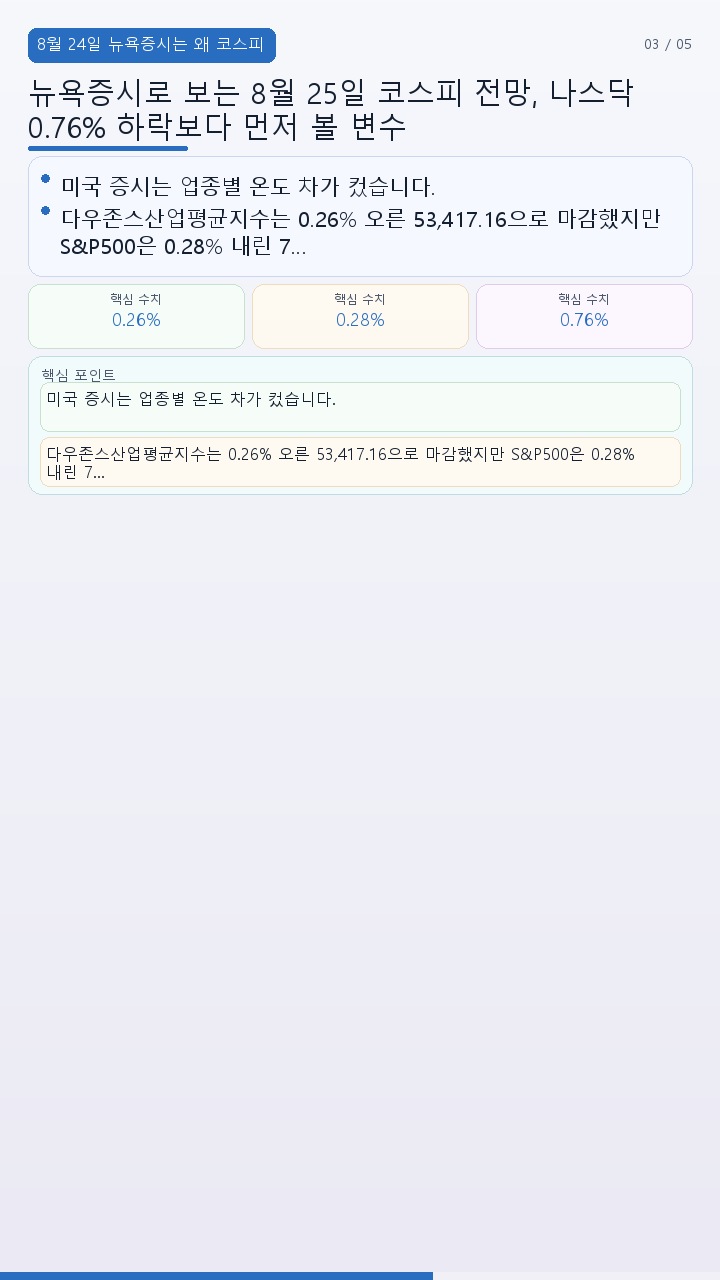
For the KOSPI, the weakness in the Nasdaq and semiconductor stocks deserves more attention than the Dow's gains. Nvidia declined 2.9%, Micron Technology fell 5.8%, and Broadcom dropped 2.6%. Although the entire U.S. market did not collapse simultaneously, selling was concentrated in technology and semiconductor stocks that have strong connections to the Korean stock market.
According to the author's calculation, the Nasdaq's daily percentage change was 0.48% percentage points lower than that of the S&P500.
The calculation is:
-0.76% - (-0.28%) = -0.48% percentage points.
Therefore, the signal from U.S. stocks can be summarized as a market experiencing greater pressure on technology and semiconductor stocks, rather than a broad-based flight from risk.
For today's KOSPI session, it is more practical to examine the movements of major semiconductor companies with large market capitalizations, including Samsung Electronics and SK Hynix, before focusing on the overall index.
Why You Should Not Look at U.S. Stocks Without Considering the KOSPI's 3.12% Plunge the Previous Day
On August 24, the KOSPI closed at 6,696.96, down 215.99 points, or 3.12%, from the previous trading session. During the session, it fell as low as 6,656.07. Meanwhile, the KOSDAQ rose 1.42% to close at 813.33.
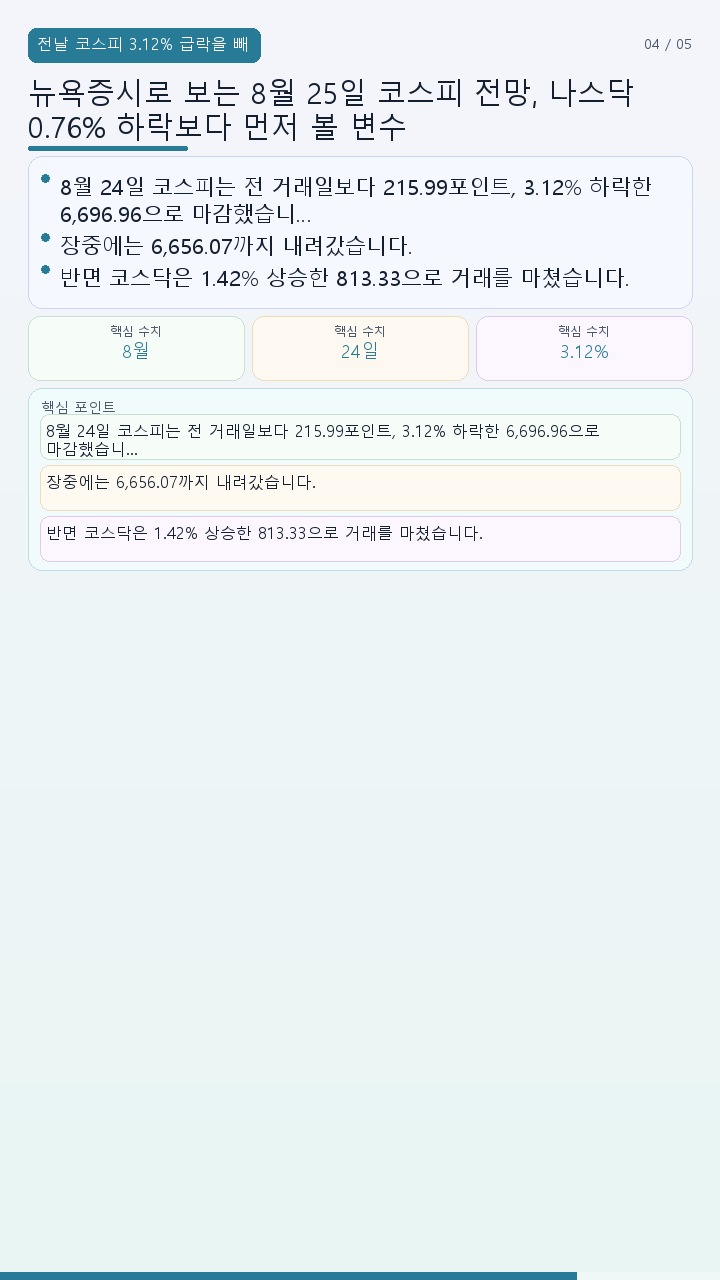
The fact that the KOSPI and KOSDAQ moved in completely opposite directions suggests that the previous day's decline cannot simply be characterized as uniform selling across all Korean stocks.
In particular, Samsung Electronics fell more than 8% following the announcement of its shareholder return plan, while SK Hynix also weakened, highlighting the substantial influence of major semiconductor stocks on the index.
Samsung Electronics announced on August 21 that its estimated shareholder returns for 2026 would amount to approximately 90 trillion to KRW 110,000,000,000,000. The company is applying its existing policy of allocating 50% of free cash flow generated over the 3-year period from 2024 to 2026 to shareholder returns.
Samsung Electronics plans to distribute approximately KRW 30,000,000,000,000 in cash dividends, including regular dividends, during the 3 quarter of 2026. Specific details are expected to be determined at the October board meeting. The remaining shareholder return amount and the precise allocation among cash dividends, share repurchases, and share cancellations will be determined at the January 2027 board meeting after the company's 2026 financial results are finalized.
In other words, even though the figure of 90 trillion to KRW 110,000,000,000,000 has been announced, not all methods and amounts have been finalized at this stage.
For this reason, when assessing today's KOSPI, investors should separately examine how much of the selling pressure related to Samsung Electronics has already been absorbed following the previous day's decline, alongside the weakness in U.S. stocks.
Samsung Electronics and Semiconductor Stocks Are the First Things to Check in Today's KOSPI Session
During the early trading session on August 25, it may be more useful to examine the opening prices and movements during the first 30 minutes of Samsung Electronics and SK Hynix than to focus solely on the KOSPI index level.
With the KOSPI having fallen 3.12% the previous day and the Nasdaq subsequently declining another 0.76%, there is insufficient evidence to conclude that investor sentiment toward semiconductor stocks has already recovered strongly.
On the other hand, the S&P500 declined only 0.28%, while the Dow actually rose 0.26%. The entire U.S. stock market did not experience a sharp decline in the same direction.
Therefore, rather than simply assuming that 'U.S. stocks fell, so the KOSPI will fall,' investors should examine three separate developments.
First, watch whether Samsung Electronics and SK Hynix retest their previous day's lows during early trading. If major semiconductor stocks experience further substantial declines, the KOSPI could face additional pressure because of the index's composition.
Second, check whether sector rotation continues into the KOSDAQ or non-semiconductor industries that showed relative strength the previous day. Even if the KOSPI declines, an increase in the number of advancing stocks could create a different picture for individual shares than the headline index suggests.
Third, monitor whether bargain hunters enter semiconductor stocks following an early selloff. Because the KOSPI's decline the previous day was larger than the declines recorded by major U.S. indexes on 24, it would be premature to determine the entire day's direction based solely on the opening moves.
Can the KOSPI Rebound Even When U.S. Technology Stocks Are Weak?
Whether a rebound is possible must be assessed after trading begins, and a recovery cannot be confirmed at the current time. However, there is also insufficient evidence to assume that the KOSPI will fall by the same magnitude as the previous day simply because Wall Street declined.
On August 24, the KOSPI fell 3.12%. On the same date, the S&P500 declined 0.28%, while the Nasdaq dropped 0.76%.
According to the author's calculation, comparing only the absolute percentage changes, the KOSPI's decline was 2.36% percentage points greater than the Nasdaq's.
The calculation is:
3.12% - 0.76% = 2.36% percentage points.
The two markets have different trading hours, constituent stocks, and reasons for their declines, so this difference should not be interpreted directly as a measure of how oversold the Korean market is. Nevertheless, it is a meaningful comparison showing that a much larger price adjustment had already occurred in the domestic market the previous day.
Even if the KOSPI opens lower today, its intraday direction could differ from its opening performance if losses in Samsung Electronics and SK Hynix narrow and buying interest spreads to other sectors.
Conversely, if weakness in U.S. semiconductor stocks leads directly to additional selling of major Korean semiconductor companies, a recovery above the 6,700 level could be delayed.
Nvidia Earnings and U.S. Inflation Data Are Also Scheduled This Week
Even when focusing only on the KOSPI's performance on August 25, major U.S. economic events scheduled for this week could discourage investors from taking aggressive directional positions.
According to the official schedule of the U.S. Bureau of Economic Analysis, the July personal income and outlays report and the 2 estimate of GDP for the 2 quarter of 2026 are scheduled for release at 8:30 a.m. U.S. Eastern Time on August 26. The figures will become available later that night in Korean time.
U.S. investors are also awaiting Nvidia's earnings announcement. In New York trading on 24, Nvidia declined 2.9% ahead of its earnings release.
For the Korean stock market, changes in expectations for AI and semiconductor investment following Nvidia's earnings announcement may have a greater influence on sentiment toward Samsung Electronics and SK Hynix than Nvidia's share price movement on any single day.
A Jackson Hole speech by the chair of the U.S. Federal Reserve is also scheduled for later this week, making interest rate expectations and reactions in the U.S. Treasury market additional factors to monitor.
Therefore, with several important events still ahead, it would be premature to conclude from the KOSPI's performance on 25 alone that the semiconductor trend has returned to an upward trajectory or that further declines are inevitable.
What to Check After the KOSPI Opens on August 25
After 9 a.m., confirmation matters more than prediction.
First, examine whether Samsung Electronics and SK Hynix open higher or lower than their previous closing prices. If both stocks fall sharply again, it could signal that weakness in U.S. semiconductor stocks is carrying over into the Korean market.
Next, check whether the KOSPI recovers above the 6,700 level. Because the previous day's closing level was 6,696.96, the 6,700 level lies immediately above it. However, this single figure should not automatically be treated as a confirmed support or resistance level.
Then examine the distribution of advancing and declining stocks. If the movements of large-cap index constituents diverge from those of small- and mid-cap stocks, as they did the previous day, the KOSPI's percentage decline alone may not accurately represent conditions across the entire market.
Foreign investor trading activity also deserves attention throughout the session. Because selling was concentrated in major semiconductor stocks the previous day, it is useful to determine whether foreign investor flows reverse direction today or whether continued selling coincides with movements in the index.
Finally, it is important not to establish momentum-buying or stop-loss decisions solely on movements during the first 10 to 20 minutes after the opening bell. In a volatile market, opening prices, morning lows, and subsequent rebound patterns can differ significantly.
The KOSPI Outlook for August 25 in One Sentence
Based solely on currently available overseas market data, semiconductor-led weakness continues to pose risks to the KOSPI at the opening, but after the previous day's 3.12% plunge, another sharp decline should not be treated as a foregone conclusion.
The most important issue today is not the Nasdaq's 0.76% decline itself, but whether weakness in U.S. semiconductor stocks triggers further selling in Samsung Electronics and SK Hynix or whether buyers return following the previous day's substantial correction.
During the morning session on August 25, it is more practical to monitor Samsung Electronics and SK Hynix, whether the KOSPI regains the 6,700 level, foreign investor flows, and the distribution of advancing and declining stocks, rather than trying to predict the index's direction in advance.
Stock markets can respond differently to the same information depending on how much of it has already been reflected in prices. This analysis is a market review based on publicly available information verified through 7:39 a.m. on 2026-08-25. It does not constitute a guaranteed basis for buying or selling specific stocks or generating investment returns.
※ This article is provided for informational purposes to help readers understand market trends and does not constitute investment advice or a recommendation to buy any particular stock or asset. All final investment decisions and associated responsibilities rest with the individual investor.
Related Articles
KOSPI Outlook for August 21: The Previous Day's 5.89% Surge Is Key After the Nasdaq's -1% Move
KOSPI Outlook for August 12: 3 Key Factors to Watch After Recovering the 6,345 Level