

KOSPI Rebounds 11.49%, 4.6% Away from 7300…Foreign Buying Concentrated in Samsung Electronics and SK Hynix
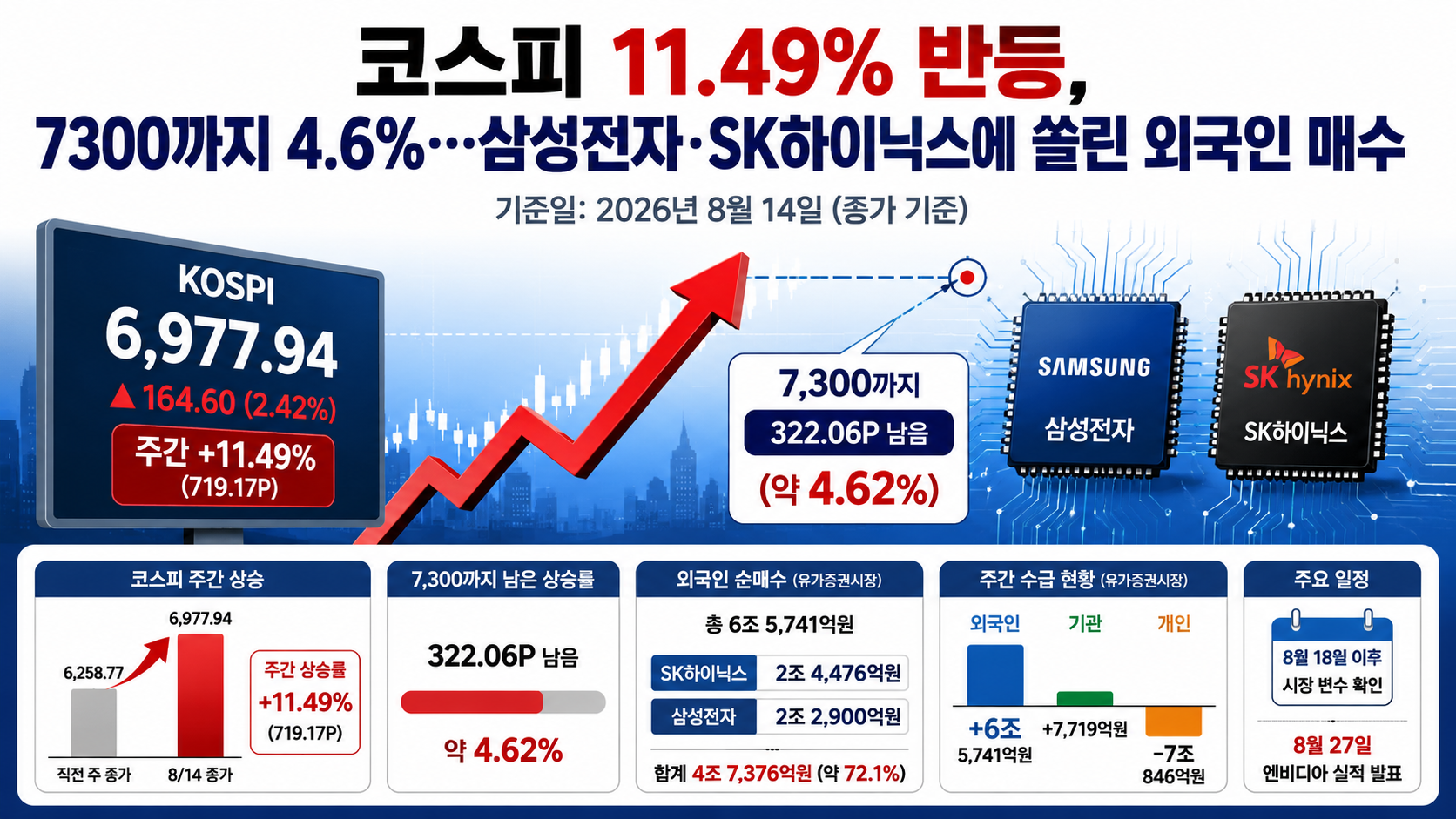
The KOSPI closed at 6,977.94 on 2026-08-14, rising 11.49% over the week. The important distinction is that 11% represents the weekly gain for August 10–14, not a single-day increase. The index remains 322.06 points, or approximately 4.62% by the author's calculation, below 7,300.
The Korean stock market was closed on August 17 for the substitute holiday marking Liberation Day. Therefore, as of the evening of August 17, the latest regular-session closing figure available for assessing the domestic market is the figure from August 14.
KOSPI Rises 11%: How Much Did It Actually Gain?
The KOSPI ended trading at 6,977.94 on August 14. This represented an increase of 719.17 points, or 11.49%, from the previous week. Looking only at 14, the index gained 164.60 points, equivalent to 2.42%.
In other words, interpreting the statement that the KOSPI surged 11% as meaning it rose 11% in a single day would misrepresent the actual market movement. The reported gain is a weekly figure covering 5 trading sessions.
Working backward from the weekly increase of 719.17 points gives an estimated previous-week closing level of approximately 6,258.77.
Author's calculation
6,977.94 - 719.17 = 6,258.77
(6,977.94 - 6,258.77) ÷ 6,258.77 × 100 ≈ 11.49%
The index rose for 5 consecutive trading sessions last week. During intraday trading on 14, it reached 7,010.86, briefly reclaiming the 7,000 level. However, because it closed below 7,000, investors should separately assess whether the index can establish a sustained closing position above that level in subsequent sessions rather than focusing solely on an intraday breakout.
How Far Is the KOSPI from 7300?
From its August 14 closing level of 6,977.94, the KOSPI needs to gain 322.06 points to reach 7,300.
Author's calculation
7,300 - 6,977.94 = 322.06 points
322.06 ÷ 6,977.94 × 100 ≈ 4.62%
Therefore, from its current position, the KOSPI needs an additional increase of approximately 4.6% to reach 7,300.
However, 7,300 does not represent entirely uncharted territory for the KOSPI. Earlier this year, the index had already surpassed both the 7,000 and 8,000 levels before undergoing a substantial correction. In the current market, 7,300 is less a target representing an unprecedented milestone and more a benchmark for measuring how quickly the index can recover its previous price range after the sharp decline.
Recent volatility also deserves attention. On July 31 alone, the KOSPI rose 1,001.89 points, or 17.91%. In such a market, an index gap of 4–5% can potentially be covered in less time than usual, but the magnitude of a subsequent reversal can also be substantial.
Why Are Samsung Electronics and SK Hynix Back in the Spotlight?
The recovery in Samsung Electronics and SK Hynix shares, together with foreign buying, stood out during the rebound in August 10–14. Samsung Electronics gained 18.83% over the week, while SK Hynix rose 15.68%.
During the same period, foreign investors recorded net purchases of KRW 6,574,100,000,000 in the KOSPI market. Of that amount, net purchases of SK Hynix totaled KRW 2,447,600,000,000, while those of Samsung Electronics reached KRW 2,290,000,000,000.
Together, the two stocks accounted for KRW 4,737,600,000,000.
Author's calculation
KRW 2,447,600,000,000 + KRW 2,290,000,000,000 = KRW 4,737,600,000,000
KRW 4,737,600,000,000 ÷ KRW 6,574,100,000,000 × 100 ≈ 72.1%
By the author's calculation, approximately 72% of foreign investors' net KOSPI purchases last week were concentrated in Samsung Electronics and SK Hynix. This explains why it is important to examine where foreign capital is flowing rather than looking only at the index rebound itself.
Institutional investors also recorded net purchases of KRW 771,900,000,000 during the week. Individual investors, by contrast, were net sellers of KRW 7,084,600,000,000. Rather than all investor groups moving in the same direction, the market showed a pattern in which foreign and institutional buying absorbed shares sold by retail investors.
Were Semiconductor Stocks Supported by Actual Earnings?
Both Samsung Electronics and SK Hynix confirmed strong performance in their AI and memory businesses through their recently announced official earnings. However, strong historical results do not automatically guarantee further share-price gains.
Samsung Electronics reported consolidated revenue of KRW 133,900,000,000,000.0 and operating profit of KRW 57,200,000,000,000.0 for 1 quarter of 2026. Compared with the previous quarter, revenue increased 43% and operating profit rose 185%.
In particular, its Device Solutions (DS) division recorded revenue of KRW 81,700,000,000,000.0 and operating profit of KRW 53,700,000,000,000.0. Samsung Electronics stated that its memory business achieved record quarterly performance, supported by rising memory prices and demand for high-value-added AI products.
SK Hynix announced revenue of KRW 79,318,700,000,000 and operating profit of KRW 60,542,600,000,000 for 2 quarter of 2026. Compared with the same period a year earlier, revenue increased 257% and operating profit rose 557%.
The company explained that its results were supported by demand arising from increased AI infrastructure investment and sales of high-value-added products, including HBM, DRAM for AI servers, and eSSDs.
Ultimately, the recent rebound in semiconductor shares is supported not merely by expectations but also by substantial earnings growth that has already been reported. The market's next question is shifting from 'Were earnings strong?' to 'Can earnings and demand remain at these levels in the next quarter?'
Samsung Electronics and SK Hynix Are Recovering at Different Speeds
Although both stocks rose sharply last week, their positions following the rebound are not identical.
On July 31, Samsung Electronics closed at KRW 262,500 and SK Hynix at KRW 1,718,000. After subsequent corrections, both stocks climbed again during the second week of August. However, as of August 14, Samsung Electronics was 4.57% above its July 31 closing price, while SK Hynix remained 4.25% below its corresponding level.
It is therefore necessary to distinguish between the fact that both semiconductor stocks rose and the conclusion that both have recovered equally to their previous high-price ranges.
SK Hynix also staged a strong rebound in terms of short-term returns, but using July 31 as the comparison date reveals a different degree of recovery from Samsung Electronics. Even within the same semiconductor industry, perceived investment returns can vary depending on the reference date.
7000 Is the Number to Watch Before 7300
Even if forecasts suggest that the KOSPI is approaching 7,300, the market must first confirm whether the index can recover the 7,000 level on a closing basis. On August 14, the KOSPI climbed as high as 7,010.86 intraday but closed at 6,977.94.
Crossing 7,000 during trading and establishing a closing position above 7,000 are different signals. Closing-price movements must also be examined to determine whether short-term buying momentum can be sustained through the end of the session.
Continued foreign buying is another important factor. Foreign investors recorded net purchases exceeding KRW 6,000,000,000,000 last week, with approximately 72% concentrated in Samsung Electronics and SK Hynix. If foreign demand for these two stocks weakens, the market structure that supported last week's gains could also change.
Conversely, if confidence in semiconductor earnings remains intact and foreign buying continues, the distance to 7,300 would naturally become the next level to monitor after another breakout above 7,000.
Volatility Has Declined, but the Market Is Not Yet Calm
The KOSPI 200 Volatility Index (VKOSPI) closed at 55.31 during the second week of August, down 20.28 points, or 26.83%, from the previous week. Compared with its intraday rise to 93.27 on July 29, the level of market fear has fallen considerably.
The fact that VKOSPI has declined by more than 40% over the past 12 trading sessions also indicates that investor sentiment has stabilized compared with the period of sharp market declines.
Nevertheless, falling volatility cannot be interpreted as a guarantee of rising stock prices. Within just a few weeks, the KOSPI experienced both a substantial selloff and a single-day rebound of record proportions.
At present, monitoring daily price fluctuations alongside changes in investor trading flows provides a more accurate picture of market conditions than focusing solely on market direction.
August 27 Is the Key Date for Assessing the Next Quarter's Direction
Market participants view Nvidia's earnings announcement, scheduled for August 27, as an important opportunity to reassess underlying AI demand.
The recent strong rebound in Korean semiconductor shares has partly reflected easing concerns about AI infrastructure investment and data center demand. Therefore, Nvidia's commentary on AI infrastructure investment and semiconductor demand, rather than just a single revenue figure, could significantly influence investor sentiment toward Korean memory stocks.
Samsung Electronics and SK Hynix have reported exceptionally strong results, but stock markets quickly price in expectations about the sustainability of future earnings rather than focusing only on results already announced. Instead of watching only the 7,300 index level, investors should also examine whether AI demand continues to translate into actual corporate earnings.
What Should Investors Watch Starting August 18?
Because August 17 is a domestic stock market holiday, the next regular trading session is August 18. No new trading in Korean stocks has occurred since the close on 14. Therefore, as of the evening of 17, it would be inaccurate to state that the KOSPI has risen further or recovered 7,000.
In the next session, investors can first examine whether the KOSPI closes above 7,000, whether foreign investors continue making net purchases of Samsung Electronics and SK Hynix, and whether these two semiconductor heavyweights maintain stronger performance than the broader index.
Beyond those factors, approximately 4.62% remains between the August 14 closing level and 7,300. Although that distance is clearly within sight from a short-term perspective, the KOSPI's recent volatility means that reaching it soon cannot be treated as a certainty.
The more important development in this rebound is not simply that the KOSPI gained 11.49% in a week. Rather, approximately 72% of foreign net buying was concentrated in Samsung Electronics and SK Hynix, with the companies' actual earnings performance forming the core of the investment rationale. The nature of the next upward move may likewise depend on whether confidence in semiconductor earnings continues to align with foreign capital inflows.
※ This article is provided for informational purposes to help readers understand market trends and does not constitute investment advice or a recommendation to buy any particular stock or asset. Final investment decisions and responsibility rest with each individual.