

August 21 KOSPI Outlook: Preserving the Previous Day's 5.89% Surge Is Key After Nasdaq Falls -1%
▼▼ 제품 구매하러 가기 ▼▼
https://link.coupang.com/a/gnMKD5NcUC
이 포스팅은 쿠팡 파트너스 활동의 일환으로, 이에 따른 일정액의 수수료를 제공받습니다.
쿠팡 추천 상품쿠팡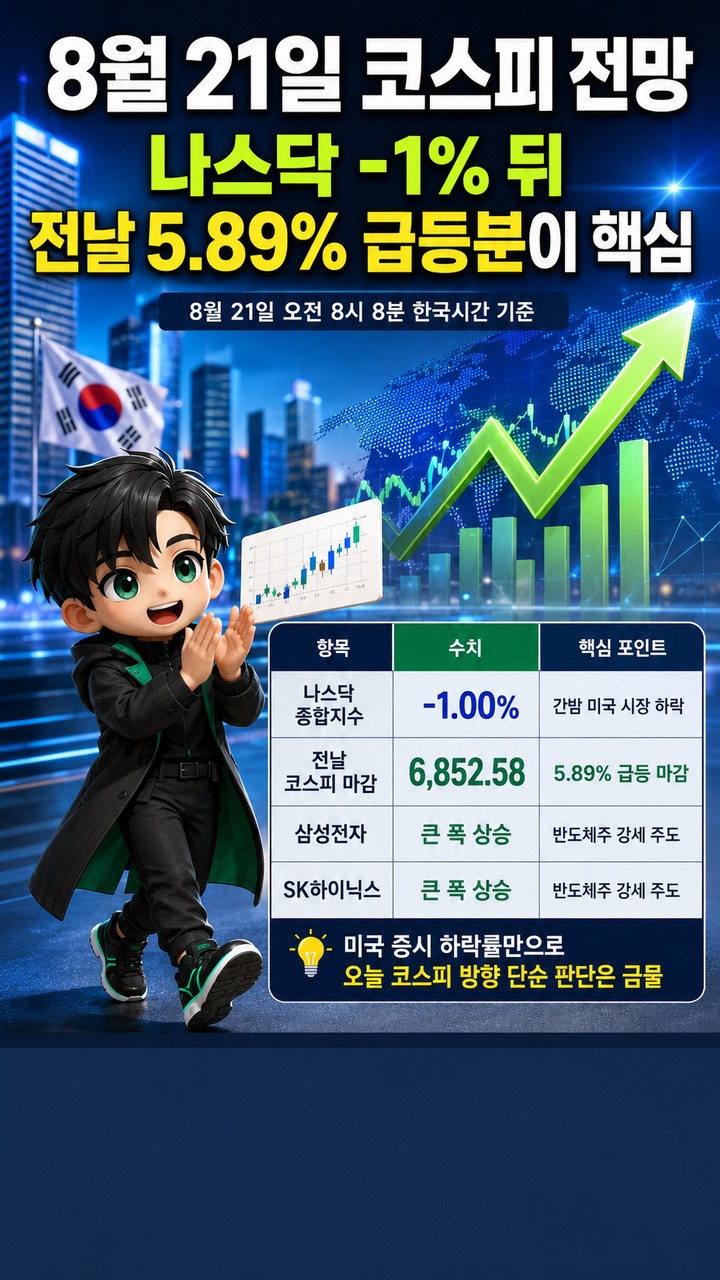
As of 8:8 a.m. Korea time on August 21, the first figure to check before the KOSPI opens is the overnight Nasdaq Composite's -1.00%. However, South Korea's stock market closed the previous session at 6,852.58 after the KOSPI surged 5.89%, with Samsung Electronics and SK Hynix posting substantial gains. It is therefore difficult to predict today's KOSPI direction based solely on the decline in U.S. stocks.

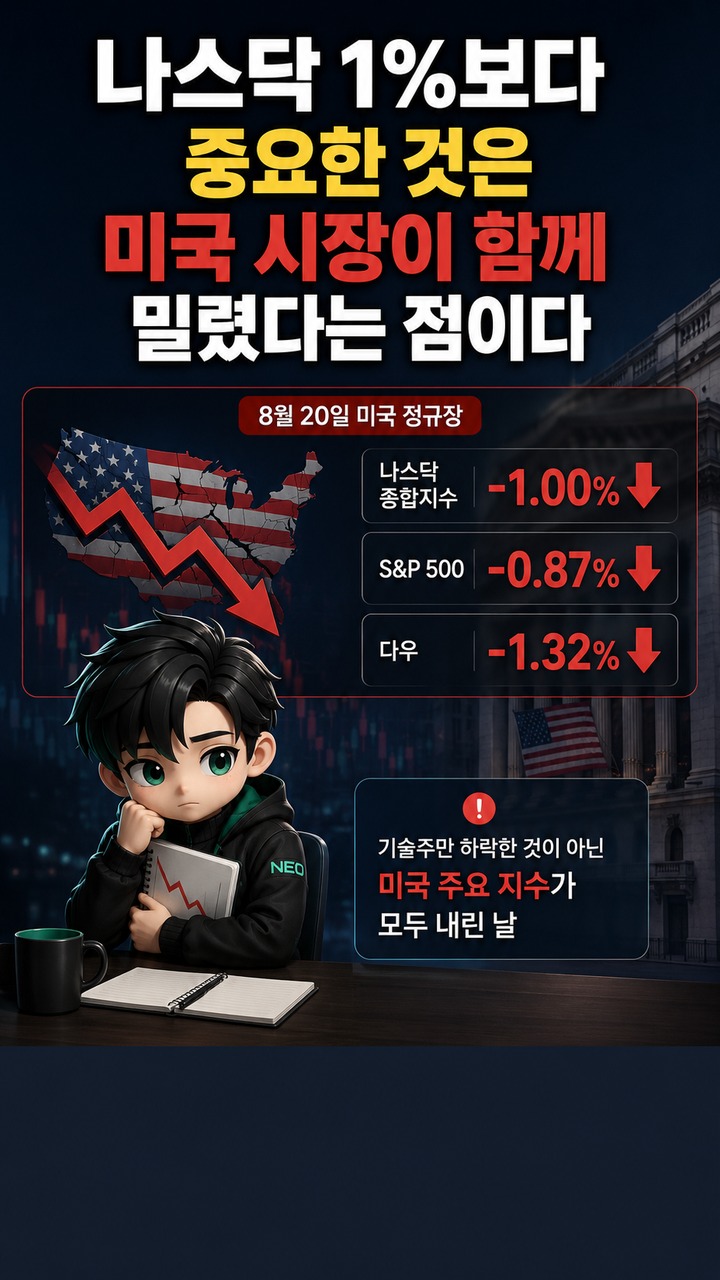
Overnight, not only the Nasdaq but also the S&P 500 and Dow declined. The Nasdaq Composite closed at 26,067.17, down 263.92 points; the S&P 500 finished at 7,641.16, down 66.82 points; and the Dow ended at 52,759.21, falling 703.84 points.
In today's South Korean market, investors need to distinguish whether weakness in U.S. technology stocks leads to profit-taking in Samsung Electronics and SK Hynix following their sharp gains the previous day, or whether company-specific developments in domestic semiconductor stocks and foreign investor demand can absorb that pressure.
More Important Than Nasdaq's -1% Decline Is the Broad Weakness Across U.S. Markets
During the August 20 regular U.S. trading session, the Nasdaq Composite fell 1.00%. The S&P 500 also declined 0.87%, while the Dow lost 1.32%. Rather than a selloff confined to technology stocks, it was a session in which all major U.S. indexes declined.
The pressures evident in U.S. markets included renewed increases in Treasury yields and international oil prices, along with weakness in consumer-related stocks following Walmart's earnings. Treasury yields, which had stabilized the previous day after the U.S. Treasury announced an expansion of its long-term bond buyback program, began rising again, weakening stock market sentiment.
In particular, the Nasdaq recorded 3,217 declining stocks, outnumbering the 1,672 advancing stocks. This means the decline was not simply driven by a handful of major technology companies pulling down the index; falling stocks also outnumbered rising stocks across the broader market.
Therefore, when assessing U.S. markets ahead of the KOSPI opening on August 21, it is more accurate to consider the simultaneous rise in Treasury yields and broad weakness across U.S. equities rather than focusing solely on the Nasdaq's -1.00% reading.
The KOSPI Had Already Priced In a Major Rebound After Rising 5.89% the Previous Day
On August 20, the KOSPI closed at 6,852.58, up 381.41 points, or 5.89%, from the previous trading session. During intraday trading, it climbed as high as 6,904.55, briefly moving above the 6,900 level.
The index had risen 381.41 points in just one day from its previous closing level of 6,471.17. According to the author's calculation, the Nasdaq's overnight 1% decline cannot simply be applied mechanically to the KOSPI's 381.41-point gain on August 20. The U.S. and South Korean stock markets differ in index composition, trading hours, and company-specific factors.
The previous day's gains in South Korea were particularly driven by major semiconductor stocks. On August 20, Samsung Electronics rose by around 9%, while SK Hynix gained approximately 12%. Foreign investors made net purchases of approximately 1 trillion 7 hundred billion won in the KOSPI market.
In contrast, foreign investors were net sellers of approximately KRW 1,070,000,008,000 in KOSPI 200 futures. The divergence between cash equities and futures is an important factor to monitor when assessing today's investor flows.
Consequently, the scale of the previous day's rally could itself contribute to greater volatility today. Even if the index falls shortly after the opening, investors should distinguish between a partial reversal of the previous day's gains and a decline accompanied by foreign selling in the cash market.
Samsung Electronics and SK Hynix Will Be the First Key Drivers of Today's KOSPI Direction
The first stocks to monitor in the KOSPI are Samsung Electronics and SK Hynix. Because both companies contributed significantly to the previous day's index gains, the extent to which their share prices retain those gains on 21 could directly influence the broader market's performance.
SK Hynix announced a share repurchase and cancellation plan worth KRW 40,000,000,000,000. The company also stated that it intends to allocate at least 50% of its cumulative free cash flow from 2025 through 2027 to shareholder returns.
Samsung Electronics is in a different position. Reports suggested that a new shareholder return policy worth more than KRW 100,000,000,000,000 would be announced this month, but Samsung Electronics has not officially confirmed those reports. It is therefore important to maintain the distinction that SK Hynix's KRW 40,000,000,000,000 plan has been officially announced, while Samsung Electronics' shareholder return plan exceeding KRW 100,000,000,000,000 remains at the reporting stage.
The two companies that drove the gains on August 20 do not have catalysts of the same nature. When assessing whether Samsung Electronics can maintain its previous day's gains, investors should not treat an unconfirmed shareholder return amount as an established fact.
U.S. Treasury Yields and Oil Prices Have Reemerged as Sources of Pressure
Treasury yields were an important factor in the U.S. stock market's rebound followed by another decline. Although the U.S. Treasury's expansion of long-term bond buybacks temporarily stabilized the bond market, long-term Treasury yields began rising again on 20.
Higher Treasury yields increase the discount rate used to calculate the present value of future earnings. This can place relatively greater pressure on technology stocks whose valuations reflect high growth expectations. However, this does not mean that all technology stocks will necessarily decline.
International oil prices also deserve attention. West Texas Intermediate crude oil prices exceeded USD 87 per barrel during trading on 20. Rising energy prices were among the factors that renewed inflation concerns in U.S. markets.
For South Korean equities, it is more practical to use Treasury yields and oil prices as supplementary indicators to assess whether semiconductor investor flows and the won-dollar exchange rate are moving together, rather than treating them as standalone indicators that determine the KOSPI's direction.
Three Indicators to Check in Sequence After the Market Opens on August 21
When assessing today's trading session, it is better to monitor Samsung Electronics and SK Hynix, foreign investor flows, and the won-dollar exchange rate together rather than focusing on a single index reading immediately after the opening.
The first is the price movement of Samsung Electronics and SK Hynix after their opening trades. If both stocks surrender a substantial portion of their previous day's gains, the KOSPI could also come under pressure. Conversely, if they remain strong despite the Nasdaq's decline, it would suggest that domestic company-specific factors are operating differently from the broader weakness in U.S. markets.
The second is the direction of foreign investor trading in cash equities and KOSPI 200 futures. On 20, foreign investors made substantial net purchases in the cash market while maintaining a net selling position in futures. Checking whether foreign investors move in the same direction across both markets today can help assess the sustainability of investor demand following the previous day's surge.
The third is the won-dollar exchange rate. As of 3:30 p.m. on 20, the won-dollar exchange rate stood at KRW 1,392.6, down KRW 5.1 from the previous day. Investors should watch whether the won weakens sharply again today or maintains its position around the KRW 1,300 level, alongside foreign investor flows.
Rather than determining the entire day's market direction based only on price movements during the first 5 to 10 minutes after the opening, it is better to examine whether these three indicators are moving in the same direction.
Why a Nasdaq Decline Does Not Guarantee a KOSPI Decline
There are clearly unfavorable conditions for the KOSPI today. The Nasdaq fell 1% overnight, while the S&P 500 and Dow also declined. Long-term U.S. Treasury yields rose again as well.
However, South Korea's market has separate factors carrying over from the previous session. SK Hynix has already announced its KRW 40,000,000,000,000 share repurchase and cancellation plan, and foreign investors purchased more than 1 trillion 7 hundred billion won in KOSPI cash equities the previous day.
At the same time, because the KOSPI rose as much as 5.89% in a single day, profit-taking pressure is also present. This is why it is difficult to make a definitive prediction of either a rise or a decline based on only one side of the picture.
The most accurate approach to the market on the morning of August 21 is not to assume that 'because the Nasdaq fell 1%, the KOSPI will also fall,' but instead to examine how much weakness in U.S. markets affects domestic semiconductor stocks that surged the previous day and foreign investor flows.
With the KOSPI having rebounded to 6,852.58 the previous day, the level at which it can preserve those sharp gains, rather than the size of any additional advance, will be a useful benchmark for assessing market strength in early trading.
※ This article is provided for informational purposes to help readers understand market trends and does not constitute investment advice or a recommendation to buy or sell any particular stock or asset. All final investment decisions and responsibility rest with the individual investor.
▼▼ 제품 구매하러 가기 ▼▼
https://link.coupang.com/a/gnMKD5NcUC
이 포스팅은 쿠팡 파트너스 활동의 일환으로, 이에 따른 일정액의 수수료를 제공받습니다.
쿠팡 추천 상품쿠팡