

Why Is My Loss Still the Same After Averaging Down Even Though My Average Cost Fell? How to Calculate Unrealized Profit and Loss Before and After Buying More
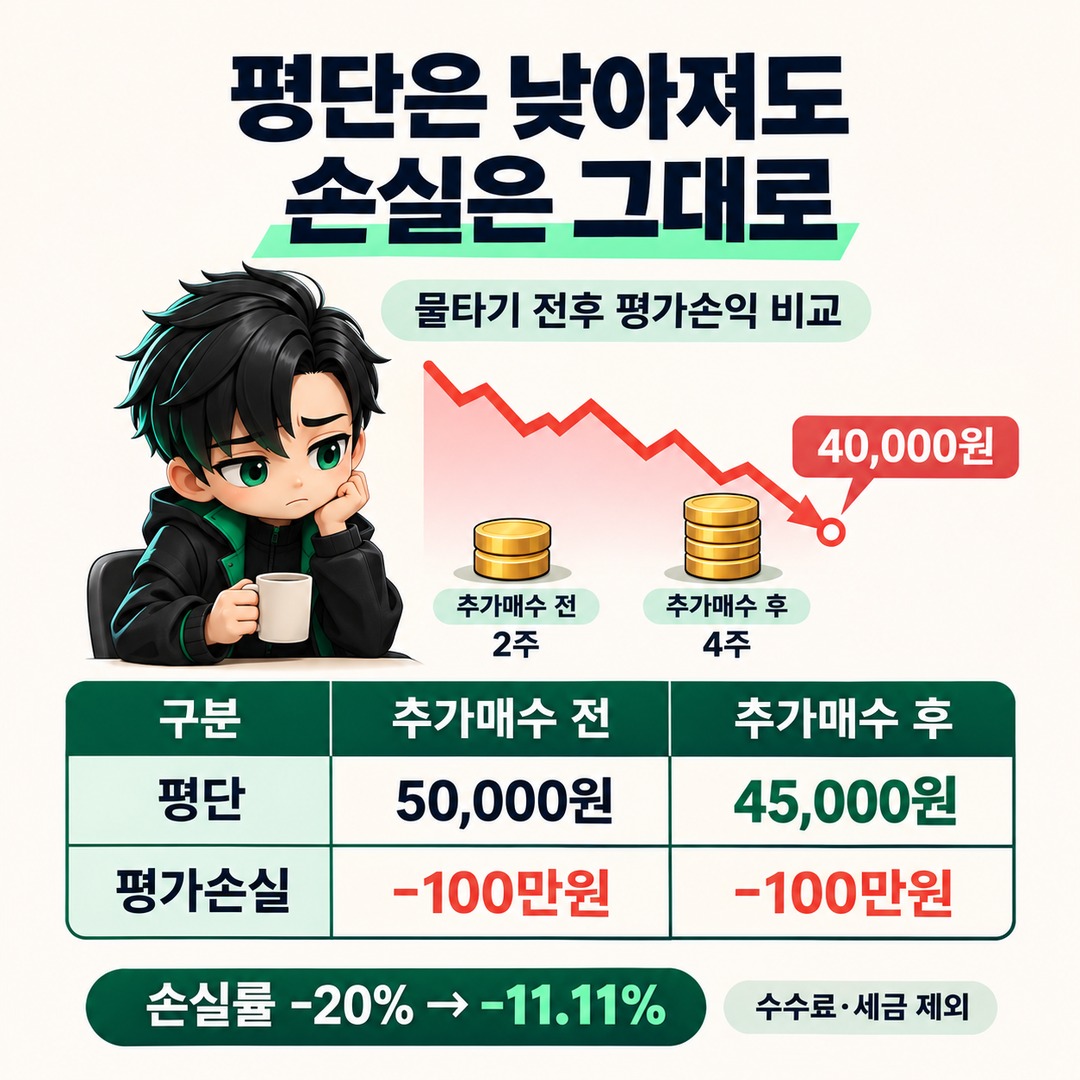
Averaging down on a stock lowers your average purchase price, but it does not automatically erase losses that have already occurred. Buying more increases both the number of shares you hold and your total investment, so you need to check not only your average price but also your unrealized profit or loss, loss rate, and potential losses if the price falls further.
In particular, the fact that your average price has fallen and the fact that your investment loss has decreased are two different things. Distinguishing between them is the first step to understanding your account accurately after averaging down.
1. Why Do Average Cost and Loss Amounts Move Differently?
Your average price falls after averaging down because the additional purchase amount is added to the original purchase amount, and the total is divided by the increased number of shares held.
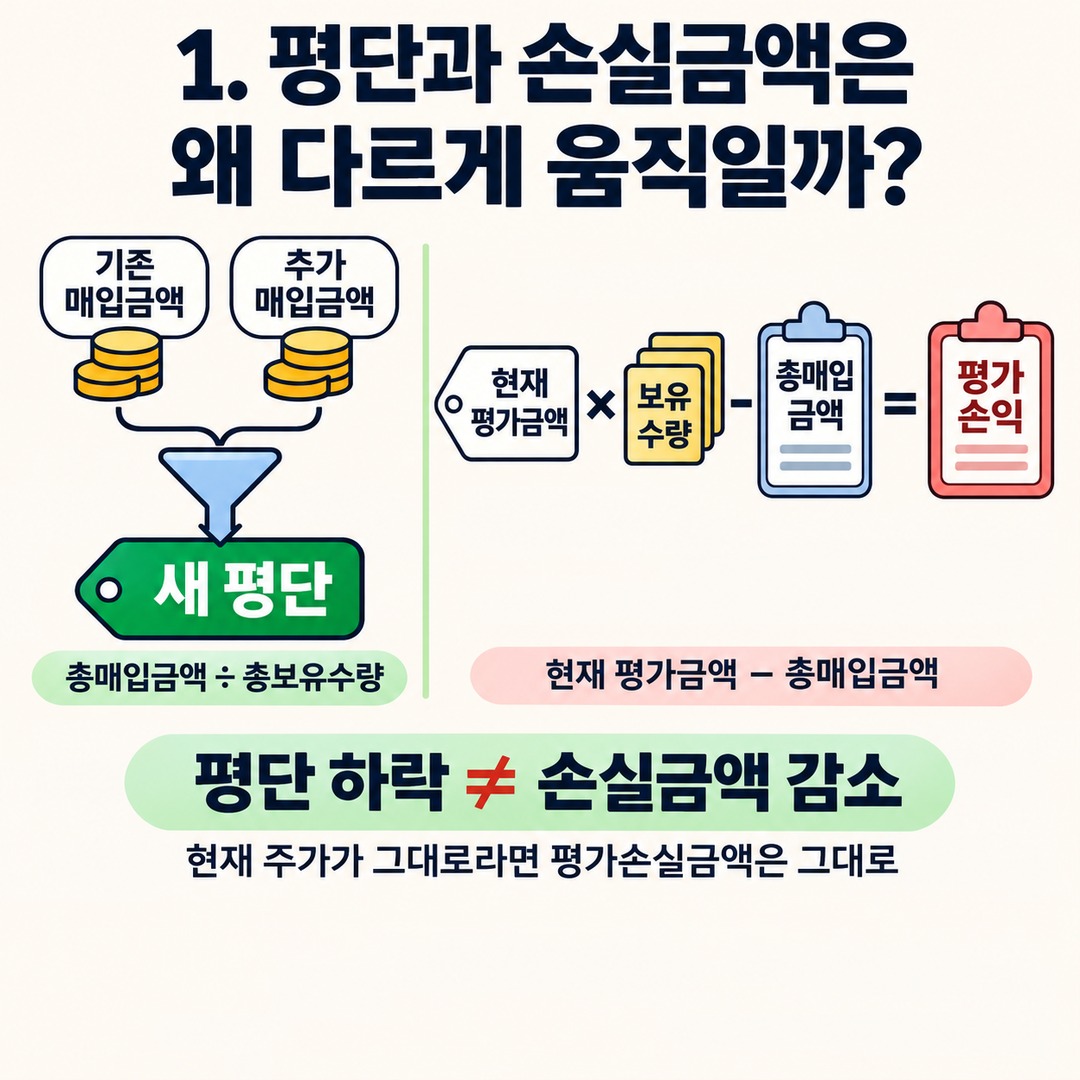
By contrast, unrealized profit or loss is the current market value of your shares minus your total purchase amount. Therefore, even if your average price falls, the existing unrealized loss generally remains unchanged if the current stock price stays the same.
The two calculations are as follows.
① New average price after buying more
(Original average price×Original number of shares)+(Additional purchase price×Additional number of shares)Original number of shares+Additional number of shares② Current unrealized profit or loss
(Current stock price×Total number of shares held)−Total purchase amount③ Unrealized profit or loss rate
Unrealized profit or lossTotal purchase amount×100The key point is that unrealized profit or loss and the unrealized profit or loss rate have different denominators.
Unrealized profit or loss is an actual amount, while the unrealized profit or loss rate is the profit or loss as a proportion of the total purchase amount.
2. What happens if you add KRW 4,000,000 after investing in KRW 5,000,000?
The difference becomes clear when you compare the numbers.
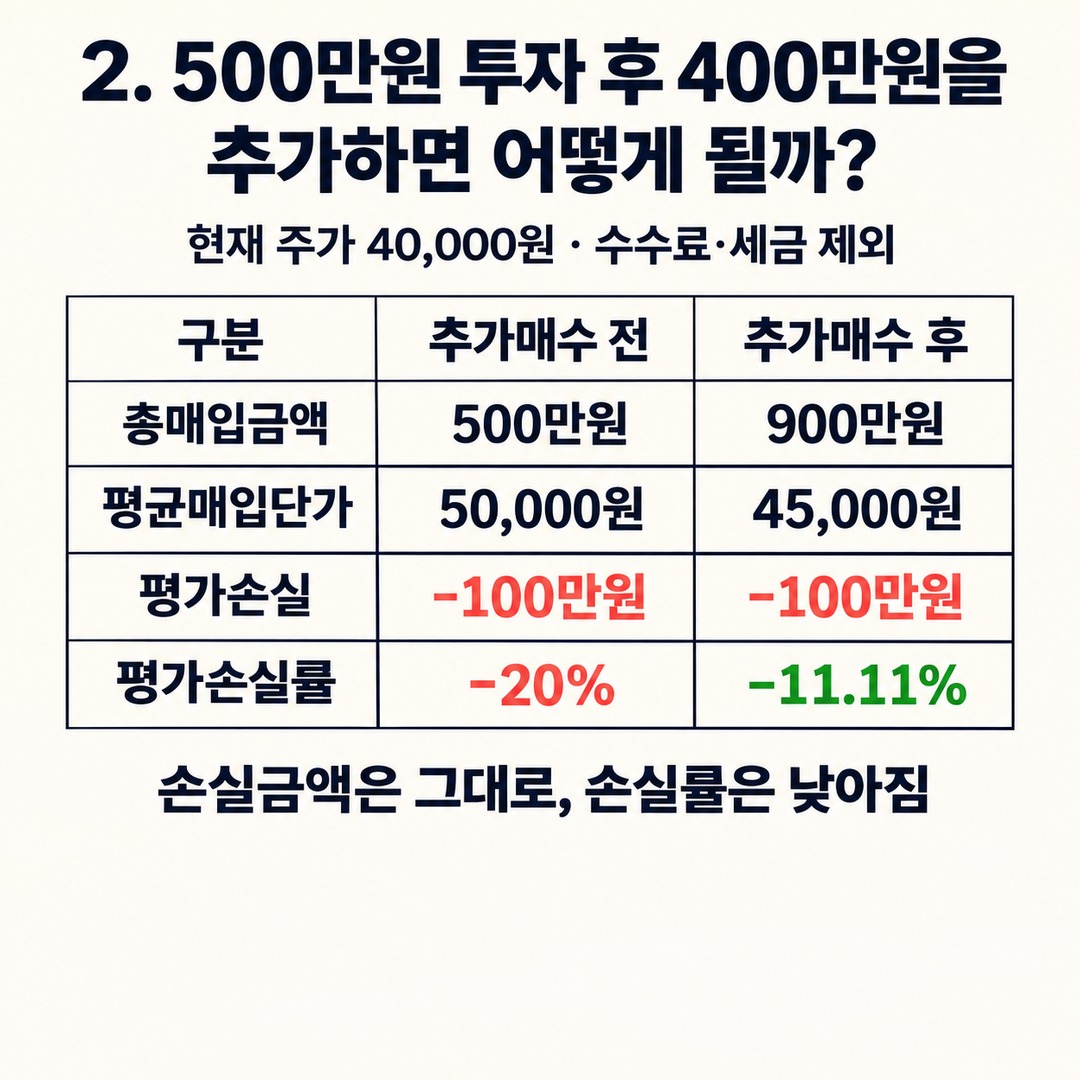
The following is a hypothetical domestic stock investment example, excluding fees and taxes.
Initial purchase price: KRW 50,000
Initial number of shares held: 100 shares
Current stock price: KRW 40,000
Additional purchase price: KRW 40,000
Additional number of shares purchased: 100 shares
Author's calculation · Fees and taxes excluded
| Category | Before buying more | After buying more |
|---|---|---|
| Total purchase amount | KRW 5,000,000 | KRW 9,000,000 |
| Number of shares held | 100 shares | 200 shares |
| Average purchase price | KRW 50,000 | KRW 45,000 |
| Current market value | KRW 4,000,000 | KRW 8,000,000 |
| Unrealized profit or loss | -KRW 1,000,000 | -KRW 1,000,000 |
| Unrealized profit or loss rate | -20% | -11.11% |
Unrealized profit or loss rates before and after averaging down, based on the same stock price, KRW 40,000. Fees and taxes excluded.
Before buying more: unrealized loss rate -20%
After buying more: unrealized loss rate -11.1%
This reveals an important point.
You invested an additional KRW 4,000,000, but the unrealized loss amount is still KRW 1,000,000. Meanwhile, the unrealized loss rate fell from -20% to -11.11%.
The unrealized loss did not recover. The loss rate's basis changed because the total purchase amount increased.
Therefore, you should not assume that your investment situation has improved just because the return shown in your account has improved.
3. How Much Larger Could Your Loss Get if the Stock Price Falls Further After Averaging Down?
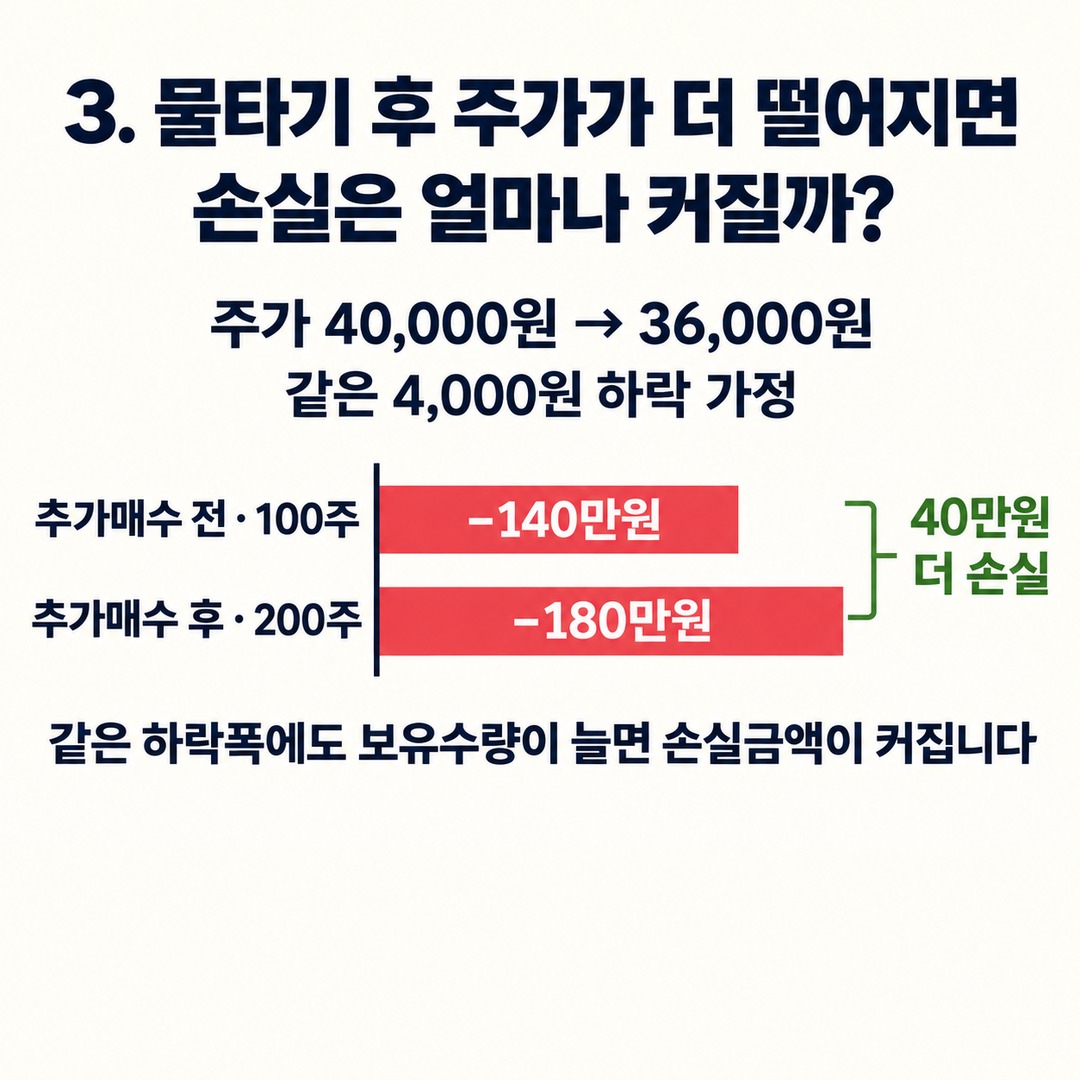
One major risk of averaging down arises if the stock price falls further after you buy more.
Using the example calculated earlier, assume the stock price falls from KRW 40,000 to KRW 36,000.
| Category | Before buying more | After buying more |
|---|---|---|
| Number of shares held | 100 shares | 200 shares |
| Total purchase amount | KRW 5,000,000 | KRW 9,000,000 |
| Current market value | KRW 3,600,000 | KRW 7,200,000 |
| Unrealized loss | -KRW 1,400,000 | -KRW 1,800,000 |
| Unrealized loss rate | -28% | -20% |
Increase in loss amount if the price falls further. The stock price fell by the same KRW 4,000, but after buying more, the number of shares held became 2 times greater.
As a result, the unrealized loss grows by KRW 400,000, from KRW 1,400,000 to KRW 1,800,000.
The calculations are as follows.
Before buying more: KRW 4,000 × 100 shares = KRW 400,000 additional loss
After buying more: KRW 4,000 × 200 shares = KRW 800,000 additional loss
In other words, after buying more, the loss amount can grow faster even with a decline of the same magnitude.
Looking only at the fact that the loss rate fell from -28% to -20% may make it seem that the risk has decreased. In reality, the amount exposed to price movements has also grown in proportion to the additional funds invested.
4. How High Must the Stock Price Rise to Break Even After Averaging Down?
Lowering your average price also changes how much the stock price needs to rise for you to break even.
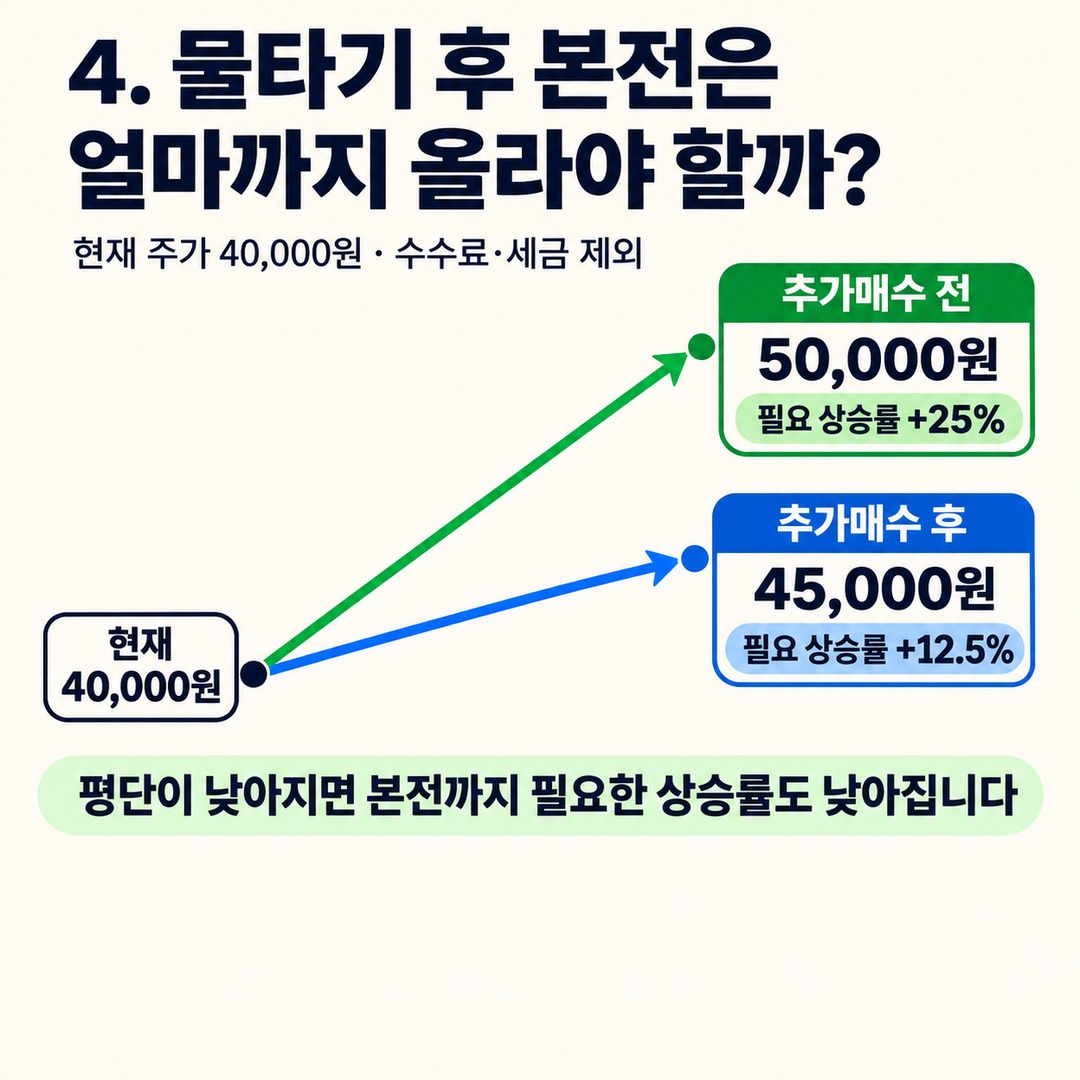
In the earlier example, the initial average price was KRW 50,000, but after buying more it became KRW 45,000.
Using the current stock price of KRW 40,000, the calculations are as follows.
Before buying more
(50,000/40,000−1)×100=25%After buying more
(45,000/40,000−1)×100=12.5%Comparison of the price increases needed to break even
Before buying more
+25%
KRW 40,000 → KRW 50,000
After buying more
+12.5%
KRW 40,000 → KRW 45,000
Lowering your average price can reduce the percentage increase needed to reach the break-even point. However, this is a simple calculation that excludes fees and taxes.
This is the mathematical effect of averaging down.
The reference price that the stock must rebound to is lower, but you also need to consider that you increased your investment and the number of shares you hold to achieve that effect.
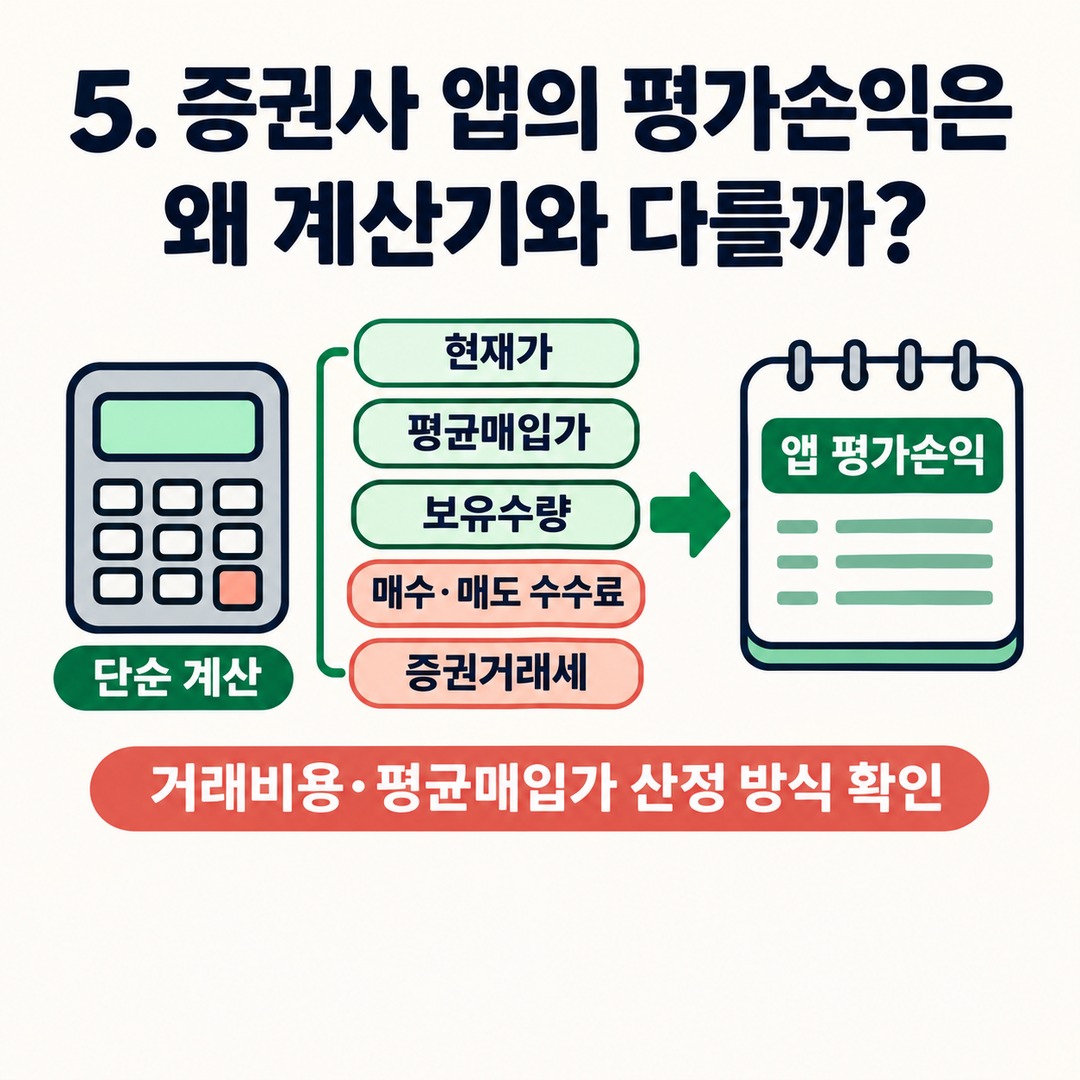
5. Why Might Unrealized Profit and Loss in a Brokerage App Differ from a Calculator?
The profit or loss you calculate yourself may not match the figure shown in your brokerage app exactly.
Common reasons include transaction costs and the method used to calculate the average purchase price.
Kiwoom Securities' real-time account balance help explains that unrealized profit or loss is calculated using the current price, average purchase price, number of shares held, trading commissions, and selling taxes. Kiwoom download
Check the following items.
Purchase commission: the transaction cost incurred when buying more
Selling commission: the cost incurred when you sell later
Securities transaction tax: tax related to selling in applicable transactions
Average purchase price: whether the brokerage includes costs in this figure or displays them separately
Real-time valuation price: the exchange quote used on the account balance screen
Actual costs can vary depending on the brokerage's fee discounts, order channel, and exchange.
So, rather than relying on the break-even price from another calculator as is, check the actual fees and tax information provided by the brokerage you use.
For reference, KRW 45,000 in the example above is a simplified break-even price that excludes costs; it is not the after-tax break-even price following an actual sale.
6. What Should You Recalculate Before Buying More?
When considering averaging down, calculating only how much you can lower your average price is not enough.
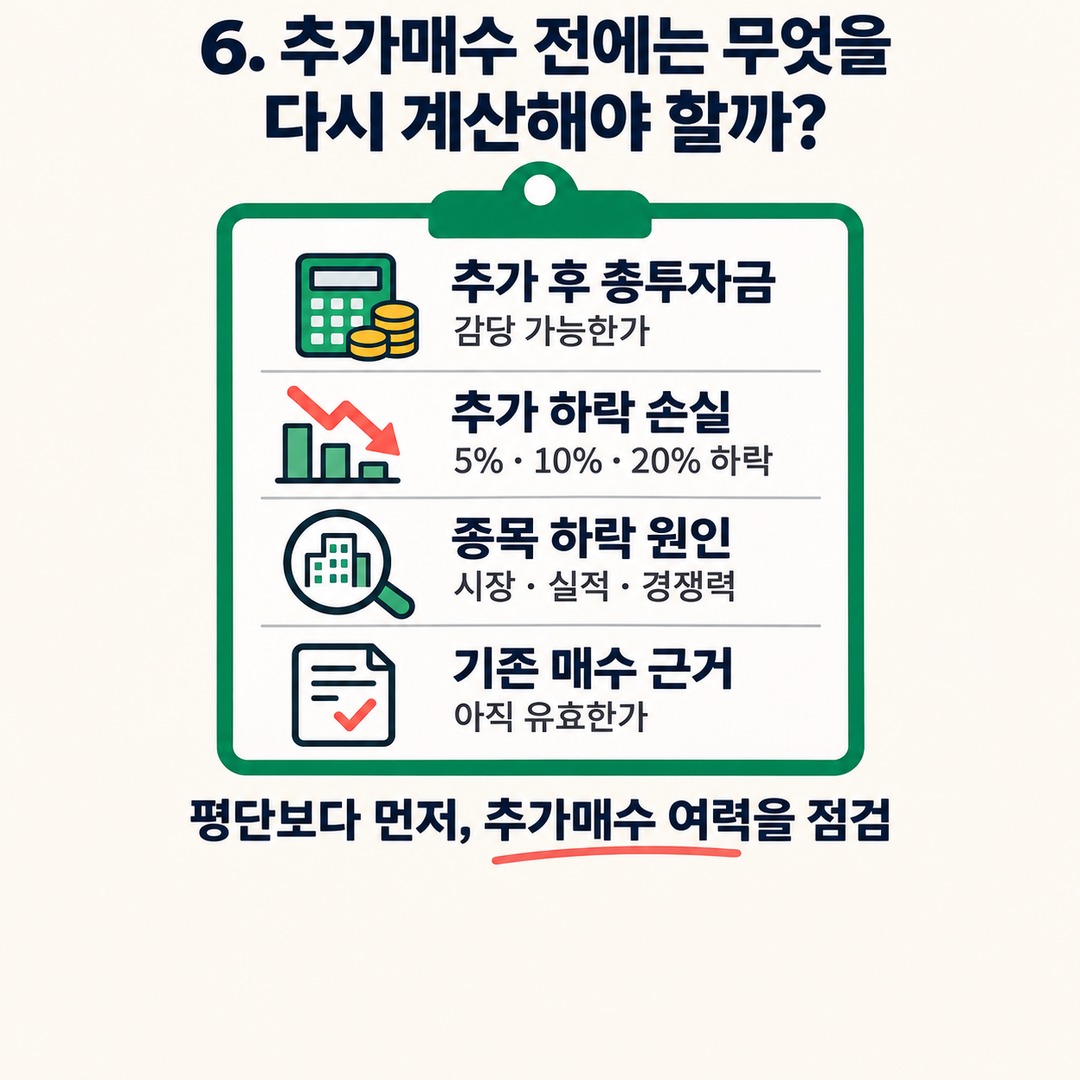
It is best to check the following four things together.
First, your total investment after buying more
Add your existing investment to the amount you plan to invest. Check whether you can afford the additional funds needed to lower your average price.
Second, the loss amount if the price falls further
Calculate scenarios in which the price falls further from its current level by 5%, 10%, and 20%, respectively. After buying more, the loss amount may be greater even for the same percentage decline.
Third, the reason the stock is falling
Determine whether it is due to a broad market correction, deteriorating company performance, or a change in the company's business competitiveness.
A lower price alone does not mean the company's value has improved.
Fourth, whether your original investment rationale still holds
Check whether the rationale for your initial purchase is still valid. If that rationale no longer holds, reconsidering your original decision may take priority over lowering your average price.
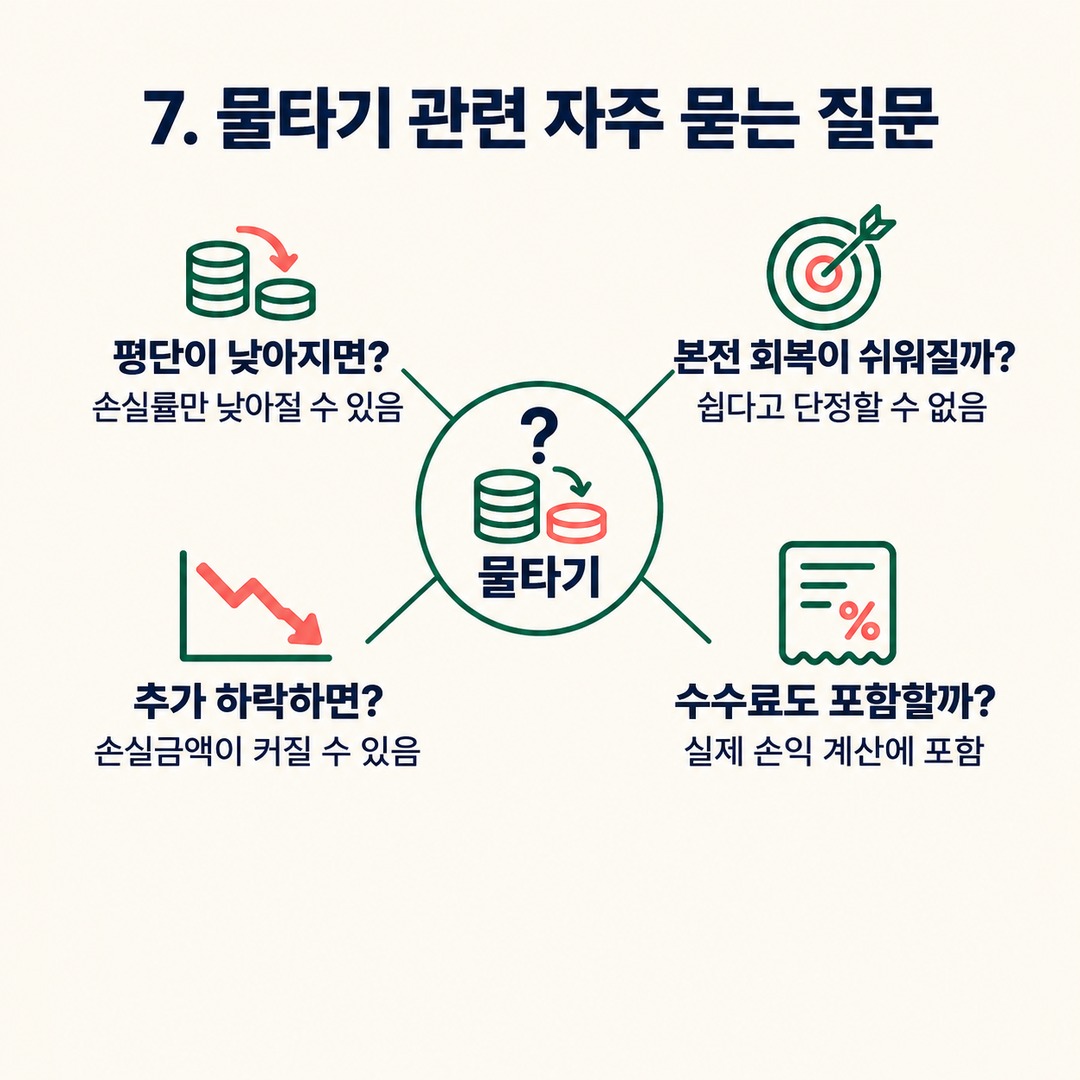
7. Frequently Asked Questions About Averaging Down
Q. If my average price falls, shouldn't my unrealized loss also decrease?
Not necessarily. If the current stock price and the unrealized profit or loss on your existing shares remain unchanged, buying more at the current price leaves the existing unrealized loss amount the same, while the unrealized loss rate may decrease.
Q. If I average down heavily, will it be easier to break even?
Your average price falls, so the percentage increase in the stock price needed to break even may decrease. But your additional investment grows, and if the stock price falls further, your loss amount also increases. It cannot be assumed that breaking even will be easier.
Q. Why can the loss amount actually increase after averaging down?
Because the additional shares you bought also fall in value. When the number of shares held increases, the total unrealized loss can be greater even if the stock price falls by the same amount.
Q. Should I include fees when calculating the effects of averaging down?
It is best to include them when calculating actual profit or loss and the break-even selling price. A simple average-price calculation should be distinguished from a profit or loss calculation that includes actual transaction costs.
Conclusion
Averaging down does not eliminate losses; it changes your average purchase price and the number of shares you hold by putting in additional funds.
A lower average price and a reduced loss rate do not mean that the actual loss amount in your account has recovered.
Before deciding whether to buy more, make sure to check these three things separately.
1. The new average purchase price
2. Your total investment and unrealized profit or loss after buying more
3. The loss amount you would need to withstand if the price falls further
Before considering how much you can lower your average price, first consider whether you could withstand a further decline on the additional money you invest.
This article provides calculation information to help with investment decisions and does not recommend buying or selling any specific stock. Investing in stocks may result in a loss of principal.
※ This article is for reference in understanding market trends and is not an investment recommendation for any specific stock or asset. You are responsible for your final decisions and investments.