

Should You Average Down on a Losing Stock? Livermore-Style Add-on Buying: Criteria and When to Stop

Buying more shares of a losing stock and adding to a position that has confirmed gains are entirely different strategies. Jesse Livermore’s pyramiding approach is not averaging down to lower your purchase price as a stock falls; it means increasing your position when price action confirms that your judgment is right. The key is to decide first what conditions will make you stop adding to the position.
The reference date is 2026-11-10. Even when applying Livermore’s principles to modern stock investing, preserving capital and ensuring the trading thesis remains valid should take priority over recovering losses.
What Is the Difference Between Averaging Down and Pyramiding?
The biggest difference is whether you buy when the stock moves against your expectations or when signs appear that your expectations are right.

| Category | Averaging Down | Pyramiding |
|---|---|---|
| When to add to the position | When the price falls | When the price rises |
| Existing position | At a loss | Gains confirmed |
| Main purpose | Lowering the average purchase price | Expanding the position in a favorable trend |
| Basis for the decision | Falling prices and an assessment of value | Confirmation from price action |
| Main risk | Concentrating capital in losing stocks | Larger losses if prices reverse after rising |
Averaging down lets you lower your average purchase price because you buy more shares at a lower price. But a lower average purchase price does not mean your actual unrealized loss has decreased.
The Difference Becomes Clear in a Calculation
The following is a hypothetical example that excludes fees and taxes.
Case A: Averaging Down as the Price Falls
Initial purchase: KRW 50,000 × 100 shares
Additional purchase: KRW 45,000 × 100 shares
Current share price: KRW 40,000
Author’s calculation
| Item | Result |
|---|---|
| Total purchase amount | KRW 9,500,000 |
| Total shares held | 200 shares |
| Revised average purchase price | KRW 47,500 |
| Current market value | KRW 8,000,000 |
| Unrealized loss | -KRW 1,500,000 |
If you had held only the initial 100 shares, the unrealized loss would be KRW 1,000,000.
After averaging down, the average purchase price fell from KRW 50,000 to KRW 47,500, but the unrealized loss grew to KRW 1,500,000.
Case B: Pyramiding After Confirming an Uptrend
Initial purchase: KRW 50,000 × 100 shares
1th add-on: KRW 52,000 × 50 shares
2th add-on: KRW 54,000 × 25 shares
Current share price: KRW 54,000
Author’s calculation
| Item | Result |
|---|---|
| Total purchase amount | KRW 8,950,000 |
| Total shares held | 175 shares |
| Average purchase price | Approximately KRW 51,143 |
| Current market value | KRW 9,450,000 |
| Unrealized gain | +KRW 500,000 |
In the second example, the additional shares were bought at a higher price, but the current share price is above the average purchase price for the entire position.
This does not prove that pyramiding always produces a profit. If the uptrend reverses, even the additional shares are exposed to losses.
The key is not to lower your average purchase price, but to avoid committing more capital to a losing judgment.
When Did Jesse Livermore Add to His Position?
Jesse Livermore’s pyramiding approach involves gradually expanding a position after the initial purchase when the market supports his judgment.

In 1923, Edwin Lefèvre’s Reminiscences of a Stock Operator describes the principle of not rushing into a second purchase before the initial purchase shows a profit.
Here is the principle laid out as a sequence of actual trades.
1. Initial position entry: Buy only part of the planned position instead of committing the full amount at once. At this stage, check whether the market is moving in line with your judgment.
2. Confirm that the initial purchase is profitable: Check whether the share price has risen above your initial purchase price and is moving in the expected direction. Do not add to the position if the initial purchase is already at a loss.
3. Confirm that the trend is continuing: Watch whether market action remains favorable. Add to the position if further upward movement is confirmed.
4. Complete the position: Invest the remaining planned amount when further favorable price movement appears. Do not rush into the final purchase simply because the stock has already risen substantially.
See Richard Wyckoff’s compiled account of his interview with Livermore, the pyramiding chapter in Jesse Livermore's Methods of Trading in Stocks.
There is one more source worth noting.
In Richard Wyckoff’s account of his interview with Livermore, Livermore describes limited pyramiding: instead of taking a full position from the start, buy part of it first, then expand the position if the market confirms the accuracy of the judgment.
The key point is the conditions for adding to a position, not the number of times you add.
You do not buy solely because the share price has risen. You need to check whether the market has moved in the expected direction since the initial purchase.
At What Price Should You Actually Add to a Position?

If you apply Livermore’s method to modern stock charts, it is useful to distinguish in advance between the initial purchase price, the price that confirms the trend, and the add-on purchase price.
However, there is no single rule that applies a particular moving average or percentage gain to every stock.
The following hypothetical price scenario is provided to explain the trading rules.
A staged buying plan for a hypothetical stock
The prices below are hypothetical examples for illustration, not actual market prices.
Initial purchase
KRW 50,000
100 shares · Initial position; 1 add-on purchase
KRW 52,000
50 shares · Confirm that the initial purchase is profitable and the price is trending upward; 2 add-on purchase
KRW 54,000
25 shares · Confirm further upward movement; hypothetical stopping point
KRW 50,000
Assuming the price is set in advance as the point at which the trading thesis for the entire position is invalidated, this scenario adds 1 shares after the initial purchase at KRW 52,000, then buys the final shares at KRW 54,000 after further gains are confirmed.
What happens if the share price falls back to KRW 50,000?
The final position consists of 175 shares, with a total purchase amount of KRW 8,950,000.
Assuming all shares are sold at KRW 50,000, the market value would be KRW 8,750,000, resulting in a loss of KRW 200,000.
This is a simple calculation that excludes fees, taxes, and slippage.
The important point is that KRW 50,000 is not a formal stop-loss price prescribed by Livermore. It is the stopping price set in advance for this hypothetical trading plan.
When Should You Stop Pyramiding?
The most important thing in pyramiding is to set separate conditions for stopping additional purchases and closing the entire position.
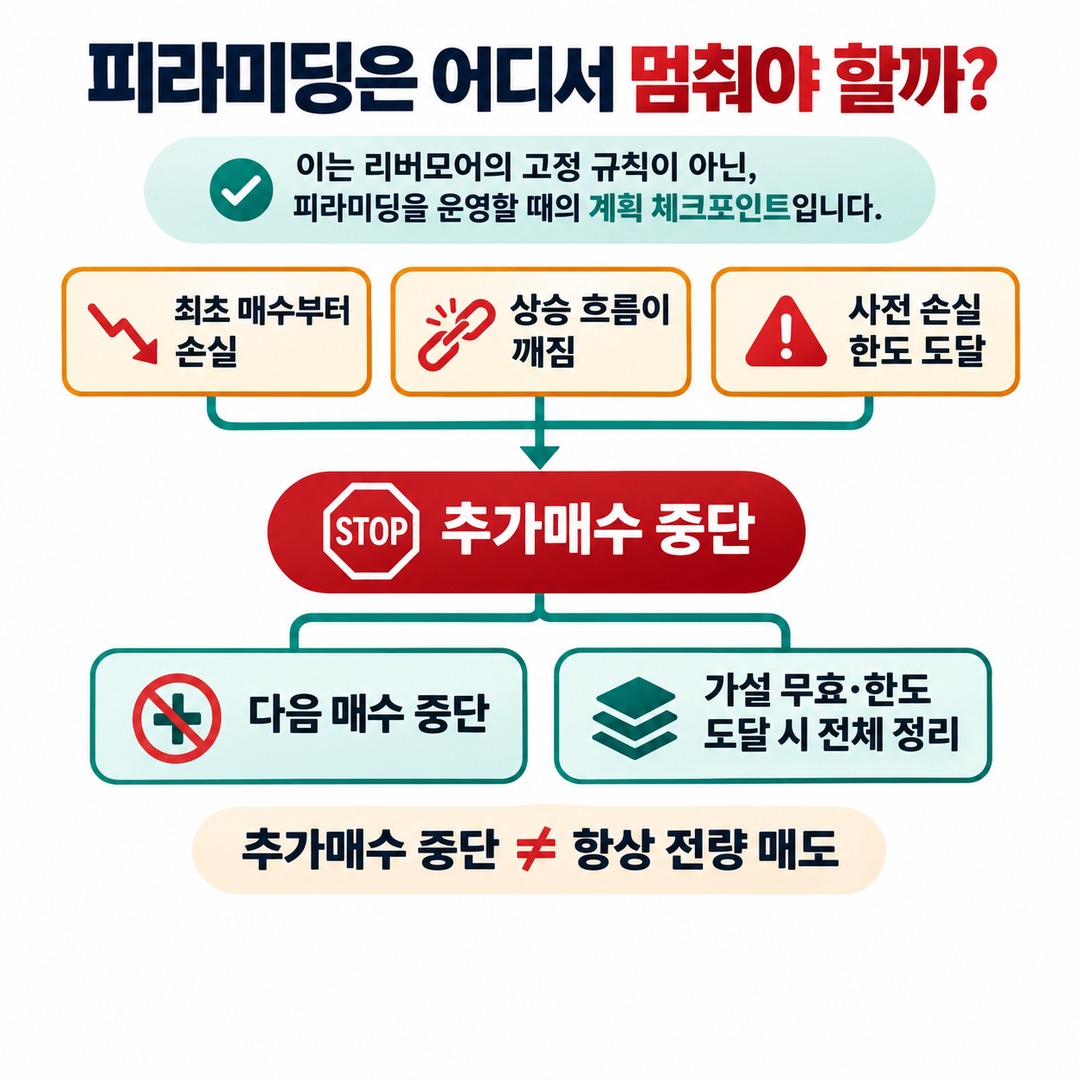
Stopping additional purchases does not necessarily mean you must sell all the shares you already hold. Conversely, if the trading thesis has been invalidated, it can be risky to stop adding while continuing to hold the existing shares.
You need to distinguish among the following three situations.
1. When the position is at a loss from the initial purchase price
This is the situation that most directly reflects Livermore’s principle.
If the share price moves against your expectations after the initial purchase, do not respond by buying more.
He acknowledged that his judgment could be temporarily wrong, while emphasizing that you should not increase the size of a position that is losing money.
2. When the uptrend breaks after adding to the position
Even if the position is already profitable, stop making further purchases if the basis for adding to it no longer holds.
Examples include the following:
After a breakout, the price falls back into its previous range
The volume pattern that supported the rise disappears
Market and sector trends diverge from the initial expectations
The company’s results or financial condition no longer match the original investment thesis
These are examples of checks for a modern trading plan, not fixed rules Livermore applied in every situation.
3. When the pre-set loss limit is reached
Set a stopping price so the total position does not exceed its loss limit.
It is more accurate to calculate risk based on the combined position, including shares added later, than to set a stop-loss based only on the initial purchase price.
For example, in the hypothetical scenario discussed earlier, selling the entire position at KRW 50,000 would result in a loss of KRW 200,000.
If you keep buying more based only on the hope that the stock will recover after falling below KRW 50,000, you undermine the trading plan you had already set.
Set your stop-loss criteria before buying, and recalculate how the risk of the entire position changes each time you add to it.

When Averaging Down May Be Considered—and When to Avoid It
Averaging down is not wrong for every stock that falls. However, planned periodic purchases for long-term investing should be distinguished from impulsive add-on buying intended to recover losses.
The U.S. Securities and Exchange Commission (SEC) also emphasizes asset allocation suited to an investor’s time horizon and risk tolerance in its guidance on asset allocation and diversification. It separately explains rebalancing, which adjusts a portfolio when an asset class’s share moves away from its target.
| Situation | Approach to consider |
|---|---|
| Regular purchases under a long-term investment plan | Consider planned periodic purchases |
| The investment thesis for the company has been undermined | Reassess instead of adding to the position |
| The only reason is that the average purchase price is high | Hold off on adding to the position |
| An uptrend is confirmed after the initial purchase | Consider limited pyramiding |
| The position in one stock is already too large | Check concentration risk first |
| You are using margin | Check the collateral ratio and risk of forced liquidation |
Long-term investors, in particular, do not need to conclude that their investment thesis has been invalidated just because of a short-term price decline.
Conversely, be cautious about adding to a position simply because the share price has fallen sharply when the company’s business competitiveness or financial condition has deteriorated.
Rebalancing adjusts the asset allocation to the proportions originally set; it is not a strategy of automatically buying more of an individual stock that is at a loss.
5 Things to Check Before Adding to a Position
Checking the following in order before an actual trade can help you avoid confusing averaging down with pyramiding.

Pre-purchase checklist
Check 0/5 items
During review
Is the investment thesis behind the initial purchase still valid?
Has price action moved in the expected direction since the initial purchase?
What will the total investment and the stock’s portfolio share be after adding to the position?
Have you calculated the loss limit for the entire position, including the additional shares?
Did you set the stopping price and the conditions for closing the entire position before buying?
If you cannot explain the investment thesis and loss limit among these five items, it is best not to rush into adding to the position.
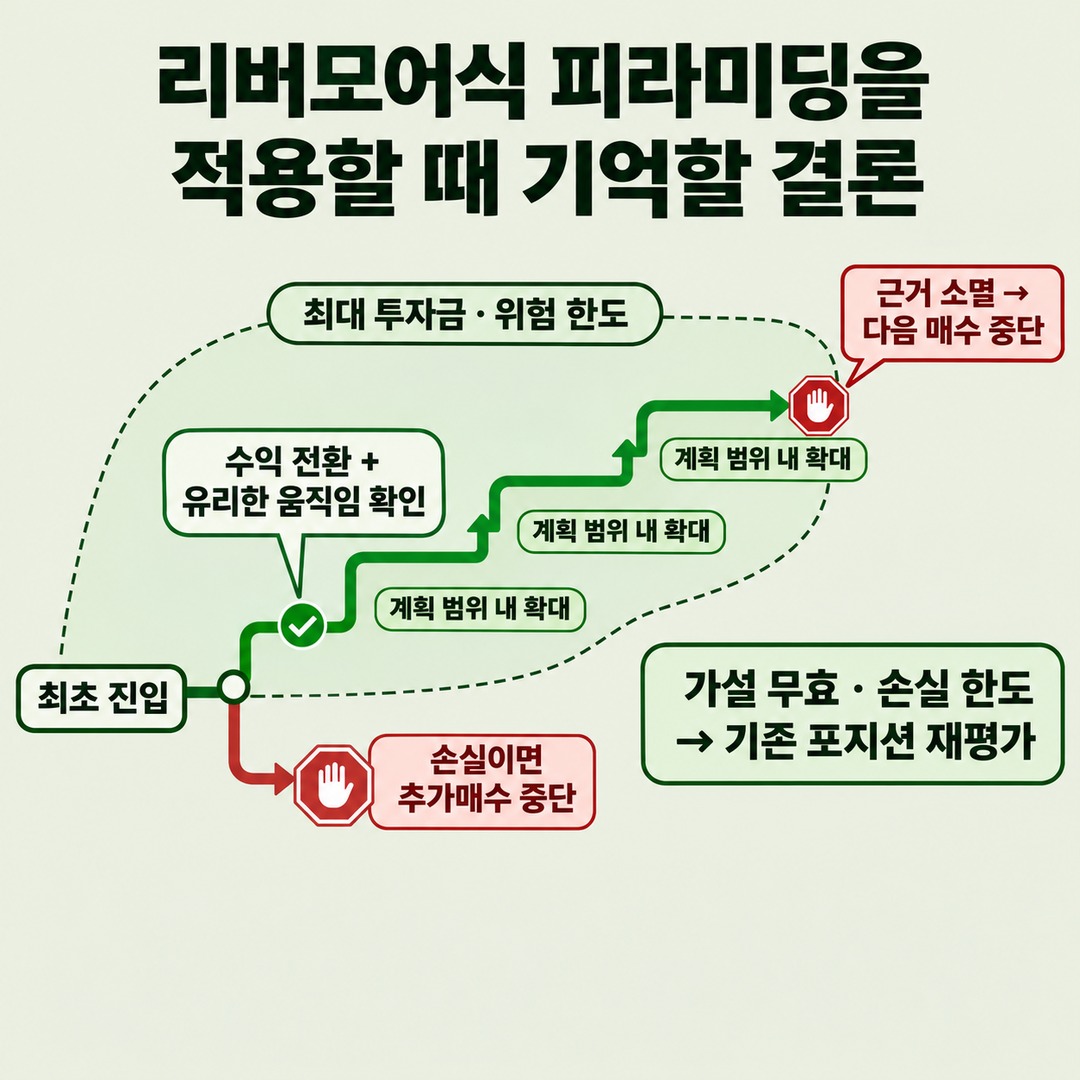
What to Remember When Applying Livermore-Style Pyramiding
Livermore’s pyramiding is not a technique for increasing the number of shares you buy to reduce a loss.
After the initial entry, you wait for market action to confirm that your judgment is right, then expand the position within the planned limits each time that confirmation appears.
The practical criteria can be summarized as follows:
Do not add to the position if the initial purchase is at a loss.
Consider adding once the initial purchase becomes profitable and favorable price action is confirmed.
Even if the price keeps rising, do not exceed your planned maximum investment or risk limit.
Stop making further purchases when the basis for adding to the position disappears.
Reassess the existing position if the trading thesis is invalidated or the pre-set loss limit is reached.
The most important question for understanding Livermore’s trading principles is not how much cheaper the stock has become.
Is there evidence that the judgment I made at the outset is still right?
If there is no such evidence, reassessing your judgment should come before buying more to lower your average purchase price.
※ This article is for informational purposes to help readers understand market trends and is not an investment recommendation for any specific stock or asset. You are responsible for your own final decisions and investments.