

Turtle Trading: A 20-Day Breakout Entry, 10-Day Low, and 2N Stop-Loss Are Different Exit Criteria
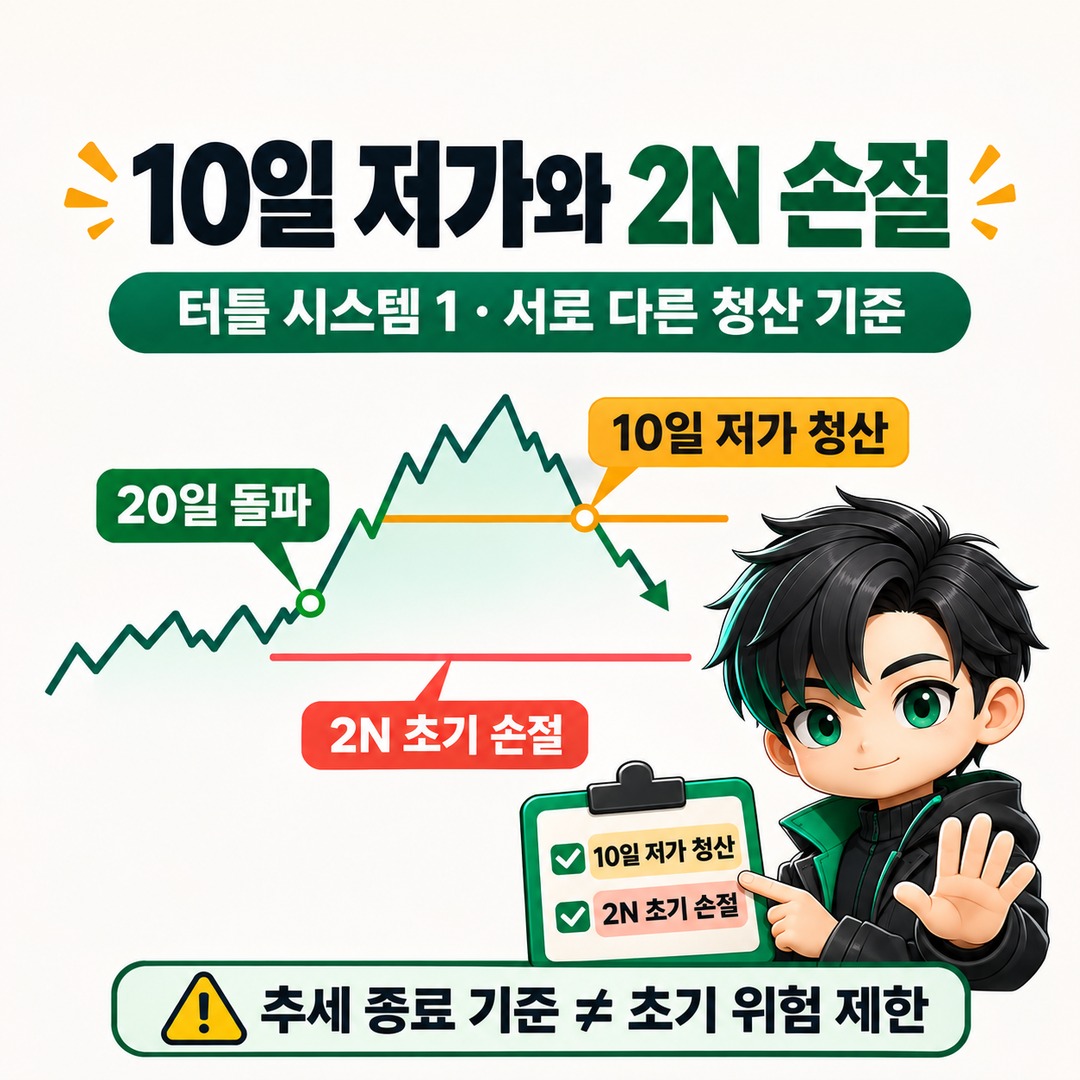
In Turtle Trading System 1 (System 1), after buying on a breakout above the 20-day high, the position is exited on a trend signal if it falls below the 10-day low, and stopped out initially if it drops 2N from the entry price. The 10-day low is the criterion for judging whether the trend has ended, while 2N limits the initial risk accepted on a single trade. These two conditions are managed separately rather than as substitutes.
The information was checked as of 2026-11-18. However, the original Turtle rules were designed primarily for futures markets, so when applying them to individual domestic stocks, price gaps, transaction costs, and execution methods must be considered separately.
Do the 20-Day Breakout and 10-Day Low Break Have to Be Used Together?
Yes. Buying on a 20-day breakout and exiting at the 10-day low are the entry-and-exit combination for Turtle System 1.

The original rules are divided into two systems.
| Category | System 1 | System 2 |
|---|---|---|
| Entry | Break above the 20-day high | Break above the 55-day high |
| Long position exit | Break below the 10-day low | Break below the 20-day low |
| Initial stop-loss | 2N | 2N |
| Basic character | Captures short-term trends | Captures long-term trends |
Therefore, entering on a 20-day breakout but using the 20-day low as the exit criterion is a different combination of rules from the original System 1.
How Is the 2N Stop-Loss Calculated?
2N is a price distance calculated as twice the volatility N at the time of entry. Here, N is not simply the 20-day average price increase; it is the 20-day exponential moving average of True Range, which also accounts for gaps between the previous close and the current day's high and low.
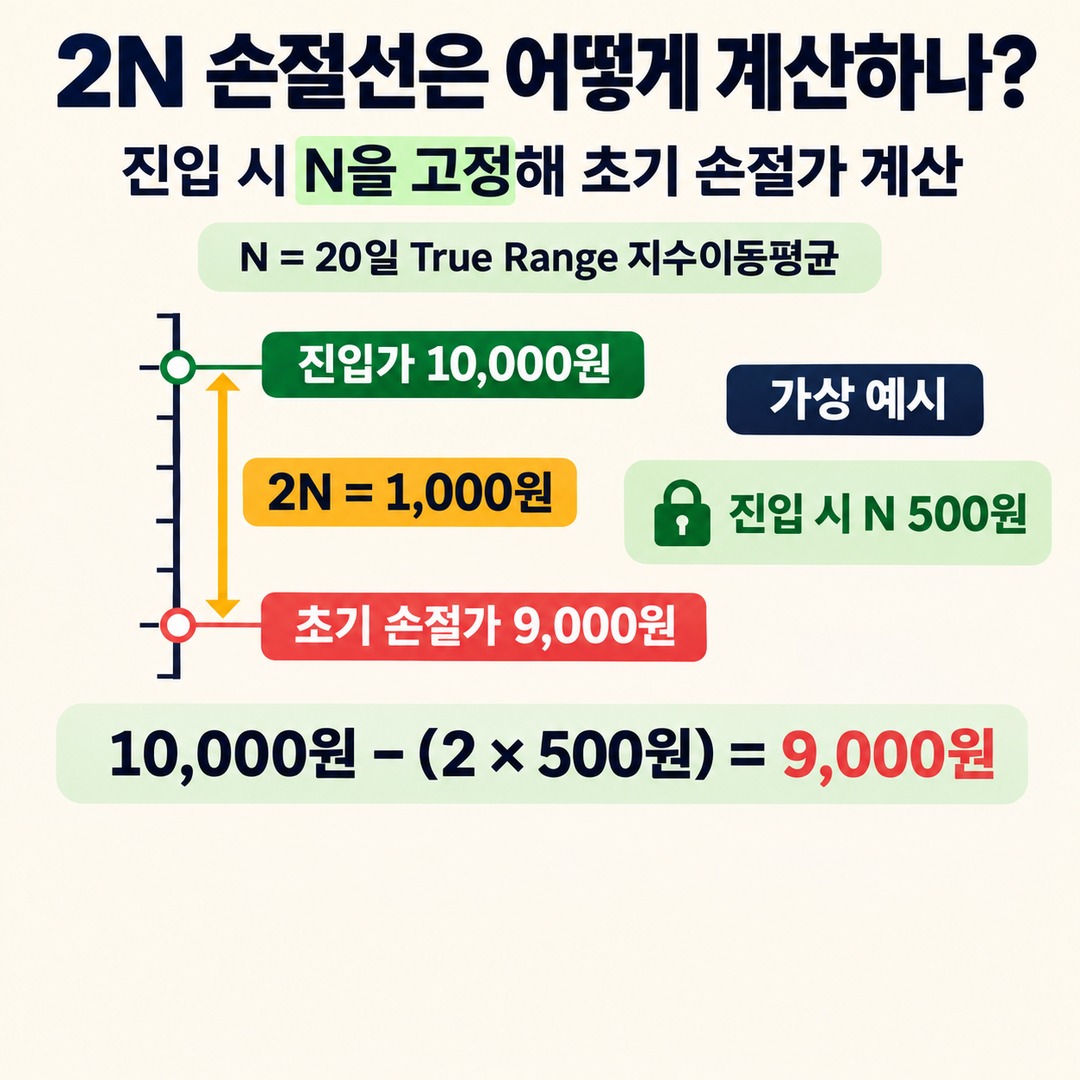
The original Turtle rules calculate N as follows.
TR=max(H−L, ∣H−PDC∣, ∣PDC−L∣)Nt=19Nt−1+TRt20- H: Current day's high
L: Current day's low
PDC: Previous day's close
N: Volatility expressed in price units
This calculation method can be found in the Position Sizing section of the Original Turtles rules document.
The initial stop-loss price for a long position is as follows.
Initial stop-loss price = entry price − (2 × N)The important point is that 2N is not the same as a 2ATR trailing stop that is recalculated every day after buying. The initial stop-loss price is set using N at the time of the initial entry.
Hypothetical Example: What If You Buy at KRW 10,000 and N Is KRW 500?
This is a hypothetical example, not the historical price or investment performance of an actual stock.
| Item | Price |
|---|---|
| Entry price | KRW 10,000 |
| N at entry | KRW 500 |
| 1N | KRW 500 |
| 2N | KRW 1,000 |
| Initial stop-loss | KRW 9,000 |
The calculation is as follows.
10,000−(500×2)=9,000Therefore, if the stock price reaches KRW 9,000, the initial stop-loss condition is met.
Here, 2N is a stop-loss distance set in terms of the stock price, not a target loss percentage. The actual account loss depends on the number of shares purchased, execution price, transaction costs, and whether a price gap occurs.
In Practice, Which Triggers First: the 10-Day Low or 2N?

Calculate both prices just after buying and monitor which level the actual price reaches first.
In the hypothetical example above, the 2N stop-loss price is KRW 9,000. The exit order now depends on the 10-day low.
| Scenario | 10-day low | 2N stop-loss price | First criterion triggered |
|---|---|---|---|
| A | KRW 9,300 | KRW 9,000 | 10-day low |
| B | KRW 8,800 | KRW 9,000 | 2N stop-loss |
| C | KRW 9,000 | KRW 9,000 | Same price level |
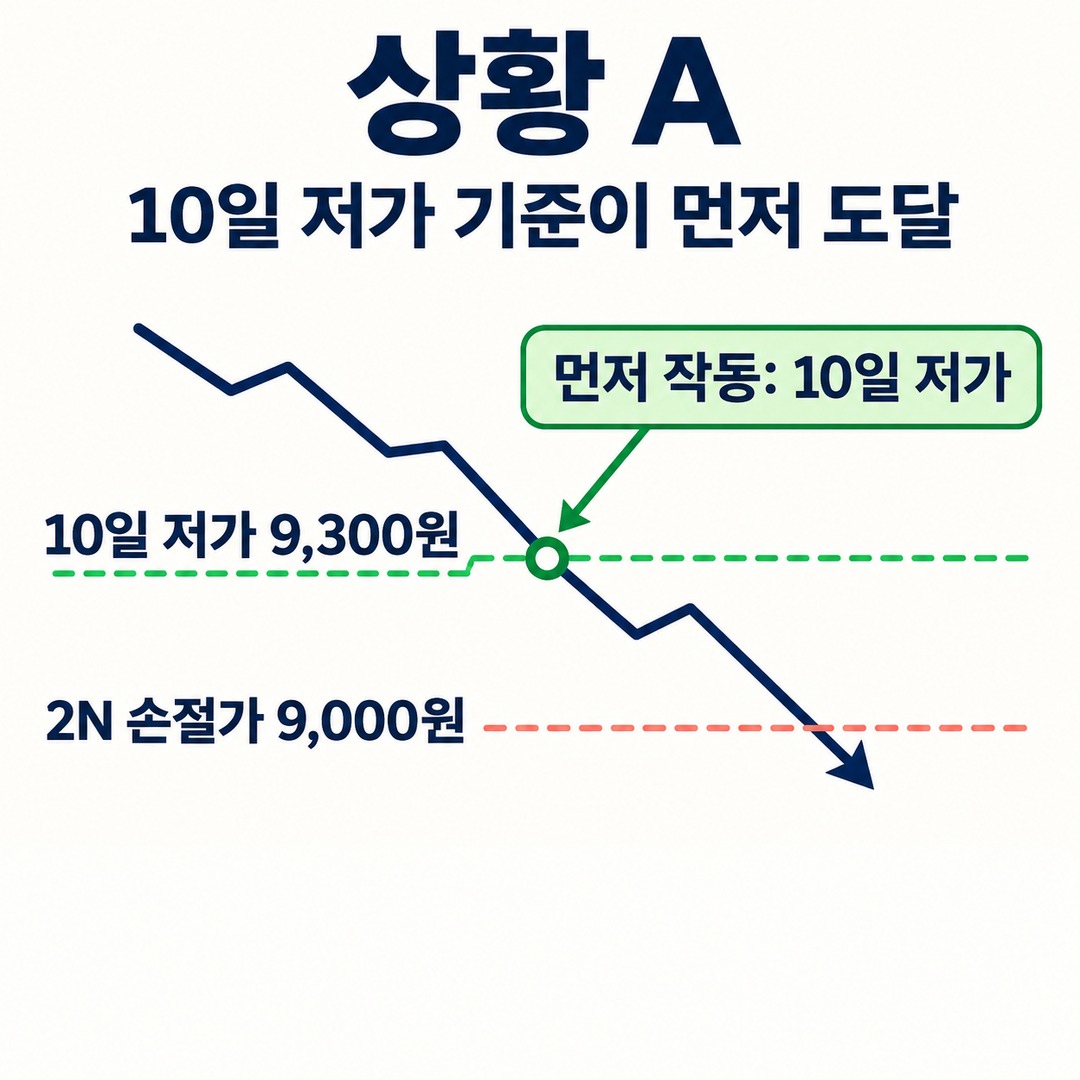
Scenario A
If the stock price falls to KRW 9,300, the 10-day low break is triggered first. There is no need to wait for the initial stop-loss level of KRW 9,000.
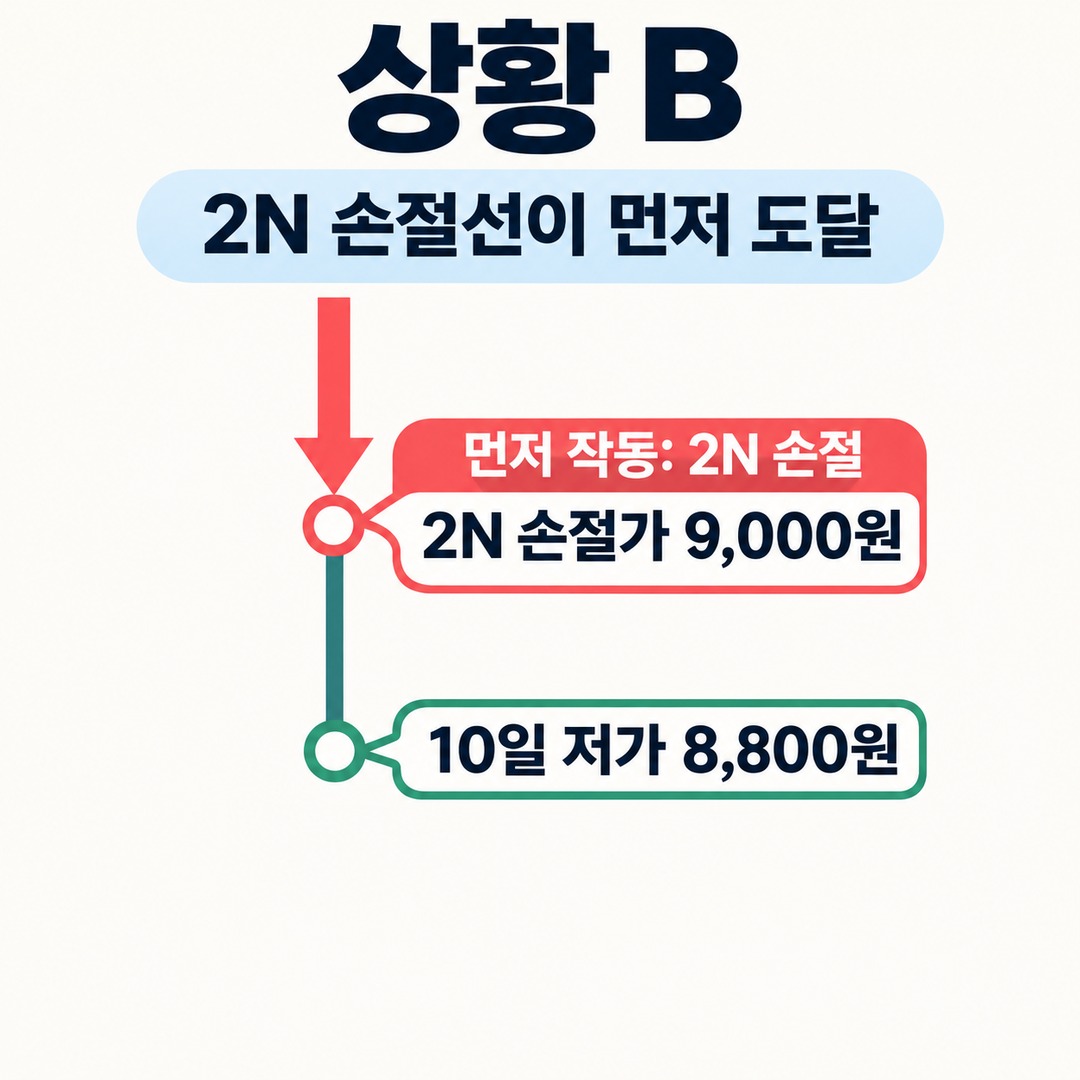
Scenario B
Even if the 10-day low has fallen to KRW 8,800, the 2N stop-loss level of KRW 9,000 is reached first. Waiting for a break below the 10-day low would violate the initial loss-limit rule.
Scenario C
If both criteria are at the same price, the exit conditions are effectively triggered at the same time. In actual orders, the outcome may vary depending on the price increment and execution conditions.

This comparison is the key to understanding the two rules.
Why Is the 10-Day Low Exit Needed Separately from the 2N Stop-Loss?
The 10-day low exit is a rule for closing a position when the trend weakens, even if the trade is profitable. By contrast, the 2N stop-loss limits losses when the decision to buy proves wrong.

The Turtle system distinguishes between these two:
2N: Limits risk on losing trades
10-day low: Trend-ending signal for System 1
For example, suppose the stock is entered at KRW 10,000 and then rises to KRW 13,000. If it later pulls back and breaks below the 10-day low, the exit signal for System 1 is triggered even if the position is still profitable.
By contrast, the 2N stop-loss is triggered when the stock falls far enough below the entry price to reach the initial risk limit.
Therefore, treating the 10-day low only as a way to protect profits, or using 2N as the final exit criterion for every trade, differs from the original rules.
Two Easily Overlooked Conditions in the Original Turtle Rules
① A 20-Day Breakout Signal Did Not Always Mean Buying
System 1 had an entry filter that took the result of the previous breakout trade into account.
If the previous breakout was considered a winning trade, the rule was to skip the next 20-day breakout signal. However, to avoid missing a major trend, a 55-day breakout was used as an alternative entry signal.
This rule differs from simply buying every signal just because the price has moved above the 20-day high.
This can be confirmed in the Original Turtles source and in the Original Turtle Trading Rules section of Curtis Faith's book Way of the Turtle.
② If You Add to a Position, You Also Need to Manage the Stop-Loss Price
The Turtle system used pyramiding, adding to positions that were moving in a profitable direction.
Under the original rules, units were added at intervals of ½N, and the stop-loss prices for existing units were also raised to control risk.
Therefore, after adding to a position, simply calculating 2N based on the initial entry price is not enough to accurately assess the risk of the entire position.
Record the additional entry prices and each unit's stop-loss price separately.
What Should You Consider Differently When Applying This to Individual Domestic Stocks?
The original Turtle system was not designed specifically for individual domestic stocks. Curtis Faith's original rules explain that it was operated in the liquid futures markets of U.S. exchanges.
Therefore, when applying it to domestic stocks, distinguish among the following three factors.
1. Set the position size based on 2N.
It makes sense to calculate the stop-loss price first, then decide how many shares to buy.
A simplified risk-budget formula for applying this to stocks is as follows.
Number of shares to buy = permitted loss amount2NIn the example above, assume 2N is KRW 1,000 and the permitted loss per trade is KRW 200,000:
200,000÷1,000=200 sharesAuthor's calculation: 200 shares. This is a hypothetical calculation that excludes fees, taxes, slippage, and losses from price gaps.
The original Turtle system's account risk allocation and the actual position-size calculation for domestic stocks are not the same, so they should be designed separately.
2. Account for a gap down at the market open.
Setting a stop-loss at KRW 9,000 does not guarantee that the stock can actually be sold at KRW 9,000.
For example, if the previous day's closing price is KRW 9,200 and the stock opens at KRW 8,800 the next day, trading begins below the KRW 9,000 stop-loss level.
In that case, the actual loss may be greater than the planned 2N loss.
3. Distinguish an intraday break from a closing-price break.
Under the original Turtle rules, the position was exited if the price crossed the exit level intraday.
By contrast, for domestic stock investors, checking whether the price has fallen below the 10-day low based on the closing price is a separate modified rule.
Whichever method you use, the entry and exit conditions must match the criteria used to validate them against historical data.
What to Check Before Trading
If you apply the 20-day breakout entry strategy, manage it in the following order.
1. Check the highest price over the previous 20 trading days.
2. Check the entry filter based on the outcome of the previous System 1 breakout.
3. Calculate N at the time of entry.
4. Subtract 2N from the entry price to set the initial stop-loss.
5. Calculate the number of shares to buy based on 2N and the account's risk budget.
6. While holding the position, track the lowest price over the previous 10 trading days.
7. Act on whichever occurs first: the 2N stop-loss or the 10-day low exit.
8. If you add to the position, recalculate the stop-loss price for each unit and the risk of the total position.
The 7 point is key. Do not ignore an 2N stop-loss that has already been reached just to wait for the 10-day low.
Frequently Asked Questions: Q. What if the 10-day low is above the 2N stop-loss level?
In that case, the 10-day low is reached first. If the price breaks below that level, System 1's trend-exit condition is triggered.
Q. Can I keep holding if the 2N stop-loss has not been triggered?
No. Even if the 2N stop-loss has not been triggered, System 1 exits the position if the 10-day low exit condition occurs.
Q. When should I sell if the price keeps rising without breaking below the 10-day low?
System 1 has no fixed profit target. The basic approach is to follow the trend until the 10-day low exit condition occurs.
Q. Can I use a 20-day low exit with a 20-day breakout entry?
You can, but it would not be the original System 1. Define and test it as a separate strategy that combines a 20-day breakout with a 20-day low exit.
One Key Point to Remember
In Turtle Trading, after a 20-day breakout entry, the 10-day low break and the 2N stop-loss are not competing sell strategies.
2N limits losses from an entry that proves wrong, while the 10-day low is an exit rule for holding a profitable trade until the trend ends.
Therefore, the key to System 1 is to set both criteria and act on whichever is met first.
However, applying this to individual stocks requires separate risk management and testing that account for gaps and execution losses.
※ This article is for informational purposes to help readers understand market trends; it is not an investment recommendation for any particular stock or asset. You are responsible for your own final decisions and investments.