

Can Married Couples Living Apart for Work Each Claim a Monthly Rent Tax Credit in 2026? Combined Couple Limit of KRW 10,000,000 and Eligibility
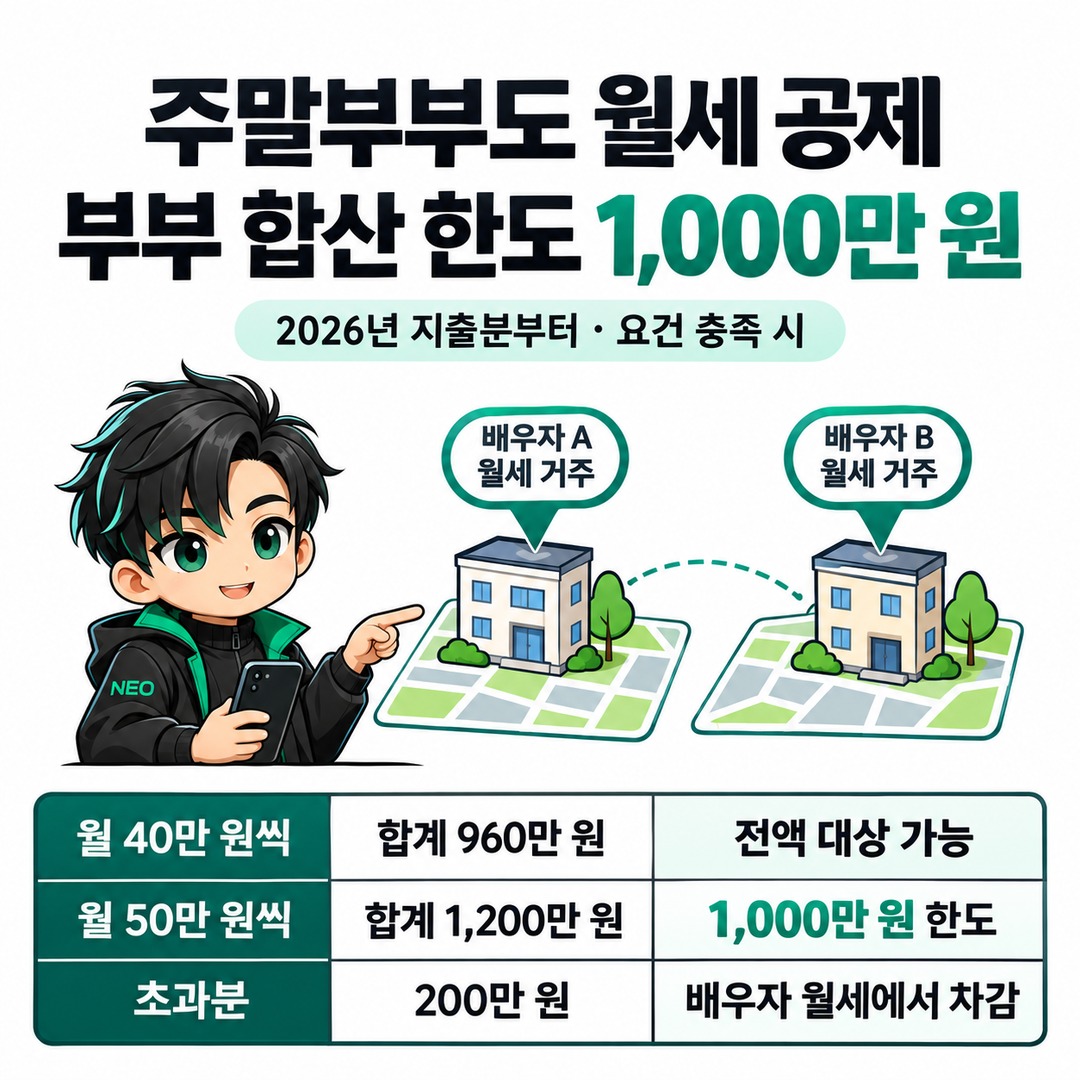
Starting in 2026, married couples who own no home and live apart for work may each claim a monthly rent tax credit if they meet the requirements. However, this does not mean each spouse can claim KRW 10,000,000. The couple’s eligible annual rent expenses are combined, and only up to KRW 10,000,000 is recognized.
Previously, monthly rent tax credits were often assessed with a focus on the head of household, but additional credits are now available to couples who live separately for housing reasons and meet certain requirements, for rent paid on or after 2026-01-01.
1. Why did the monthly rent tax credit rules for couples living apart for work change in 2026?
This change is intended to reduce housing costs for married couples who live in different regions because of work or other circumstances.
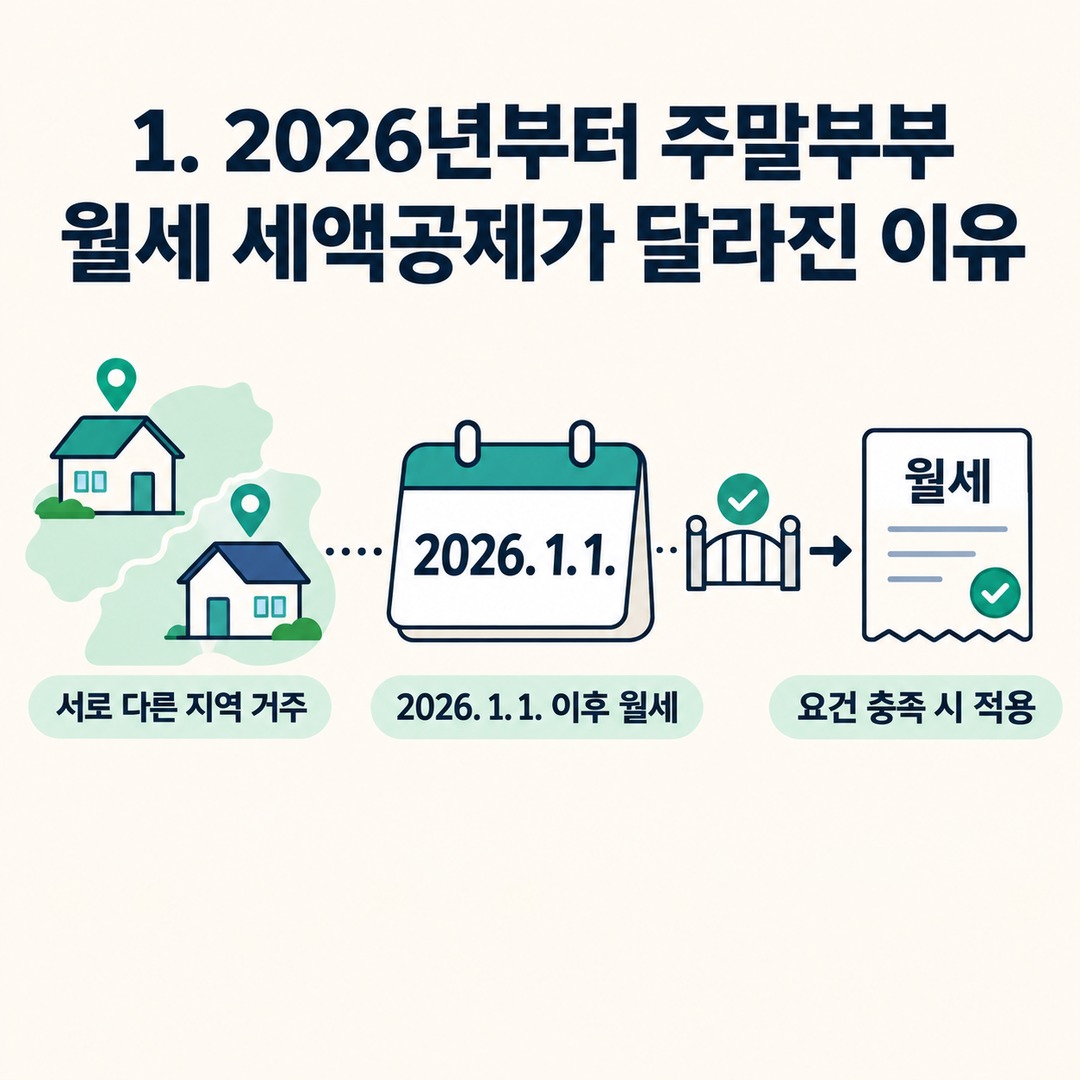
The tax reform announced by the Ministry of Finance and Economy was incorporated into the Restriction of Special Taxation Act, and applies to rent paid on or after 2026-01-01.
The key point is that simply living in different homes as a couple does not automatically qualify you for the credit.
The head of household and the spouse must have registered addresses in different cities, counties, or districts. They must also meet requirements such as the spouse and family members living with them owning no home.
2. What requirements must a couple meet to each claim the credit?
For the spouse to qualify for the additional credit, both the standard monthly rent tax credit requirements and the special requirements for couples living apart for work must be met.
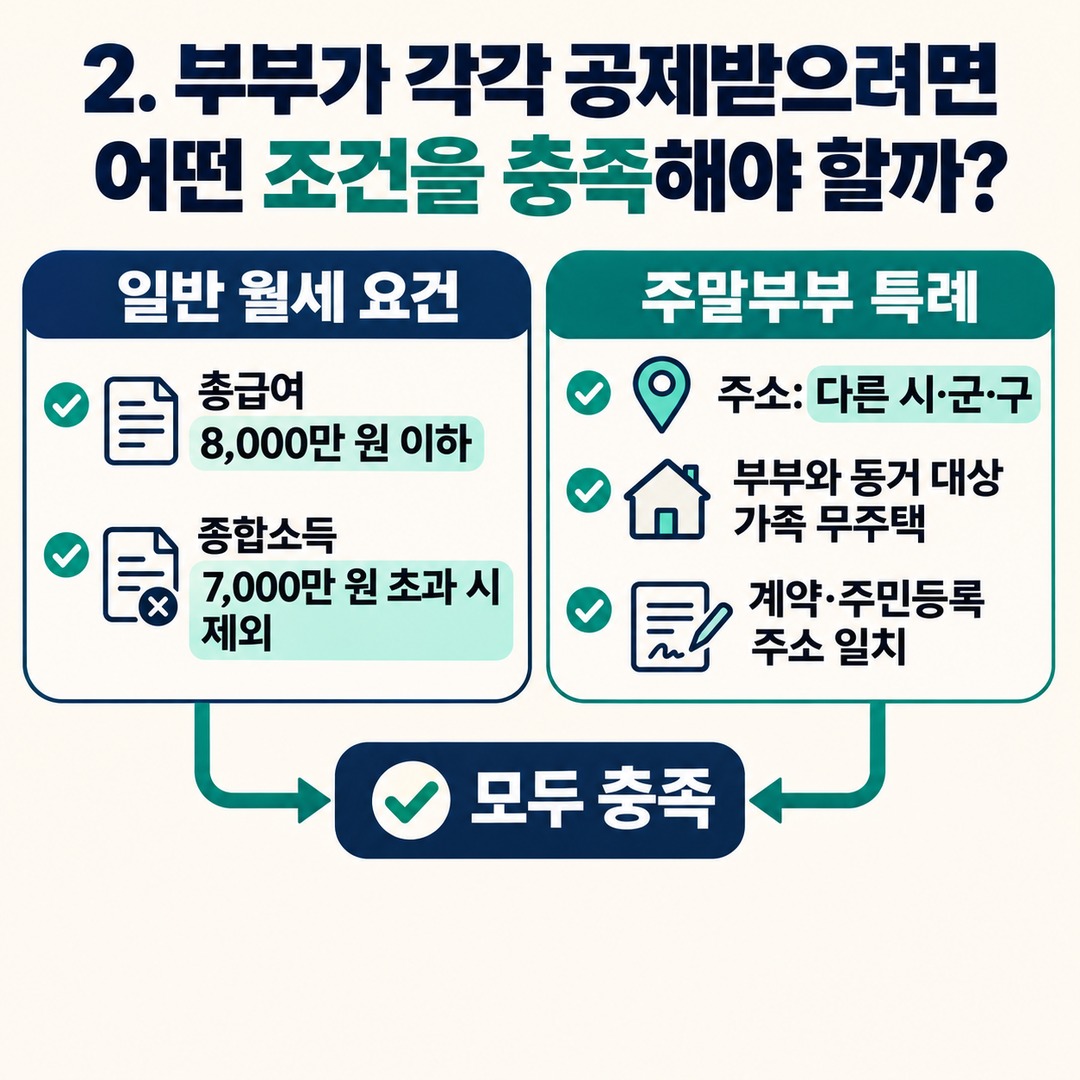
| Item to check | Eligibility standard |
|---|---|
| Head of household’s address | Check the address on the lease and resident registration |
| Spouse’s address | A different city, county, or district from the head of household |
| Spouse’s income | Total salary of no more than KRW 80,000,000 |
| Comprehensive income amount | Excluded if it exceeds KRW 70,000,000 |
| Homeownership | Must meet the no-homeownership requirement |
| Family members living together | Family members covered by the rule who live with the spouse must also own no home |
| Rent contract | Must meet requirements such as having the contract in the taxpayer’s or a statutory basic deduction dependent’s name |
| Actual residence | The address must match the address on the contract and resident registration |
In particular, it is important to check whether the addresses are in different cities, counties, or districts.
By contrast, living in different neighborhoods within the same city, county, or district does not meet this special provision’s address requirement.
You must also check whether family members specified by law, such as lineal ascendants and descendants and siblings who live with the spouse, own a home. Do not assume that the requirement is met just because the two spouses themselves own no home.
3. How much tax credit can a couple claim if each pays KRW 600,000 in monthly rent?
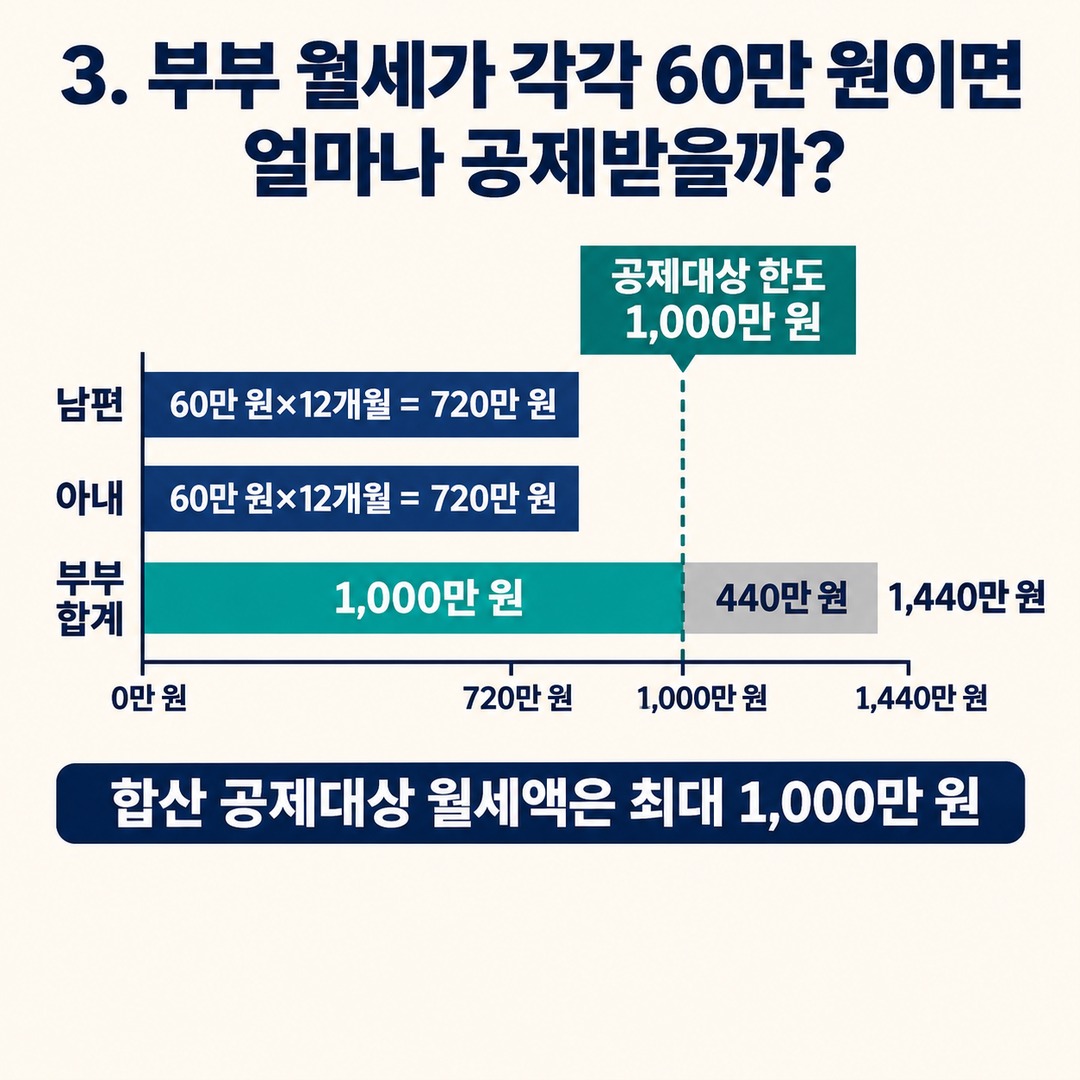
The point people most often find confusing is the combined limit for couples.
Even if each spouse pays rent separately, the eligible rent amount is subject to a combined annual limit of KRW 10,000,000 for the couple.
Let’s look at the calculations.
Example A: Both pay KRW 400,000 in monthly rent
Husband: KRW 400,000 × 12 months = KRW 4,800,000
Wife: KRW 400,000 × 12 months = KRW 4,800,000
Combined total for the couple: KRW 9,600,000
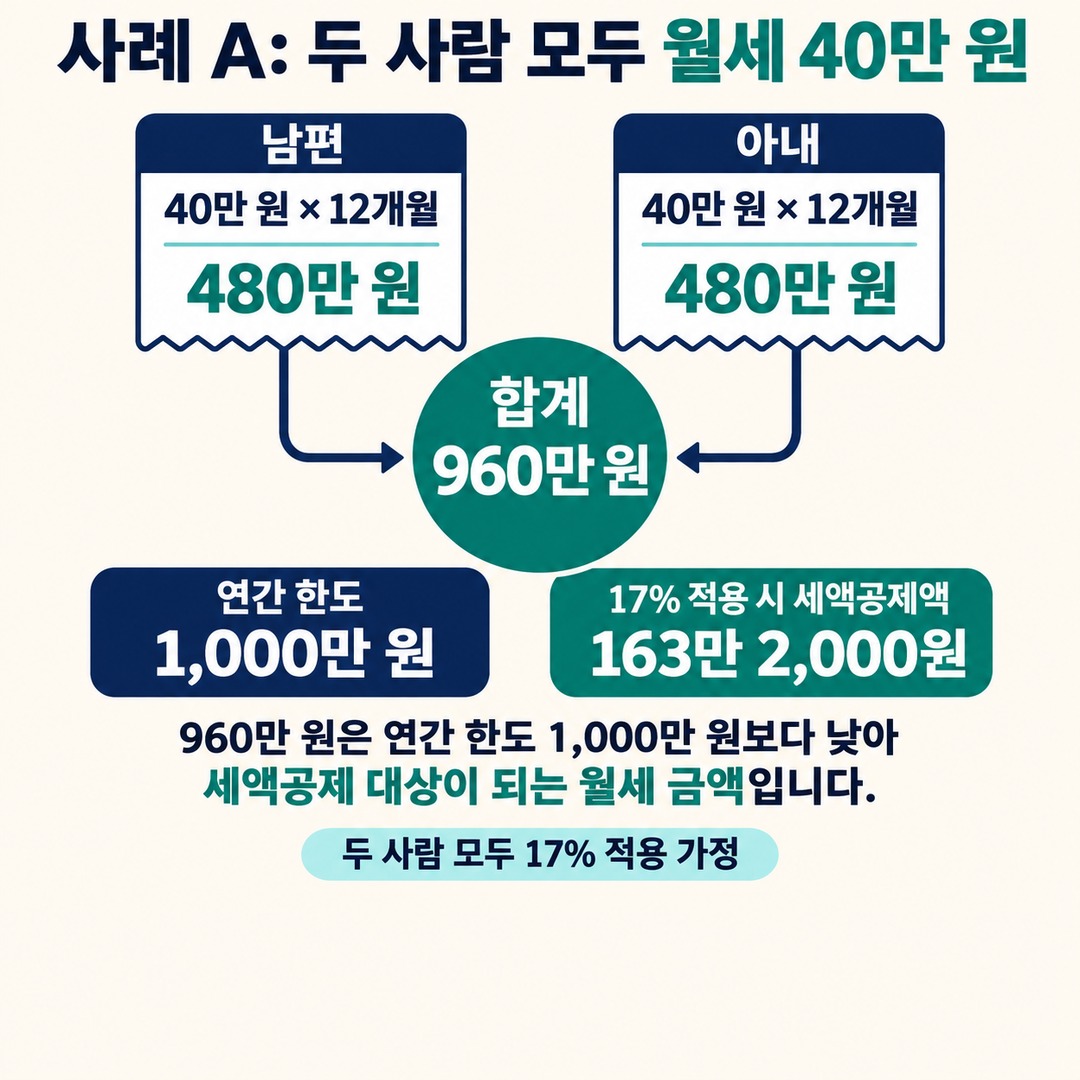
Because this is less than the annual limit of KRW 10,000,000, the full KRW 9,600,000 may qualify as an eligible amount.
If both spouses qualify for the 17% credit rate, the tax credit amount is KRW 1,632,000 based on the author’s calculation.
Example B: Both pay KRW 500,000 in monthly rent
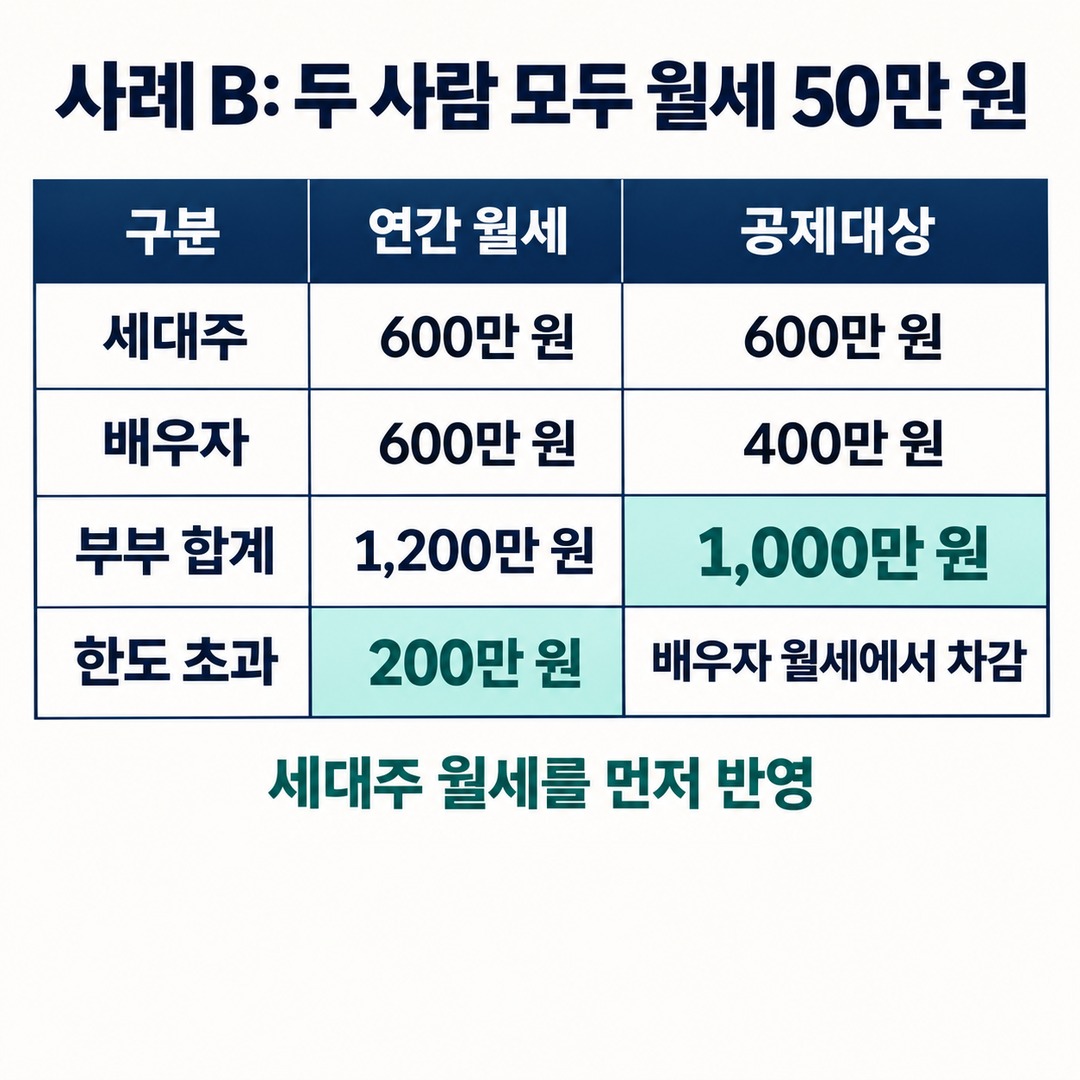
Husband: KRW 500,000 × 12 months = KRW 6,000,000
Wife: KRW 500,000 × 12 months = KRW 6,000,000
Combined total for the couple: KRW 12,000,000
In this case, KRW 2,000,000 exceeds the limit.
| Category | Amount |
|---|---|
| Husband’s annual rent | KRW 6,000,000 |
| Wife’s annual rent | KRW 6,000,000 |
| Combined total for the couple | KRW 12,000,000 |
| Eligible amount limit | KRW 10,000,000 |
| Amount over the limit | KRW 2,000,000 |
The rent paid by the statutory head of household is counted first. If the combined amount exceeds KRW 10,000,000, the excess is deducted from the spouse’s rent.
Therefore, in the example above, the head of household’s rent of KRW 6,000,000 and KRW 4,000,000 of the spouse’s rent qualify as eligible amounts. Statutory information + 1
4. Are the monthly rent tax credit rates the same for the husband and wife?
Not necessarily. The applicable credit rate differs depending on each employee’s income eligibility.
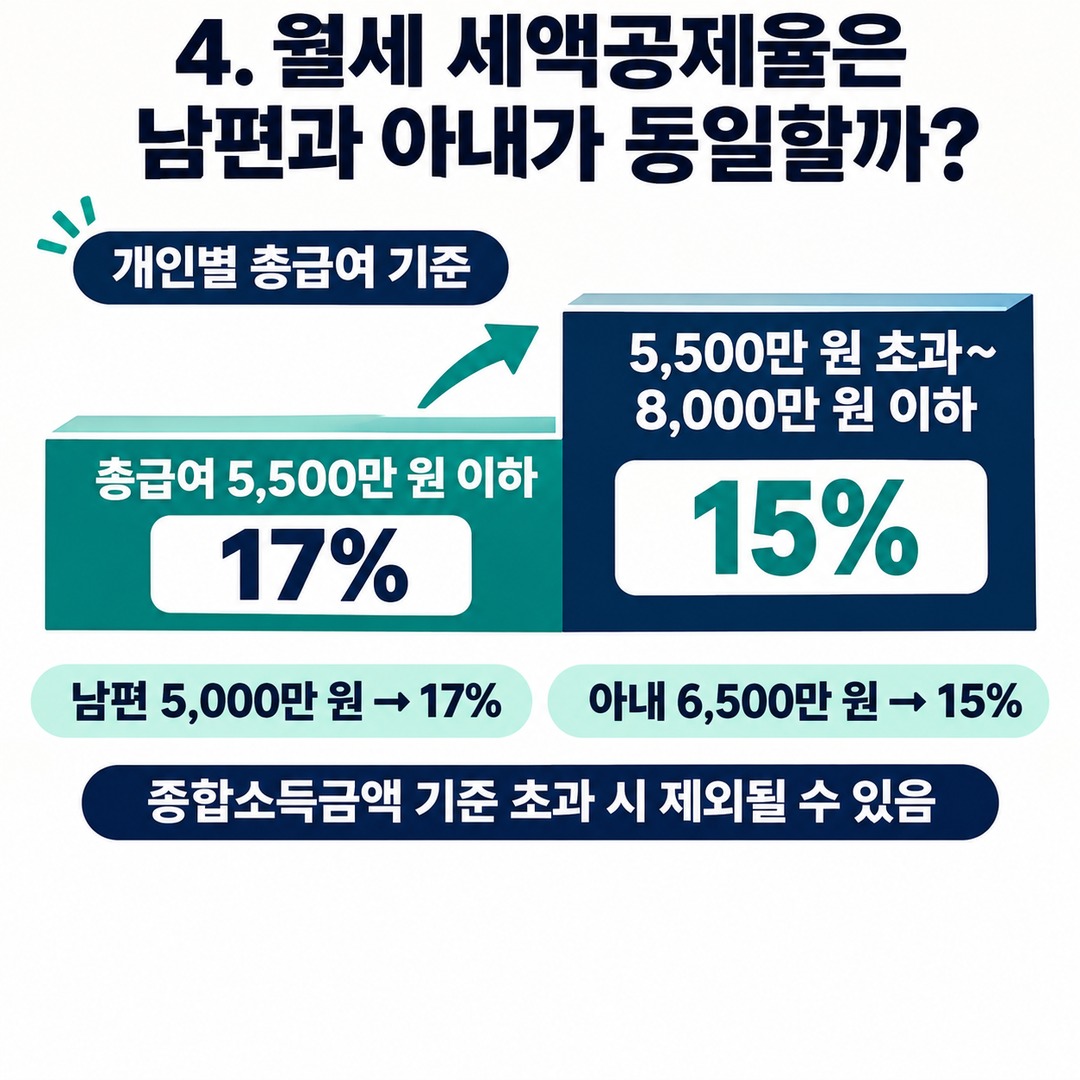
| Individual total salary | Tax credit rate |
|---|---|
| KRW 55,000,000 or less | 17% |
| More than KRW 55,000,000 and no more than KRW 80,000,000 | 15% |
However, there are conditions that exclude a person from eligibility if their comprehensive income amount exceeds KRW 45,000,000 or KRW 70,000,000, respectively.
For example, if the husband’s total salary is KRW 50,000,000 and the wife’s is KRW 65,000,000, eligibility for 17% for the husband and 15% for the wife is assessed separately.
Checking whether the couple’s combined rent is within KRW 10,000,000 and checking each spouse’s individual credit rate are separate steps.
Also, the calculated tax credit is not always the same as the actual refund. The final tax due may vary depending on each person’s calculated tax and other deductions. Statutory information + 1
5. What documents should you prepare before year-end tax settlement in 2026?
To qualify under the special provision for couples living apart for work, you must be able to show that each spouse actually paid rent and lived at the residence.
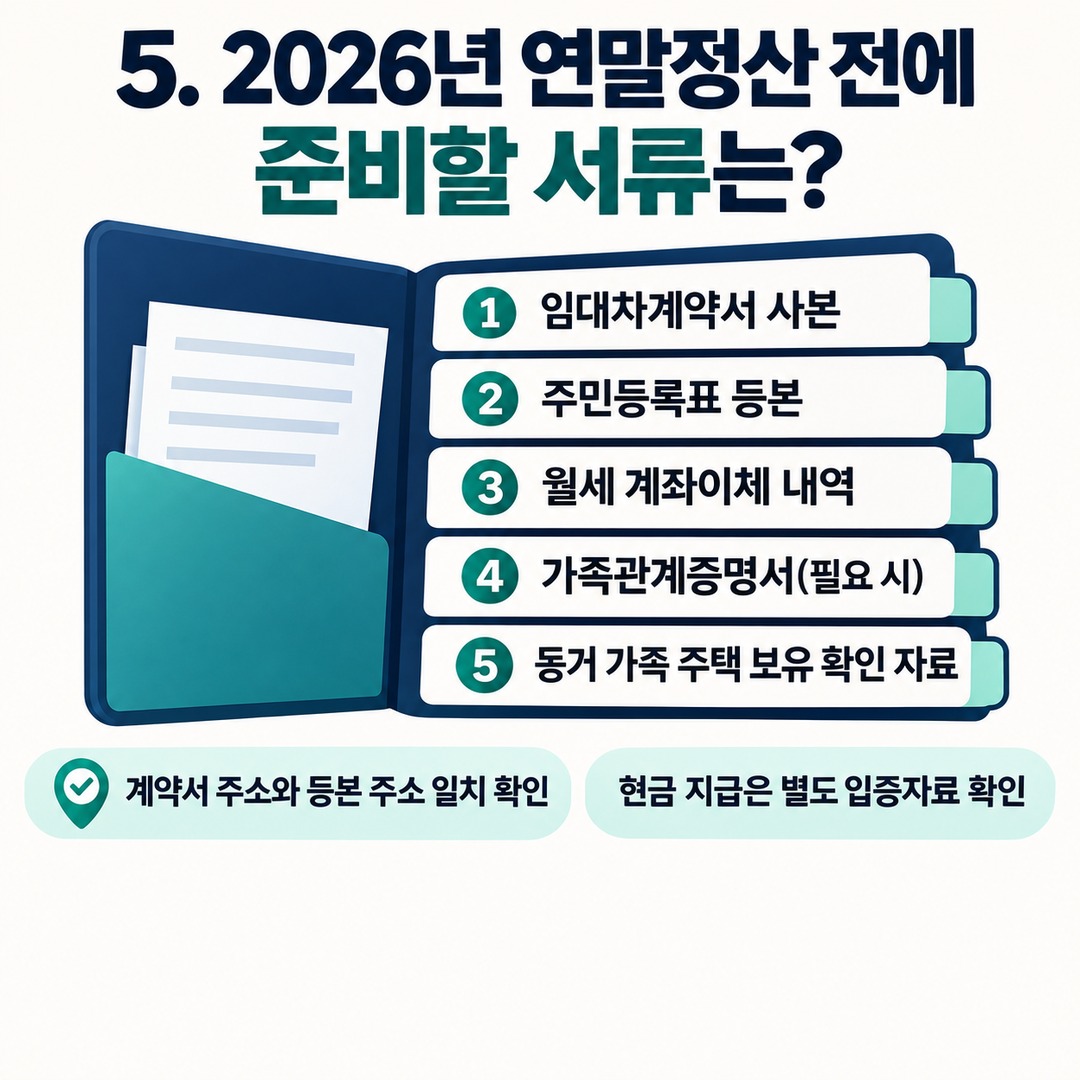
It is a good idea to prepare the following documents in advance.
1. A copy of each spouse’s lease
2. A copy of each spouse’s resident registration record
3. Bank transfer records showing rent payments to the landlord
4. A family relationship certificate, if needed to confirm family relationships
5. Documents confirming whether family members who live with the spouse own a home
In particular, check that the address on the lease matches the address on the resident registration record.
If rent was paid in cash, there may be no bank transfer records, so check separately for documents that can prove the payments were made.
It is a good idea to ask your company’s year-end tax settlement contact in advance whether you qualify for the special monthly rent tax credit provision for couples living apart for work in 2026.
6. These couples may have difficulty claiming the additional credit
Living at different addresses alone does not guarantee eligibility for the credit.
Pay particular attention to the following cases.
The spouses’ addresses are in different neighborhoods but within the same city, county, or district
The spouse’s total salary exceeds KRW 80,000,000
A legally designated family member living with the spouse owns a home
The address on the lease does not match the address on the resident registration record
The actual rent payments cannot be proven
The rental home does not meet the floor-area or officially assessed value requirements
As a rule, the home must be no larger than the national housing size limit or have an officially assessed value of no more than KRW 400,000,000. Residential officetels and goshiwons are also eligible if they meet certain requirements.
There is also a separate provision that expands the floor-area limit for families with multiple children, so check for exceptions based on the number of children.
7. When should you claim the 2026 monthly rent tax credit?
Rent paid on or after 2026-01-01 can be claimed through the year-end tax settlement for employment income attributable to 2026.
Rent paid in 2025 is not eligible under this special provision for couples living apart for work.
| Category | Applicable period |
|---|---|
| Special provision takes effect | 2026-01-01 |
| Eligible rent payments | Payments made from 2026 onward |
| Tax year | 2026 |
| Year-end tax settlement | Early 2027 |
| Combined limit for the couple | KRW 10,000,000 per year |
Therefore, if both spouses are paying rent during 2026, it is a good idea to organize the lease, registered addresses, and rent payment records before the end of the year.
Confirm final eligibility based on the National Tax Service’s year-end tax settlement guidance, Article 95-2 of the Restriction of Special Taxation Act, and Article 95 of its Enforcement Decree.
Frequently Asked Questions: Q. Can the wife qualify if the husband owns a home and only the wife rents?
No. The special provision for couples living apart for work requires both spouses to meet the no-homeownership condition. If either spouse owns a home, it is difficult to meet the general eligibility requirements.
Q. Can we qualify if we live in the same city but in different districts?
Possibly. The law looks at whether the addresses are in different cities, counties, or districts. Addresses in different autonomous districts may therefore meet the requirement even within the same special city.
Q. What happens if the couple’s combined rent exceeds KRW 10,000,000?
Any amount exceeding KRW 10,000,000 is excluded from the eligible amount. The head of household’s rent is counted first, and the excess is deducted from the spouse’s rent.
Q. Can rent paid in 2025 be claimed retroactively?
The newly introduced special provision for couples living apart for work applies to rent paid on or after 2026-01-01. The new provision cannot be applied retroactively to rent paid in 2025.
The most important change to the monthly rent tax credit for couples living apart for work in 2026 is that the spouse can now claim a separate credit.
However, if you overlook the combined annual limit of KRW 10,000,000 or the requirement to live in different cities, counties, or districts, you may receive less than you expected.
If both spouses pay rent, check each person’s address, income, and homeownership status before year-end tax settlement.
※ This article provides information for understanding market trends and is not a recommendation to invest in any particular stock or asset. You are responsible for your own decisions and investments.