

Shin Dae-chul 'Thug' Comment Insult Case: Why Did the Supreme Court Send It Back With a View Toward Acquittal?
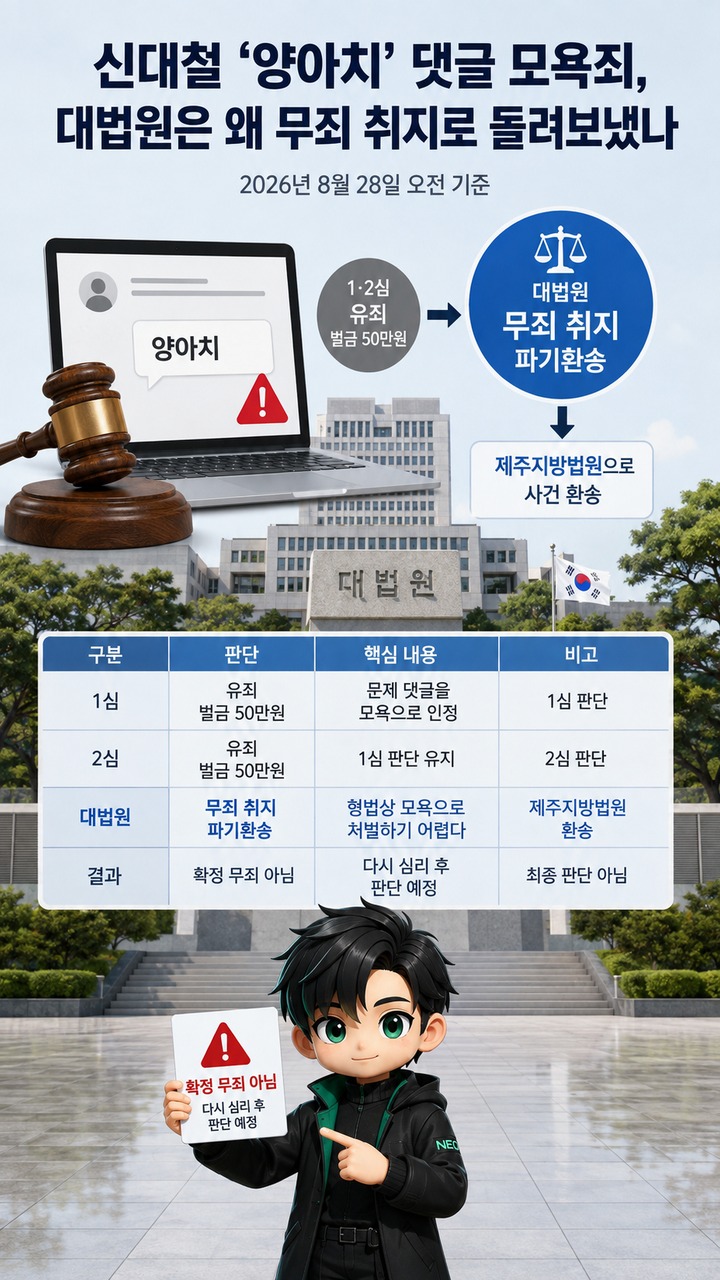
As of the morning of 2026-08-28, the Supreme Court had not issued a final, legally binding acquittal in the case involving a comment that used the term 'thug' to describe Shin Dae-chul. Instead, the Supreme Court overturned the guilty verdicts and fine of KRW 500,000 imposed by the 1 and 2 courts and sent the case back to the Jeju District Court. The ruling reversed and remanded the case with a view toward acquittal, finding that the comment in question was difficult to punish as criminal insult under the Criminal Act.

The important point about this ruling is that it does not mean the word 'thug' can never constitute criminal insult. Rather than judging a single word in isolation, the Supreme Court considered the circumstances surrounding the comment, its overall context, the severity of the language, and the nature of the debate at the time to determine whether criminal punishment was warranted.
What Comment About Shin Dae-chul Led to a Criminal Trial?
The case began with a comment posted on an internet news article in February 2022. At the time, an article reported that Shin Dae-chul of the rock band Sinawe had publicly expressed his position regarding a presidential election candidate. A person identified as Kim posted a comment on the article that included language referring to Shin Dae-chul as a 'thug.'
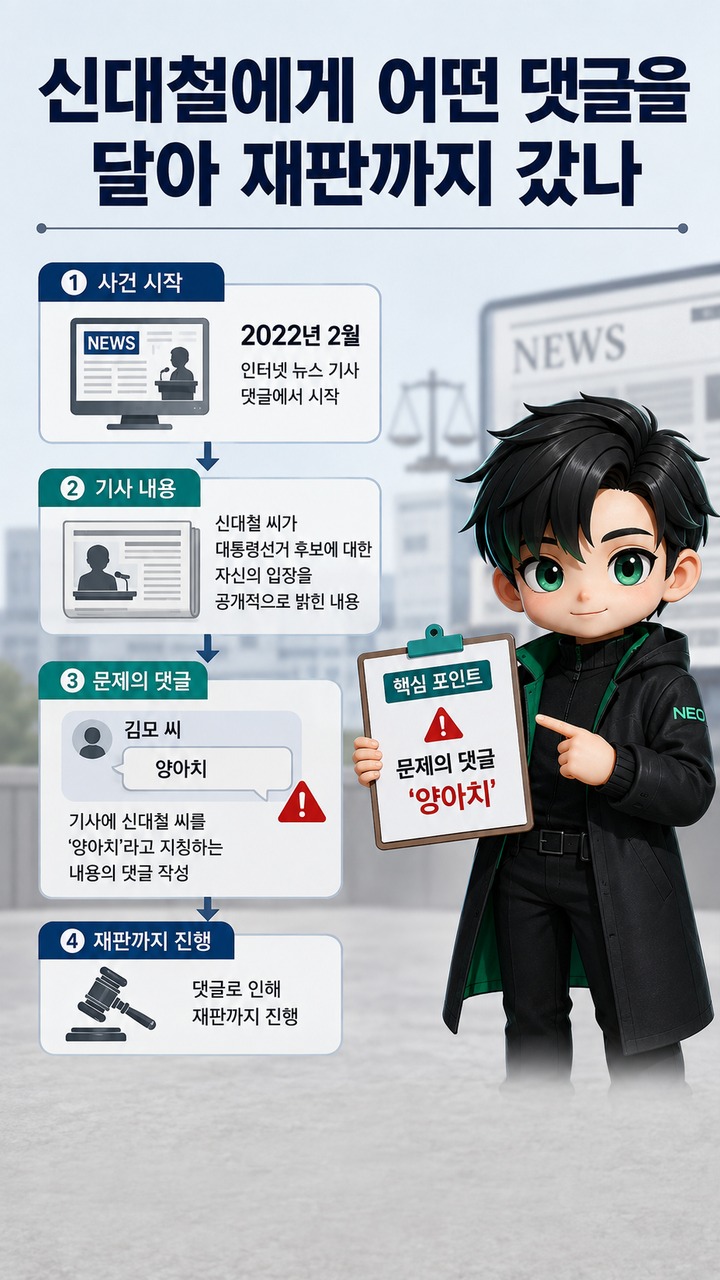
Prosecutors concluded that the comment constituted a public insult against Shin Dae-chul and indicted Kim.
The Jeju District Court, hearing the case at the 1 level, sentenced Kim to a fine of KRW 500,000 in July 2023. The court determined that the word 'thug' could be used to demean another person and constituted a contemptuous expression capable of lowering Shin Dae-chul's social standing.
Kim appealed, but the Jeju District Court at the 2 level upheld the 1 ruling in September of the same year. Up to that point, the courts had treated the 'thug' comment as criminal insult and returned guilty verdicts.
The Supreme Court, however, reached a different conclusion.
In its 2023Do13790 judgment delivered on 2026-07-16, the Supreme Court's 2 Division overturned the lower court's ruling and remanded the case to the Jeju District Court. In essence, it found that the 1 and 2 courts had interpreted the scope of criminal insult too broadly.
Therefore, as of 2026-08-28, the accurate description of the proceedings is that 'the Supreme Court reversed and remanded the case with a view toward acquittal.' Because the proceedings on remand have not yet concluded, simply describing the case as 'Shin Dae-chul thug case: acquittal finalized' would misrepresent its current procedural status.
Why the Supreme Court Did Not Judge the Word 'Thug' in Isolation
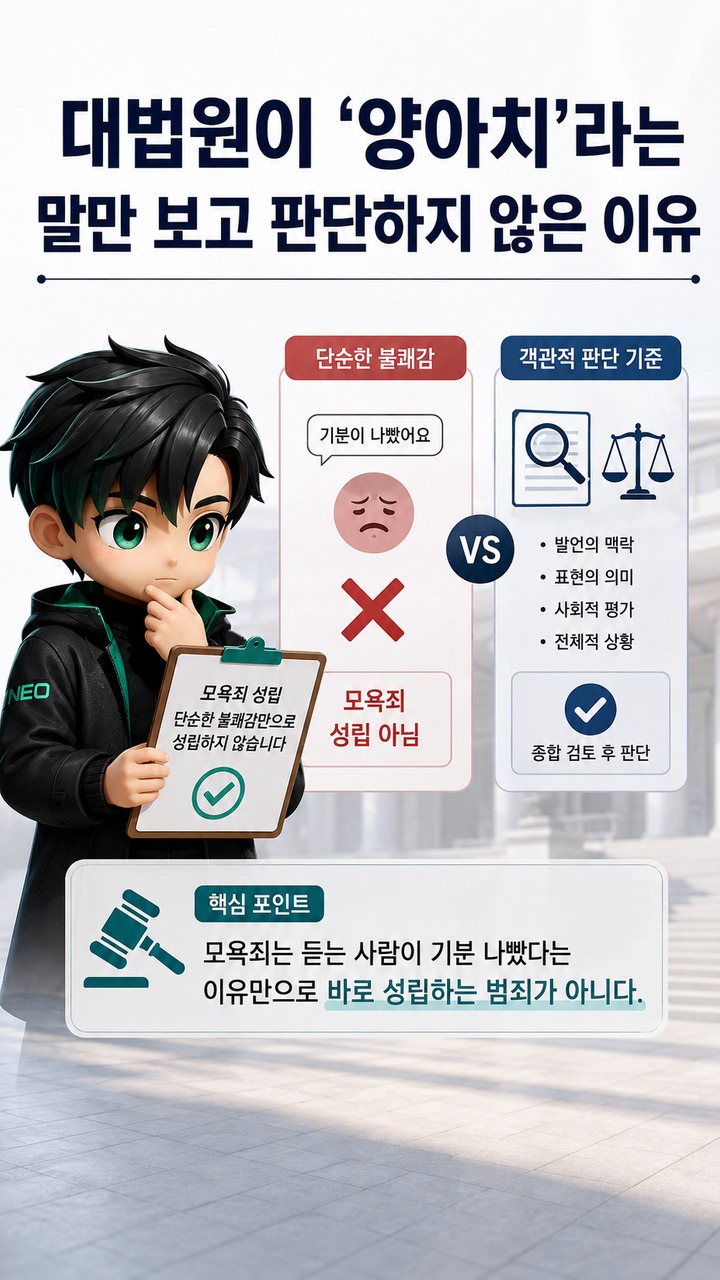
Criminal insult is not automatically established simply because someone feels offended by what another person says.
Article 311 of the Criminal Act provides for punishment when a person publicly insults another person. In this case, the Supreme Court again emphasized that the central question was not the individual's subjective sense of offense but whether the expression was serious enough to infringe upon the person's external reputation, meaning their standing in society.
That made the circumstances in which the disputed word was actually used more important than its dictionary definition alone.
The Supreme Court examined the content of the article on which the comment appeared, the circumstances that prompted the defendant to post it, and the overall meaning and severity of the language used. In particular, it considered that the expression appeared while the commenter was expressing a negative opinion about Shin Dae-chul's public position regarding a presidential candidate and the news coverage of that position.
The Supreme Court regarded the comment as closer to an unrefined expression of criticism or emotion than language severe enough to seriously damage the other person's dignity or character.
Ultimately, the legal assessment of the same word can differ depending on when, where, toward whom, and in what kind of debate it was used.
Where Did the 1 and 2 Courts Differ From the Supreme Court?
Both the 1 and 2 courts and the Supreme Court examined the case on the understanding that the word 'thug' itself could cause offense. The difference lay in whether the state should impose criminal punishment for an expression of that severity under the law on criminal insult.
The lower courts found that the expression was contemptuous and capable of diminishing Shin Dae-chul's social standing, and imposed a fine of KRW 500,000.
In this ruling, the Supreme Court also cautioned against isolating a single word from the comment.
It applied established legal principles governing criminal insult, which require courts to consider the overall meaning and context of the statement, the circumstances in which it was made, the nature of the forum where the debate occurred, and the relationship between the speaker and the person targeted.
Accordingly, the Supreme Court found that the lower court had misinterpreted the law by recognizing the comment as an insult under Article 311 of the Criminal Act, and overturned its judgment.
Does This Mean Calling Someone a 'Thug' Will No Longer Constitute Criminal Insult?
That conclusion would be too broad.
The Supreme Court's ruling did not establish a blanket exemption declaring that 'the word thug does not constitute criminal insult.' Its conclusion followed an examination of the entire comment, the article's content, the circumstances surrounding the exchange of political opinions, and the severity of the language.
Even when the same expression is used, the legal assessment may differ if it is directed repeatedly at a particular person, used without any meaningful context of debate solely to degrade someone's character, or combined with substantially more abusive language.
Applying the Supreme Court's criteria to actual online comments also means that it is difficult to create a simple list of offensive words and declare that some are acceptable while others are punishable.
In particular, several factors operate together when determining whether an expression constitutes criminal insult:
The meaning of the entire statement and its surrounding context
The circumstances that led to the expression being used
The severity of the expression and whether it was repeated
Whether it occurred during a public discussion or debate
The relationship between the speaker and the person targeted
Whether the expression was serious enough to infringe upon the other person's social standing
Therefore, interpreting this case as a ruling that people are free to insult specific individuals in internet comments would go beyond the scope of the Supreme Court's decision.
How Is a Reversal and Remand With a View Toward Acquittal Different From a Final Acquittal?
In this case, the Supreme Court did not directly issue a final acquittal. Instead, it overturned the lower court's judgment and returned the case to the Jeju District Court for reconsideration.
In criminal proceedings, reversal and remand is a procedure in which a higher court identifies a legal error in a lower court's decision, overturns that decision, and sends the case back for a new hearing.
In this case, the Supreme Court found a problem with the lower court's legal interpretation of the requirements for establishing criminal insult. The court hearing the case on remand will therefore reconsider it based on the legal interpretation provided by the Supreme Court.
This is why it is important to distinguish the case's actual procedural status, even if search results frequently use phrases such as 'Shin Dae-chul thug acquittal.'
1 and 2 courts: Guilty of criminal insult; fine of KRW 500,000
Supreme Court: Lower court judgment overturned; case remanded to the Jeju District Court with a view toward acquittal
Current status: Proceedings on remand remain pending, so the acquittal is not yet final
The significance of this case is not that the amount of the fine changed. Rather, the lower courts considered the same comment grounds for criminal punishment, while the Supreme Court determined that the legal elements of criminal insult must be applied more strictly.
The Key Legal Standards to Understand From This Ruling
When encountering harsh language online, it is difficult to determine whether it constitutes criminal insult based on a single word alone.
In this case, the Supreme Court applied its established legal principles requiring caution before imposing criminal punishment merely because a rude expression causes offense or a critical opinion contains mildly abusive language.
Conversely, this does not mean that all abusive language is permitted. Depending on the severity of the expression and its overall context, criminal insult may still be at issue if the language is considered serious enough to damage another person's social standing.
The central point established in the case involving Shin Dae-chul is straightforward. The Supreme Court did not create a universal legal-or-illegal classification for the word 'thug.' Instead, it determined that criminal insult was difficult to establish when considering the entire comment and the circumstances in which it was used.
Another important distinction is that criminal liability and the appropriateness of an expression are separate questions. A finding that an expression does not satisfy the legal elements of criminal insult does not mean that the language is socially appropriate or recommended.
※ This article is provided for reference purposes to help readers understand market trends and does not constitute investment advice concerning any particular stock or asset. Readers are responsible for their own final investment decisions and the associated risks.