

Samsung Electronics DS 10.5% Special Bonus: Could the Labor Ministry’s ‘N% Bonus’ Guidelines Invalidate the Existing Agreement?
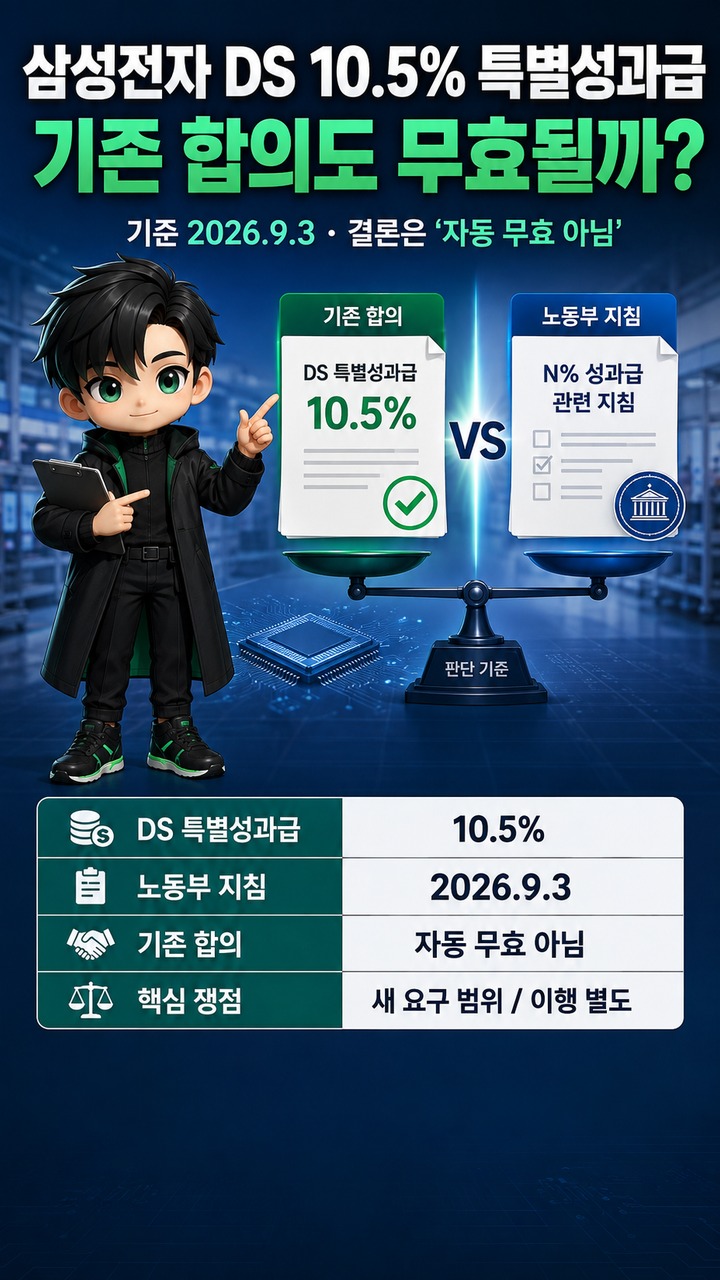
The bottom line is that the existing agreement between Samsung Electronics and its labor unions on the DS division’s 10.5% special management performance bonus will not automatically become invalid because of the Labor Ministry guidelines issued on 2026-09-03. The guidelines primarily define the scope of mandatory collective bargaining, mediation, and industrial action when workers newly demand a fixed percentage of corporate profits as bonuses. Whether an agreement already concluded must be implemented is a separate matter.
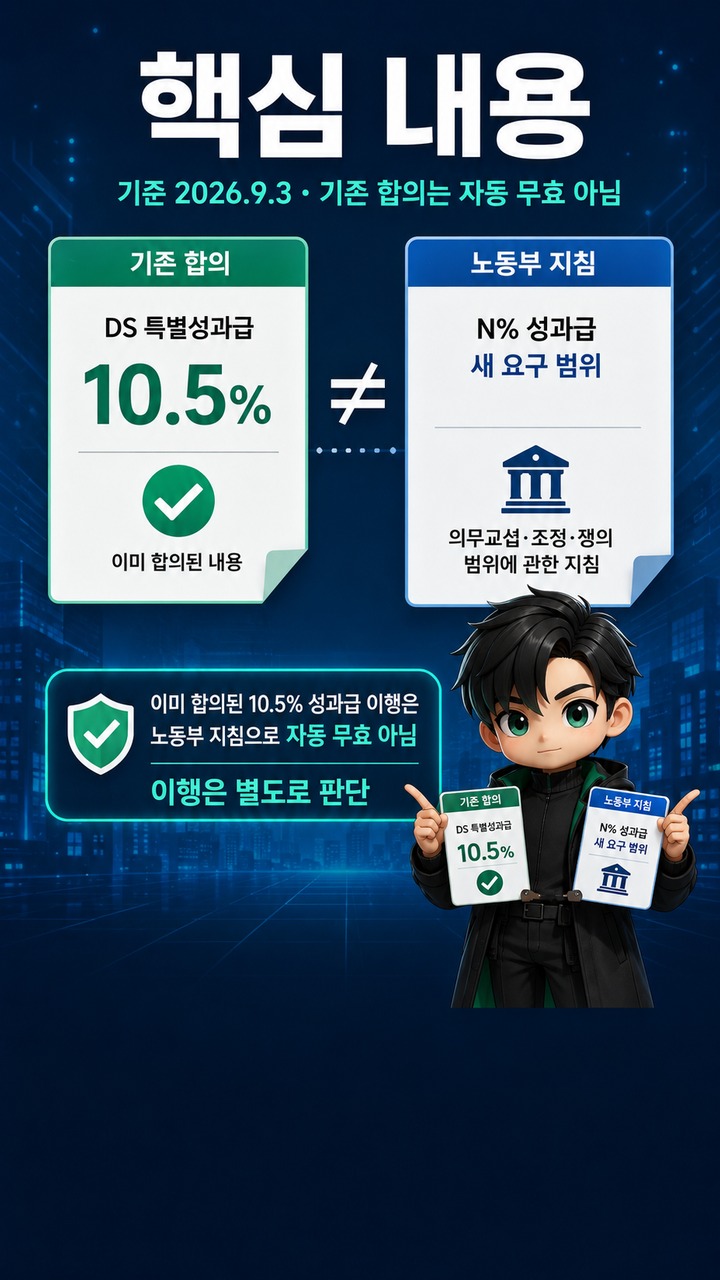
When examining Samsung Electronics’ performance bonus controversy, two questions therefore need to be considered separately.
“Can workers strike in the future to demand N% of operating profit?” and “Will the Samsung Electronics DS bonus that has already been agreed upon disappear?” are not the same issue.
The Labor Ministry Guidelines Do Not Ban N% Performance Bonuses Themselves
The central point of the Ministry of Employment and Labor’s 2026-09-03 announcement of its Guidelines on the Scope of Labor Disputes Involving Management Performance Bonuses is that demands to allocate a predetermined percentage of corporate profits, such as revenue, operating profit, or net income, to performance bonuses are difficult to classify as matters subject to mandatory collective bargaining.
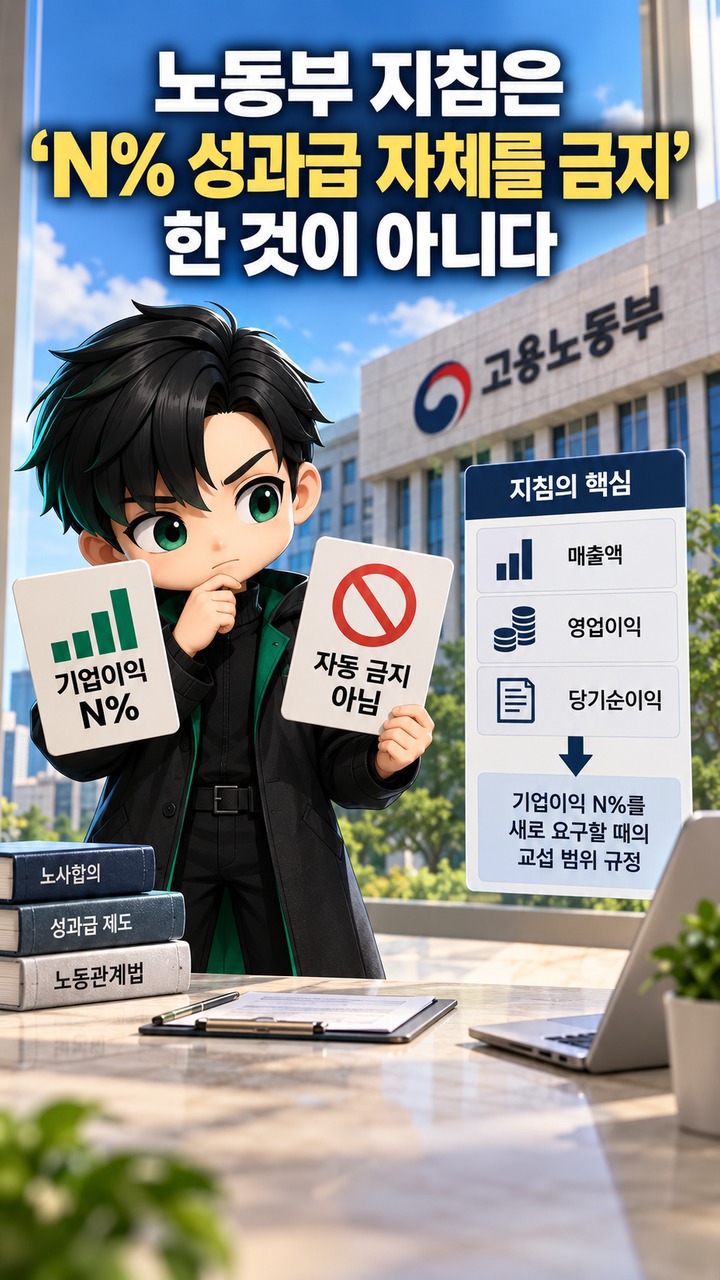
This is where much of the confusion arises.
The guidelines do not prohibit employers and unions from voluntarily negotiating N%-based performance bonuses. The Labor Ministry has also explained that voluntary discussions remain possible. What changes is whether a union can use mandatory bargaining obligations or industrial action under labor union law to enforce such a demand when an employer refuses it.
The distinction can be summarized as follows.
| Situation | Meaning of the New Guidelines |
|---|---|
| Employer and union voluntarily agree on an N% bonus | Permitted |
| Union makes a new demand for N% of operating profit | The demand itself is permitted |
| Employer rejects the N% demand | The refusal may not constitute a violation of mandatory bargaining obligations |
| Industrial action primarily intended to enforce the N% demand | Questions may arise about the legitimacy of the action |
| Agreement already concluded | Does not automatically expire because of the guidelines |
Therefore, interpreting the policy simply as an “N% bonus ban” would significantly overstate its actual scope.
Samsung Electronics DS 10.5% Bonus Agreement Was Already Concluded on May
At Samsung Electronics, the 2026 wage agreement was formally concluded on 2026-05-27, approximately 3 months before the new guidelines were announced.
After a tentative agreement was reached on May 20, union members voted on the proposal. It was approved with a voter turnout of 95.5% and an approval rate of 73.7%. Samsung Electronics also officially announced the signing of the wage agreement with its unions on the same day.
The agreement included the introduction of a special management performance bonus for the DS division, separate from the existing OPI system.
The funding pool for the special management performance bonus was agreed to be 10.5% of the business performance measure established by management and labor, with no cap on the payout rate. The agreement also established a distribution structure allocating 40% at the DS division level and 60% at the business unit level.
In other words, when the guidelines were announced on September, Samsung Electronics’ DS 10.5% bonus was not merely a proposal that the union intended to demand in future negotiations. It was already the subject of a concluded labor-management agreement.
Could the 10.5% Agreement Be Canceled Because of the September Guidelines?
It is difficult to interpret the new implementation guidelines as automatically invalidating an existing agreement.
The Ministry of Employment and Labor’s guidelines provide administrative criteria for determining which demands fall within mandatory collective bargaining, mediation, and industrial action under labor union law. Explanations surrounding the guidelines also confirm that they do not overturn the validity of existing collective agreements concluded before implementation, and questions about fulfilling existing agreements must be assessed separately.
Three distinctions are important here.
First, can the parties reach an agreement?
Employers and unions can voluntarily negotiate N%-based performance bonuses.
Second, can an agreement be compelled?
Following the new guidelines, it has become considerably more difficult to treat an employer’s refusal to accept a demand for N% of operating profit as grounds for mandatory bargaining or industrial action.
Third, must an agreement already concluded be fulfilled?
This question must be assessed separately based on the wording of the agreement, its validity period, payment conditions, and other relevant terms.
It would therefore be incorrect to conclude that Samsung Electronics’ DS bonus must also be canceled simply because the government has restricted the use of mandatory bargaining and industrial action to pursue N%-based bonuses.
Existing OPI Bonuses and the 10.5% Special Management Performance Bonus Are Not the Same Payment
Because news reports about Samsung Electronics’ performance bonuses frequently mention both OPI and 10.5%, it is easy to mistake them for a single system.
However, the 2026 agreement distinguishes the existing OPI system from the DS special management performance bonus.
OPI is Samsung’s existing performance bonus system, under which payments are determined by business unit performance and can reach up to 50% of an employee’s annual salary. For OPI payments made on January 2026 based on 2025 performance, the payout rates were 47% for the DS semiconductor division, 50% for MX, and 12% for certain DX business units.
By contrast, the DS special management performance bonus introduced under the 2026 labor-management agreement is a separate system based on 10.5% of the designated business performance funding pool.
Therefore, when analyzing Samsung Electronics’ future performance bonus expenses in relation to its financial results, investors should not simply add an OPI percentage to the DS business performance 10.5% funding rate as though they were the same type of percentage.
Investors Should Focus on Actual Expense Recognition Rather Than Whether 10.5% Disappears
For Samsung Electronics shareholders, the significance of the guidelines needs to be viewed somewhat differently.
The announcement does not automatically eliminate expenses associated with the DS special management performance bonus that has already been agreed upon. Conversely, it would also be inaccurate to assume that 10.5% of Samsung Electronics’ total operating profit will automatically be paid to employees every year simply because the agreement refers to 10.5% of business performance.
To assess the potential effects on the company’s share price and financial performance, investors should monitor the following factors.
1. The actual business performance measure used to calculate the special management performance bonus
2. Whether the payment conditions have been satisfied
3. The allocation method between the DS division and individual business units
4. Actual payment amounts and the timing of expense recognition
5. The impact of personnel expenses and one-time costs disclosed by Samsung Electronics in its quarterly and annual financial results
In particular, because bonus payments may increase as business performance improves, investors need to examine both the increase in operating profit and the corresponding increase in bonus expenses to determine how much of the improvement ultimately benefits shareholders.
What Will Change in Future Negotiations?
The guidelines are likely to have a more direct impact on new negotiations that have yet to begin than on Samsung Electronics’ 2026 agreement, which has already been concluded.
Instead of an N%-based formula directly linked to corporate profits, the Labor Ministry has suggested that employers and unions negotiate bonuses calculated as a fixed percentage of base pay or annual salary, fixed-amount bonuses, or payment criteria, timing, and eligibility that are not directly tied to a fixed percentage of corporate profits.
This means that even demands for bonuses of similar value may receive different legal treatment depending on the calculation formula.
For example, consider these two demands:
“Allocate 10% of operating profit to the performance bonus funding pool.”
“Pay 1000% of base salary as a performance bonus.”
Even if the resulting payment amounts are similar, the two demands may not be treated identically under the new guidelines. South Korean law firm Bae, Kim & Lee also analyzed that the funding source and calculation formula underlying a bonus demand have become more important than whether the payment is labeled a performance bonus.
Accordingly, future wage negotiations at Samsung Electronics, SK hynix, and companies in the automotive, shipbuilding, and IT industries may increasingly depend not only on how much workers demand in bonuses but also on how the bonus calculation formula is designed.
Key Conclusion on Samsung Electronics’ 10.5% Bonus
As of 2026-09-04, the conclusion is that Samsung Electronics’ existing agreement on the DS division’s 10.5% special management performance bonus does not automatically become invalid simply because the Labor Ministry has issued criteria indicating that N%-based bonuses linked to corporate profits are difficult to classify as matters subject to mandatory bargaining or industrial action.
The guidelines primarily address the circumstances under which future N%-based bonus demands can be pursued through collective bargaining and industrial action. The specific implementation of labor-management agreements already concluded must be assessed separately according to the terms of those agreements.
For Samsung Electronics investors, the more important figures to monitor are not merely 10.5% itself but the actual business performance measure used for calculation, the resulting payment amounts, and the extent to which those payments are reflected as expenses in Samsung Electronics’ profits and cash flow.
Related Articles
Domestic ETF Trading Value Halves: What Changed After Falling From 33 Trillion to 17 Trillion?