

MANGOS, Bug Bounties, and Continuation Vehicles: How to Understand Them as of August 2026
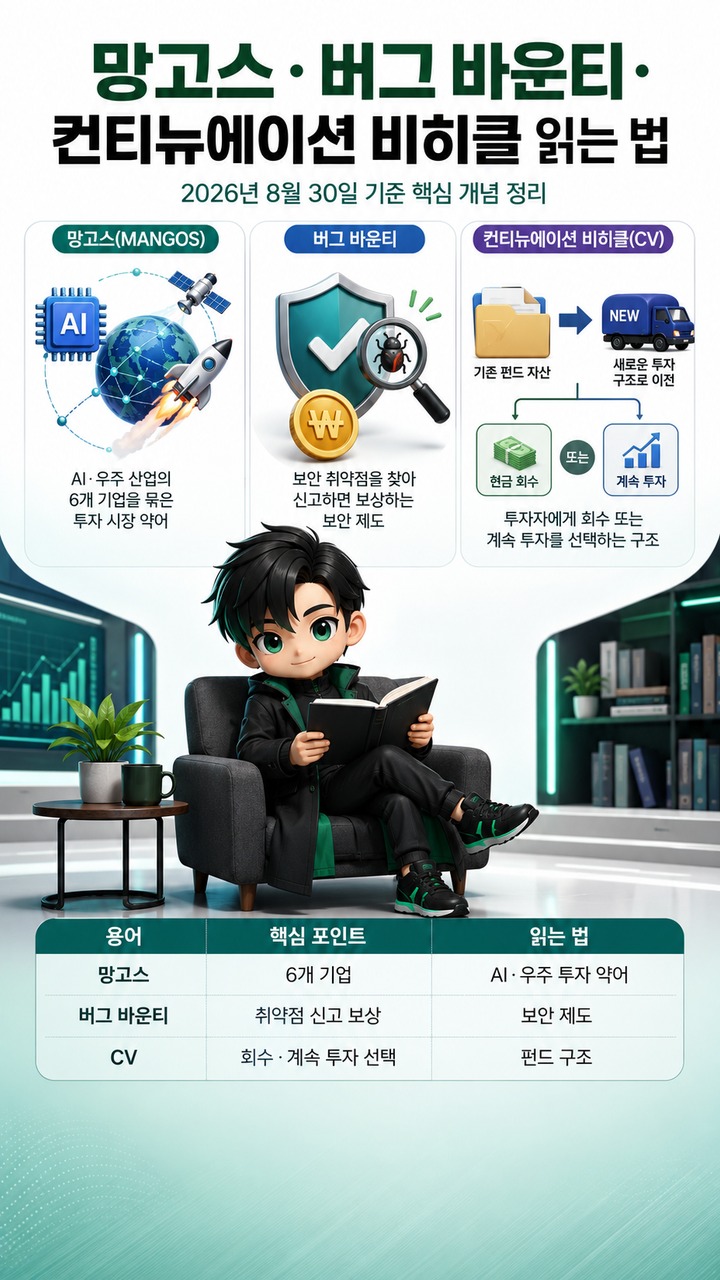
As of 2026-08-30, 'MANGOS' is an investment-market acronym grouping six companies in the AI and space industries, a 'bug bounty' is a program that rewards people for reporting security vulnerabilities, and a 'continuation vehicle (CV)' is a structure that transfers assets from an existing fund into a new investment vehicle, giving investors the option to cash out or continue investing. Although the names may be unfamiliar, each is a term that appears when trying to understand AI investing, cybersecurity, and capital recovery in private markets.
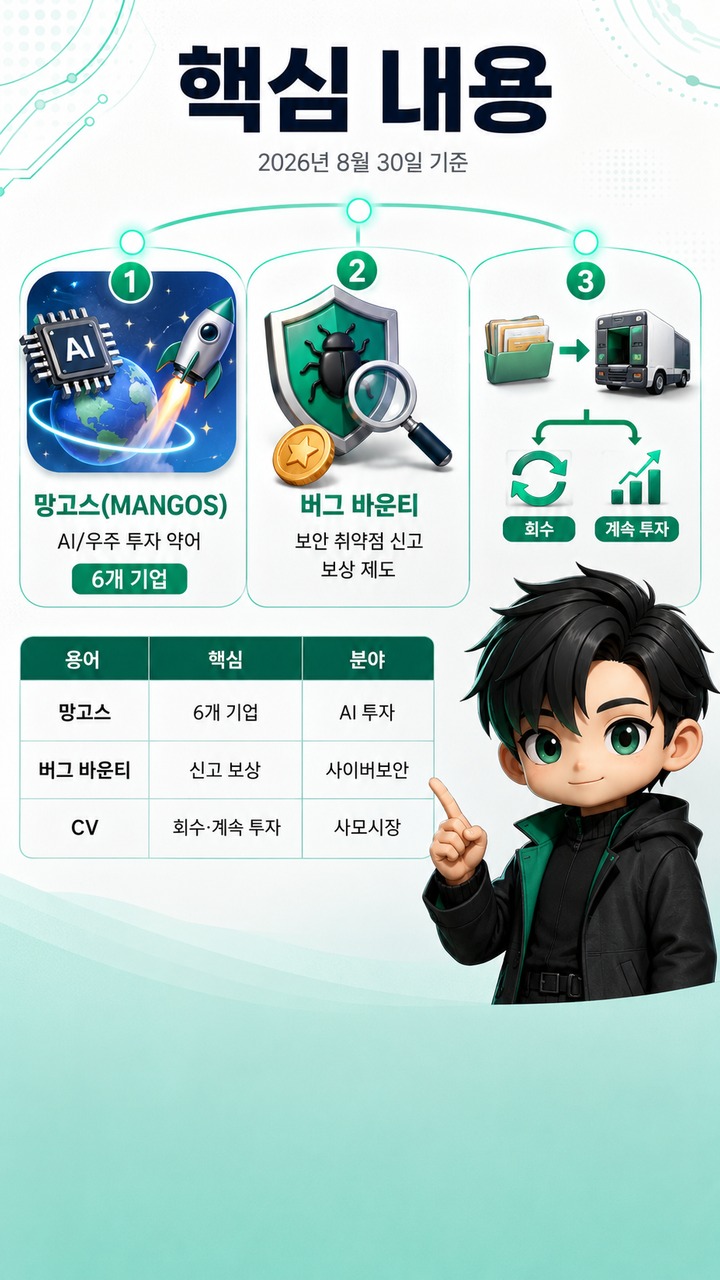
| Term | Main area of use | Simplest explanation | What to check as of 2026-08-30 |
|---|---|---|---|
| MANGOS | U.S. technology stocks and AI investing | A name grouping 6 AI-related companies | Related ETF registration developments and the IPO processes of OpenAI and Anthropic |
| Bug bounty | Cybersecurity | Find and report a vulnerability, then receive a reward after evaluation | The 2026 financial-sector focused reporting period runs through August 31 |
| Continuation vehicle (CV) | Private equity and private markets | Transfers existing assets into a new investment vehicle to extend their holding period | Valuation and conflict-of-interest management are the key issues |
Which Stocks Does MANGOS Refer To?
MANGOS is a collective name for Meta, Anthropic, NVIDIA, Alphabet (which owns Google), OpenAI, and SpaceX. Rather than referring to a single company or stock, it is more accurate to understand it as a market term formed from the English names of six companies.
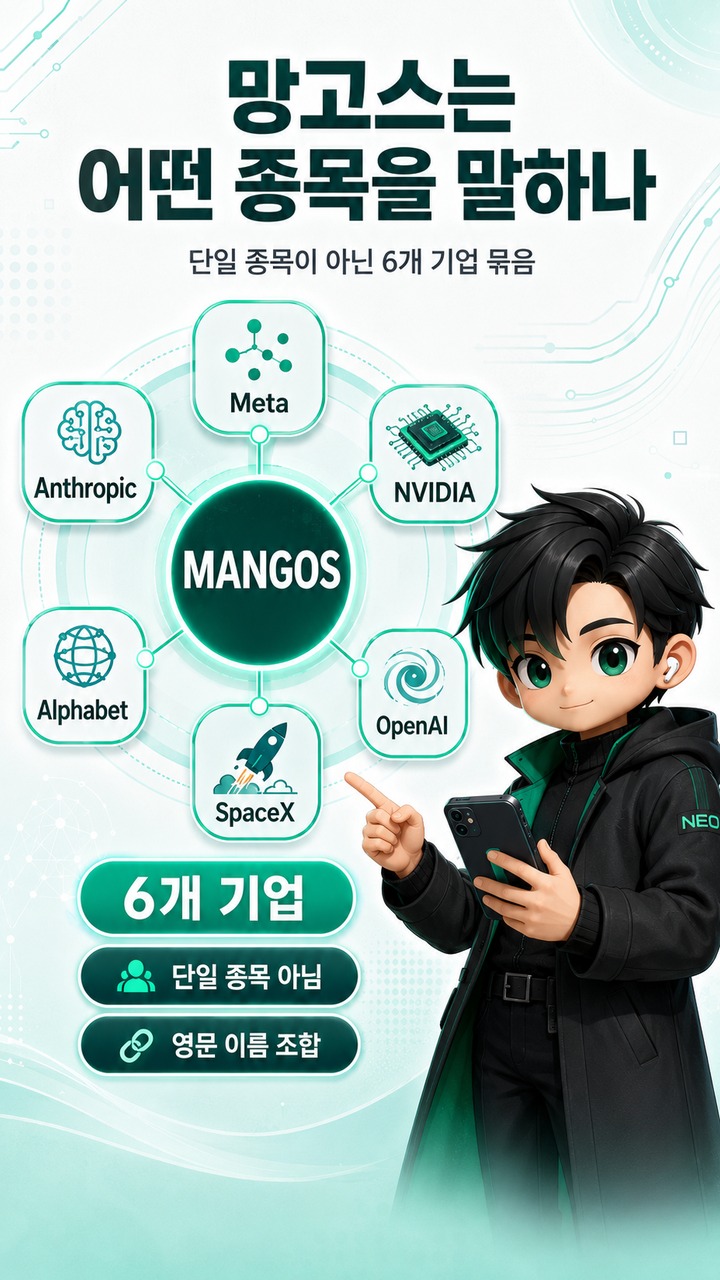
The acronym breaks down as follows.
M: Meta
A: Anthropic
N: NVIDIA
G: Google/Alphabet
O: OpenAI
S: SpaceX
The biggest difference from established groups such as FAANG or the Magnificent 7 is not simply the composition, but the idea of grouping AI model developers, AI semiconductor companies, platform businesses, and space infrastructure companies into a single investment theme.
Actual financial products are also being developed. Documents filed with the U.S. SEC for the Corgi MANGOS ETF explicitly identify these six businesses as the MANGOS Companies. The proposed fund structure calls for investing at least 80% of the fund's net assets, under normal market conditions, in shares of these companies or products providing related investment exposure.
There is one important point to keep in mind. Just because the name MANGOS is widely used does not mean investors can immediately purchase shares of all six companies as ordinary publicly traded stocks.
In the prospectus Corgi filed on June 15, Anthropic and OpenAI were described as companies that were not publicly traded at the time. The document explains that exposure to private companies may therefore be obtained through special purpose vehicles (SPVs), private investment structures, or similar arrangements.
Have OpenAI and Anthropic Already Gone Public?
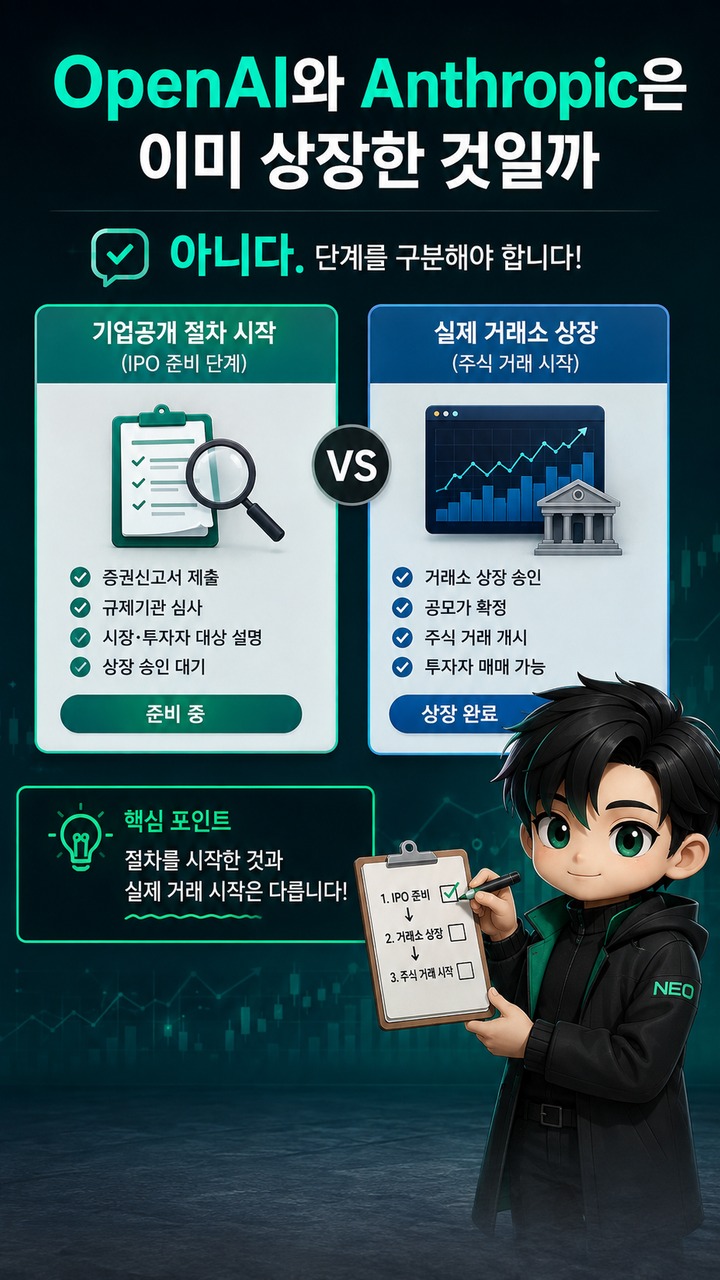
No. Beginning the initial public offering process and actually starting to trade shares on a stock exchange are two different things.
Anthropic directly announced that it had confidentially submitted a draft S-1 registration statement to the U.S. SEC for an initial public offering on 2026-06-01. The company explained that any actual offering would depend on market conditions and other factors, and that the number of shares to be offered and their price had not yet been determined.
OpenAI also announced on June 8 that it had confidentially submitted an S-1. However, OpenAI stated that it had not decided when to go public and that it still had priorities to pursue while remaining a private company, meaning an actual listing could take time.
Therefore, 'S-1 filing = immediate stock market listing' is the wrong interpretation. Filing an S-1 means that the process toward a U.S. stock market listing is underway. It is not an announcement confirming that trading will begin on a particular date.
MANGOS-related ETFs should be viewed in much the same way. The submission of product registration documents and the actual listing and trading commencement date are separate matters.
For example, SEC documents relating to the Defiance MANGOS ETF redesignated the effective date of a registration amendment from the originally scheduled 2026-08-22 to September 6. Because this date is also the effective date of registration documents, investors need to check the final prospectus and exchange information separately to determine whether the ETF is actually available for trading.
Does a Bug Bounty Mean You Can Hack Any System and Receive a Reward?
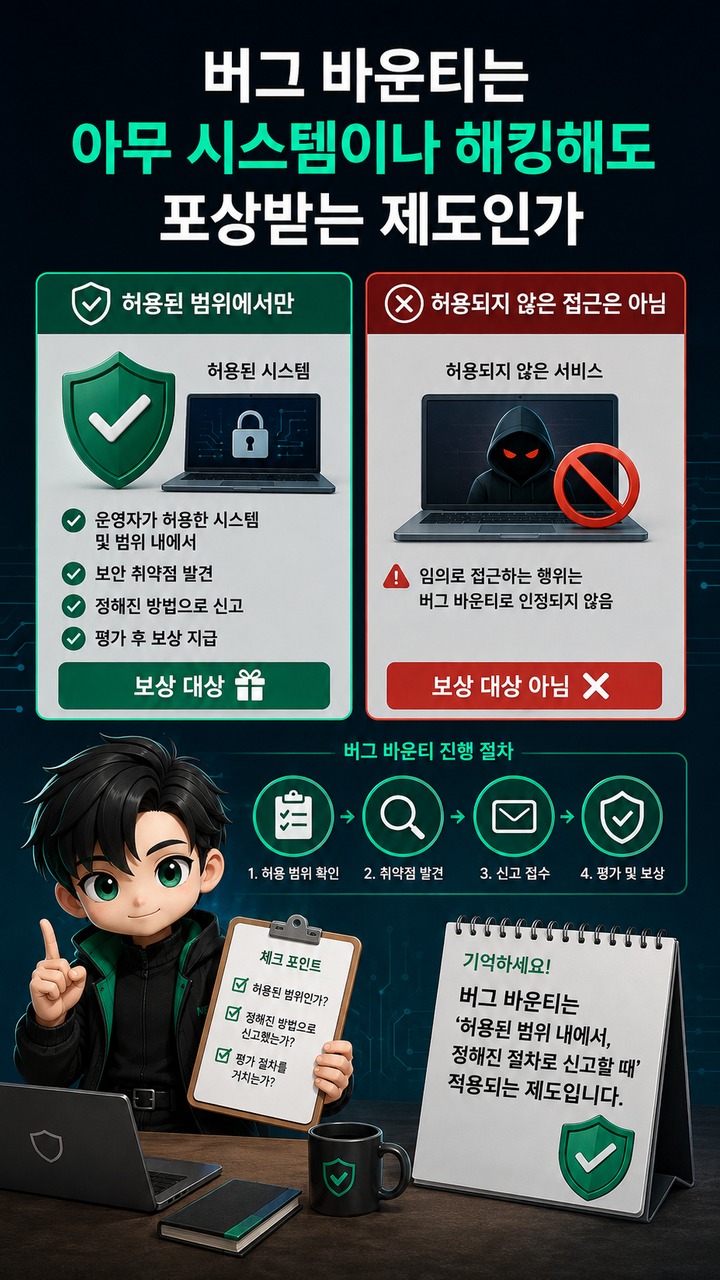
No. A bug bounty is a program in which participants identify security vulnerabilities within systems and boundaries authorized by the operator, report them through prescribed procedures, and receive rewards after evaluation. Unauthorized access to services outside the permitted scope does not qualify as legitimate bug bounty activity.
In South Korea, the 2026 financial-sector program provides a relatively straightforward example.
The 2026 financial-sector security vulnerability reporting and reward program, operated by the Financial Security Institute and the Financial Supervisory Service, identified 70 participating companies and a total of 306 digital financial services as eligible targets. Participation increased from 32 companies in the previous year to 70 companies, an increase of 119%. The scope expanded beyond banks, financial investment firms, and insurers to include virtual asset service providers and general agencies (GAs) in the insurance industry.
The 2026 financial-sector focused vulnerability reporting period runs from June 1 through August 31. As of August 30, the period was one day away from ending.
Applications to participate are also accepted through August 31. South Korean citizens can register as white-hat hackers on the Financial Security Institute's Financial Sector Software Supply Chain Security Platform and then apply to participate in the focused reporting program. Submitted vulnerabilities undergo evaluation and may qualify for rewards of up to KRW 10,000,000 per report.
What matters is not simply whether someone discovers a vulnerability. Participants must first verify which systems are eligible and what activities are permitted. A bug bounty does not grant unlimited authorization to attack systems. It is a structured process for identifying vulnerabilities within an operator-defined scope and reporting them responsibly.
How Is a Continuation Vehicle Different From Simply Extending an Existing Fund?
A continuation vehicle (CV) is a more active arrangement than simply extending the maturity of an existing fund. A common structure involves transferring assets held by an existing fund into a new investment vehicle and giving existing investors the opportunity to choose between receiving cash proceeds and continuing their investment.
Consider a simple example.
Suppose a general partner (GP) managing a private equity fund (PEF) holds Company A, but the existing fund is approaching the end of its term. Selling Company A to an outside buyer would allow the GP to return capital to existing limited partners (LPs). However, if the GP believes the company is worth holding longer, it may establish a new CV and transfer Company A into that vehicle.
In this process, existing LPs typically consider two options.
Investors who want cash proceeds can choose to exit their existing investment, while investors who want to maintain their holdings can continue investing through the new vehicle. The structure can also allow new investors to participate and provide liquidity to existing investors.
For fund managers, a CV therefore offers a way to extend the holding period of valuable assets. For investors, it can provide an exit option rather than requiring their capital to remain tied up for an extended period without a choice.
However, the convenience of the structure does not mean the interests of everyone involved are straightforward.
Why Valuation and Conflicts of Interest Matter So Much in CV Transactions
In a continuation vehicle transaction, the same GP may be involved with both the existing fund and the new investment vehicle. This makes it essential to assess whether the asset price is appropriate and whether existing LPs receive sufficient information and meaningful choices.
The Institutional Limited Partners Association (ILPA) also identified transaction process integrity, investor election procedures, conflict-of-interest management, valuation verification, and transparency as major priorities in its 2026 work to revise CV-related guidance.
This does not mean continuation vehicles are inherently problematic. They allow existing fund investors to recover capital while enabling the GP to continue investing in assets it holds. However, the price at which assets are transferred to the new vehicle can affect the interests of existing and new investors differently.
ILPA released a new draft of its CV guidance on June 2026 and completed public consultation on August 5. As of August 30, the organization indicated that the final guidance would be published later.
Continuation vehicles are not merely theoretical concepts, either. According to a August filing submitted to the U.S. SEC by BlackRock TCP Capital Corp., the company completed a transaction on August 4 involving a continuation vehicle containing approximately USD 523,000,000 in loans to 78 portfolio companies. It sold a 95% interest in the vehicle to investors managed by Pantheon Ventures while retaining 5%.
When encountering the term CV in financial news, it is more useful to look beyond simply 'extending a fund's term' and ask which assets are being transferred, who determines their value, and what choices existing LPs have between cashing out and continuing their investments.
The Simplest Way to Distinguish These Three Terms
MANGOS, bug bounties, and continuation vehicles are not directly connected programs or structures. They belong to different industries.
For MANGOS, the key question is 'Which companies are being grouped together?' It is an expression used to view Meta, Anthropic, NVIDIA, Alphabet, OpenAI, and SpaceX as a collective investment theme in the AI era.
For bug bounties, the key question is 'What activity is being rewarded?' They are security programs that reward participants, following evaluation, for discovering and reporting vulnerabilities in designated systems.
For continuation vehicles, the key question is 'How are investors' capital and assets carried forward?' They are private-market structures that transfer assets from an existing fund into a new investment vehicle, allowing different investors to choose between recovering their capital and continuing their investments.
As of 2026-08-30, the immediate developments to watch also differ across the three terms. For MANGOS, it is important to distinguish financial product registrations from the IPO processes of OpenAI and Anthropic. For financial-sector bug bounties, the key date to check is August 31, when the focused reporting period ends. For CVs, more important considerations than transaction size are how valuation verification, existing investors' choices, and conflict-of-interest management are structured.
※ This article is provided for informational purposes to help readers understand market developments and does not constitute an investment recommendation for any particular stock or asset. Final investment decisions and responsibility rest with each individual investor.
Related Articles
After Bitcoin Broke Through USD 80,000, Where Did the Money Supporting This Rebound Come From?