

Does Renominating a Supreme Court Justice Require a New Recommendation Committee? Can Existing Candidates Be Selected Again?

As of the morning of 2026-08-29, the law does not clearly specify whether the Chief Justice can select another candidate from the existing recommendation list or must establish a new Supreme Court Justice Candidate Recommendation Committee when making a new nomination. Under the current Court Organization Act, the committee must be formed whenever the Chief Justice nominates a Supreme Court justice candidate and is considered dissolved once it completes its recommendations. However, the law does not prescribe a separate procedure for situations in which the president declines to accept a nomination and requests a new one.
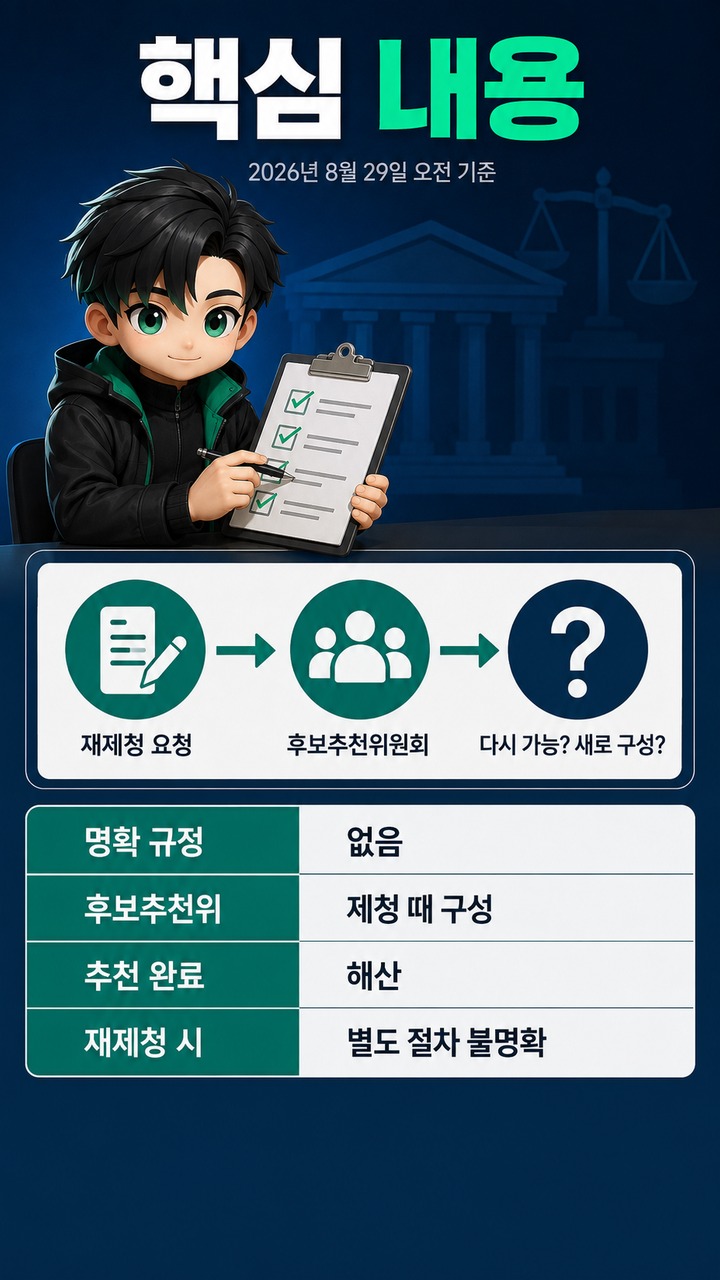
This is precisely the central issue in the current request for a new nomination following the nomination of Supreme Court justice candidate Son Bong-ki. The presidential office maintains that the Chief Justice should respect the recommendations of the existing committee and promptly submit a new nomination. Meanwhile, Chief Justice Cho Hee-dae plans to review the subsequent procedures and announce his official position next week.
How Are Supreme Court Justices Normally Appointed?
Supreme Court justices are not appointed through a process in which the president independently selects and appoints candidates. Article 104, Paragraph 2 of the Constitution of the Republic of Korea establishes the following structure: nomination by the Chief Justice → consent of the National Assembly → appointment by the president.

The Chief Justice also cannot simply nominate anyone without a preliminary process. Under the Court Organization Act, the Supreme Court Justice Candidate Recommendation Committee first reviews potential candidates and recommends at least 3 times as many candidates as the number of Supreme Court justice positions to be filled. The Chief Justice then selects the final nominee while giving due consideration to those recommendations.
The procedure can be summarized as follows.
Candidate proposals and screening → Supreme Court Justice Candidate Recommendation Committee recommendations → nomination by the Chief Justice → submission of an appointment consent motion to the National Assembly by the president → National Assembly confirmation hearing and consent → presidential appointment
Because Supreme Court justices are public officials whose appointments require National Assembly consent, an appointment consent motion submitted to the Assembly is subject to examination by a special confirmation hearing committee.
Can Another Candidate Be Selected From the Existing 3 Candidates?
At present, it cannot be definitively concluded either that this is permissible or that it is legally mandatory.
The Candidate Recommendation Committee convened on January 2026 to select a successor to former Supreme Court Justice Noh Tae-ak recommended 4 candidates: Kim Min-ki, Park Soon-young, Son Bong-ki, and Yoon Seong-sik. Chief Justice Cho Hee-dae subsequently nominated Son Bong-ki from among them on August 18.
Because the presidential office decided not to submit Son's appointment consent motion to the National Assembly, the remaining candidates on the existing recommendation list, excluding Son, are Kim Min-ki, Park Soon-young, and Yoon Seong-sik.
The presidential office has stated that Chief Justice Cho should respect the existing recommendations of the Supreme Court Justice Candidate Recommendation Committee and promptly proceed with a new nomination.
Accordingly, nominating another person from the existing recommendation list is the first option currently under discussion.
However, this does not mean it is the only legally permissible approach.
Could a New Candidate Recommendation Committee Be Established?
The second possibility is to establish a new Supreme Court Justice Candidate Recommendation Committee and restart the process from the candidate recommendation stage.

This is where the statutory language becomes ambiguous.
Article 41-2 of the Court Organization Act requires the Candidate Recommendation Committee to be formed each time the Chief Justice nominates a Supreme Court justice candidate. It also provides that the committee is deemed dissolved once it completes its candidate recommendations.
Under a literal reading of the law, the previous committee had already completed its duties and been dissolved after recommending 4 candidates on January.
However, the law contains no separate provision addressing the following situation.
What should happen if the Chief Justice has already nominated a candidate, but the president does not submit the appointment consent motion to the National Assembly and instead requests a new nomination?
The law does not explicitly state whether the existing candidate list may be reused or whether a new nomination must be treated as a separate nomination requiring the Candidate Recommendation Committee to be established again. This is why legal experts are divided between the two interpretations.
It would therefore be inaccurate to assume that a request for a new nomination automatically requires the recommendation committee to be reconstituted.
What Happened When Candidates Were Replaced in the Past?
There are historical cases that may appear similar, but they differ from the current situation.
In 2012, when Supreme Court justice candidate Kim Byung-hwa voluntarily withdrew during the National Assembly confirmation hearing process, a new Candidate Recommendation Committee was established and the selection process restarted from the candidate proposal stage. However, that case did not involve the president rejecting a nomination made by the Chief Justice. Instead, a candidate who had already been nominated withdrew voluntarily.
In the current case, Son Bong-ki did not withdraw during a confirmation hearing.
Rather, after Chief Justice Cho Hee-dae nominated Son, the presidential office decided not to submit his appointment consent motion to the National Assembly and requested the nomination of a different candidate. The presidential office has also stated that there has been no comparable case since the establishment of the current constitutional system in 1987.
For that reason, it is difficult to apply the 2012 precedent directly and conclude that a new recommendation committee must necessarily be established.
Must the Chief Justice Comply if the President Requests a New Nomination?
This question is also difficult to answer with a simple yes or no because the current law does not clearly prescribe the detailed procedure.
What the Constitution clearly establishes is that Supreme Court justices are appointed by the president with the consent of the National Assembly upon nomination by the Chief Justice. However, Article 104 of the Constitution does not separately specify the procedure for requesting a new nomination when the president declines to accept a nominated candidate, or how the Chief Justice must respond to such a request.
The presidential office maintains that the president's appointment authority includes substantive decision-making discretion. Conversely, some political figures and legal experts have raised constitutional questions concerning the scope of the president's ability to effectively reject a Chief Justice's nomination, as well as the Chief Justice's constitutional nomination authority and judicial independence.
This is why neither interpretation should be presented as a definitive legal conclusion at the current stage.
What Should Be Watched Next?
As of the morning of 2026-08-29, the most important development to monitor is which procedure Chief Justice Cho Hee-dae chooses.
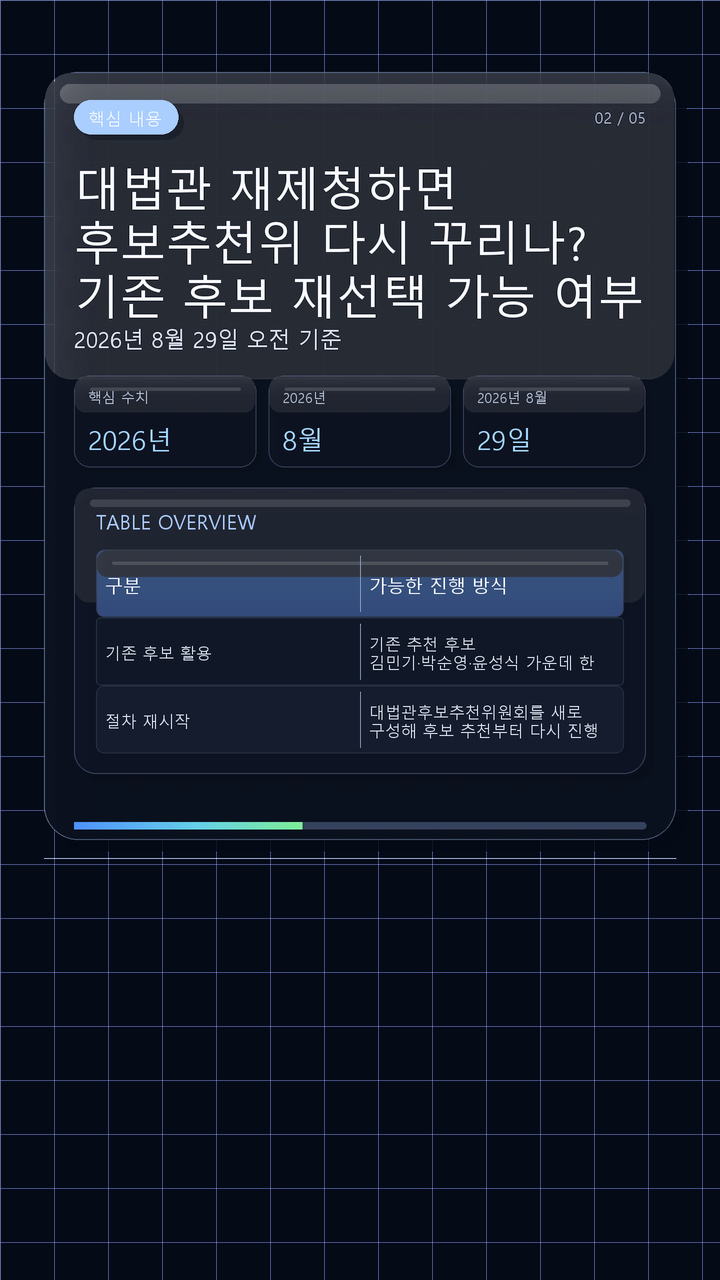
There are two main possible paths.
| Category | Possible Procedure |
|---|---|
| Use existing candidates | Nominate one of the previously recommended candidates: Kim Min-ki, Park Soon-young, or Yoon Seong-sik |
| Restart the process | Establish a new Supreme Court Justice Candidate Recommendation Committee and repeat the candidate recommendation process |
It has not yet been determined which approach will be taken. Chief Justice Cho is reviewing the presidential office's request for a new nomination and has stated that he will announce his official position next week.
Even if a new candidate is nominated, that person does not immediately become a Supreme Court justice. Once the president submits the candidate's appointment consent motion to the National Assembly, the candidate must undergo the Assembly's confirmation hearing and consent procedures. The process is completed only after the president formally appoints the candidate.
Therefore, rather than speculating about who the next nominee will be, the most important point is to verify whether an official decision has been made to use the existing recommendation list or restart the candidate recommendation process itself.
Key Points at a Glance
Supreme Court justices are selected through nomination by the Chief Justice, consent of the National Assembly, and appointment by the president.
The Supreme Court Justice Candidate Recommendation Committee recommends at least 3 times as many candidates as the number of Supreme Court justice positions to be filled.
The recommendation committee is deemed dissolved once it completes its candidate recommendations.
There is no separate statutory provision establishing a new nomination procedure following the president's rejection of a nomination.
It has not yet been determined whether another candidate from the existing recommendation list will be nominated or a new recommendation committee will be established.
The 4 candidates originally recommended to succeed former Supreme Court Justice Noh Tae-ak were Kim Min-ki, Park Soon-young, Son Bong-ki, and Yoon Seong-sik, and Son Bong-ki was nominated.
The presidential office is requesting a prompt new nomination that respects the existing recommendations.
Chief Justice Cho Hee-dae plans to review the subsequent procedures and announce his official position next week.
Related Articles
What Do Jin, Seon, Mi, Ye, and Jae Mean in Miss Korea? Do Ye and Jae Represent 4 and 5 Place?