If Dow Futures Fall, Will the Regular Session Fall Too? Why the Opening Direction and Closing Price Can Differ
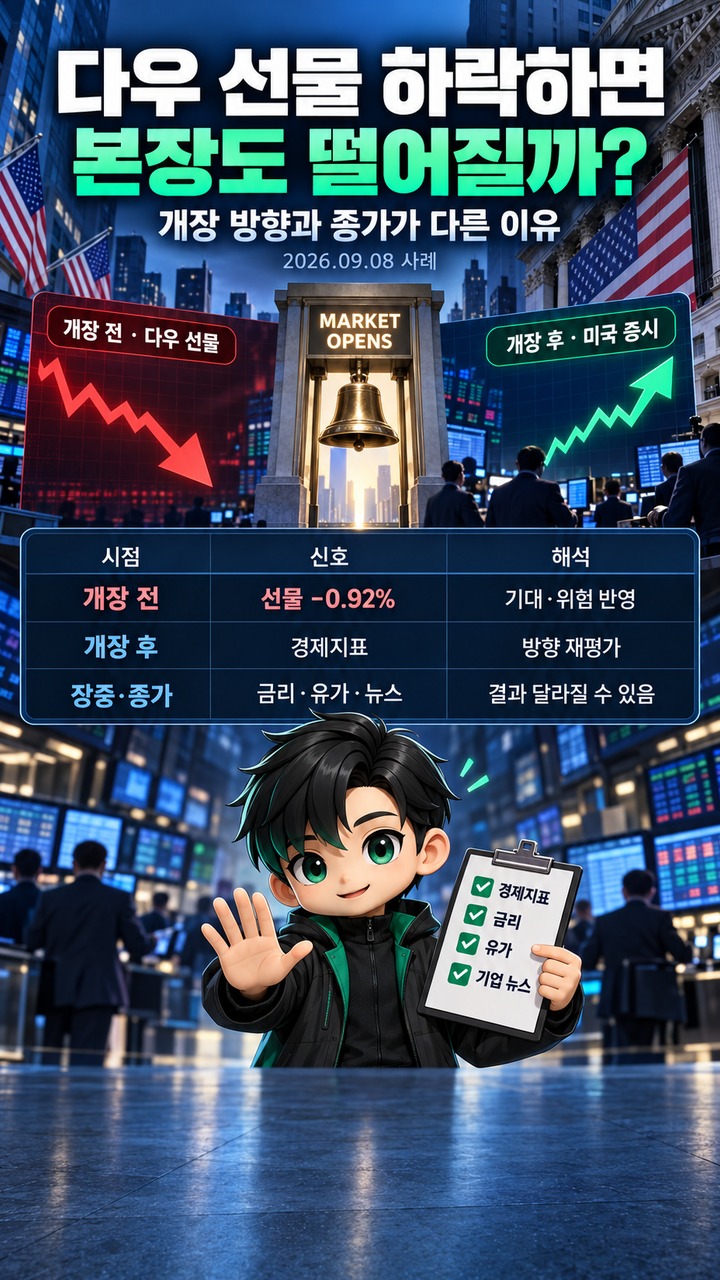
A decline in Dow futures does not necessarily mean that the regular U.S. stock market session will fall by the same amount or close lower. Futures are better understood as an indicator of the expectations and risks already priced in by the market before the regular session opens. Once trading begins, stock prices can change direction in response to economic data, interest rates, oil prices, corporate news, and other developments.

In fact, during European trading hours on 2026-09-08, Dow Jones futures fell approximately 0.92%, while the Dow Jones Industrial Average actually closed down 1.18% that day. Both moved in the same direction, but their declines were not identical.
Dow Futures Are Not the Dow Index Itself
The 'Dow futures' mentioned in financial news and the 'Dow index' quoted when the U.S. stock market is open are closely related, but they are not the same financial instrument.

The Dow Jones Industrial Average (DJIA) is a price-weighted stock index calculated using the share prices of 30 major U.S. blue-chip companies. E-mini Dow futures, by contrast, are derivative contracts based on that index and trade on CME for nearly the entire day.
Here is a simple comparison.
| Category | Dow Futures | Dow Jones Industrial Average |
|---|---|---|
| Nature | Futures contracts based on the index | Stock index comprising 30 major U.S. blue-chip companies |
| Representative instrument | E-mini Dow, YM | DJIA |
| Trading | Trading for nearly 24 hours | Primarily during regular U.S. cash market hours |
| Main function | Reflecting market expectations before the opening bell | Reflecting actual movements in constituent stocks |
Therefore, if Dow futures show -1% in the morning, that should not be interpreted as meaning 'the Dow index will finish today at -1%.'
If Dow Futures Fall, Is the Regular Session More Likely to Open Lower?
If futures remain sharply lower immediately before the U.S. stock market opens, they can serve as a reference point for assessing whether the regular session is likely to open below the previous closing level.
That is because futures continue trading while the U.S. cash market is closed. Information emerging overnight, including developments in the Middle East, oil prices, interest rates, economic indicators, and corporate earnings, can therefore be reflected in futures prices first. CME also describes equity index futures as instruments used to respond to major market-moving events and manage index exposure.
The important distinction, however, is that the direction of the market at the opening bell and its closing performance are entirely different questions.
For example, even if Dow futures are down -1% before the opening bell, the market could quickly recover some of those losses if newly released economic data exceed expectations or Treasury yields decline after trading begins.
Conversely, even if futures have fallen only -0.3%, additional negative developments after the opening bell could push the regular session down by -1% or more.
What Actually Happened on September 8?
On 2026-09-08, futures and the regular session both declined, but the figures differed.

During European trading hours, Dow futures were around 52,950, down 0.92%. High oil prices, tensions in the Middle East, inflation concerns, and interest rate worries were cited as major factors at the time.
Later, during the regular U.S. session, the Dow Jones Industrial Average closed at 52,786.07, down 1.18% from the previous trading session. The S&P500 fell 0.58%, while the Nasdaq Composite declined 0.32%.
In other words:
Pre-market futures -0.92% → Regular-session closing performance -1.18%
The difference between the two figures was 0.26% points.
This illustrates that Dow futures may provide clues about the likelihood of a decline during the regular session, but their movements do not directly predict the market's final daily decline.
Why Don't Futures at -0.92% and the Regular Session at -1.18% Match?
The main reason is that new information continues to emerge between the time futures prices are observed and the time the regular session's closing level is determined.
On September 8, movements in individual Dow components also affected the index, alongside rising oil prices and developments in the Middle East. Declines in companies such as Amgen and Salesforce placed considerable pressure on the Dow at the time.
Unlike the S&P500, which assigns greater weight to companies with larger market capitalizations, the Dow uses a price-weighted methodology in which movements in higher-priced stocks have a relatively greater impact.
That is why the Dow, S&P500, and Nasdaq can move by different amounts on the same day.
Futures prices also reflect factors such as contract expiration, interest rates, and dividends, so futures prices and the underlying cash index do not always match exactly.
What Else Should You Check When Watching Dow Futures?
Rather than relying on Dow futures alone to assess the direction of the entire U.S. stock market, it is better to examine at least several additional indicators.
First, comparing S&P500 futures and Nasdaq100 futures makes it easier to determine whether selling pressure is concentrated in the Dow or reflects a broader decline across U.S. equities.
U.S. 10-year Treasury yields are also important. Rapidly rising market interest rates can put pressure on corporate valuations and financing costs, potentially affecting stock prices.
It is also worth monitoring WTI and Brent crude oil prices. On days like September 8, when surging oil prices intensify inflation concerns, the effects can spread to equities through changes in interest rate expectations. That day, Brent crude rose to its highest level in 6 weeks amid concerns about supply disruptions in the Middle East.
Finally, investors should check economic data released immediately before the opening bell and news involving Dow component companies. If new developments outweigh the factors that previously moved futures, the market's direction can change after the regular session begins.
Can Futures Be Positive Before the Open but the Regular Session Finish Negative?
Yes, that is possible.
Futures represent prices at a particular moment. Even if they rise in the morning as positive developments are priced in, market sentiment can change after the regular session opens if inflation comes in higher than expected, interest rates rise, corporate earnings deteriorate, or geopolitical news emerges.
The reverse is also possible.
Futures may fall sharply before the opening bell, only for the regular session to rebound as negative developments ease or economic indicators exceed expectations.
Therefore, the most appropriate way to interpret Dow futures is to use them to assess the direction in which market participants are currently pricing the upcoming U.S. stock market session.
They should not be treated as a forecast of where the market will close that day.
Why You Shouldn't Use a Decline in Futures as an Immediate Trading Signal
Futures provide a quick indication of market sentiment, but they are not signals that automatically determine whether investors should buy or sell.
On particularly volatile days, market direction can reverse within hours. Dow futures, S&P500 futures, and Nasdaq100 futures may even move in different directions.
On September 8, when Dow futures fell 0.92%, S&P500 futures declined 0.41% and Nasdaq100 futures dropped 0.24%, showing differences in the magnitude of their losses.
Even when the overall market is described as 'U.S. stocks falling,' the actual impact on individual investors can vary considerably depending on which sectors and stocks account for most of the decline.
The key is to distinguish between Dow futures as a pre-market reference indicator and regular-session stock prices as the outcome of actual trading.
※ This article is provided for informational purposes to help readers understand market movements. It is not an investment recommendation concerning any particular stock or asset. Investors are responsible for their own final decisions and investment outcomes.
Related Articles
Why Did Dow Jones Futures Fall 0.92% on September 8?