

How Many Years of National Pension Old-Age Benefits Can You Receive If You Claim Late? Understanding the 5-Year Retroactive Payment Rule
You can still claim National Pension old-age benefits after reaching the eligible age, but this does not mean all previously unpaid benefits will be paid without any time limit. As of 2026-08-29, the National Pension Service (NPS) explains that people who file late claims can receive old-age pension payments covering the most recent 5 years, calculated backward from the claim date.
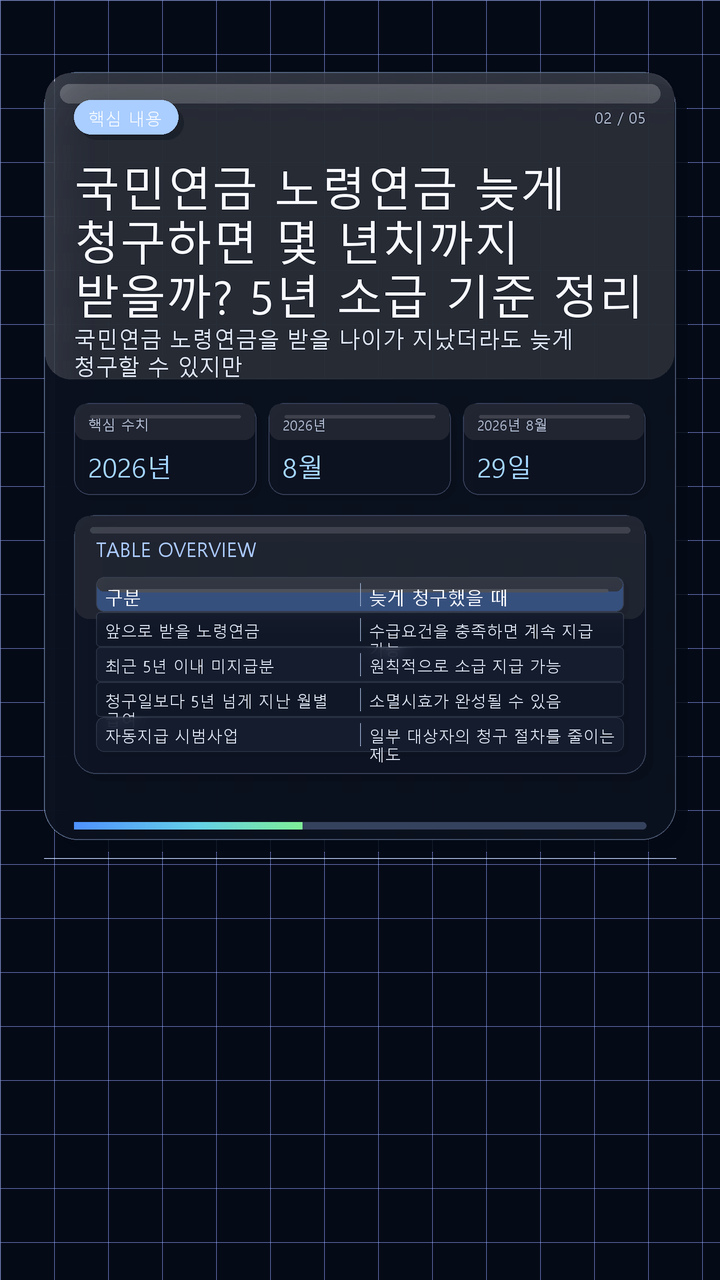
A pilot program for automatic old-age pension payments is scheduled to begin in September 2026 for certain individuals whose eligibility is clearly established. However, this should not be interpreted as meaning that all previously unclaimed pension payments will be restored without any time limit. According to currently available NPS guidance, the existing 5-year statute of limitations remains in effect separately.
If You Claim Your Old-Age Pension More Than 5 Years Late, Do You Lose Everything?
No, you do not lose everything. The most important distinction is between the underlying right to receive an old-age pension and the statute of limitations applying to individual monthly pension payments.
According to the National Pension Service, even if someone does not claim their old-age pension for a long time after becoming eligible, this does not necessarily mean their underlying right to receive future pension payments disappears entirely.
However, the statute of limitations applies to each monthly pension payment that has already become due. Therefore, when filing a late claim, you can generally receive payments corresponding to the 5 years preceding the claim date, but monthly benefits from earlier periods may no longer be recoverable.
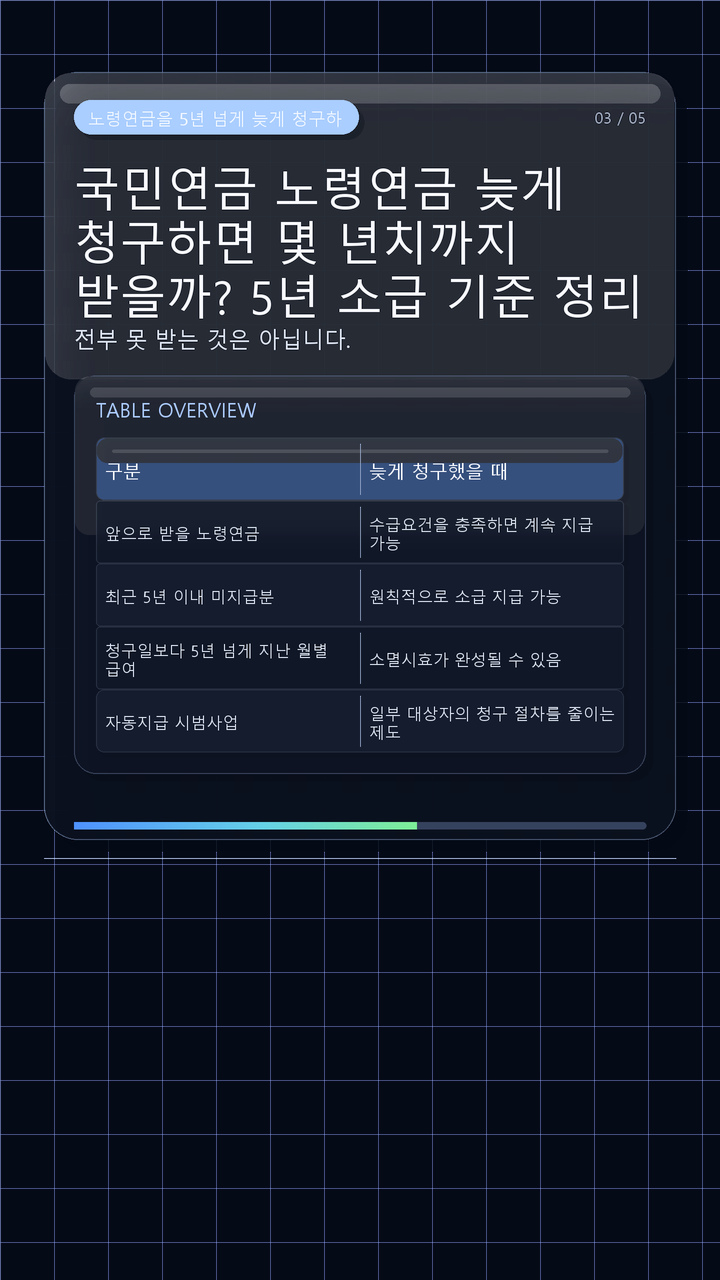
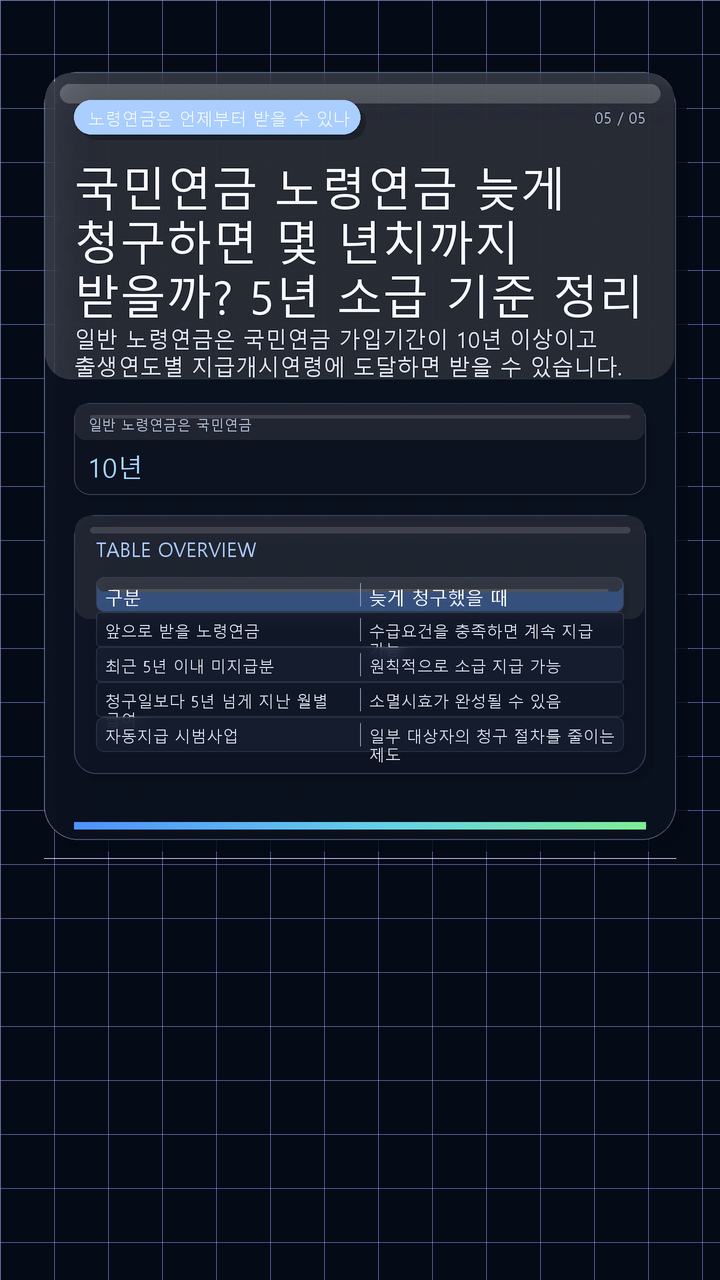
The distinction can be summarized as follows.
| Category | What Happens When You Claim Late |
|---|---|
| Future old-age pension payments | Payments can continue if eligibility requirements are met |
| Unpaid benefits from the most recent 5 years | Generally eligible for retroactive payment |
| Monthly benefits dating back more than 5 years before the claim date | May be barred by the statute of limitations |
| Automatic payment pilot program | A system designed to simplify the claims process for certain eligible individuals |
Therefore, neither of these statements is accurate: "Once 5 years have passed, you can never receive your National Pension in the future" or "You can claim at any time and receive every past pension payment."
How Are Payments Calculated If You Claim 6 Years Late?
An example provided by the National Pension Service makes the rule easier to understand.
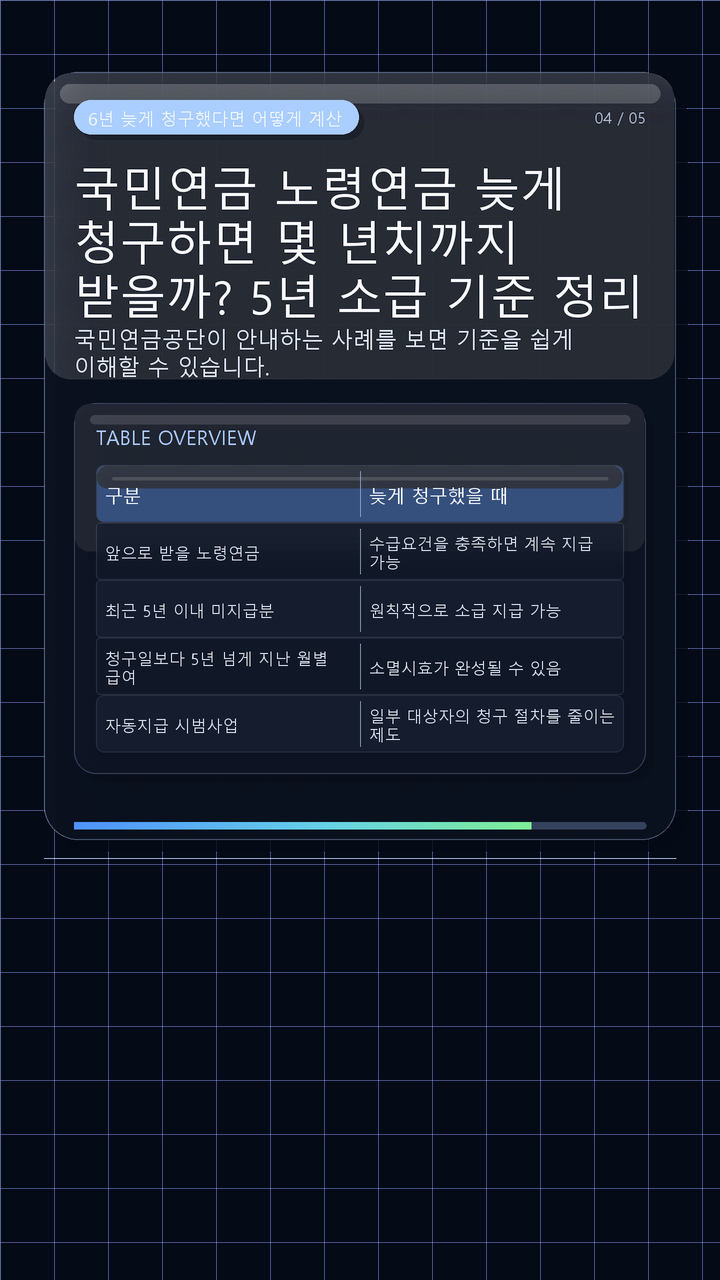
The NPS describes a case in which old-age pension eligibility arose in 2020-02-25, but the claim was not filed until 2026-06-02. In this example, the agency explains that benefits covering June 2021 through June 2026 are paid, corresponding to the most recent 5 years calculated backward from the claim date. Monthly pension payments then continue afterward.
In other words, rather than simply calculating that "a delay of 6 years means deducting 1 years of benefits," it is necessary to determine whether each monthly payment falls outside the 5-year period measured from the actual claim date.
For this reason, anyone who has already passed the eligible pension age but has not yet claimed their old-age pension should prioritize checking when their pension entitlement arose and whether a claim has been filed, rather than waiting for automatic payments to become available to more people.
When Can You Start Receiving an Old-Age Pension?
You can generally receive a National Pension old-age pension if you have contributed to the system for at least 10 years and have reached the pension commencement age applicable to your birth year. In principle, pension payments begin in the month following the month in which eligibility arises.
The standard old-age pension commencement ages by birth year are as follows.
| Birth Year | Old-Age Pension Commencement Age |
|---|---|
| Born 1953–1956 | 61 |
| Born 1957–1960 | 62 |
| Born 1961–1964 | 63 |
| Born 1965–1968 | 64 |
| Born in 1969 or later | 65 |
Therefore, you should not determine your eligibility based solely on your date of birth. You must also verify whether you have completed at least 10 years of pension coverage and when your pension entitlement actually arose.
Will All Previously Unclaimed Benefits Be Paid Automatically Once September Automatic Payments Begin?
That cannot be concluded from the information currently available to the public.
The automatic payment system beginning in September 2026 is not a program that will immediately convert every National Pension recipient to automatic payments. Instead, it is a pilot program initially targeting certain individuals whose eligibility is straightforward and clearly established, such as those with no unpaid pension contributions and no possibility of repaying a previously received lump-sum refund or making additional contributions for past periods. The program is expected to expand after its initial operating results are reviewed.
Therefore, people who have already passed their pension eligibility age by a considerable period but have not filed a claim should avoid simply waiting under the assumption that "starting in September, all my past pension payments will automatically be deposited."
In particular, the explanations released so far about automatic payments do not indicate that the existing 5-year statute of limitations will be abolished or that all unclaimed pension payments older than 5 years will be restored.
The safest approach is to treat automatic payment eligibility and the period for which past unclaimed benefits remain payable as two separate issues requiring confirmation.
What Should You Check First If You Have Not Yet Claimed Your Pension?
First, contact the National Pension Service to confirm whether you are eligible to file an old-age pension claim and the actual date on which your pension entitlement arose.
According to existing NPS guidance, old-age pension claims can be submitted through an NPS branch office, by mail or fax, through digital ARS, on the National Pension Service website, through Government24, or using the mobile app "National Pension by My Side." You can also receive assistance through the NPS customer service center at 1355.
The verification process is straightforward.
1. Check whether your National Pension coverage period is at least 10 years.
2. Confirm the old-age pension commencement age applicable to your birth year.
3. If you have already reached that age, check whether you have filed a claim.
4. If you have not filed a claim, verify when your pension entitlement arose and how far back retroactive payments may be available.
5. If you are unsure whether you qualify for automatic payments, contact the NPS for an individual eligibility check rather than waiting.
Additionally, if you still have options that could affect your pension coverage period or benefit amount, such as repaying a previously received lump-sum refund or making additional contributions for past periods, your automatic payment eligibility may not be straightforward and should be checked individually. During the actual old-age pension processing procedure, the NPS also reviews eligibility and contribution collection records, including refunded contributions being repaid and additional contributions.
When Are Pension Payments Made?
Once old-age pension payments begin, the regular payment date is the 25 of each month. If the 25 falls on a Saturday or public holiday, payment is made on the preceding day.
Automatic payments represent a change that simplifies the claims process for certain individuals whose eligibility for an old-age pension is clearly established. However, for people who have already passed their pension eligibility age without filing a claim, the more important step is not simply waiting for automatic payments. It is confirming when their pension entitlement arose and which past pension payments they may still be entitled to receive.
Tags and Labels
National Pension, Old-Age Pension, National Pension Benefits, Old-Age Pension Claims, National Pension Statute of Limitations, Retroactive National Pension Payments, Automatic National Pension Payments, National Pension Eligibility Age