

Trump Administration Warns Apple Against Buying Chinese Memory Chips…How This Differs From an Actual Ban
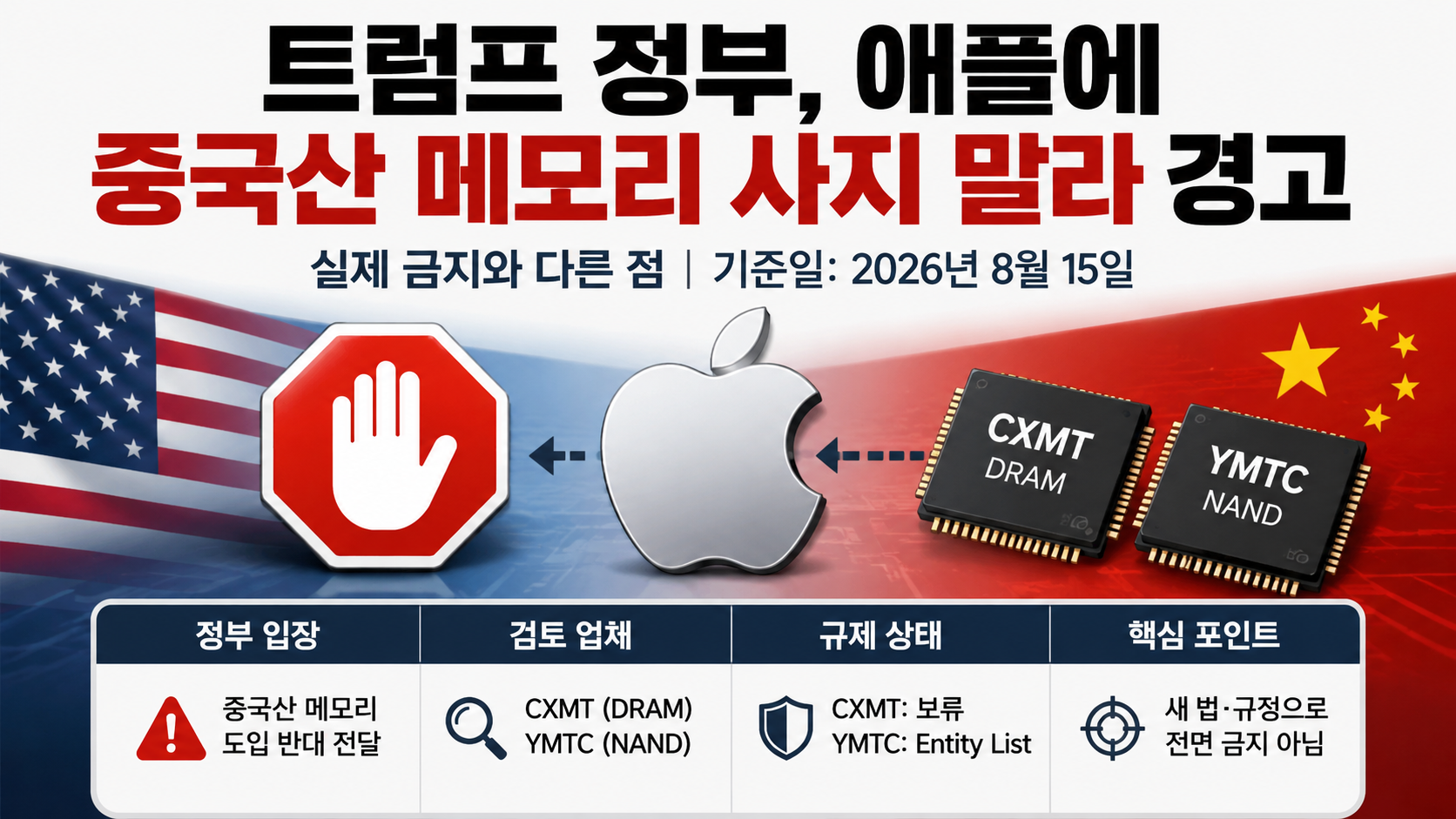
The Trump administration has directly intervened in Apple's consideration of Chinese-made memory chips. However, the key point as of 2026-08-15 is that it is too early to conclude that the U.S. government has imposed a blanket ban on Apple's purchases of Chinese memory through a new law or regulation.
The situation is better characterized as U.S. Commerce Secretary Howard Lutnick expressing opposition after Apple began considering Chinese memory suppliers. This issue should therefore be viewed not simply as a component purchasing decision, but as a supply chain challenge involving memory shortages and prices, U.S. semiconductor policy toward China, and efforts to strengthen domestic manufacturing.
What Exactly Did the U.S. Government Ask Apple to Do?
U.S. Commerce Secretary Howard Lutnick conveyed his opposition to Apple sourcing memory chips from China. The Chinese companies reportedly under consideration include DRAM manufacturer CXMT and NAND flash producer YMTC.
It is important to distinguish between a 'warning' and a 'legal prohibition.'
What has been confirmed is that the Trump administration is applying strong policy pressure on Apple not to choose Chinese memory suppliers. This is different from saying that a new, comprehensive ban covering all of Apple's purchases of Chinese memory has taken effect.
This distinction matters when assessing what happens next.
The matter could end with the administration's opposition alone. However, if it leads to additional export controls or transaction restrictions involving CXMT, or new regulations targeting Chinese-made memory, the range of suppliers Apple can realistically choose from could narrow further.
Pressure on Chinese memory supply chains is already building in the U.S. Congress. Lawmakers have pushed Apple to commit to avoiding CXMT and YMTC, while calls for tighter restrictions on Chinese memory manufacturers have continued.
At this stage, therefore, it is more accurate to understand the situation not as a simple sequence of 'Apple finalizes Chinese memory adoption → U.S. legally prohibits it,' but as an escalating process of 'Apple reviews its supply chain → Congress applies pressure → administration directly opposes the move.'
Why Was Apple Considering Chinese Memory in the First Place?
The most immediate reasons are memory supply shortages and rising costs.
As investment in AI data centers has surged, demand for high-performance memory has increased sharply, intensifying competition for memory manufacturers' production capacity. General-purpose memory used in smartphones and PCs is also unlikely to escape the effects of these supply conditions.
For a company like Apple, which manufactures iPhones, iPads, and Macs on a massive scale, changes in memory prices can significantly affect product costs. If supply is concentrated among a handful of major manufacturers, including Samsung Electronics, SK Hynix, and Micron, securing additional suppliers can be valuable for both price negotiations and supply stability.
This is where China's CXMT enters the picture.
CXMT is a Chinese memory manufacturer that produces DRAM. Apple has reportedly been testing whether CXMT products could be used in iPhones, MacBooks, and other devices, particularly in products sold in China.
Using Chinese-made memory in Apple products intended for the Chinese market could free up supplies from existing vendors for products sold in other regions. From Apple's perspective, Chinese memory may therefore serve not as a complete replacement for existing suppliers, but as an additional option to ease shortages and strengthen its purchasing leverage.
The U.S. government, however, sees supply chain security as a greater concern than price.
CXMT and YMTC Are Neither the Same Company Nor Subject to the Same Regulatory Status
This is one of the easiest aspects of the issue to misunderstand.
CXMT primarily produces DRAM. DRAM is the memory used by iPhones and computers to process data quickly while tasks are running.
YMTC focuses on NAND flash memory. NAND retains data even when power is turned off, making it useful for storage devices.
Their regulatory status in the United States also differs.
YMTC is already on the U.S. Commerce Department's Entity List. The Entity List identifies companies and other entities considered to pose concerns related to U.S. national security or foreign policy and imposes significant restrictions on exports or transfers of U.S. technology and products to them.
CXMT, by contrast, is considered a U.S. security concern, but reports in June 2026 indicated that the U.S. government was holding off on adding approximately 100 Chinese companies, including CXMT, to the Entity List.
It would therefore be inaccurate to say that 'CXMT and YMTC are both on the same U.S. Commerce Department blacklist, so Apple cannot buy their products.'
Being placed on a regulatory list also does not automatically mean that every company worldwide is prohibited from purchasing that company's products. Actual restrictions can vary depending on the specific list, the nature of the export or transfer, and the extent to which U.S. technology is involved.
That is why understanding this issue requires checking which regulatory list a company is on and whether the applicable restrictions actually prohibit purchases, rather than focusing solely on the company's name.
U.S. Opposition Is Not Just About National Security
The Trump administration's opposition reflects two overlapping priorities: national security and the promotion of American manufacturing.
U.S. policymakers have long expressed concern that growth in China's memory industry could bring China closer to semiconductor self-sufficiency while weakening the market positions of American and allied companies. Memory is particularly important because it is essential not only for smartphones and PCs, but also for data centers and AI infrastructure.
The implications become even greater when a major American company like Apple is the buyer.
If Apple formally adds Chinese manufacturers to its supply chain, the move could represent a significant milestone for those companies, extending beyond sales volumes to product qualification and market credibility. It could also influence sourcing decisions by other global companies.
The Trump administration's strong push to expand manufacturing in the United States is another important factor.
Apple is expanding its manufacturing investments in the United States. It is pursuing a plan to invest and spend USD 600,000,000,000 in the United States over 4 years, while preparing to expand Mac mini production in Houston following AI server manufacturing there. Programs to increase the production of semiconductors and essential components in the United States are also underway.
Against that backdrop, Apple's decision to turn to Chinese suppliers as a solution to memory shortages could directly conflict with the U.S. government's supply chain strategy.
This makes the dispute much bigger than simply deciding which company's memory chips go into an iPhone. Apple's pursuit of globally competitive costs and stable supplies is colliding with the U.S. government's goal of reducing dependence on China and expanding domestic manufacturing.
Would This Benefit Samsung Electronics and SK Hynix?
In the short term, making it harder for Chinese companies to enter Apple's supply chain could reduce competitive pressure on existing memory suppliers. However, it is premature to assume that this would automatically translate into higher earnings for Samsung Electronics and SK Hynix.
After all, Apple began considering CXMT precisely because of memory shortages and cost pressures.
If China is effectively removed as an additional supply source, Apple may need to secure more memory from its existing vendors. That could increase the strategic importance of established suppliers such as Samsung Electronics, SK Hynix, and U.S.-based Micron.
There are also factors that could work in the opposite direction.
Apple has enormous purchasing power worldwide. A smaller supplier pool does not necessarily mean memory manufacturers can obtain whatever prices they demand. Actual contract terms depend on long-term agreements, product specifications, production capacity, and delivery schedules.
It would also be unreasonable to assume that CXMT can immediately compete with Samsung Electronics and SK Hynix at the same level across every product category. China's manufacturers' production capacity, technological capabilities, and potential prioritization of domestic customers must also be considered.
Therefore, when evaluating the impact on South Korean memory manufacturers, it is better to examine three factors together rather than focusing solely on whether Chinese suppliers are excluded.
First, whether Apple actually abandons plans to adopt CXMT memory.
Second, whether Apple sources the additional memory it needs from Samsung Electronics, SK Hynix, or Micron.
Third, how long memory shortages and rising prices persist.
Only after these three conditions become clearer will it be possible to assess the scale of any actual benefits.
Could Apple Still Use Chinese Memory Despite U.S. Government Opposition?
As of 2026-08-15, Apple has not reached a confirmed final decision to adopt Chinese memory. Reports indicate that it has been testing CXMT products and evaluating potential supply arrangements, while political pressure from the U.S. government and Congress is increasing.
Being technically capable of using a component and deciding to purchase it in large quantities are separate matters.
Apple must first verify product performance and reliability. It must then assess production capacity, pricing, and the ability to maintain supplies over the long term. U.S. export controls and national security policies must also be taken into account.
The situation could change significantly if the U.S. government tightens restrictions on CXMT in the future.
Apple's available options will depend on whether the current policy opposition develops into new legal restrictions and whether CXMT's regulatory status changes.
Conversely, if no additional restrictions are introduced, it remains possible that Apple will continue considering Chinese memory for products intended specifically for the Chinese market.
In other words, the most important question right now is not 'Has Apple bought Chinese memory?' but 'Will U.S. government opposition turn into regulations that actually block the transactions?'
The Most Important Developments to Watch Next
The first is Apple's official sourcing decision. There is a substantial difference between testing a component and actually adopting it, so the key is whether CXMT memory receives approval for mass-produced iPhones or Macs.
The second is any follow-up regulation from the U.S. government. Whether the administration's opposition leads to new export controls or transaction restrictions is the biggest variable in this issue.
The third is activity in the U.S. Congress. If demands to restrict the use of Chinese-made memory translate into administration policy or legislation, the consequences could extend beyond Apple to the supply chains of other American technology companies.
The fourth is the supply situation and memory prices at Samsung Electronics, SK Hynix, and Micron. If memory shortages persist while Apple is unable to use Chinese suppliers, the bargaining power of established major manufacturers could change.
Reducing this issue to 'The United States has stopped Apple from using Chinese semiconductors' would overlook important distinctions.
As of 2026-08-15, the confirmed development is that the U.S. administration has directly opposed Apple's consideration of Chinese suppliers as a way to address memory shortages. What remains unconfirmed is whether that pressure will lead to new regulations legally blocking Apple's purchases of Chinese memory.
Ultimately, the first thing to watch in subsequent news coverage is not Apple's explanation, but whether the U.S. government's regulatory treatment of CXMT actually changes. Only once that change is confirmed will it be possible to assess the implications for Apple's supply chain and for Samsung Electronics and SK Hynix with greater precision.