

CAN SLIM’s 8-Week Holding Rule: When Should You Sell if a Stock Rises 20% in Just 3 Weeks?

CAN SLIM has a general principle of taking profits when a stock rises 20~25% above its purchase price, as well as an exception that suggests considering a minimum 8-week holding period for stocks that surge 20% or more within 1~3 weeks of a breakout. However, this does not mean you must hold for 8 weeks no matter what. Market conditions, the stock’s quality, and signs of a sharp decline must also be considered.
After understanding the principle of limiting losses to 7~8%, the next thing to consider is what to do when profits come quickly. William O’Neil proposed the 8-week holding rule to help investors avoid selling some stocks with strong upward momentum too early.
Under what conditions does the CAN SLIM 8-week holding rule apply?
The 8-week holding rule is not a general long-term investing principle for every stock. It is an exception intended to help investors avoid missing a major gain by being shaken out by a temporary pullback when a stock breaks out from a proper buy point and rises strongly in a short time.

In an article William O’Neil contributed to AAII in 2004, he set out three conditions:
1. The overall market must be in a bull market.
2. The stock must be a market leader, with strong earnings and growth, institutional sponsorship, and a competitive industry group.
3. After breaking out of a proper chart pattern, it must rise 20% or more on increased volume within 1~3 weeks.
When all three conditions are met, consider holding the stock for at least 8 weeks from the breakout buy point.
The key point is that the rule does not apply simply because a stock has risen 20%.
It is difficult to judge by the same standard when a stock with weak earnings or one that has lost market leadership surges over a short period.
How do taking profits at 20% and holding for 8 weeks differ?
The two rules do not contradict each other; they apply to different stocks.

For a typical growth stock, consider taking some or most of the profit when it rises 20~25% above the purchase price. By contrast, for an exceptional stock showing strong upward momentum, the 8-week holding rule can help assess its potential for further gains.
| Category | Typical profit-taking | 8-week holding exception |
|---|---|---|
| Rise condition | Rises 20~25% | Rises 20% or more within 1~3 weeks |
| Stock characteristics | Typical growth stock | Strong market leader |
| Market condition | Assessed stock by stock | Bull-market conditions matter |
| Approach | Consider taking profits | Consider holding for at least 8 weeks |
| Purpose | Secure profits | Identify stocks with major upside |
Let’s look at this difference using numbers.
Suppose the chart’s pivot price is KRW 100,000 and the stock reaches KRW 120,000 in 3 weeks.
The author’s calculations are as follows.
Pivot price: KRW 100,000
Price after a 20% rise: KRW 120,000
If the actual purchase price is KRW 103,000: an unrealized return of about 16.5%
Price gain required by the 8-week holding rule: 20% above the pivot price
In this example, the chart shows a 20% gain, while the investor’s actual return is about 16.5%.
So it is important to distinguish the chart’s breakout reference point from your personal return.
Also, the 8-week holding rule does not automatically apply to every investor who achieves a 20% return.
Are there situations where you should sell before 8 weeks have passed?

Yes. The 8-week holding rule is not an instruction to ignore warning signs.
William O’Neil’s published explanation also says exceptions may be appropriate if a stock’s quality deteriorates or a serious problem arises.
The following situations deserve particular attention.
1. Weak earnings and limited institutional sponsorship
If the stock price has surged but the company’s earnings growth or institutional buying does not support the move, reconsider whether it qualifies as a market leader.

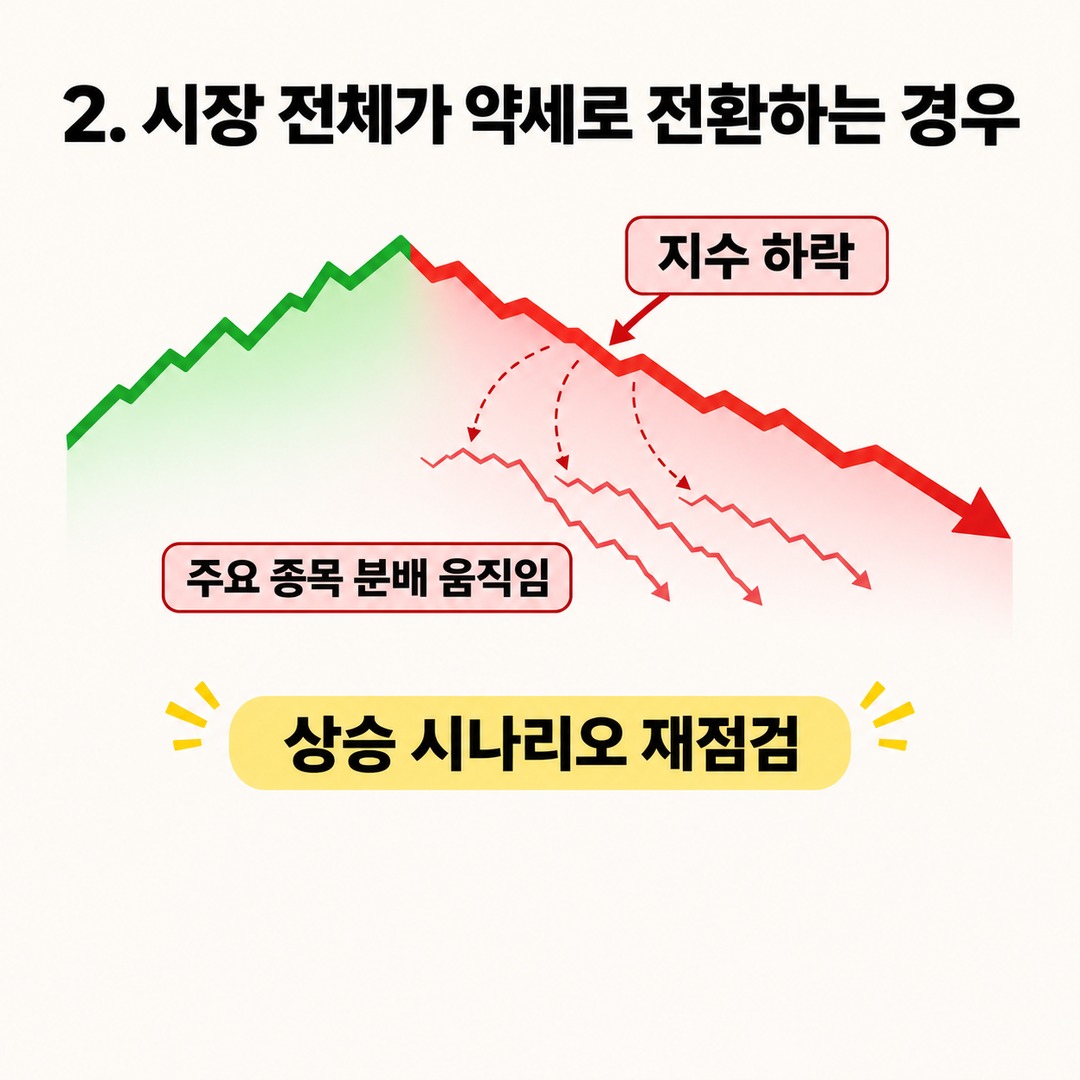
2. The overall market turns weak
A bullish-market scenario can change when the market corrects. Watch for declines in the indexes and distribution activity in leading stocks.
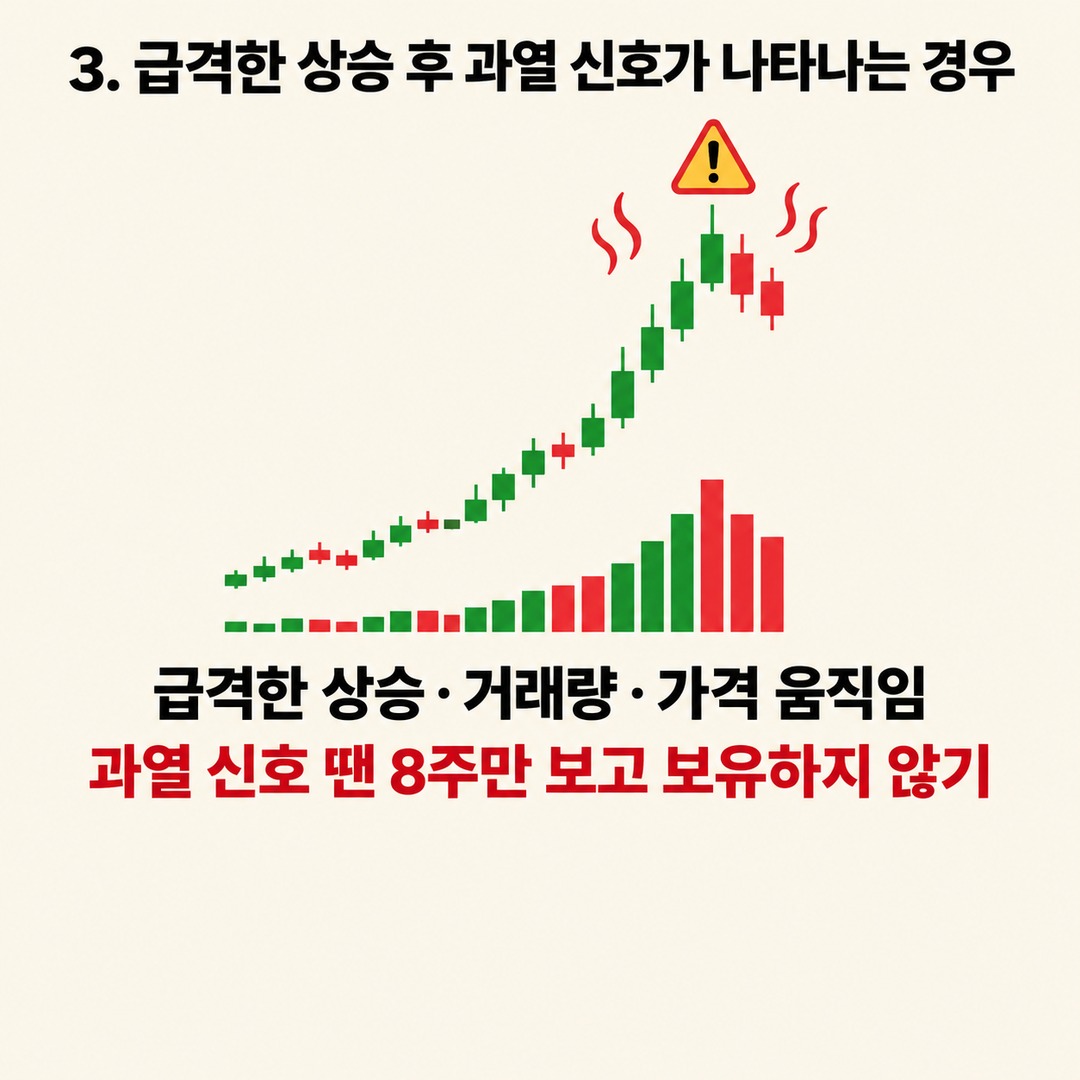
3. Signs of overheating appear after a sharp rally
If the stock rises too steeply in a short period or its volume and price action show signs of a climax, do not hold simply because of the 8-week period.
4. The loss-limiting rule applies
The 7~8% loss limit should be managed separately from the 8-week holding rule. Ignoring the loss-limiting rule just to complete the holding period goes against the rule’s purpose.

In other words, holding for 8 weeks is a way to ride out a normal pullback in a strong stock, not a reason to let losses go unchecked.
When does the 8-week holding period start?
The starting point is when the stock begins rising from the breakout buy point. This is different from simply counting 8 weeks from the day you placed the buy order in your account.
For example, if the week in which the stock breaks out from a proper buy point is counted as week 1, the timeline is as follows.
| Category | Calculation |
|---|---|
| Week 1 | The week of the breakout |
| Week 2 | The week after the breakout |
| Week 3 | The third week |
| Weeks 4~7 | The advance and pullback |
| Week 8 | The point at which to assess the minimum holding period |
This period is different from simply counting 56 calendar days. It should be considered in terms of the stock market’s trading weeks.
The fact that 8 weeks have passed does not mean you must sell.
Instead, the key is to reassess whether to hold longer by reviewing the company’s earnings, the stock’s trend, trading volume, and its relationship to the 10-week moving average when 8 weeks have passed.
A checklist for applying the rule in practice
Before applying the 8-week holding rule, checking the following points can help reduce errors in judgment.
Did the stock break out from a proper chart pattern?
Did it rise 20% or more within 1~3 weeks after the breakout?
Did trading volume support the advance?
Is the overall market maintaining a bullish trend?
Are the company’s earnings and its industry group’s competitiveness holding up?
Is the stock supported by institutional interest and buying?
Have no serious sell signals or loss-limit conditions emerged?
Do not apply the 8-week holding rule automatically just because some of these criteria are met.
In particular, there is no guarantee that a stock that rose sharply in the past will repeat the same move later.
Key points to remember about the CAN SLIM 8-week holding rule
CAN SLIM’s 8-week holding rule is an exception to the usual profit-management approach. It is intended to help investors avoid selling high-quality growth stocks too early after a strong short-term advance.
This rule should be distinguished from the general 20~25% profit-taking principle. You should also consider the bull market, the company’s competitiveness, trading volume, and the timing of the breakout.
More important than the 8-week period itself is whether the reasons for holding the stock remain valid.
Be wary both of selling a strong stock too early and of continuing to hold a weakening stock simply because a rule says to.
This material is intended to explain William O’Neil’s investing principles. It does not recommend buying or holding any particular stock or guarantee profits.
※ This article is for informational purposes to help readers understand market trends. It is not an investment recommendation for any specific stock or asset. You are responsible for your own investment decisions.