

Can Crypto Trading Bots Be Used for Every Cryptocurrency? Exchange Support Requirements and How to Check

Crypto trading bots cannot be used for every cryptocurrency. As of 2026-10-25, whether automated trading is possible depends on the exchange's trading support, the bot's supported markets, and order requirements. Even if a cryptocurrency is listed on an exchange, you must separately confirm whether your chosen trading bot supports it.
In particular, the conditions to consider when applying an automated trading strategy differ between well-known cryptocurrencies such as Bitcoin and Ethereum and altcoins with lower trading volumes.
Does Every Cryptocurrency Need Its Own Trading Bot?
A separate trading bot does not necessarily have to be developed for each cryptocurrency. A single automated trading program can support multiple trading pairs, allowing users to configure different trading conditions for each pair.

A trading bot is software that executes orders based on predefined prices, indicators, times, or trading conditions.
For example, someone who wants to automate Bitcoin and Ethereum trading does not necessarily need to purchase a separate program for each cryptocurrency. Instead, they can choose a bot that supports both trading pairs and configure an individual strategy for each.
However, not all programs offer the same features. Supported exchanges, trading pairs, order types, and strategy configuration options must be checked for each program.
Three concepts are important to distinguish:
Exchange listing: The cryptocurrency is available for trading on a particular exchange.
Automated trading support: The bot supports the exchange and the relevant trading pair.
Strategy execution eligibility: The actual trading requirements, including order amounts, order types, and account permissions, have been met.
You need to check all three conditions to determine whether automated trading is possible for your chosen cryptocurrency.
Can Any Cryptocurrency Listed on an Exchange Be Traded Automatically?
You should not assume that automated trading is possible simply because a cryptocurrency is listed on an exchange. You also need to check the API used by the trading bot and the exchange's order requirements.
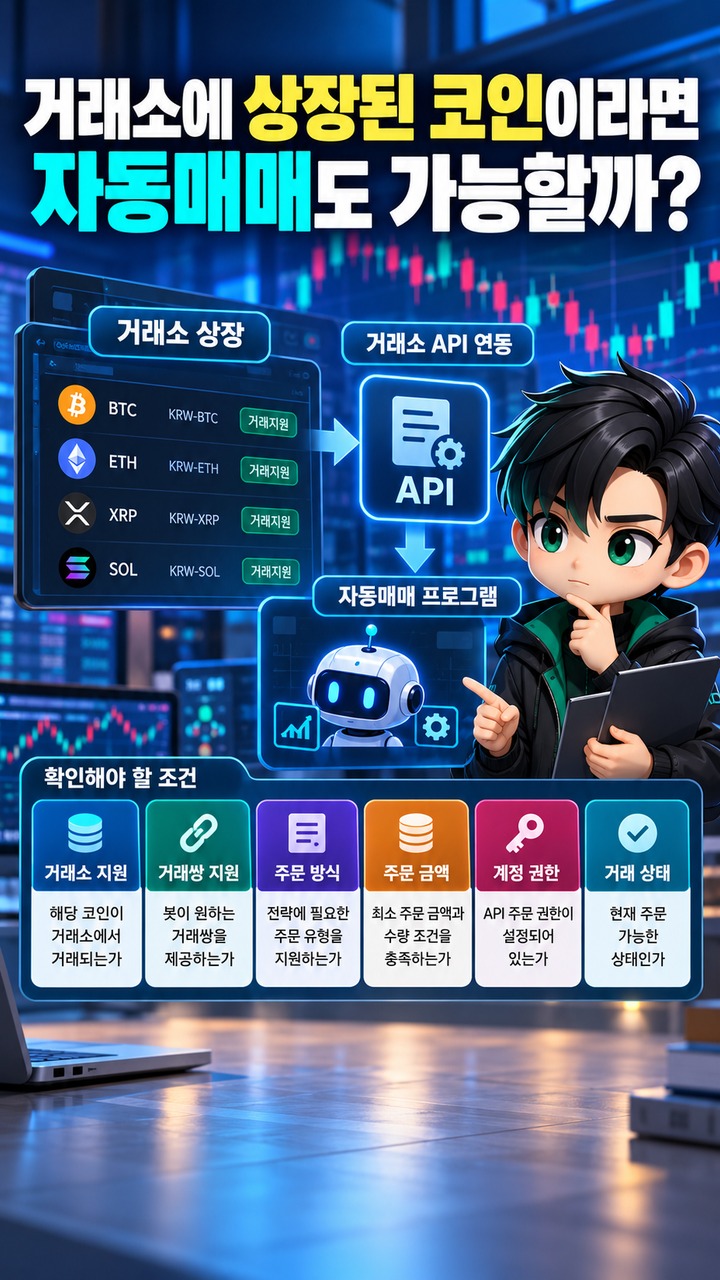
An API is a connection mechanism that allows an external program to exchange data with an exchange's systems or submit order requests.
Upbit provides an API for retrieving trading pair lists in its official developer documentation. This API can be used to check which trading pairs Upbit supports.
For example, `KRW-BTC` represents a trading pair in which Bitcoin is traded against the South Korean won.
However, finding a cryptocurrency in the trading pair list does not mean that an external automated trading program can immediately execute orders for it.
The following conditions should be checked:
| Item to Check | Evaluation Criteria |
|---|---|
| Exchange support | Is the cryptocurrency available for trading on the exchange? |
| Trading pair support | Does the bot support the desired trading pair? |
| Order types | Does the exchange support the order types required by the strategy? |
| Order amount | Does the order meet the minimum amount and quantity requirements? |
| Account permissions | Have API trading permissions been configured? |
| Trading status | Is the market currently accepting orders? |
For instance, even if a cryptocurrency is listed on Upbit, you cannot trade it automatically through a particular bot if that program does not support the relevant trading pair.
Conversely, even if you can select a trading pair in the bot, an order may not be processed successfully if it fails to meet the exchange's order requirements.
How Do Automated Trading Conditions Differ Between Bitcoin and Altcoins?

Both Bitcoin and altcoins can be selected for automated trading if their trading pairs are supported and the relevant order requirements are met. However, it is better to evaluate a strategy's suitability based on trading volume, order book conditions, price movements, and exchange order restrictions rather than the cryptocurrency's name alone.
Liquidity is one of the important factors in automated trading. It refers to how easily an asset can be bought or sold at a price close to the desired level.
In a market with limited trading activity, an order may not be filled for the desired quantity at the intended price, even after it has been submitted.
For example, even if a trading bot is configured to place a buy order at a specific price, insufficient sell-side liquidity at that price may cause the order to be only partially filled or remain open.
Upbit's official order creation documentation also explains that a limit order may remain unfilled if the market price does not reach the specified order conditions.
Therefore, when choosing a cryptocurrency for automated trading, you should look beyond whether it appears on the program's list of supported assets and consider how orders may actually be executed.
How to Check Whether a Trading Bot Supports Your Chosen Cryptocurrency
You can determine whether automated trading is possible by checking the trading pair first and then reviewing the order requirements step by step. Although program interfaces vary, the basic information needed to make this assessment is similar.
First, find the trading pair for your chosen cryptocurrency on the exchange.
Rather than searching only by the cryptocurrency's name, check which asset is used to buy and sell it.
The `KRW-BTC` market, where Bitcoin is traded against the South Korean won, is different from Bitcoin markets that use other quote assets.
Second, review the automated trading program's list of supported markets.
Check whether the bot service supports the exchange and trading pair you want to use.
You should also distinguish between programs that only provide price data and those that support actual order execution.
Third, check the order requirements.
Upbit provides an API for retrieving order availability information for each trading pair, including order sides, supported order types, order amount limits, and applicable fee rates.
You can use this information to check whether the order type configured in your bot matches the exchange's actual order requirements.
Fourth, review trading permissions and the execution environment.
If you intend to use automated order placement, your API key may need permission to submit orders.
Upbit requires an API key with order placement permission when using its order API. API secret keys should never be disclosed to third parties, and permissions granted to automated trading services should be limited to what is necessary.
Can an Order Fail Even When the Cryptocurrency Appears in the Trading Bot?
An order can fail or remain unfilled even when the cryptocurrency appears in the bot's selection list. This is because trading pair support and actual order eligibility are separate conditions.
One common example is failing to meet the minimum order amount.
According to Upbit's official guidance, the minimum order amount in its South Korean won market is KRW 5,000.
Let's examine the difference using a hypothetical automated trading configuration.
| Automated Trading Configuration | Comparison With Minimum Order Amount |
|---|---|
| Buy amount per 1: KRW 3,000 | Below KRW 5,000 |
| Buy amount per 1: KRW 10,000 | At least KRW 5,000 |
| Buy amount per 1: KRW 30,000 | At least KRW 5,000 |
This table is a hypothetical example comparing only the minimum order amount in the South Korean won market.
If the buy amount per 1 is set to KRW 3,000, it does not meet the minimum amount requirement of KRW 5,000.
Even if the amount is set to KRW 10,000 or KRW 30,000, other requirements must also be met, including available balance, order type, price increments, and whether trading is currently permitted.
In other words, a cryptocurrency appearing in an automated trading program and an actual order being processed successfully are two separate matters.
Will Automated Trading Produce Similar Returns Across All Cryptocurrencies?
Applying the same automated trading strategy does not mean that every cryptocurrency will produce similar returns. Price movements and trading conditions differ, and actual execution results can also vary depending on the order type.
In automated trading, what matters is not only whether a trading signal is generated correctly but also the price at which the resulting order is actually filled.
Trading fees must also be considered.
For a hypothetical calculation, assume that a fee of 0.05% applies separately to one purchase and one sale.
If the purchase amount and sale amount are each KRW 1,000,000, the simplified fee calculation is as follows:
Buy fee: KRW 1,000,000 × 0.0005 = KRW 500
Sell fee: KRW 1,000,000 × 0.0005 = KRW 500
Total round-trip trading fees: KRW 1,000
This is a hypothetical calculation using arbitrarily selected fee rates and transaction amounts. It does not represent the actual fees charged by any exchange or applied to any account. Price fluctuations, slippage, taxes, and other costs have been excluded from the calculation.
As the number of automated trades increases, trading costs can accumulate. Therefore, when reviewing historical trading results, you should distinguish between returns before fees and results that account for actual costs.
A trading bot is a tool that automates the trading process. It is not a service that guarantees investment returns or protects your principal.
Which Cryptocurrency Should You Choose Before Starting Automated Trading?
A reasonable approach is to begin by evaluating cryptocurrencies supported by your trading program whose trading conditions and compatibility with your strategy you can assess.
Rather than configuring several cryptocurrencies simultaneously from the beginning, choosing one trading pair and reviewing its order amounts, execution status, trading costs, and program behavior can make configuration errors easier to identify.
For example, if you want to trade Bitcoin automatically in the South Korean won market, you can follow these steps:
1. Check whether the exchange supports the `KRW-BTC` trading pair.
2. Confirm that your chosen bot supports order placement for `KRW-BTC`.
3. Check the minimum order amount and available order types.
4. Before committing real funds, check whether the program provides simulated trading or order validation features.
5. If you activate automated trading, regularly review execution records and error logs.
The list of cryptocurrencies supported for automated trading may change depending on the exchange's policies and the program's support policies.
The key point as of 2026-10-25 is that there is no universal list of cryptocurrencies supported for automated trading across all platforms. You need to check both the exchange's available trading pairs and the supported markets of the bot you intend to use.
If you are considering automated trading for a particular cryptocurrency, start by comparing the exchange's trading pair list with the bot's order execution support.
※ This article is provided for informational purposes to help readers understand how the market works. It is not a recommendation to invest in any particular cryptocurrency or asset. You are responsible for your own final investment decisions and their outcomes.