

Why U.S. Stock Stop-Loss Orders Execute Below Your Set Price: The Key Difference Between Stop and Stop-Limit Orders
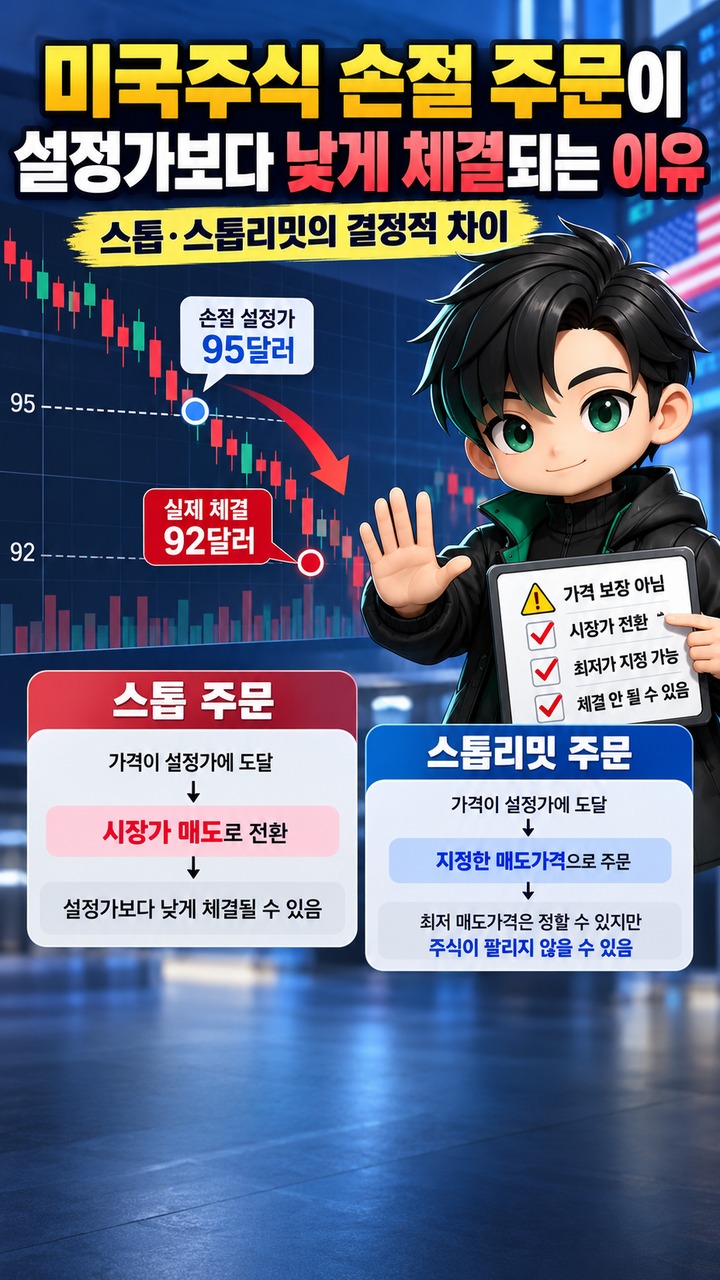
You may place a stop-loss order for a U.S. stock at USD 95, only to have your shares sell at USD 92. A regular stop order does not guarantee a sale at USD 95. Instead, it becomes a market sell order once the price condition is met. A stop-limit order lets you set a minimum selling price, but it also carries the risk that your shares will not sell.
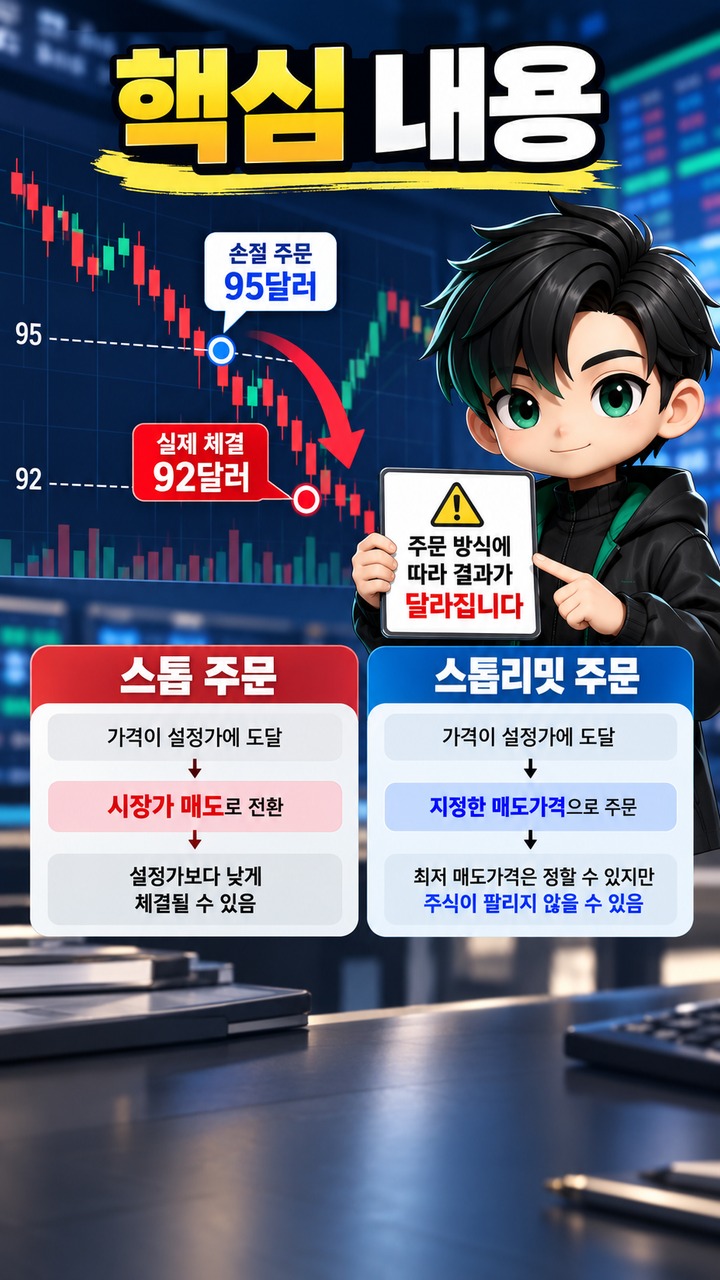
This article compares how the two order types work and what investors should check, based on investor education materials from the U.S. Securities and Exchange Commission (SEC) and explanations from the Financial Industry Regulatory Authority (FINRA).
Information verified as of: 2026-10-24 Korea Standard Time
1. Why Did My Shares Sell at USD 92 When I Set a Stop-Loss at USD 95?
With a regular stop order, USD 95 is not the guaranteed execution price. It is the trigger price that activates the order. Once the specified condition is met, the order becomes a market order, so the actual selling price depends on the prices available in the market at that time.

The SEC's investor guidance on stop orders, updated on 2026-08-18, also explains that the stop price and actual execution price can differ significantly.
For example, suppose you place a sell stop order at USD 95 when a stock is trading at USD 100.
If the stock price falls enough to trigger the stop, the sell order becomes a market order. However, if the available buying price is USD 92 when the order is actually processed, your shares may sell below USD 95.
When stock prices move quickly, it is important to distinguish between two prices:
Stop Price: The price level that triggers the order.
Execution Price: The price at which the shares are actually traded.
Without understanding this distinction, investors may assume that placing a stop-loss order also establishes a firm limit on their maximum loss.
However, a regular stop order does not guarantee a maximum loss amount.
2. What Is the Difference Between a Stop Order and a Stop-Limit Order?
A stop order becomes a market order once triggered, while a stop-limit order becomes a limit order. A stop order therefore prioritizes executing the sale, whereas a stop-limit order restricts the minimum acceptable selling price.
FINRA emphasizes in its guide to order types that placing a limit on the price also creates the possibility that an order will not be executed.
| Feature | Stop Order | Stop-Limit Order |
|---|---|---|
| Trigger condition | Stop price reached | Stop price reached |
| Order type after triggering | Market order | Limit order |
| Minimum selling price | Not guaranteed | At or above the limit price |
| Likelihood of execution | Relatively higher | May remain unfilled depending on market conditions |
| Main risk | Selling at a lower price than expected | Continuing to hold shares as the price falls |
The limit price in a stop-limit order sets a floor on the selling price. It is not a promise that the shares will actually sell at that price.
For example, if you set a stop price of USD 95 and a sell limit price of USD 94, the shares can only be sold at USD 94 or higher after the stop condition is met.
If the market price falls to USD 93 and there are no buyers willing to purchase at USD 94 or higher, the sale may not take place.
The key difference between these two order types is therefore not that one is always safer. It is whether you are willing to accept uncertainty about the execution price or the risk that your order may remain unfilled.
3. How Much Difference Can the Order Type Make When Selling 100 Shares of the Same Stock?
Stop orders and stop-limit orders can produce very different outcomes even when they are triggered at the same price. The following is a hypothetical example, not a reconstruction of an actual stock's performance or a historical trade.
Hypothetical Example: 100 Shares of a U.S. Stock Purchased at USD 100 per Share
The initial assumptions are as follows:
Purchase price per share: USD 100
Number of shares held: 100 shares
Initial purchase amount: USD 10,000
Stop price: USD 95
Sell limit price for the stop-limit order: USD 94
Assumed available execution price after the decline: USD 92
Commissions, taxes, and exchange-rate fluctuations are excluded from the calculations.
Hypothetical Price Movement
An illustrative hypothetical price path. This is not actual market data or a record of executed trades.
Scenario A: The Stop Order Is Fully Executed at USD 92
Assume the order is triggered at USD 95, but the actual execution price of the market sell order is USD 92.
The total proceeds from the sale are calculated as follows:
USD 92 × 100 shares = USD 9,200
Compared with the initial purchase amount of USD 10,000, the loss is USD 800.
The percentage loss is 8%.
If all the shares had been sold at USD 95, the loss would have been USD 500. Because the actual execution price was lower at USD 92, the loss increased by USD 300.
These are the author's calculations, intended to illustrate the difference between the stop price and the execution price.
Scenario B: The Stop-Limit Order Is Not Executed
Now suppose you set a stop price of USD 95 and a sell limit price of USD 94 for the same stock.
Even if the stop condition is met at USD 95, the sell order can only be executed at USD 94 or higher.
If the available buying price remains at USD 92 and does not return to USD 94 or higher, all 100 shares may remain in your account.
At a valuation price of USD 92 per share, the value of the remaining shares would be USD 9,200.
The unrealized loss would be USD 800. However, because the shares have not been sold, no realized loss from a sale has occurred.
If the stock price falls further, the unrealized loss could increase.
Hypothetical Outcomes Under the Same Price Movement
| Comparison | Stop Order | Stop-Limit Order |
|---|---|---|
| Trigger price | USD 95 | USD 95 |
| Execution outcome | Assumed sale of 100 shares at USD 92 | Assumed unfilled order |
| Profit/loss status | USD 800 realized loss | USD 800 unrealized loss |
| Shares remaining | 0 shares | 100 shares |
Using a stop-limit order does not necessarily reduce the loss itself. If you cannot sell at your desired price, you remain exposed to further declines in the stock price.
In actual trading, investors must also consider the possibility that only part of an order will be filled or that shares will be executed at several different prices.
4. Can a Stop-Loss Order Execute Even If the Stock Price Drops Briefly and Then Recovers?
Yes. A stop order can be triggered by a brief price movement, and a completed sale is not automatically reversed if the stock price subsequently recovers.
Both the SEC and FINRA explain that stop orders may execute at unfavorable prices during periods of significant market volatility.
Consider a hypothetical situation in which a stock falls sharply from USD 100 to below USD 95 before recovering to USD 99.
If the stop order is triggered during the decline and the sale is completed, the subsequent rebound does not change the execution price received by the investor who already sold.
There is another important point to consider.
Brokerages may use different price references to trigger stop orders.
According to the SEC, some brokerages use the last transaction price, while others may use bid or ask quotations.
You therefore should not rely solely on the current price displayed on your screen to determine why an order was triggered.
To identify the precise reason, you need to check the stop-order trigger rules used by your brokerage.
5. Does a Stop-Limit Order Guarantee That You Can Sell at Your Desired Price?
No. A stop-limit order prevents a sale below the specified limit price, but the order will not execute if there are insufficient buyers at an acceptable price.
This can be particularly important when prices are falling rapidly or trading volume is low. The order may become active without resulting in a sale.
The stop price and limit price do not have to be identical.
The SEC's investor guidance explains that investors can enter different values for the sell stop price and the limit price.
However, widening the gap between the two prices does not guarantee execution.
For example, setting a stop at USD 95 with a limit price of USD 94 is different from using a limit price of USD 90 because the minimum acceptable selling prices are different.
Lowering the limit price allows sales at lower prices, but it also creates the possibility of execution at a less favorable price.
Conversely, raising the limit price narrows the range of acceptable selling prices and may increase the risk of the order remaining unfilled.
Ultimately, when choosing a limit price, you need to consider not only your expected loss but also whether you can continue holding the shares if they do not sell.
6. What Should You Check If Your Stop-Loss Order Has Already Executed Below the Expected Price?
First, compare the prices you entered when placing the order with the actual execution records. The priority is to determine whether the result was a normal market-order execution following a stop trigger or whether the order conditions or processing require further investigation.
FINRA's guide to order types explains that the price displayed on a screen can differ from the actual execution price and that processing an order can take time.
If the sale has already been completed, you can review the following items in order.
1. Check the order type: Review your transaction history to determine whether you placed a regular stop order or a stop-limit order.
2. Check the entered values: Confirm the stop price and limit price you specified.
4. Review the execution records: Examine the actual sale time, price, quantity, and whether the order was filled in multiple transactions.
5. Contact your brokerage: If the order and execution records do not fully explain the difference, ask about the order-processing rules and the circumstances of execution.
In particular, the last transaction price and the available selling quotation may be different.
Seeing USD 95 displayed on your screen does not mean you could have sold your entire position at USD 95 at that moment.
A market order also does not necessarily execute in full at a single price.
If the order was filled at several prices, you need to review the quantity and price of each execution to calculate the actual average selling price.
7. What to Check Before Setting Another Stop-Loss Order for U.S. Stocks
When choosing a stop-loss order, first decide whether completing the sale is more important than obtaining your preferred price, or whether avoiding a sale below a certain price is your priority.
A regular stop order can lock in a larger loss than expected when prices change rapidly. A stop-limit order restricts the selling price but may leave you holding shares that you intended to sell.
You should also check the following conditions:
Trading hours: Whether the order type is supported during regular trading hours and extended-hours trading.
Order duration: Whether the order is valid only for the trading day or remains active until canceled.
Eligible securities: Whether stop or stop-limit orders are restricted for particular stocks.
Trigger criteria: Whether the brokerage uses the last transaction price or bid and ask quotations.
Handling of unfilled orders: How partial executions and remaining quantities are processed.
The SEC advises that not all brokerages offer stop orders under identical conditions. Investors trading U.S. stocks through South Korean brokerages should therefore separately verify which order features are actually available and what conditions apply.
Can a Stop-Loss Order Limit My Loss to a Predetermined Amount?
A regular stop order alone cannot guarantee a fixed maximum loss because the shares may execute below the stop price.
Is It an Error If My Stop-Limit Order Is Triggered but the Shares Do Not Sell?
Not necessarily. Even a properly functioning order may remain unfilled if market conditions do not allow a sale at or above the specified limit price.
Which Is Better: A Stop Order or a Stop-Limit Order?
Neither order type is superior in every situation. The appropriate choice depends on whether you prioritize completing the sale or restricting the minimum selling price.
The most important distinction to remember about stop-loss orders for U.S. stocks is straightforward.
A stop price is a trigger, not a guaranteed selling price. A stop-limit price is a price restriction, not a guarantee of execution.
Before entering an actual order, it is advisable to review your brokerage's description of the order type, particularly its trigger conditions and how unfilled orders are handled.
※ This article is provided for informational purposes to help readers understand market behavior. It is not an investment recommendation for any particular stock or asset. You are responsible for your own investment decisions and their outcomes.
Related Articles
U.S. Stock Stop-Market vs. Stop-Limit Orders: Why Sell Executions Differ During Sharp Price Declines