

After Buying for a Swing Trade, When Should You Exit if the Price Moves Sideways? Time-Stop Rules and 5-Day·10-Day Guidelines

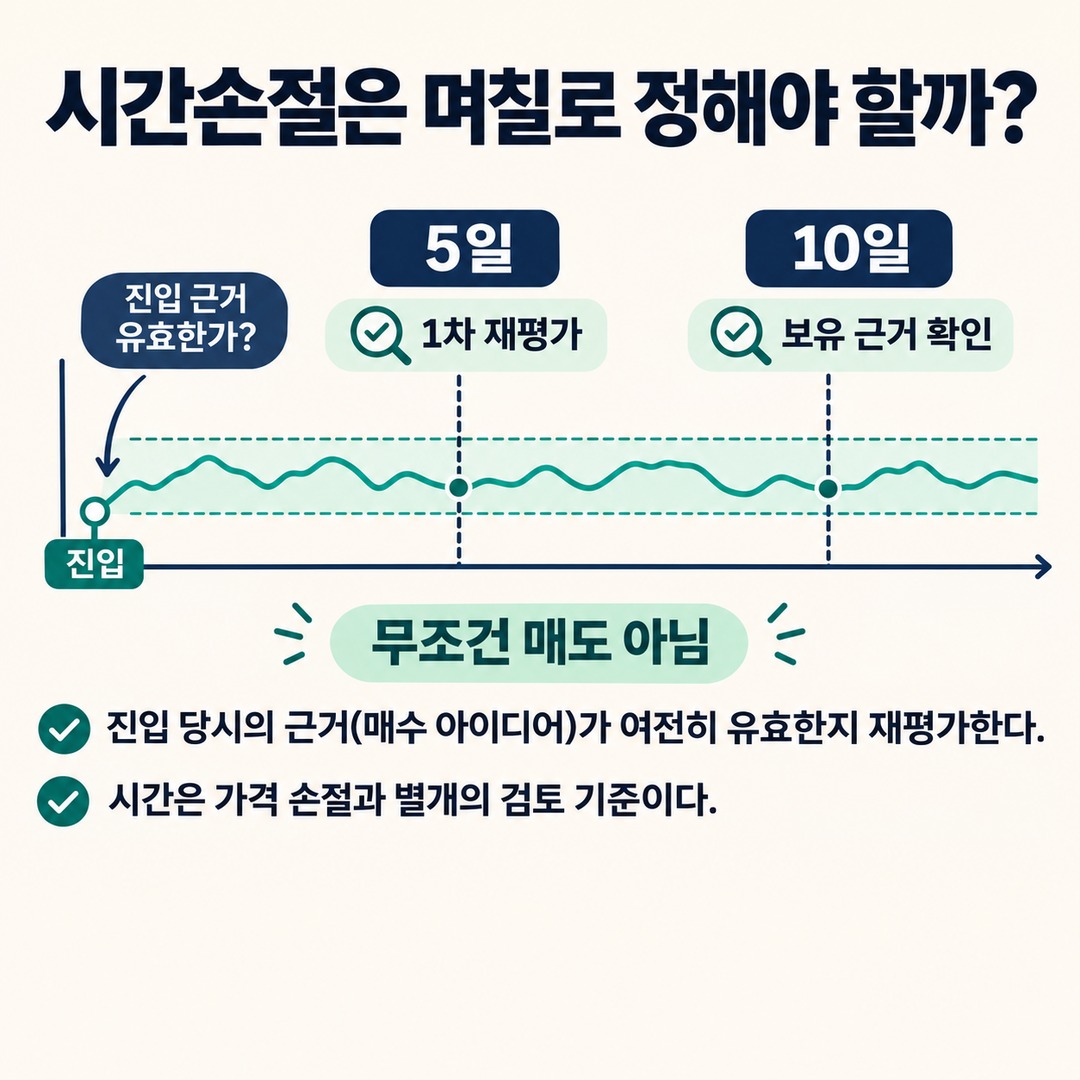
If the price moves sideways after a swing trade entry without reaching either the stop-loss or target price, it is useful to judge a time stop by whether the price movement you expected at entry occurs within a set period. The key is not to hold on for 5 days or 10 days no matter what, but to check whether there is still a reason to keep holding when the expected rise does not materialize.
A time stop is a method of reassessing or exiting a position once a predetermined holding period has passed, even if the price has not fallen to the stop-loss level.
A stop-loss is based on price, and a target is based on the price at which to take profits; a time stop differs in that it also manages how long capital remains tied up in one security.
Based on 2026-11-18, there is no single correct time-stop rule that every swing trader must apply. Instead, set rules to match the trade type, entry rationale, and expected holding period, then repeatedly evaluate them using the same criteria.
How Many Days Should You Set for a Time Stop?
A time stop should be based on whether the rationale for entering the trade played out within the expected period. For example, with a breakout entry, watch to see whether the rise continues after the breakout; with a pullback entry, watch for a rebound after support is confirmed.
Materials from U.S. investor education organizations also discuss time-based exits as a separate exit strategy.
Fidelity’s 2026-01-20 exit-strategy guide explains that a time-based reassessment may be useful when a price has moved sideways for an extended period or is rising more slowly than expected, even though it has not fallen to the stop-loss level.
Charles Schwab’s 2025-08-13 swing-trading guide explains that traders may consider closing a trade if the target price is not reached within a set time frame.
The two sources share the view that a time stop is not a substitute for a price stop. Price and time are separate criteria for deciding when to exit.
In practice, how should you distinguish between 5 days and 10 days?
The periods below are example rules that can be tested against your own trading records, not official rules that apply to every security.
| Holding period | What to check | How to decide |
|---|---|---|
| 1~3 trading days | Whether the entry rationale still holds | Avoid exiting prematurely |
| 4~5 trading days | Whether the price moved in the expected direction | 1th reassessment |
| 6~10 trading days | Whether sideways movement continues and what volume is doing | Consider exiting or confirm the rationale for holding |
| More than 10 trading days | Whether the original trade thesis remains valid | Revise the plan or exit |
The key point is not to sell automatically on day 5.
Even if the price has not moved by day 5, there may still be a reason to hold if the buying rationale remains intact and signs of a potential breakout are present.
Conversely, if the entry rationale breaks down within 2~3 days, there is no reason to wait until day 5.
So it makes sense to use the time period as a point for reassessment, not as an exit order.
Apply Time Stops Differently Depending on the Trade Type
1. Breakout entries call for a quick response
If you buy a security that has broken through resistance on rising volume, check whether the price stays above the breakout area after your purchase.
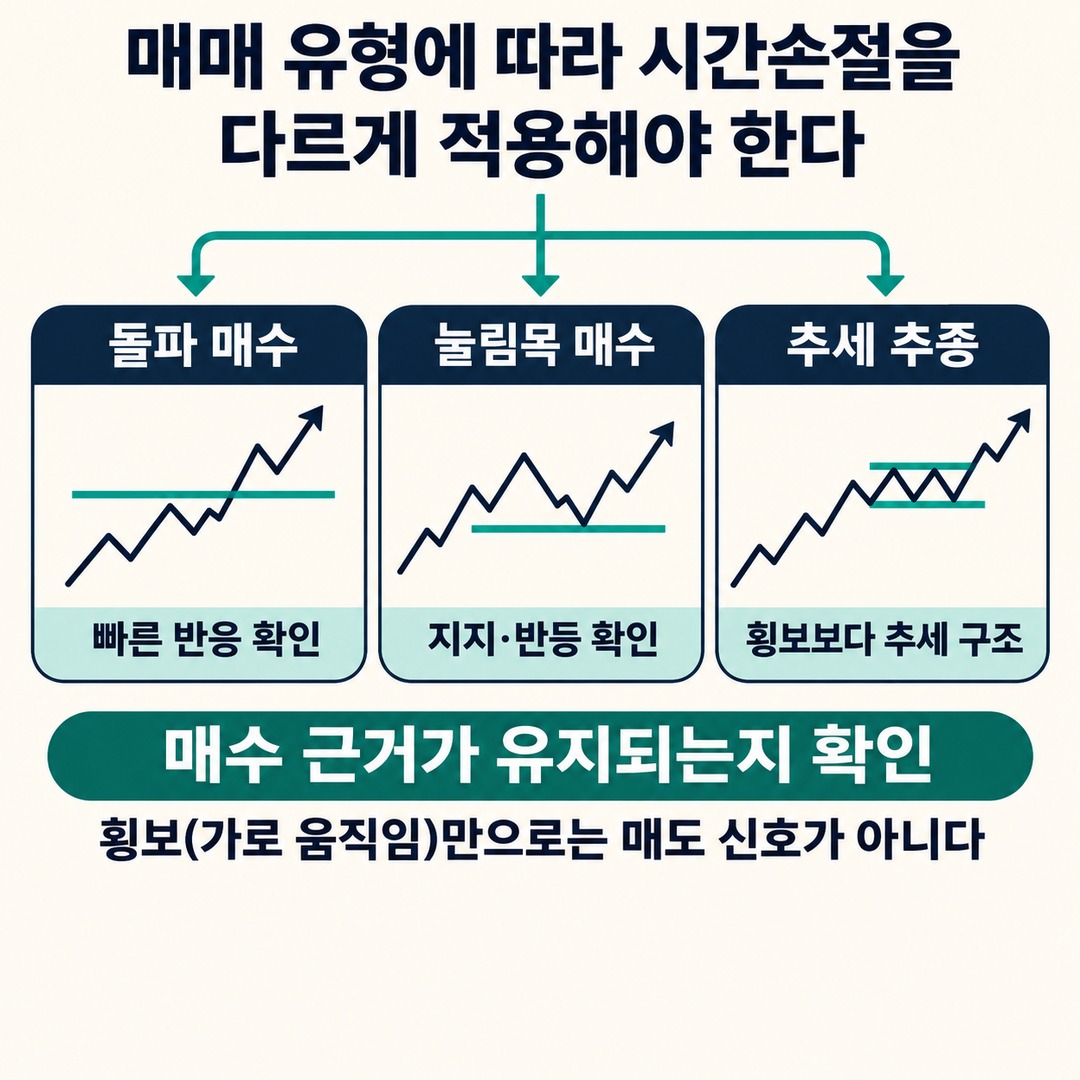
The key to a breakout trade is that the price continues rising after moving above resistance.
So consider a time stop in situations such as these:
After the breakout, the price falls back toward the resistance level.
The rise stalls as trading volume declines.
The price fails to establish a direction above the breakout level for several days.
The former resistance level turns into an area facing renewed selling pressure.
However, declining volume alone does not confirm that the breakout has failed. If the price holds support while volume falls, it may simply be a pullback.
With a breakout entry, first check whether the rationale for the breakout has disappeared, rather than focusing only on the fact that the price is not rising.
2. For pullback entries, watch how long it takes for support to hold
A pullback entry calls for a different approach from a breakout entry.
If you bought a security after it had already risen and then pulled back to a moving average or a previous support area, it is important to check whether buyers step in at that price level.
Distinguish among these three situations:
A rebound begins at the support area.
The price holds the support area, but the rebound is delayed.
The price falls below the support area, weakening the original rationale for the purchase.
A time stop may be useful in the second situation.
However, do not hold indefinitely just because support is holding. Distinguish whether the trade was intended to capture a short-term rebound or a longer-term trend.
3. Trend-following entries do not treat sideways movement itself as a failure
A trend-following strategy may allow prices to stall for a short period.
Even if the price moves within a range during an uptrend, sideways movement is not necessarily a sell signal if the lows are holding and the price structure is preparing to break above the highs.
By contrast, if the highs and lows are both falling and the trend structure is changing, reconsider the reason for holding.
Here, consider whether the trend structure is holding rather than looking only at how many days the price has been inactive.
A Hypothetical Time-Stop Example

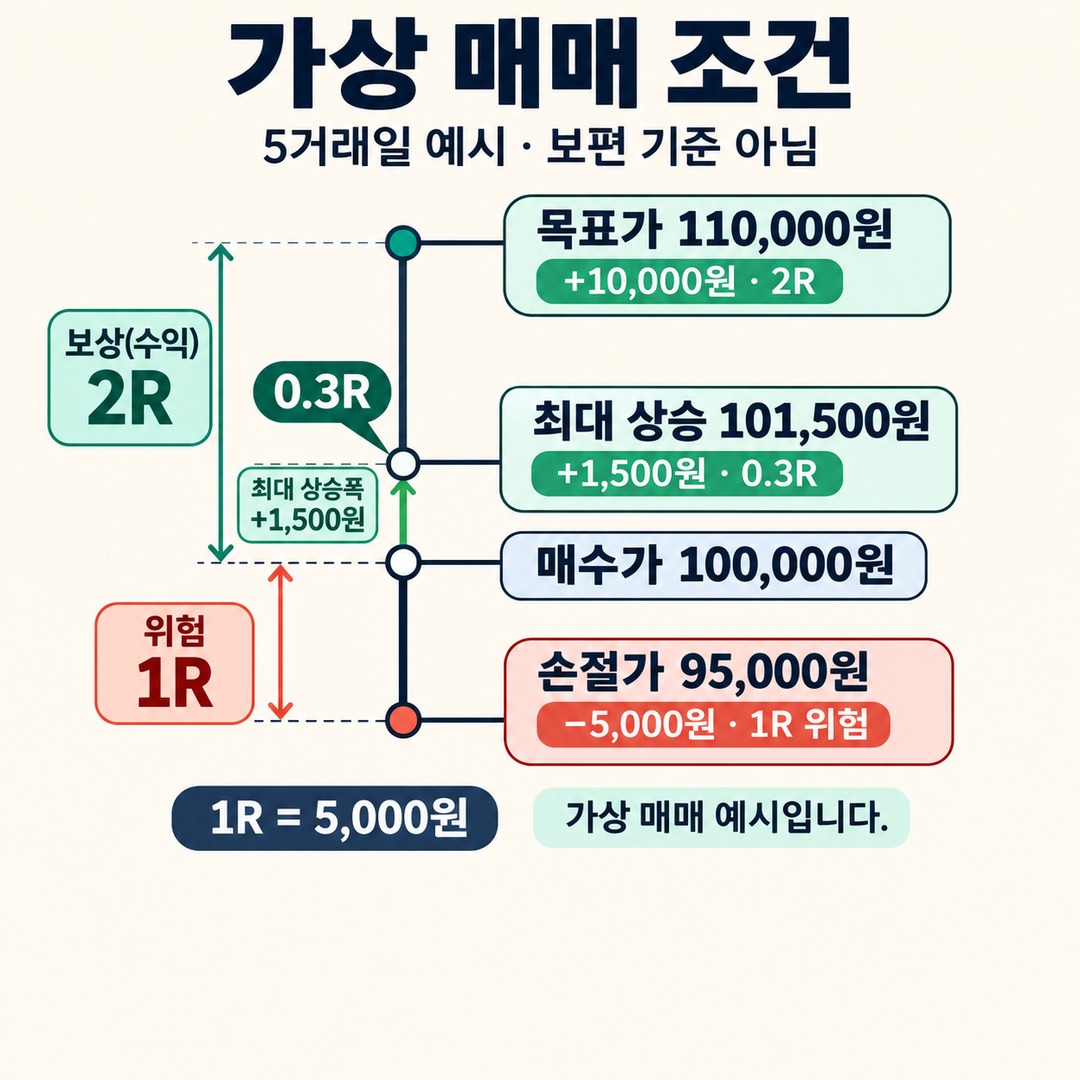
The following is a hypothetical example to explain how a time stop works. It is not a past trade result or return for an actual security.
Hypothetical Trade Conditions
| Item | Setting |
|---|---|
| Purchase price | KRW 100,000 |
| Stop-loss price | KRW 95,000 |
| Target price | KRW 110,000 |
| Initial risk per share | KRW 5,000 |
| Potential profit | KRW 10,000 |
| Risk/reward ratio | 2:1 |
|---|
Here, 1R is the difference between the initial purchase price and the stop-loss price, which is KRW 5,000.
1R=100,000−95,000=KRW 5,000If the price rises to the target, the trade is structured to yield 2R.
Now suppose 5 trading days have passed since the purchase and the price has not exceeded KRW 101,500.
The maximum gain so far is:
101,500−100,000=KRW 1,5001,500÷5,000=0.3RIn other words, the maximum favorable move over 5 trading days amounted to just 0.3R.
At this point, consider whether it makes sense to keep holding solely because the price has not reached the stop-loss level.
Are the lows holding?
Is there still a basis for a breakout or rebound?
Do volume and market conditions support the entry thesis?
Would it be better to allocate the capital to another security?
If the answers are negative, you can execute a time stop.
Conversely, if the rationale for the purchase still holds and the price appears to be building momentum within a narrow range, you can keep watching until the predetermined maximum holding period.
Author's calculation: In this example, 0.3R is the maximum favorable price movement calculated against the initial risk of KRW 5,000. Fees, taxes, and execution differences are excluded. 0.3R and 5 trading days are hypothetical settings for strategy testing, not universally validated exit criteria.
4 Checks to Make Before Using a Time Stop
1. Do not confuse a stop-loss with a time stop
A price stop is triggered when the price reaches a level at which the trade thesis is considered invalid.

A time stop is triggered when the expected results do not appear within the initially anticipated period, even if the price has not reached the stop-loss level.
These two conditions should operate independently.
If the price-stop condition occurs first, prioritize it even if time remains before the time-stop date.
2. You can extend the time if the price is approaching the target
A sideways move after buying is different from a situation where the price has already moved substantially toward the target and then pulls back.
For example, if the remaining distance to the target has become small relative to the initial risk, distinguish a simple sideways move from a pullback while the trade is in profit.
In that case, you can use a trailing stop or support-level criteria included in the original trading plan.
3. Check earnings announcements and market events
Stocks can be affected by company earnings announcements, major economic indicators, and sharp market-wide moves.
However, it is not advisable to extend the holding period simply because an event is scheduled.
It is better to decide before buying whether to hold through the event or exit before the announcement.
4. Set conditions for re-entry after a time stop
Selling under a time stop does not prevent you from buying the same security again.
However, if the original trade failed, immediately re-entering at the same price weakens the purpose of the time stop.
It is useful to distinguish between the following:
Original trade: closed because the expected move did not occur within the set period
New trade: a separate entry signal appears, such as a new breakout, confirmed support, or a change in volume

Record a re-entry as a new trade, not as an extension of the previous position.
How to Validate a Time Stop Using Your Actual Trading Records
The key is not just to choose a time period, but to check whether that period suits your strategy.
The paper *Trading to Stops* by Nora Imkeller and L. C. G. Rogers, published in 2014, mathematically analyzed various stop-loss rules while accounting for factors such as transaction costs and capital reallocation.
This study does not conclude that 5 days or 10 days is optimal for a particular swing trade. Rather, keep in mind that the effectiveness of an exit rule can vary depending on assumptions such as market movements and costs.
You can compare the following items in your own trading records:
| Record item | Purpose |
|---|---|
| Return 3 days after entry | Initial response |
| Maximum gain 5 days after entry | Initial performance |
| Maximum gain 10 days after entry | Potential for further gains |
| Actual holding period | Time capital was tied up |
| Price movement after a time stop | Whether the exit was premature |
| Results including transaction costs | Actual exit efficiency |
In particular, record whether the price rose after the time stop.
If you set the time stop too short, you may miss a rise that begins after a normal pullback. If you set it too long, your capital may remain tied up in an inactive security.
So keep the entry conditions the same and compare exit rules of 5 days, 7 days, 10 days, and so on. These time periods are settings for a comparative experiment, not durations proven to be optimal.
Time-Stop Rules to Apply
When a price moves sideways after a swing trade entry, you can assess it in this order.
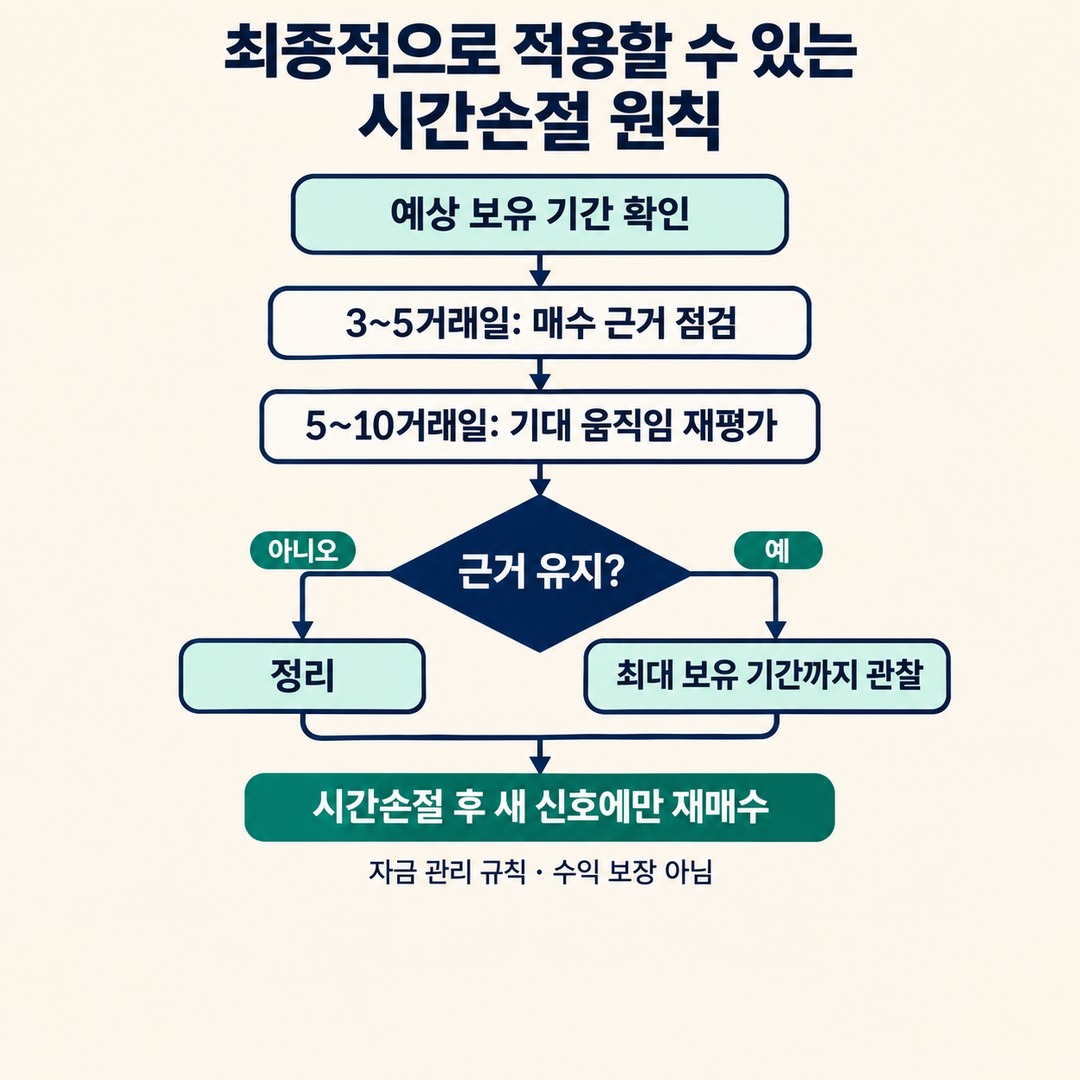
1. Check the expected holding period you set at entry.
2. At the 3~5 trading-day mark, check whether the original rationale for buying still holds.
3. If the expected move still has not occurred between 5 and 10 trading days, reassess whether to exit.
4. If the original rationale for buying has broken down, exit regardless of the time period.
5. If the rationale still holds, keep watching until the predetermined maximum holding period.
6. After a time-stop exit, consider buying again only if a new entry signal appears.
Ultimately, a time stop is not a technique for automatically selling before a loss occurs.
It is a capital-management rule for deciding how long to allocate funds to a position that is not moving in the expected direction.
More important than the numbers 5 days or 10 days themselves is recording and testing when the price movement expected under your strategy fails to appear.
Stock trading involves the risk of losing principal and sudden price swings. Setting a time stop cannot prevent losses or guarantee profits.
※ This article is for informational purposes to help readers understand market conditions and is not an investment recommendation for any particular security or asset. You are responsible for your own final decisions and investments.