

Samsung Electronics Plunges 8.70%, KOSPI Falls Below 6700…Foreign Investors Sell 3.68 Trillion and Key Dates Ahead
이 포스팅은 쿠팡 파트너스 활동의 일환으로, 이에 따른 일정액의 수수료를 제공받습니다.
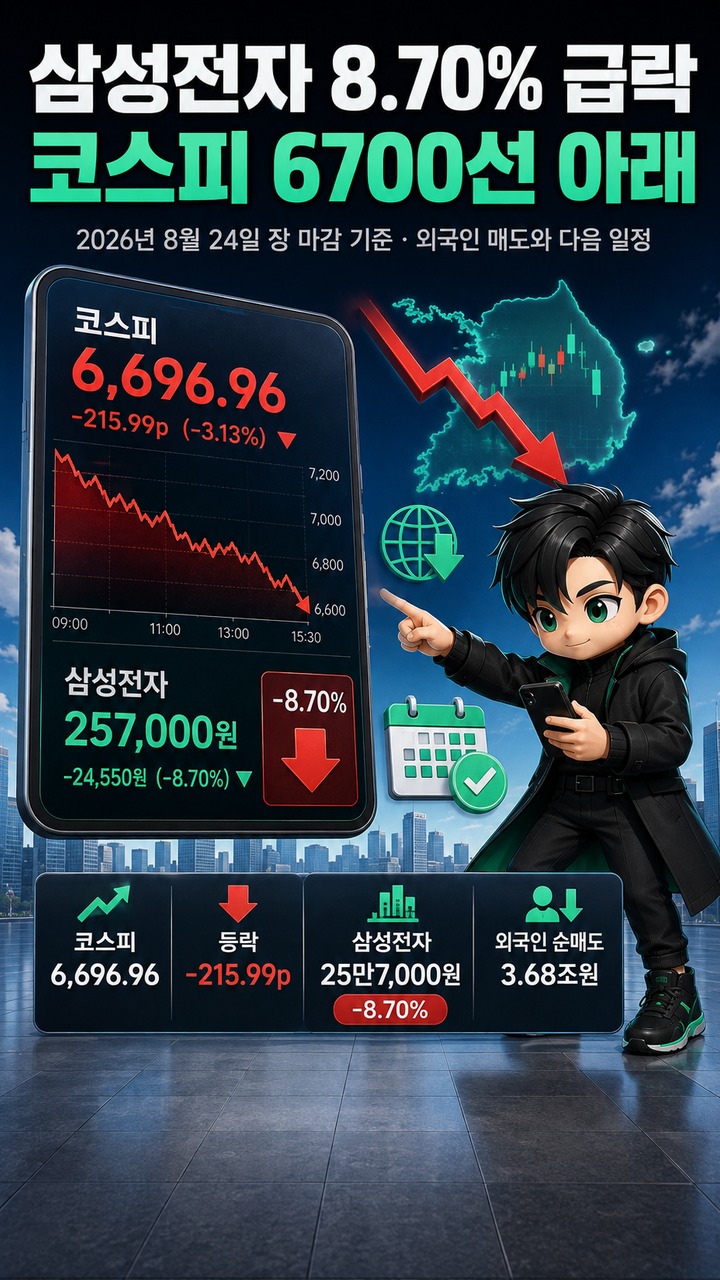
At the close of trading on 2026-08-24, the KOSPI finished at 6,696.96, down 215.99 points, or 3.12%, from the previous session, while Samsung Electronics plunged 8.70% to close at KRW 257,000. Foreign investors' net selling on the KOSPI market totaled approximately KRW 3,680,000,000,000 according to Korea Exchange data. However, figures combining Korea Exchange and Nextrade transactions showed approximately KRW 3,900,000,000,000, making it important to distinguish between the different reporting scopes.
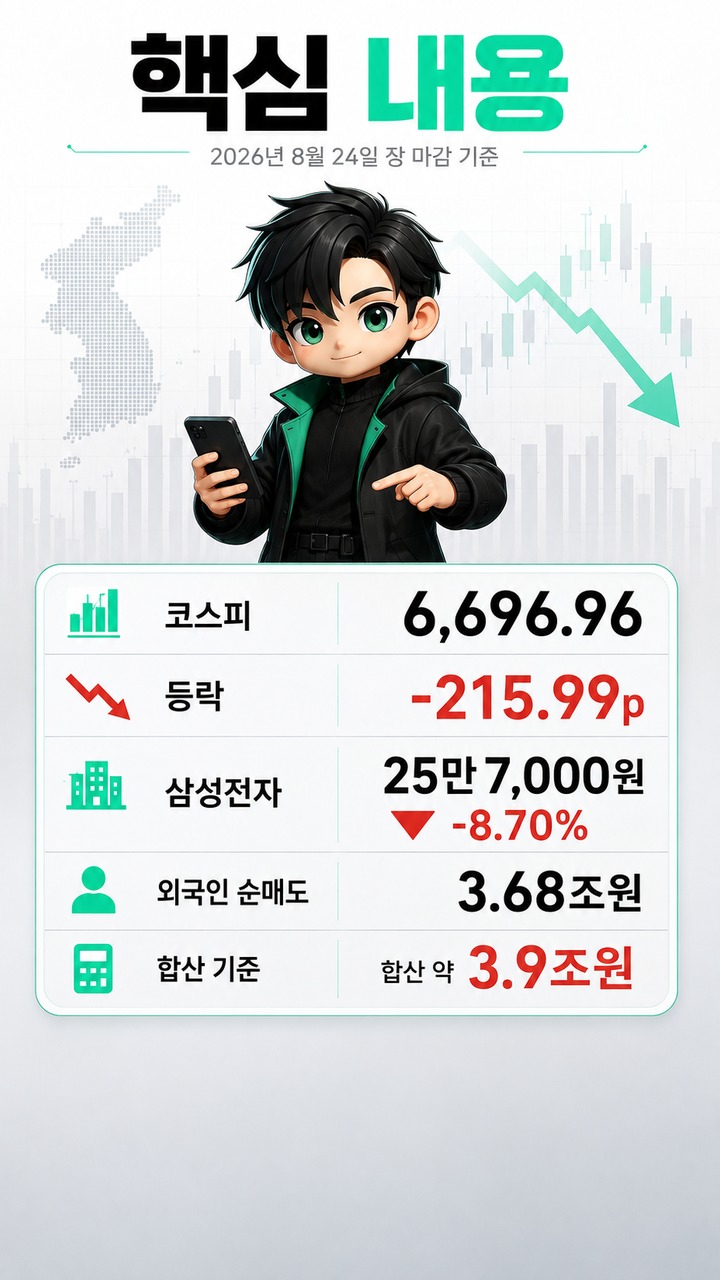
What stood out about this decline was that not every KOSPI stock fell in the same way. Major semiconductor stocks, including Samsung Electronics and SK Hynix, along with certain Samsung Group affiliates, suffered particularly steep losses. Meanwhile, the KOSDAQ actually finished up 1.42% at 813.33.
How Far Did Samsung Electronics and the KOSPI Fall on August 24?
Samsung Electronics fell KRW 24,500 from its previous closing price of KRW 281,500 to KRW 257,000. Its percentage decline was 8.70%, while SK Hynix also closed at KRW 1,671,000, down 3.41%.
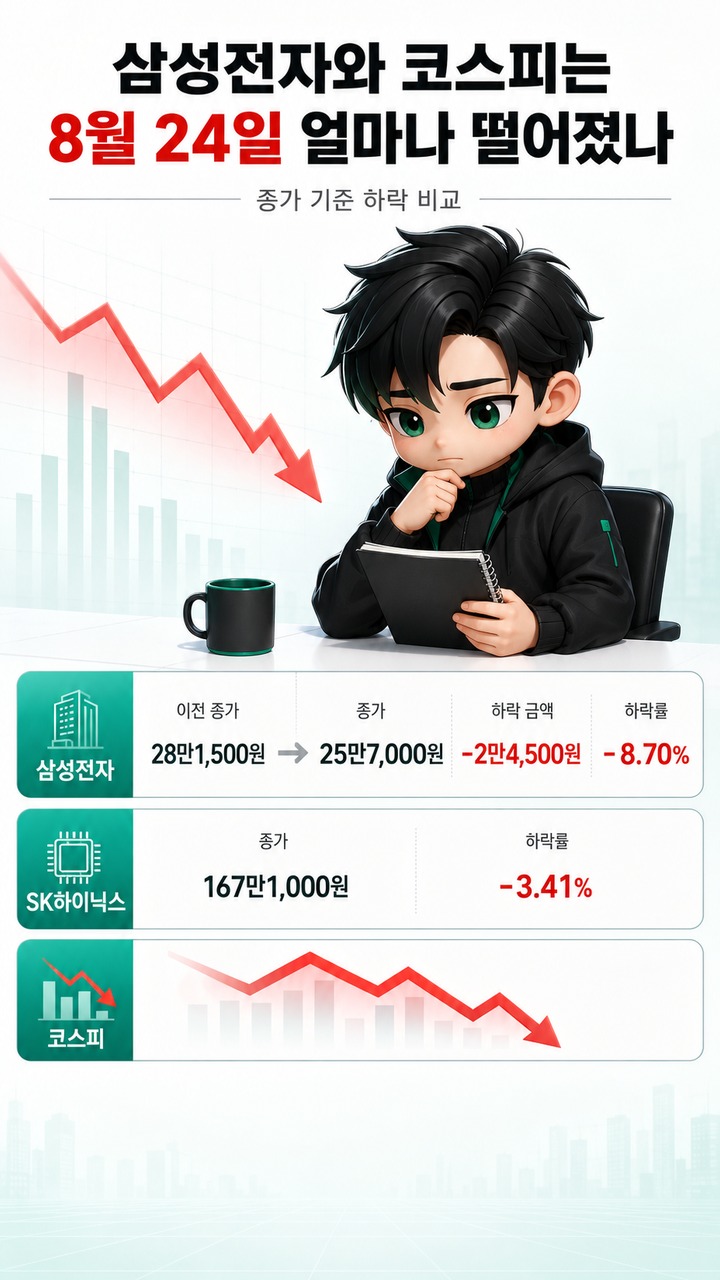
The KOSPI declined from 6,912.95 in the previous trading session to 6,696.96. During the session, it dropped as low as 6,656.07 and ultimately ended regular trading without recovering the 6,700 level.
There was also a substantial difference between the declines in Samsung Electronics and SK Hynix.
Author's calculation
Samsung Electronics -8.70% − SK Hynix -3.41%
= 5.29% percentage-point difference
Although both companies are major semiconductor stocks, Samsung Electronics experienced a decline that was 5.29% percentage points greater than SK Hynix's on that day. This does not mean the two companies have identical earnings or long-term outlooks. It is simply a comparison of their share-price movements during the single trading day August 24.
Why Do Foreign Investor Selling Figures of 3.6 Trillion and 3.9 Trillion Differ?
On August 24, foreign investors' net selling on the KOSPI market amounted to approximately KRW 3,680,000,000,000, according to Korea Exchange data. Various market-close reports showed figures ranging from 3 trillion 6,758 to KRW 3,687,500,000,000, while institutional investors also recorded net selling of approximately KRW 1,290,000,000,000.
By contrast, some market-close reports listed foreign investors' net selling at approximately KRW 3,900,000,000,000. In some cases, this figure was presented as a combined total of transactions on Korea Exchange and Nextrade. It should therefore not be directly compared with figures covering Korea Exchange alone.
For a straightforward description of the day's trading flows, it is appropriate to say that foreign investors recorded net selling of approximately KRW 3,680,000,000,000.00 on the KOSPI market. When using the combined Korea Exchange and Nextrade figure, the reporting basis should be stated separately as approximately KRW 3,900,000,000,000.0.
Without understanding this distinction, readers might think that foreign investors' net selling changed from the KRW 3,600,000,000,000.0 range to the KRW 3,900,000,000,000.0 range across articles published about the same trading day. In reality, the markets included and the scope of classification must be checked first.
Why Did Samsung Electronics Plunge Despite KRW 110,000,000,000,000 in Shareholder Returns?
Samsung Electronics' projected shareholder returns for 2026 are substantial. According to the company's official announcement on August 21, the expected amount ranges from approximately 90 trillion to KRW 110,000,000,000,000, roughly 5 times the previous record of KRW 20,300,000,000,000 set in 2020.
However, the distribution methods for the entire 90 trillion to KRW 110,000,000,000,000 have not yet been finalized.
What Samsung Electronics has specifically disclosed so far is its plan to pay approximately KRW 30,000,000,000,000 in cash dividends, including the regular dividend for 3 quarter of 2026. The details are expected to be finalized at a board meeting in late October.
The amount and methods of the remaining shareholder returns will be decided by the board in January 2027, after the company's 2026 financial results are finalized. Both cash dividends and share buybacks and cancellations will be considered at that time.
This was precisely the issue that attracted market attention. Analyses from domestic and international securities markets suggested that investors were disappointed not because the overall amount was necessarily smaller than expected, but because the company had not specified how much of the remaining funds would be allocated to share buybacks and cancellations. This is an interpretation by market participants and securities analysts, not an official explanation from Samsung Electronics for the decline in its share price.
The KRW 15,000,000,000,000 Share Buyback Should Be Distinguished From the KRW 110,000,000,000,000 Shareholder Return Plan
Samsung Electronics also approved a share buyback worth approximately KRW 15,000,000,000,000 on August 21, but its purpose needs to be understood accurately. The company's official regulatory filing explicitly states that these shares are being purchased for use in employee stock compensation.
The planned acquisition covers 5,328 million 5,968 common shares, with an estimated value of approximately KRW 15,000,000,000,000. The scheduled purchase period runs from 2026-08-24 to November 21, and the company has decided to acquire the shares through on-market transactions.
The number of shares to be purchased was calculated using the August 21 closing price of KRW 281,500. The company disclosed that the actual purchase amount could vary depending on subsequent share-price movements.
The important distinction is that the KRW 15,000,000,000,000 share buyback should not automatically be interpreted as KRW 15,000,000,000,000 in share cancellations for shareholder returns. The officially stated purpose of the confirmed KRW 15,000,000,000,000 purchase is employee stock compensation. The allocation of the remaining shareholder return funds between cash dividends and share buybacks and cancellations is scheduled to be decided at the board meeting in January 2027.
Why Did the KOSDAQ Rise While the KOSPI Fell More Than 3%?
On August 24, South Korea's two major stock indexes moved in clearly different directions. The KOSPI finished down 3.12% at 6,696.96, while the KOSDAQ closed up 1.42% at 813.33.
Author's calculation
KOSDAQ +1.42% − KOSPI -3.12%
= 4.54% percentage-point difference
The difference between the two indexes' daily percentage changes reached 4.54% percentage points.
On the KOSPI, weakness was particularly pronounced among large-cap stocks, including Samsung Electronics at -8.70%, Samsung Life Insurance at -13.09%, Samsung C&T at -7.84%, and SK Hynix at -3.41%. Conversely, certain secondary-battery stocks on the KOSDAQ performed strongly, with EcoPro BM rising 10.80% and EcoPro gaining 7.59%, among other 2-cell battery-related stocks.
Therefore, describing the August 24 session simply as 'the entire South Korean stock market plunged more than 3%' would not accurately reflect what happened. Although the benchmark KOSPI suffered a steep decline, the KOSDAQ advanced, and performance also varied across sectors and individual stocks within the KOSPI.
What Dates Should Samsung Electronics Investors Watch Next?
The next official dates to monitor regarding Samsung Electronics' shareholder return plans are late October 2026 and January 2027. Although the short-term direction of the share price cannot be determined in advance, the company has already disclosed the schedule for finalizing the details of its shareholder returns.
First, at the board meeting in late October, the company is expected to finalize the details of approximately KRW 30,000,000,000,000 in cash dividends to be paid for 3 quarter.
The more significant milestone is January 2027. After finalizing its 2026 financial results, Samsung Electronics plans to determine the amount of funds remaining for shareholder returns and how to combine cash dividends, share buybacks, and share cancellations.
Investors should not assume that the scale of share cancellations has already been finalized simply because the company announced a total shareholder return range of 90 trillion to KRW 110,000,000,000,000. Conversely, it is also difficult to draw definitive conclusions about the future direction of the share price based solely on the 8.70% decline during the single trading day August 24.
The facts currently available are clear. Samsung Electronics closed at KRW 257,000 on August 24, while the KOSPI fell to 6,696.96. Foreign investors recorded net selling of approximately KRW 3,680,000,000,000.00 according to Korea Exchange data. Going forward, it will be more accurate to monitor separately whether foreign selling ends after a single session and how Samsung Electronics finalizes the details of its shareholder return plans in October and January 2027.
※ This article is provided for informational purposes to help readers understand market developments and does not constitute an investment recommendation regarding any particular stock or asset. Readers are responsible for their own final investment decisions and the associated risks.
Related Articles
August 12 KOSPI Outlook: 3 Key Factors to Watch After the Index Recovers the 6,345 Level
이 포스팅은 쿠팡 파트너스 활동의 일환으로, 이에 따른 일정액의 수수료를 제공받습니다.