

KOSPI Plunges 5.8% as Foreign Investors Net Sell 3.5 Trillion…Samsung Electronics and SK Hynix Suffer Steep Losses
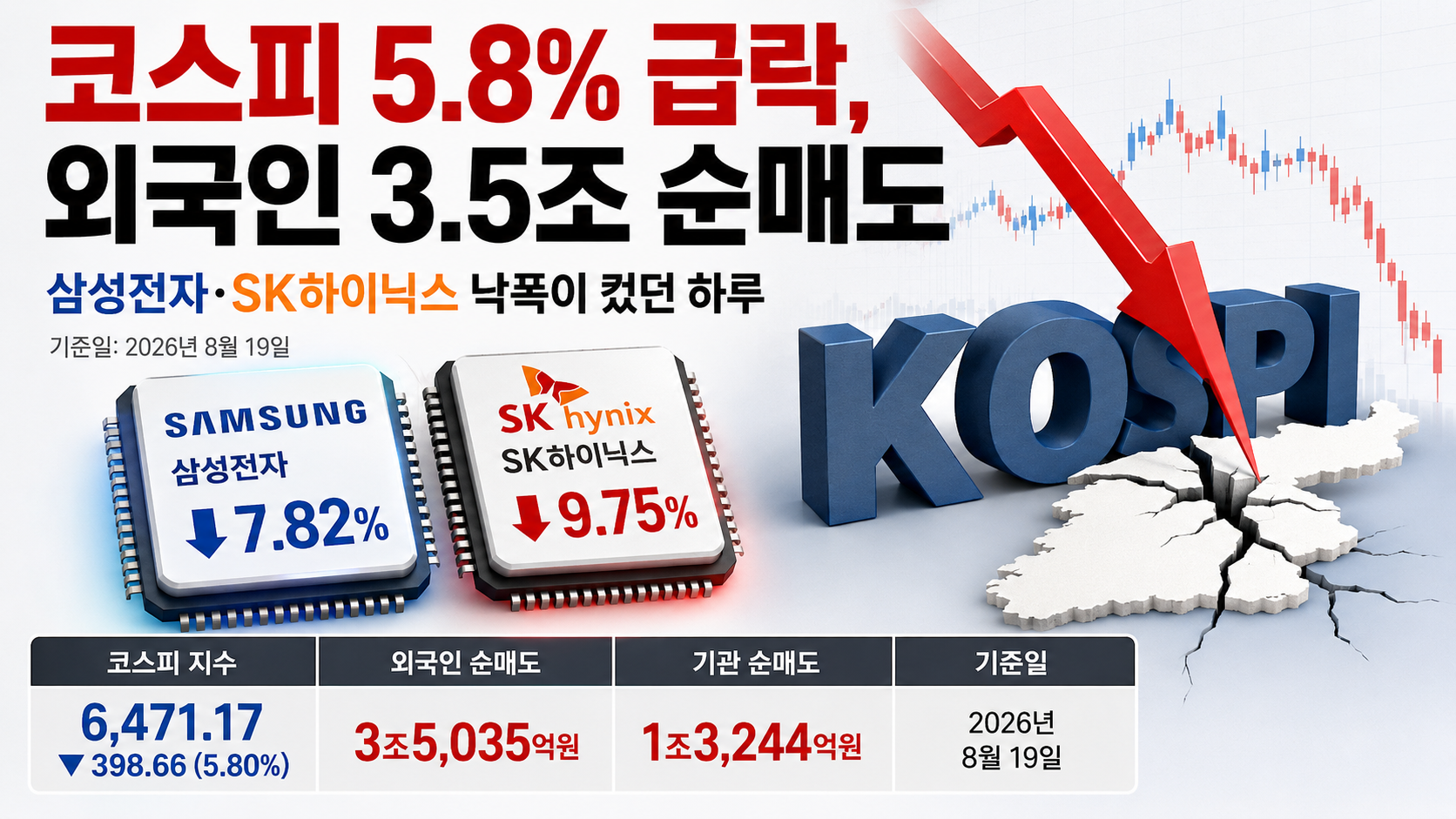
On 2026-08-19, the KOSPI closed at 6,471.17, down 398.66 points (5.80%) from the previous trading session. Foreign investors recorded KRW 3,503,500,000,000 in net selling on the main stock market, while institutional investors net sold KRW 1,324,400,000,000. Samsung Electronics and SK Hynix declined 7.82% and 9.75%, respectively, significantly widening the index's losses.
The information was verified as of 2026-08-19 23:12 Korea Standard Time. During the session, the KOSPI fell as low as 6,400.81, with its decline reaching 6.83%. Early in the session, a sell-side trading sidecar was also triggered, suspending the effectiveness of program-trading sell orders for 5 minutes.
How Much Did the KOSPI Fall in a Single Day?
The KOSPI closed at 6,471.17 on August 19. This represented a decline of 398.66 points, or 5.80%, from the previous trading session. The index fell as low as 6,400.81 during intraday trading.
The previous closing level can be calculated by adding the day's decline to the closing index value.
Author's calculation
6,471.17 + 398.66 = 6,869.83
Previous trading session's close: 6,869.83 → August 19 close: 6,471.17
One-day decline: 398.66 points
The difference between the intraday low of 6,400.81 and the closing level of 6,471.17 was 70.36 points. Although the decline widened to 6.83% during the session before partially recovering, the index ultimately finished trading without reclaiming the 6,500 level.
On the same day, the KOSDAQ closed at 824.46, down 9.74 points (1.17%) from the previous trading session. Compared with the KOSPI's decline of 5.80%, the difference in the two markets' daily percentage changes was substantial.
Did Foreign Investors Really Sell KRW 3,500,000,000,000.0 in Just One Day?
Yes. On August 19, foreign investors recorded KRW 3,503,500,000,000 in net selling on the main stock market. Institutional investors also net sold KRW 1,324,400,000,000, while individual investors made net purchases of approximately KRW 4,636,800,000,000.
Notably, foreign investors reversed direction and became net sellers after 5 consecutive trading sessions of net buying. In the KOSPI 200 futures market, foreign investors also showed a net selling position of KRW 84,000,000,000.
Combining the net selling amounts of foreign and institutional investors makes the scale clearer.
Author's calculation
Foreign investors' net selling: KRW 3,503,500,000,000
Institutional investors' net selling: KRW 1,324,400,000,000
Combined total: KRW 4,827,900,000,000 in net selling
On the same basis, individual investors' net purchases amounted to approximately KRW 4,636,800,000,000. Combined net selling by foreign and institutional investors was approximately KRW 191,100,000,000 greater than individual investors' net purchases.
Net selling is not the same as the total trading value of all shares sold in the market. Net selling is recorded when the difference between purchases and sales over a given period is negative. Therefore, interpreting the figure as 'foreign investors traded KRW 3,503,500,000,000 worth of shares' would misrepresent what the number actually means.
How Far Did Samsung Electronics and SK Hynix Fall?
On August 19, Samsung Electronics declined 7.82%, while SK Hynix fell 9.75%. SK Square also dropped 11.54%, Samsung Electro-Mechanics declined 3.68%, and Hyundai Motor fell 4.83%.
Compared with the KOSPI's overall decline of 5.80%, the losses recorded by Samsung Electronics and SK Hynix were greater than the index's percentage decline.
Author's calculation
Samsung Electronics: 2.02% percentage points greater decline than the KOSPI
SK Hynix: 3.95% percentage points greater decline than the KOSPI
By sector, electrical and electronics stocks declined 7.68%, manufacturing fell 6.36%, and insurance dropped 5.89%. However, not every stock moved in the same direction. LG Energy Solution gained 1.85%, Samsung Biologics rose 0.85%, and Hanwha Aerospace advanced 2.71%.
Across the main stock market, 171 stocks advanced, 703 declined, and 32 finished unchanged. It was not merely the index that fell; declining stocks also substantially outnumbered advancing stocks.
Why Did the Market Move So Sharply?
Market commentary that day identified rising global long-term government bond yields and issues related to delays in U.S. data center construction as major factors. After U.S. technology stocks weakened overnight, the South Korean stock market opened sharply lower, with major semiconductor stocks continuing to decline.
The yield on the 10-year U.S. Treasury bond was cited at approximately 4.68% during the session. Market experts analyzed rising long-term interest rates as one factor contributing to increased stock market volatility. However, the market figures from that day alone do not establish that the long-term earnings outlooks for Samsung Electronics or SK Hynix had definitively deteriorated.
Market participants also explained that renewed attention to regulatory issues and construction delays affecting U.S. data centers prompted selling in AI- and semiconductor-related stocks not only in South Korea but also in Japan and Taiwan. On the same day, Japan's Nikkei 225 index declined 3.16%, while Japanese semiconductor company Kioxia fell 12.60%.
At the same time, simultaneous net selling by foreign and institutional investors added pressure to domestic supply and demand conditions. However, because several factors were moving simultaneously, it is more accurate to examine interest rates, global technology stock trends, losses among major semiconductor stocks, and foreign investor trading flows separately rather than attribute the day's 5.80% decline to any single cause.
Does a Sell-Side Trading Sidecar Halt All Stock Trading?
No. The sell-side trading sidecar triggered on August 19 did not completely halt trading in all stocks, including Samsung Electronics and SK Hynix, for 5 minutes. Instead, the effectiveness of program-trading sell orders was suspended for 5 minutes early in the session.
The sidecar was activated as market volatility intensified, with the KOSPI falling toward the 6,400 level during intraday trading. However, it should not be confused with a circuit breaker, which involves a market-wide trading halt.
The activation on August 19 was recorded as the 48 sidecar activation and the 25 sell-side sidecar activation on the main stock market this year.
Therefore, when reviewing order books or trade execution patterns for stocks held at the time, it is important to distinguish between a complete suspension of stock trading and a temporary suspension of the effectiveness of sell orders related to program trading.
What Should Investors Check First After August 20?
The figures from August 19 alone cannot establish whether the market will rise or decline further in the next trading session. What was actually confirmed that day was a KOSPI decline of 5.80%, foreign investor net selling of KRW 3,503,500,000,000, institutional investor net selling of KRW 1,324,400,000,000, a Samsung Electronics decline of 7.82%, and a SK Hynix decline of 9.75%.
In the next trading session, rather than focusing solely on the previous day's sharp decline, it would be more useful to examine separately whether foreign investors return to net buying, whether losses in Samsung Electronics and SK Hynix continue, and how U.S. long-term interest rates and technology stocks perform.
In particular, because foreign investors reversed their net buying trend of the preceding 5 trading sessions in a single day, whether the KRW 3,503,500,000,000 in net selling proves to be a one-off event or continues will be an important benchmark for assessing subsequent changes in investor flows. This is not a signal guaranteeing a rise or fall in stock prices, but rather a reference point for comparing capital flows in the next trading session with those of the previous day.
The most significant figure in the market on August 19 was not simply the KOSPI's 5.80% decline. The index lost 398.66 points, foreign and institutional investors recorded combined net selling of KRW 4,827,900,000,000, and individual investors absorbed more than KRW 4,600,000,000,000 of that selling. At the same time, the percentage declines in Samsung Electronics and SK Hynix exceeded the overall KOSPI decline. To assess the direction of the next trading session, it is necessary to compare how each of these four trends changes.
※ This article is provided for informational purposes to help readers understand market trends and does not constitute investment advice or a recommendation to buy or sell any particular stock or asset. Final investment decisions and responsibility rest with the individual investor.