

Why Is a 10-Year U.S. Treasury Yield Near 5% a Concern for Stocks? The Key Figure to Watch After the S&P500 Rebound
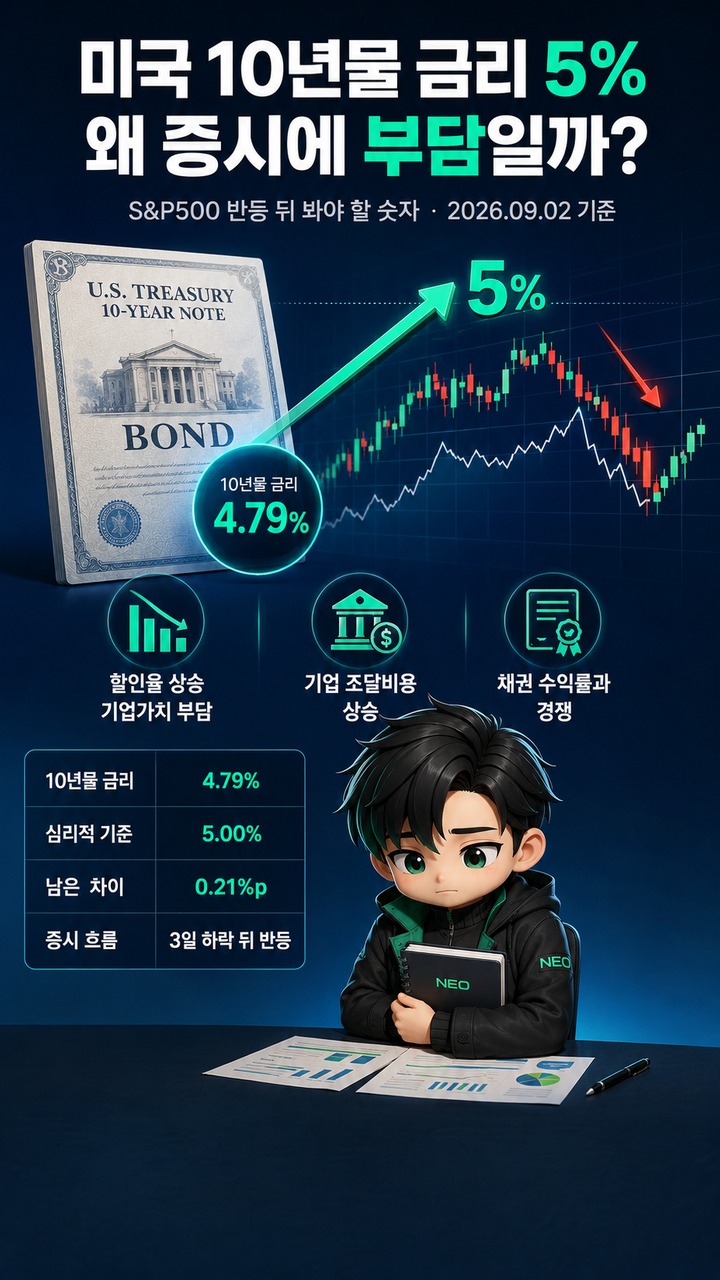
As the 10-year U.S. Treasury yield approaches 5%, the stock market faces three pressures simultaneously: higher discount rates, increased corporate financing costs, and competition with bond yields. According to the U.S. Treasury, the 10-year yield stood at 4.79% on 2026-09-02, leaving it just 0.21% percentage points below 5%.

Wall Street rebounded after 3 consecutive trading sessions of declines, but that does not mean the pressure from bond yields has disappeared. On September 2, the S&P500 closed at 7,666.60, up 0.46%. Meanwhile, investors remained cautious that stock valuations could come under renewed pressure if the 10-year Treasury yield moved closer to 5%.
Why Is the 10-Year Treasury Yield at 5% Getting So Much Attention?
5% is not an official threshold at which stock prices automatically begin to fall. However, when the long-term risk-free rate used as a benchmark for valuing U.S. stocks reaches around 5%, investors tend to demand greater compensation for the risks they take by holding equities.

According to the U.S. Treasury's daily yield curve data, the 10-year yield rose from 4.73% on August 28 to 4.79% on September 1. It also registered 4.79% on September 2. On the same day, the 30-year yield had already reached 5.27%.
Based on September 2, the calculation is:
Remaining gap before the 10-year yield reaches 5% = 5.00% - 4.79% = 0.21% percentage points, or 21bp
※ bp stands for basis point, and 100bp equals 1% percentage points. Author's calculation.
Therefore, what matters to the market is not simply the number '5' but whether long-term yields continue rising from already elevated levels.
Why Do Rising Treasury Yields Reduce Stock Valuations?
The first mechanism involves the discount rate used to calculate the present value of stocks.
A stock's price can ultimately be viewed as the present value of the profits and cash flows a company is expected to generate in the future. When interest rates rise, the discount rate used to calculate the present value of those future cash flows also increases.
For example, consider a very simple calculation of the present value of USD 100 to be received in 10 years.
At an annual discount rate of 4%, its present value is approximately USD 67.6.
At an annual discount rate of 5%, that value falls to approximately USD 61.4.
Even with identical future cash flows, an increase of just 1% percentage points in the discount rate reduces the present value by approximately 9%.
※ This is a simplified example calculated using 100÷(1+r)^10. Actual corporate valuations involve many more variables. Author's calculation.
This is why companies whose stock prices reflect expectations of future growth more heavily than current earnings may be particularly sensitive to changes in long-term interest rates.
Why Technology and AI Stocks Are Particularly Sensitive to Interest Rates
Not all stocks respond to rising interest rates in the same way.
Companies trading at high price-to-earnings ratios based on expectations of strong growth have a substantial portion of their valuations tied to future earnings. When long-term interest rates rise, the present value of those expected future profits can decline more sharply.
Recent analyses of the U.S. stock market have repeatedly suggested that technology and AI-related stocks with elevated valuations may be more sensitive to rising yields as the 10-year Treasury yield approaches 5%. Reuters reported that even with the S&P500 having risen more than 11% in 2026, elevated Treasury yields could still weigh on valuations and corporate borrowing costs.
Conversely, certain sectors, including banks, may be affected differently by a rising-rate environment. It would therefore be misleading to simplify the relationship as 'higher interest rates = lower prices for all stocks.'
Higher Bond Yields Also Create Competition for Stocks
The second major reason rising Treasury yields matter is that they change the investment options available to investors.
When Treasury yields are low, investors have a greater incentive to move into relatively risky equities in search of higher expected returns. However, the situation changes when yields rise on assets with relatively low credit risk, such as U.S. Treasuries.
If investors can expect a yield close to 5% from 10-year Treasury securities but believe that the expected returns on stocks do not adequately compensate them for the additional risk, some capital may shift into bonds.
In fact, August 2026 saw substantial inflows into bond ETFs despite rising yields, while equity inflows also continued. Rather than a one-way movement of capital from stocks into bonds, the current environment is better described as one in which investors are reassessing the relative attractiveness of the two markets.
Corporate Loan and Bond Financing Costs Also Rise
When long-term interest rates remain elevated for an extended period, the consequences go beyond theoretical stock valuation calculations.
Companies may also face higher interest costs when issuing corporate bonds or taking out loans. Businesses that require continuous financing for large-scale investments, particularly data centers and AI infrastructure, are especially sensitive to increases in the cost of capital.
Rising yields across global bond markets reflect not only inflation concerns driven by higher oil prices but also substantial bond issuance by governments and corporations. Reuters identified increased bond issuance by major companies in the AI sector as another factor expanding bond supply and influencing market interest rates.
This is why the length of time companies must actually finance their operations and investments at elevated interest rates matters more than whether yields briefly touch 5%.
Will the S&P500 Definitely Fall if the 10-Year Yield Exceeds 5%?
Not necessarily.
A move above 5% does not, by itself, guarantee a decline in the S&P500. If corporate earnings grow faster than expected, stronger profits may offset the pressure created by higher discount rates.
Recent assessments suggest that resilient earnings among U.S. companies have helped cushion the stock market against some of the pressure from rising Treasury yields. However, as the earnings reporting season for major companies draws to a close, attention may shift toward macroeconomic factors such as inflation and interest rates.
That is why it is more useful to monitor the following four factors together rather than focusing solely on 5%:
Whether the 10-year yield briefly exceeds 5% or continues climbing
Whether corporate earnings forecasts improve faster than interest rates rise
Whether rising international oil prices push U.S. inflation higher again
Whether the Federal Reserve's interest rate path becomes more restrictive than markets expect
The Most Important Figure to Watch Now Is the Direction of the 10-Year Yield
On September 2, U.S. stocks advanced as the rise in Treasury yields temporarily eased. The S&P500 gained 0.46%, the Dow Jones Industrial Average rose 0.56%, and the Nasdaq Composite increased 0.45%. However, according to the U.S. Treasury, the 10-year yield remained elevated at 4.79%.
Rather than assuming that interest rate pressure has ended simply because stocks rebounded for a day, investors should also watch whether the 10-year yield resumes climbing near 5% or begins to stabilize.
Upcoming U.S. employment and inflation reports, along with the Federal Reserve's monetary policy decisions, could all influence the direction of long-term yields. Recent signs of weak private-sector employment alongside elevated energy prices mean markets must interpret two different signals simultaneously: slowing economic growth and inflation.
Ultimately, a 10-year Treasury yield of 5% should not be interpreted as an automatic signal to sell stocks. Instead, it is better understood as a level at which the standards for justifying equity valuations become significantly more demanding.
Investment decisions should therefore consider not only Treasury yields but also corporate earnings, valuations, inflation, oil prices, and the Federal Reserve's policy path. Market prices may move differently from expectations, and there is no guarantee that historical relationships between interest rates and stock prices will repeat in the future.
※ This article is provided for informational purposes to help readers understand market developments. It is not a recommendation to invest in any particular stock or asset. All final investment decisions and responsibilities rest with the individual investor.
Related Articles
Bitcoin Is 4.1% Away From USD 80,000: Three Things to Check After Rising 21.9% in 7 Days