

When Will Bitcoin Move Before the September FOMC? U.S. Jobs and CPI Release Times and Key Figures to Watch
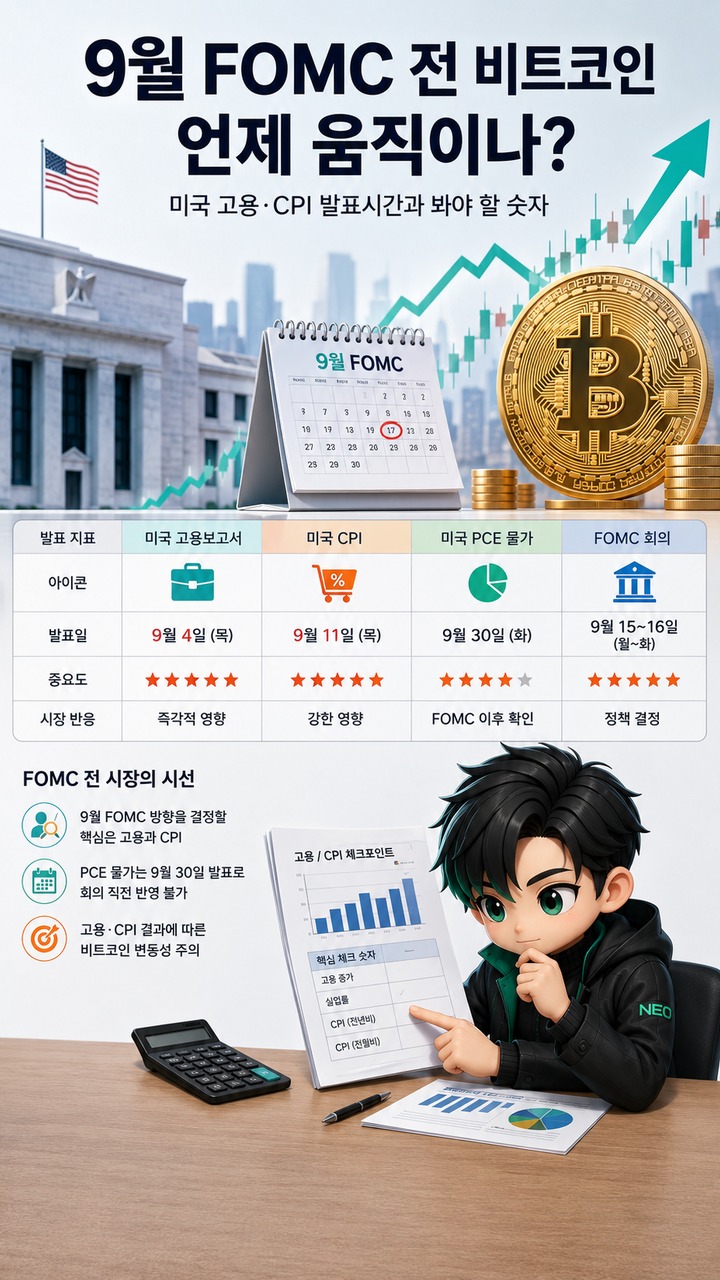
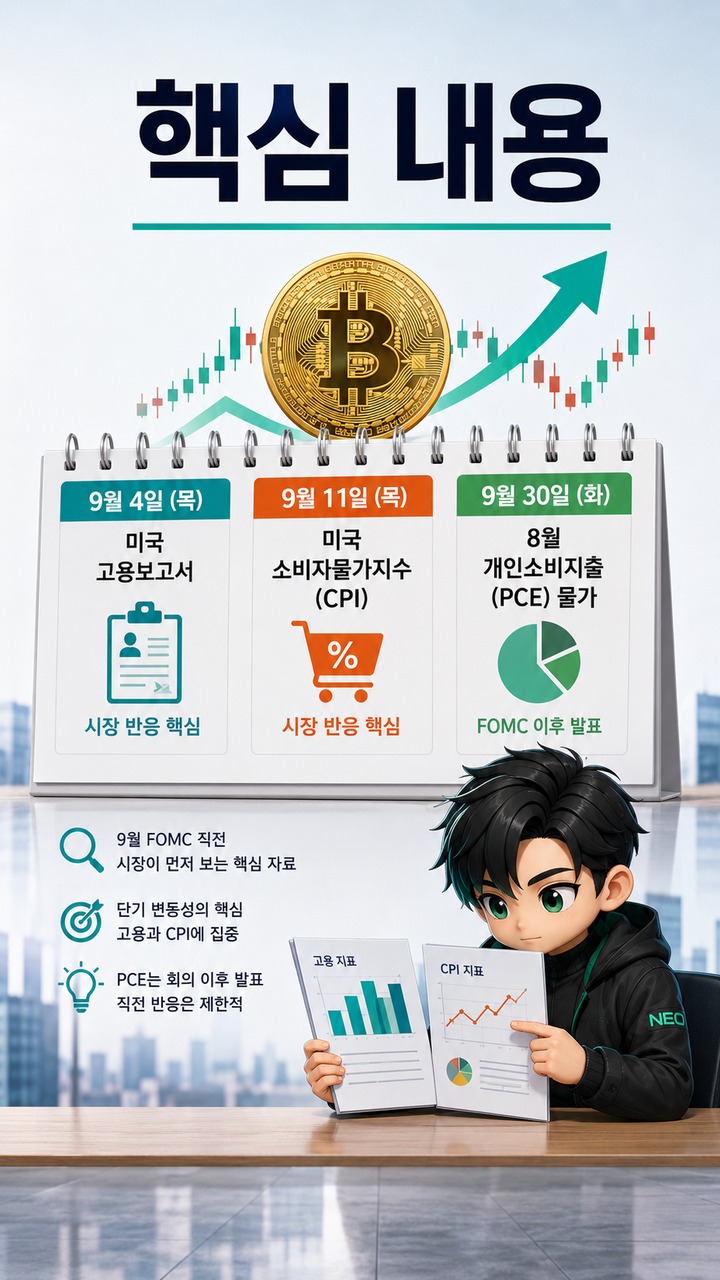
To assess Bitcoin's direction ahead of the September Federal Open Market Committee (FOMC) meeting, investors should first watch the September 4 U.S. employment report and the September 11 Consumer Price Index (CPI). In particular, the August Personal Consumption Expenditures (PCE) inflation data will not be released until September 30, after the FOMC meeting concludes. That makes employment and CPI effectively the two key economic reports most likely to move markets immediately before the September meeting.
The Federal Reserve's current policy interest rate is 3.50~3.75%, and markets are once again pricing in a substantial possibility of a rate hike in September. Rather than focusing solely on whether rates will rise or fall, investors should also examine how much of the expected outcome has already been priced in before the announcement to better understand Bitcoin's reaction.
When Is the September FOMC Meeting in Korean Time?
The Federal Reserve's September FOMC meeting will take place on September 15–16 U.S. local time. The policy statement is scheduled for September 16 at 2 p.m., followed by a press conference at 2:30 p.m.

In Korean time, these events take place early the following morning.
| Event | U.S. Eastern Time | Korean Time |
|---|---|---|
| August Employment Report | September 4, 8:30 a.m. | September 4, 9:30 p.m. |
| August Producer Price Index (PPI) | September 10, 8:30 a.m. | September 10, 9:30 p.m. |
| August Consumer Price Index (CPI) | September 11, 8:30 a.m. | September 11, 9:30 p.m. |
| FOMC Interest Rate Announcement | September 16, 2:00 p.m. | September 17, 3:00 a.m. |
| Federal Reserve Chair's Press Conference | September 16, 2:30 p.m. | September 17, 3:30 a.m. |
Korean times have been converted using U.S. Eastern Daylight Time. The September schedule published by the U.S. Bureau of Labor Statistics (BLS) also confirms that the employment report is scheduled for September 4, the PPI for the 10, and the CPI for the 11.
The First Key Variable: The September 4 U.S. Employment Report

The first figures to examine before the FOMC are August nonfarm payrolls and the unemployment rate.
If employment is considerably stronger than expected, the Federal Reserve may have more room to keep interest rates elevated for longer or consider additional monetary tightening. Conversely, if employment slows rapidly, concerns about the economy could reduce the need for further rate hikes.
This is also why markets have been paying particular attention to the employment report. Reuters reported that the August employment data scheduled for release on September 4 is being viewed as a key factor that could influence the Federal Reserve's September decision.
Bitcoin investors should not focus on just one number.
They need to examine new job creation + the unemployment rate + revisions to previous months' figures together.
That is because previously released U.S. employment statistics are sometimes revised later.
In fact, the July employment report included combined downward revisions of 103 thousand jobs to nonfarm payroll gains for May and June.
Therefore, even if new job creation exceeds expectations, substantial downward revisions to the previous two months could change how markets interpret the report.
Why the September 11 CPI Matters Even More
The final major inflation report before the September FOMC meeting is the August CPI.
Although the Federal Reserve officially targets inflation as measured by the PCE price index, the August PCE report will be released on September 30. That is after the September 16 FOMC decision.
As a result, at its September meeting, the Federal Reserve will have to evaluate the previously released July PCE data alongside the newly published August CPI and other indicators.
July PCE inflation was 3.7% year over year, while core PCE inflation was 3.3%. Both were above the Federal Reserve's long-term inflation target of 2%, making it difficult to conclude that inflation has been sufficiently brought under control.
When examining CPI, it is better to distinguish between two measures rather than looking only at the headline figure.
Headline CPI includes both food and energy prices.
Core CPI excludes food and energy, whose prices tend to be volatile, and is used to assess underlying inflation trends.
When energy prices fluctuate sharply, the two measures can move in different directions, making the market reaction less straightforward.
Will Bitcoin Automatically Rise If CPI Comes in Lower?
Not necessarily.
Bitcoin may react more strongly to the difference between market expectations and the actual reported figure than to the absolute level of an economic indicator. Another important factor is how much the data changes expectations for the Federal Reserve's future interest rate path.
For example, even if CPI falls from the previous month, the result could be viewed as disappointing if markets had already expected a larger decline.
Conversely, even if CPI remains elevated, Bitcoin's reaction may be limited if the figure matches market expectations and does not significantly alter the interest rate outlook.
In fact, when the July CPI came in close to market expectations, Bitcoin failed to establish a clear directional trend. Market attention at the time also shifted toward upcoming employment and inflation reports and the Federal Reserve's decision.
Therefore, when the data is released, it is better to examine the following factors in order.
Actual reported figure → Difference from market expectations → Revisions to previous figures → Changes in Federal Reserve interest rate expectations → Movements in U.S. Treasury yields and the dollar → Bitcoin price reaction
This is why it is difficult to determine the direction of interest rates or Bitcoin immediately based on a single number.
Right Now, Watch How the Probability of a Rate Hike Changes Rather Than Focusing on Rate Cuts
Market conditions in early September have been developing independently of President Trump's calls for interest rate cuts.
After July PCE inflation came in at 3.7%, the perceived likelihood of a rate hike in September increased again. Following Jackson Hole, markets priced in a September rate hike more aggressively than before. As of August 31, some market pricing reflected a probability of approximately 66% for a 0.25%-point increase in September.
However, this probability does not represent a confirmed Federal Reserve decision.
Market expectations can change rapidly after the employment report and CPI are released. The Federal Reserve also does not automatically set interest rates according to probabilities implied by market pricing.
For Bitcoin investors, the more important question is not simply, "Will the Fed definitely raise rates in September?" Instead, it is which direction the market's expected interest rate path moves after the employment and CPI releases.
In the Early Hours of September 17, the Press Conference Matters as Much as the Rate Announcement
Once the FOMC decision is released, investors should not stop at checking the policy interest rate alone.
The September meeting will also include the Federal Reserve's Summary of Economic Projections (SEP). The SEP contains forecasts for economic growth, unemployment, and inflation, along with the dot plot showing the future policy interest rate levels anticipated by Federal Reserve officials.
Even an unchanged interest rate can carry very different implications.
Holding rates steady while emphasizing the possibility of additional hikes sends a different message from holding rates steady while explaining that more time is needed to assess slowing inflation.
Therefore, investors should examine three factors together in the early hours of September 17.
**① The actual interest rate decision
② Changes in interest rate projections in the dot plot
③ The Federal Reserve Chair's comments on inflation and employment**
Bitcoin could also experience greater volatility depending on how these three factors affect U.S. Treasury yields and the dollar.
Key September Dates Bitcoin Investors Should Remember
The three most important dates to watch before and during the September FOMC meeting are September 4, September 11, and September 17.
On September 4, investors can assess the strength of U.S. employment. On September 11, they can determine whether inflation is beginning to decline again. Then, in the early hours of September 17, the Federal Reserve's interpretation of these two reports will become clear alongside its actual policy decision.
It is particularly important to remember that the August PCE report will not be released before this meeting.
Therefore, when Bitcoin prices fluctuate in early September, following the sequence employment → CPI → changes in interest rate expectations → FOMC will provide a better understanding of market movements than simply concluding that "expectations for rate cuts have increased" or "a potential rate hike has emerged as negative news."
Cryptocurrency prices can move sharply within a short period immediately after economic data releases. Even when actual figures match forecasts, market reactions can differ depending on expectations already priced in, bond yields, the dollar, geopolitical developments, and other factors. It is therefore difficult to determine whether to buy or sell based on any single indicator.
※ This article is provided for informational purposes to help readers understand market trends and does not constitute investment advice or a recommendation to invest in any particular security or asset. Readers are responsible for their own final investment decisions and the associated risks.
Related Articles
Bitcoin Is 4.1% Away from USD 80,000: Three Things to Check After Its 21.9% Rise on 7