

Does a Defense Minister Nominee Need National Assembly Approval? How Appointment Is Possible Without a Hearing Report

A nominee for Minister of National Defense does not require the National Assembly's consent to be appointed. Although the nominee is subject to a parliamentary confirmation hearing, the president can make the appointment after the legally prescribed procedures and additional report submission deadline have passed, even if the confirmation hearing report is not adopted.
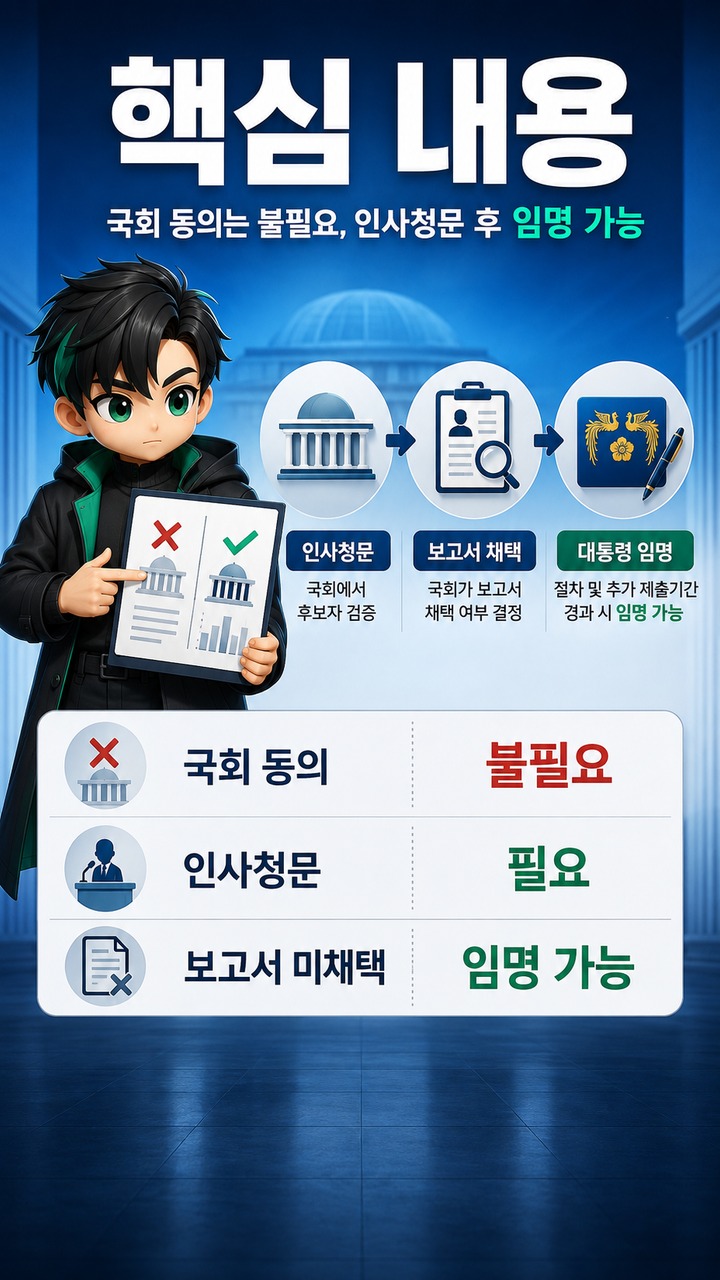
With Kang Shin-cheol, South Korea's ambassador to Saudi Arabia, nominated for Minister of National Defense on 2026-08-30, attention is now shifting to the parliamentary confirmation hearing. One of the most commonly misunderstood questions is whether a nominee must 'pass' the confirmation hearing to become a minister.
The Defense Minister Does Not Need a Majority Vote of Approval in the National Assembly
The Minister of National Defense is both a member of the State Council and the head of an executive ministry. State Council nominees are subject to parliamentary confirmation hearings, but unlike the prime minister, they do not need an appointment consent motion approved at a plenary session of the National Assembly before taking office.
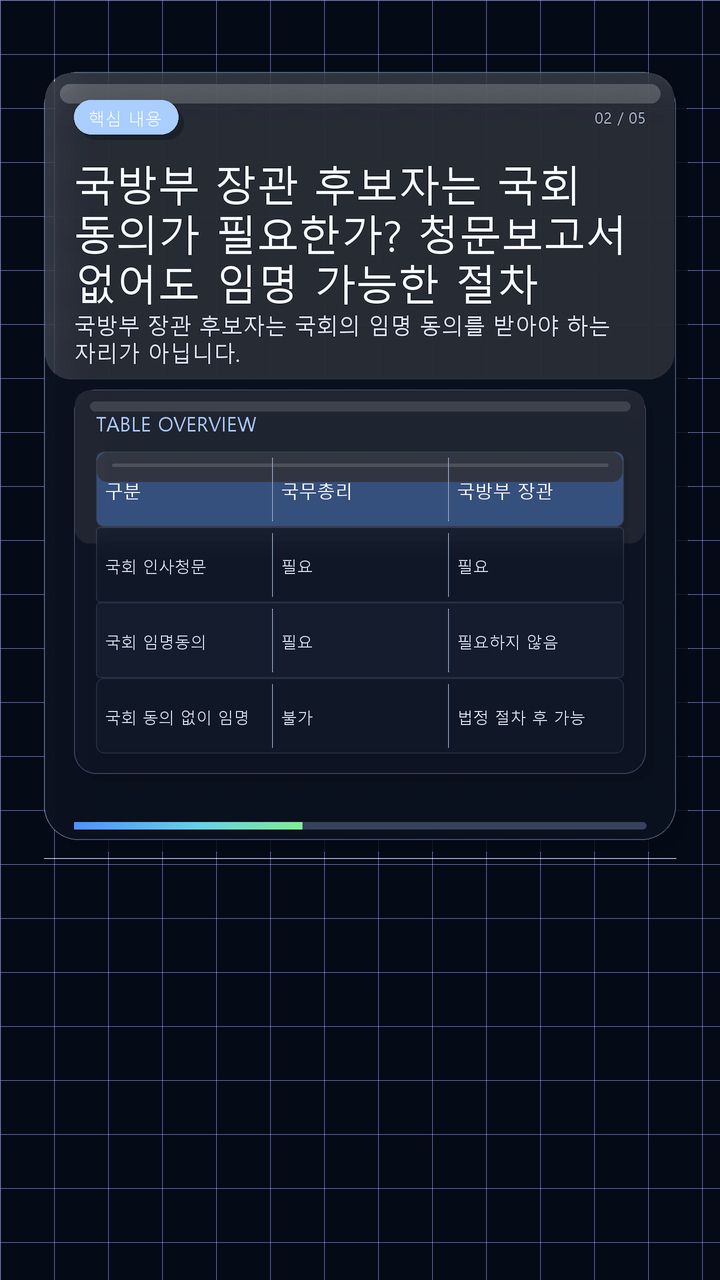
Article 65-2 of the current National Assembly Act designates nominees for membership in the State Council appointed by the president as subjects of confirmation hearings. The procedure differs from that for the prime minister, whose appointment requires National Assembly consent under the Constitution.
The distinction can be summarized as follows.
| Category | Prime Minister | Minister of National Defense |
|---|---|---|
| Parliamentary confirmation hearing | Required | Required |
| National Assembly consent to appointment | Required | Not required |
| Appointment without National Assembly consent | Not permitted | Possible after statutory procedures |
Therefore, it would be inaccurate to assume that a nominee cannot become Minister of National Defense simply because opposition lawmakers object during the confirmation hearing.
When Must the Confirmation Hearing Be Completed?
The relevant starting date is not the date the nominee is announced, but the date the president's request for a confirmation hearing is submitted to the National Assembly.
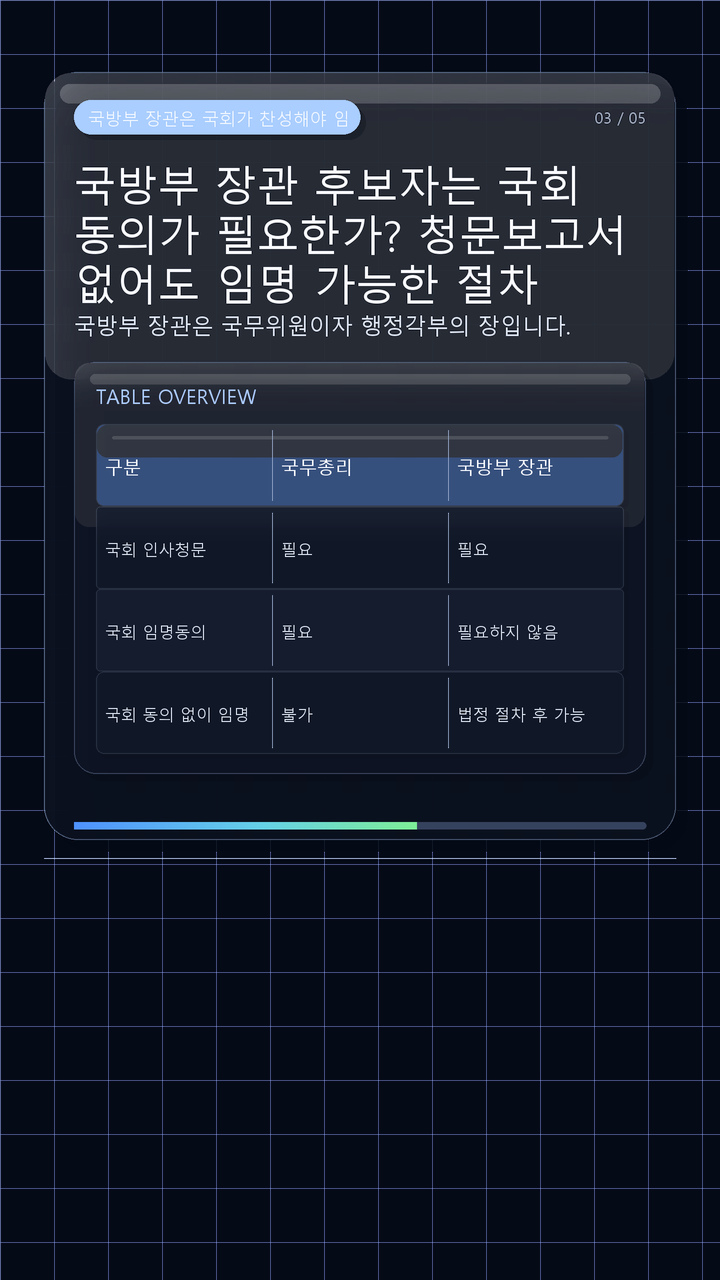
Under Article 6 of the Personnel Hearing Act, the National Assembly must complete its review or confirmation hearing within 20 days of the submission of the hearing request and related documents.
Separate deadlines also apply at the committee stage. Article 9 of the Personnel Hearing Act provides that, in principle, the confirmation hearing must be completed within 15 days of the request being referred to the committee, while the hearing itself may last no longer than 3 days. After the hearing concludes, the committee must submit its confirmation hearing report to the Speaker of the National Assembly within 3 days.
The specific date of Kang Shin-cheol's confirmation hearing will become known once the National Assembly finalizes its schedule. Therefore, neither the hearing date nor the final appointment date can be determined solely from the nomination date of August 30.
What Happens if the Confirmation Hearing Report Is Not Adopted?
Failure to adopt a confirmation hearing report does not automatically mean that the nominee's appointment has been rejected.
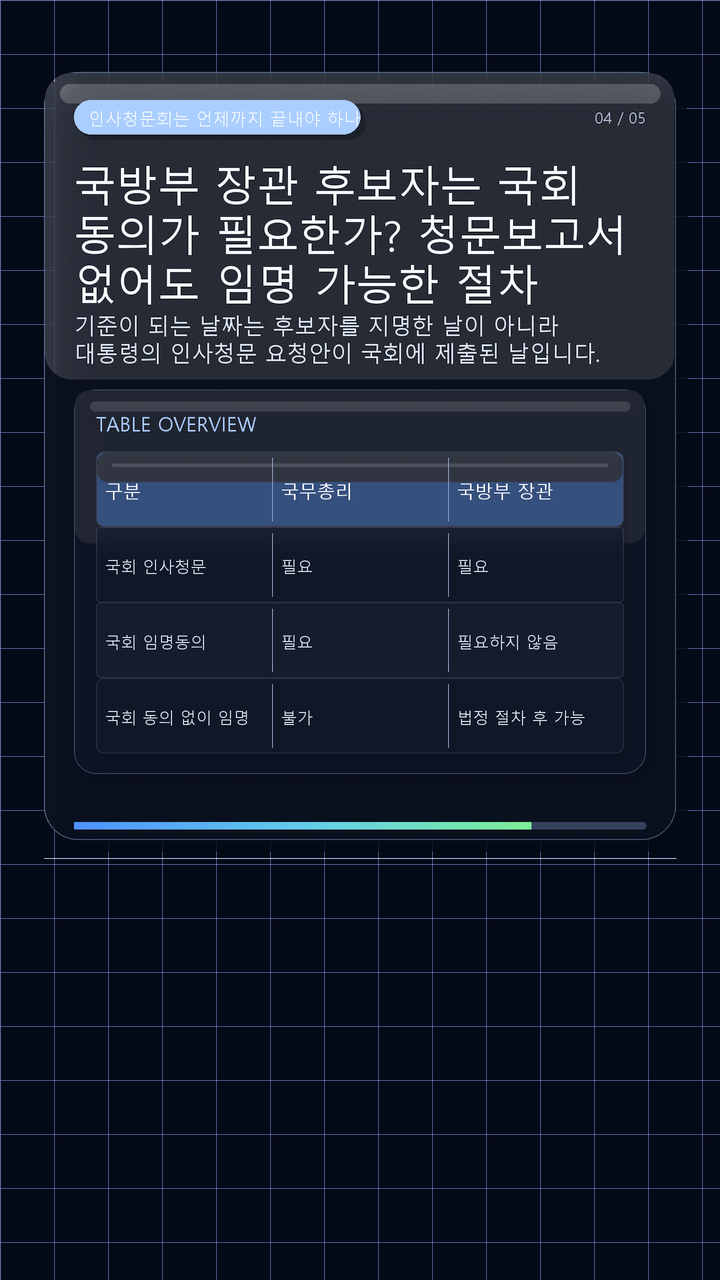
If the National Assembly fails to submit the confirmation hearing report for a State Council nominee within 20 days of the hearing request's submission, the president may, beginning the following day, set an additional period of up to 10 days and request that the report be submitted.
The process can be simplified as follows.
Submission of confirmation hearing request → National Assembly review and hearing → Submission of report within 20 days → If no report is submitted, the president sets an additional submission period of up to 10 days → If the report is still not submitted by the additional deadline, appointment becomes possible
Paragraph 4 of Article 6 of the Personnel Hearing Act allows the president to appoint the nominee if the report is not submitted within the additional period.
There have been previous cases in which ministerial nominees were appointed after the National Assembly failed to adopt their confirmation hearing reports and the deadline for a renewed submission request expired. Former Minister of National Defense Shin Won-sik was also appointed in 2023 despite the National Assembly not having adopted his confirmation hearing report.
Why Saying a Nominee Has 'Passed the Hearing' Is Not Legally Precise
Ministerial confirmation hearings are often described using phrases such as 'passed the hearing' or 'must receive parliamentary confirmation.' However, these expressions need to be distinguished when explaining the actual legal process.
A confirmation hearing for a defense minister nominee is a process through which the National Assembly examines the nominee's qualifications, integrity, and ability to perform official duties, then records its findings in a report. Unlike the appointment of a prime minister, the appointment does not depend on the passage of a consent motion at a plenary session.
The hearing report may contain an assessment that the nominee is suitable or unsuitable. It is also possible for the report itself not to be adopted because the ruling and opposition parties fail to reach an agreement.
However, the absence of a report does not, by itself, permanently prevent the president from exercising the authority to appoint a minister. What matters more is whether the statutory deadline has expired and the additional report submission request procedure has been completed.
What Procedures Remain for Nominee Kang Shin-cheol?
As of the morning of 2026-08-31, Kang Shin-cheol is a nominee for Minister of National Defense, not the Minister of National Defense. President Lee Jae-myung nominated Kang on August 30, and the National Assembly's confirmation hearing process will follow.
There are four key developments to monitor.
1. When the president's confirmation hearing request is submitted to the National Assembly
2. When the National Assembly's National Defense Committee schedules the hearing
3. Whether the confirmation hearing report is adopted
4. If the report is not adopted, how the president determines the additional submission deadline
In particular, remembering that the statutory deadline of 20 days is calculated from the submission of the confirmation hearing request, not the announcement of the nomination, will make it easier to understand the subsequent schedule.
Do the Defense Minister and Chairman of the Joint Chiefs of Staff Follow the Same Procedure?
Both positions are subject to parliamentary confirmation hearings, but the nature of the two offices differs. The current National Assembly Act explicitly includes the Chairman of the Joint Chiefs of Staff, as well as State Council members, among the officials subject to confirmation hearings.
However, whether the appointment of a particular public official requires National Assembly consent cannot be determined simply by whether a confirmation hearing is held. It is necessary to examine separately whether the Constitution or the relevant legislation requires consent to the appointment.
Therefore, when following news about appointments to senior government positions, the most accurate approach is to distinguish between 'Is this position subject to a confirmation hearing?' and 'Is National Assembly consent required for appointment?'
Key Takeaways at a Glance
Kang Shin-cheol, the nominee for Minister of National Defense, is subject to a parliamentary confirmation hearing, but National Assembly consent to his appointment is not mandatory.
The National Assembly must carry out the relevant procedures within 20 days after the confirmation hearing request is submitted. If the report is not forwarded, the president may set an additional period of up to 10 days and request its submission. If the report is still not received within that additional period, the president may appoint the nominee in accordance with the law.
Therefore, when following Kang Shin-cheol's appointment process, it is important to check not only whether the confirmation hearing report has been adopted, but also the date the hearing request was submitted, the 20-day deadline, whether an additional submission request was made, and when that additional period expires.