

Kang Shin-cheol Nominated for Defense Minister: From Sitting Ambassador to Defense Chief Nominee, with Parliamentary Hearing Next

2026-08-30 President Lee Jae-myung nominated Kang Shin-cheol, South Korea's Ambassador Extraordinary and Plenipotentiary to Saudi Arabia, as Minister of National Defense. He has not yet been appointed defense minister, and the current minister is Ahn Gyu-back. Kang is a retired 4-star general who previously served as Deputy Commander of the ROK-U.S. Combined Forces Command and Chief Director of Operations at the Joint Chiefs of Staff. He must now undergo a parliamentary confirmation hearing.
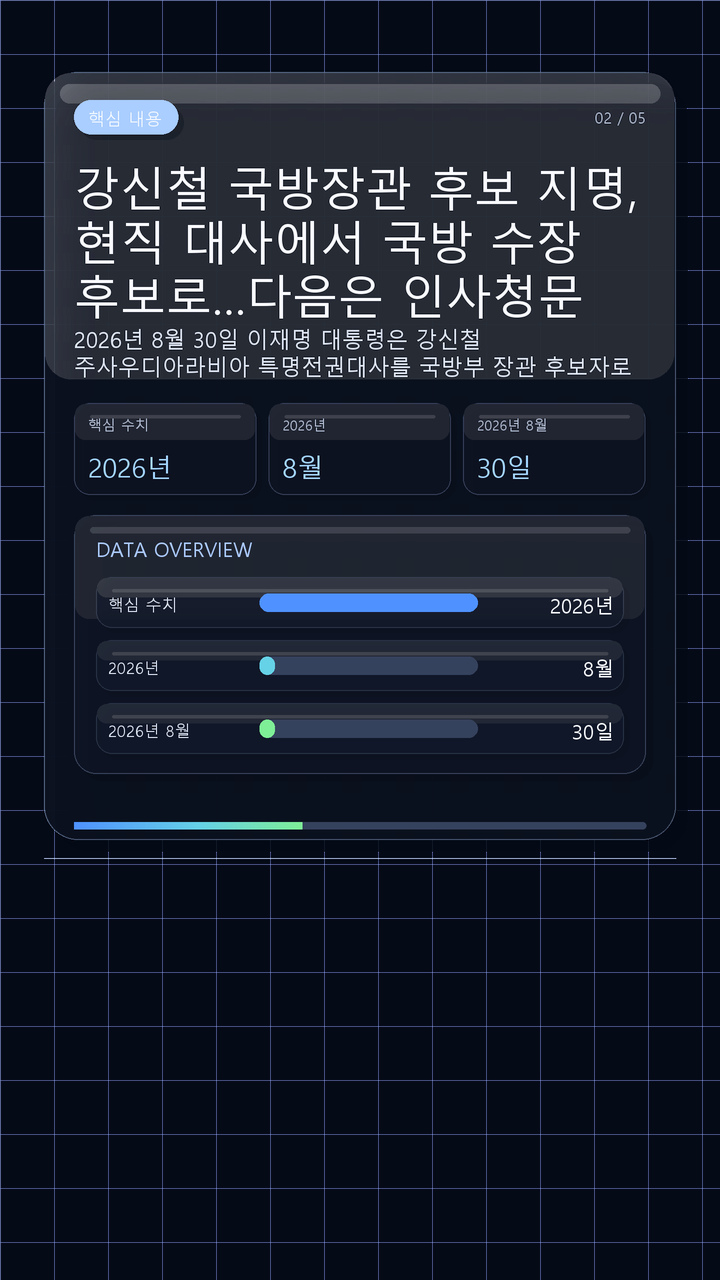
This nomination is one of the ministerial appointments announced that day across 6 ministries. Three aspects of Kang's nomination are particularly important to establish: his professional background, the responsibilities the presidential office has officially said it expects him to fulfill, and the procedures remaining before he can actually become defense minister.
Who Is Kang Shin-cheol, the Defense Minister Nominee?
Kang Shin-cheol currently serves as South Korea's Ambassador Extraordinary and Plenipotentiary to Saudi Arabia. During his military career, he rose to the rank of general and subsequently served as Deputy Commander of the ROK-U.S. Combined Forces Command. His experience across the Ministry of National Defense, Joint Chiefs of Staff, National Security Office, and ROK-U.S. Combined Forces Command is among the most notable features of his nomination.
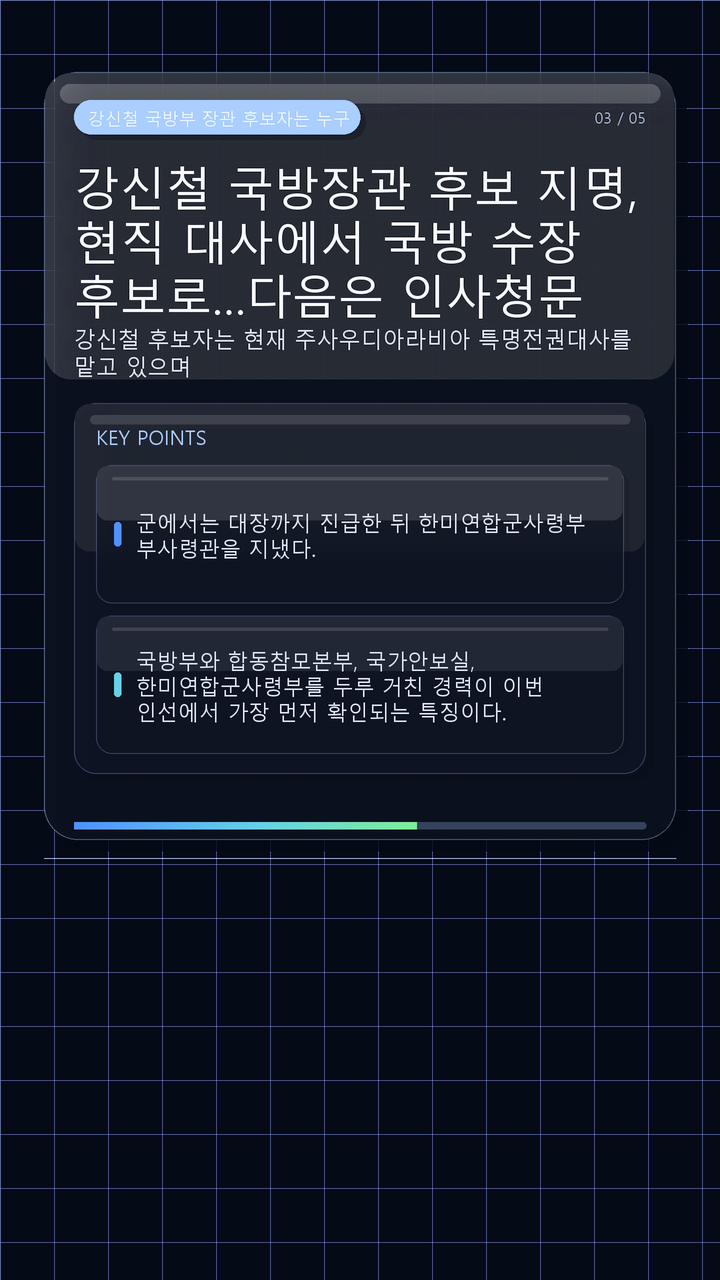
Kang graduated from the 46th class of the Korea Military Academy. His military appointments included Chief of Policy at the ROK-U.S. Combined Forces Command, Military Aide to the Minister of National Defense, Director General of Strategic Planning at the Joint Chiefs of Staff, Secretary for Defense Reform and Secretary for Security and Defense Strategy at the National Security Office, Deputy Commander of the Ground Operations Command, and Chief Director of Operations at the Joint Chiefs of Staff.
In 2023, he was promoted to general and appointed Deputy Commander of the ROK-U.S. Combined Forces Command, a position he held until September 2025. After retiring from military service, he moved into diplomacy and has served as ambassador to Saudi Arabia since January 2026.
In other words, this nomination does not involve an active-duty military officer moving directly into consideration for defense minister. Instead, a retired general who was serving as a diplomat has been nominated to return to the defense sector as a candidate for a Cabinet position.
What Reasons Did the Presidential Office Give for Kang Shin-cheol's Nomination?
The presidential office's official briefing on August 30 focused on the ROK-U.S. alliance, preparations for future warfare, strengthening independent national defense capabilities, and defense reforms, including the integration of military academies. These stated priorities should be distinguished from interpretations offered by politicians or the media.

The presidential office described Kang as a former 4-star general who had held major positions, including Chief Director of Operations at the Joint Chiefs of Staff. It added that the government expects him to strengthen independent defense capabilities in preparation for future warfare, building on the ROK-U.S. alliance, and to pursue defense reforms that include integrating military academies.
What stands out is the relatively direct connection between Kang's professional experience and the priorities publicly outlined by the government.
His experience as Deputy Commander of the ROK-U.S. Combined Forces Command demonstrates familiarity with the combined defense structure, while the Chief Director of Operations at the Joint Chiefs of Staff is responsible for a central area of military operational command and planning. At the National Security Office, Kang also handled responsibilities related to defense reform and security and defense strategy.
However, his background alone does not establish the political intentions behind his nomination or predetermine the outcomes of particular policies. What can be confirmed from the official announcement on August 30 is his career history and the scope of responsibilities the government says it expects him to undertake.
What Would Be the Biggest Change from Defense Minister Ahn Gyu-back's Leadership?
If Kang Shin-cheol is ultimately appointed, the defense minister's professional background would shift from that of a politician to that of a retired 4-star general. The Ministry of National Defense currently identifies Ahn Gyu-back as its minister. Ahn comes from a political background, having served as a National Assembly member and chair of the National Assembly's National Defense Committee.
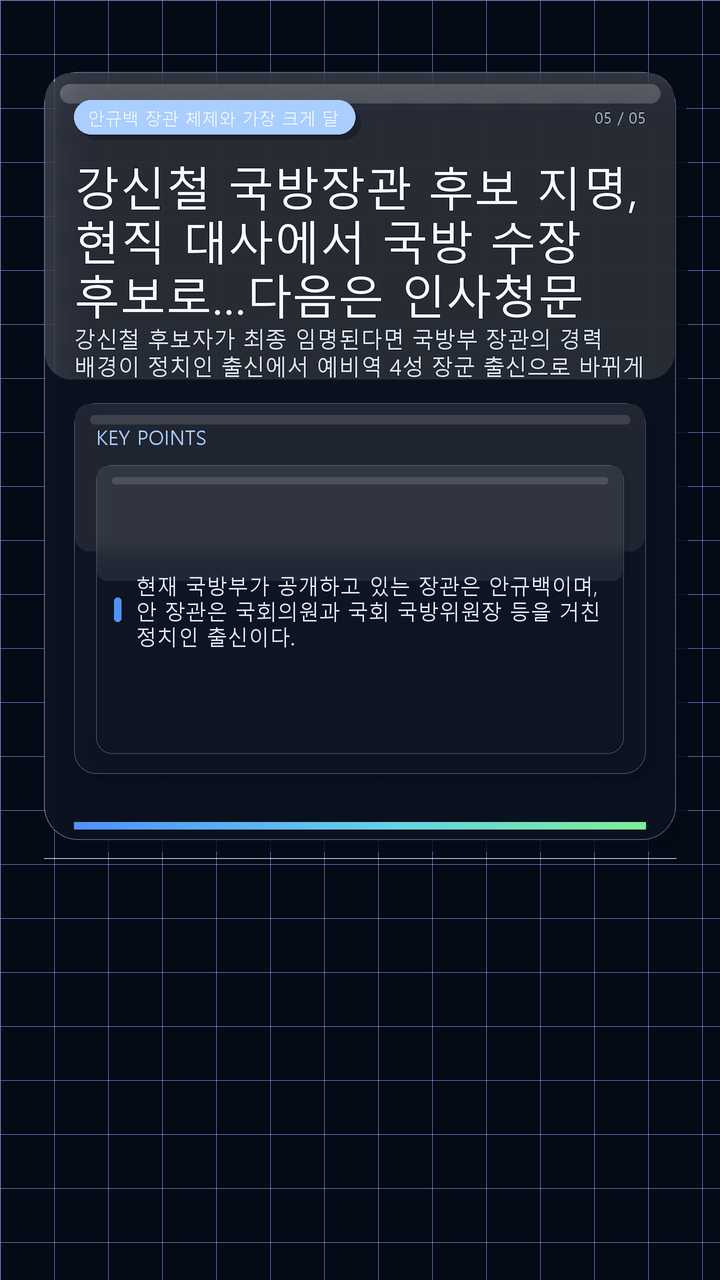
By contrast, Kang built his career primarily around military command, operations, and defense policy. His service as Deputy Commander of the ROK-U.S. Combined Forces Command and Chief Director of Operations at the Joint Chiefs of Staff highlights his experience with military organizations and combined operations.
This difference does not automatically mean that the overall direction of national defense policy will change. At the nomination stage, it is not possible to state definitively what specific policy changes will follow.
The policy areas specifically mentioned in the current official announcement include preparations for future warfare, strengthening independent national defense capabilities, and integrating military academies. Any actual policy changes will therefore need to be assessed separately through Kang's answers during his parliamentary hearing and the policies announced by the Ministry of National Defense after his final appointment.
Is the Transfer of Wartime Operational Control Also an Official Reason for This Nomination?
The transfer of wartime operational control has been discussed as a major defense issue in connection with Kang Shin-cheol's experience at the ROK-U.S. Combined Forces Command. However, the presidential office's nomination announcement on August 30 did not explicitly mention the transfer of wartime operational control.
Given Kang's experience as Deputy Commander of the ROK-U.S. Combined Forces Command, media reports have linked his nomination to wartime operational control transfer and issues involving combined ROK-U.S. defense. The deputy commander position is indeed one of the highest-ranking South Korean military posts directly involved in the combined defense structure.
Nevertheless, stating definitively that the government nominated Kang specifically to facilitate the transfer of wartime operational control would go beyond what the presidential office has publicly announced.
Based on the presidential office's own wording, the explicitly identified priorities are strengthening independent defense capabilities through the ROK-U.S. alliance, preparing for future warfare, and pursuing defense reforms, including military academy integration. Regarding wartime operational control, it would be more accurate to examine whether Kang clarifies his position and intended approach during the upcoming parliamentary confirmation hearing.
When Will Kang Shin-cheol Become Defense Minister?
As of 11:2 p.m. Korea Standard Time on August 30, Kang Shin-cheol remains the 'Minister of National Defense nominee.' The presidential office's announcement that day did not complete his appointment as minister, nor did it specify a date for his parliamentary confirmation hearing or inauguration.
Because the Minister of National Defense is a Cabinet member, the nominee is subject to a parliamentary confirmation hearing. Under the current National Assembly Act, the relevant standing committee must hold confirmation hearings for candidates nominated by the president to serve as Cabinet members.
Following the nomination, a request for a confirmation hearing is therefore submitted to the National Assembly, where lawmakers examine the nominee's professional background, assets, policy capabilities, and other matters requiring scrutiny.
It is easy to confuse the appointment procedures for the prime minister with those for ordinary Cabinet members. Candidates for Cabinet positions such as Minister of National Defense must undergo parliamentary confirmation hearings, but the procedure differs from that for the prime minister, whose appointment requires consent from the National Assembly in a plenary session.
To determine when Kang Shin-cheol actually takes office, it is necessary to follow the subsequent parliamentary hearing schedule and the president's final appointment decision, rather than relying solely on news of his nomination.
What to Watch Next: The Confirmation Hearing and Future Defense Policy
Based solely on the information released on the day of the nomination, the significance of Kang Shin-cheol's selection is clear. A retired 4-star general who currently serves as ambassador to Saudi Arabia and previously held the positions of Deputy Commander of the ROK-U.S. Combined Forces Command and Chief Director of Operations at the Joint Chiefs of Staff has been selected as the defense minister nominee. The government has identified preparations for future warfare, strengthening independent defense capabilities, and defense reforms such as military academy integration as key areas in which it expects him to contribute.
The next important information will emerge during the confirmation hearing. Kang's responses may clarify how he intends to pursue military academy integration, address the ROK-U.S. alliance and combined defense issues, and prioritize defense reform.
Conversely, it would be premature to treat predictions made on the day of the nomination as policies that have already been decided. Kang is not yet defense minister, and neither a specific hearing schedule nor an inauguration date was confirmed in the official personnel announcement on August 30.
At this stage, the most accurate description is 'Kang Shin-cheol nominated for Minister of National Defense,' rather than 'Kang Shin-cheol takes office as Minister of National Defense.'