
South Korea–Brazil Summit Results: Resuming Mercosur Negotiations, 7 MOUs, and What Remains Unconfirmed
이 포스팅은 쿠팡 파트너스 활동의 일환으로, 이에 따른 일정액의 수수료를 제공받습니다.
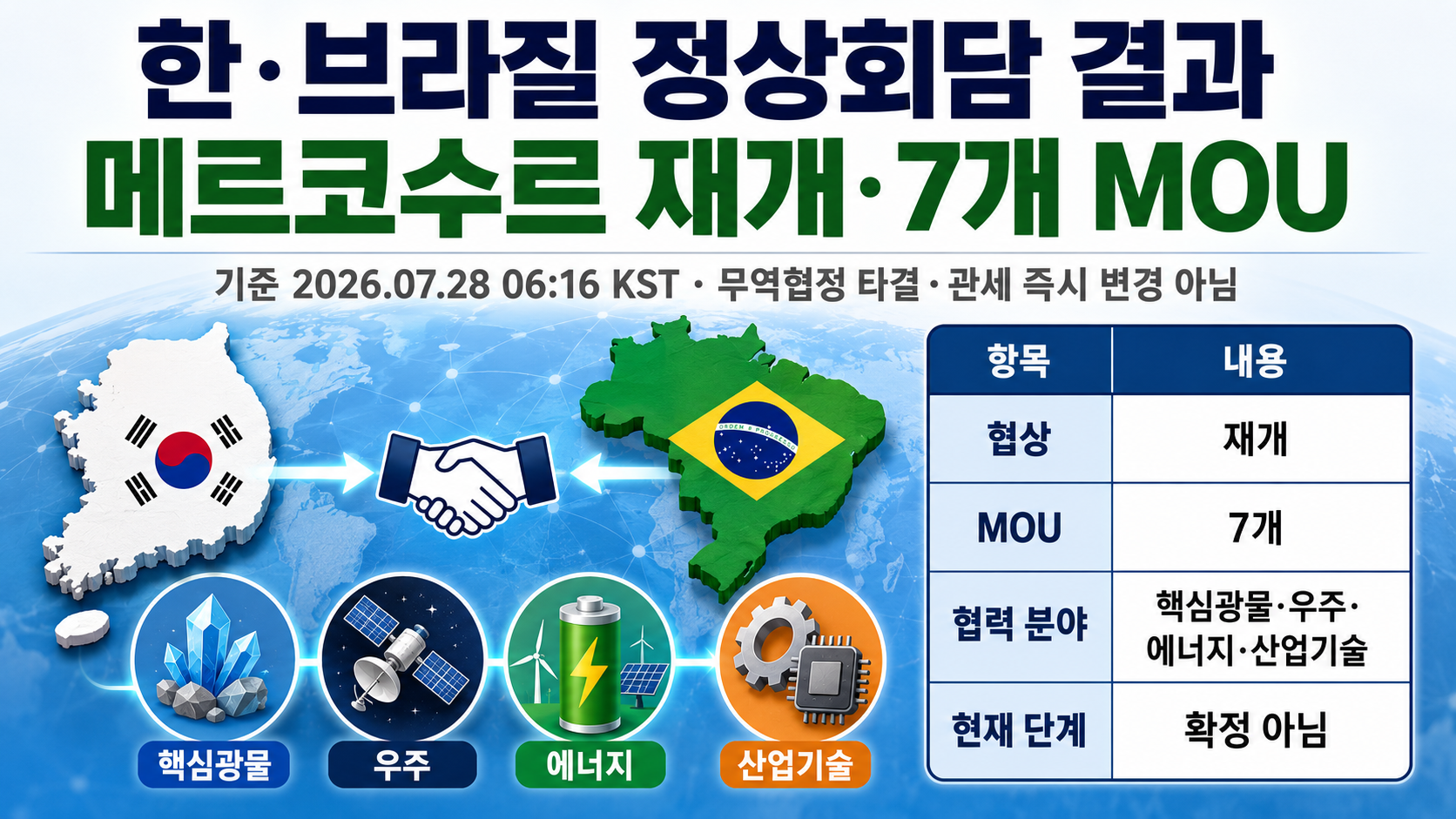
2026-07-27 local time, South Korea and Brazil agreed at their summit to accelerate negotiations on a Mercosur trade agreement and expand cooperation in critical minerals, space, energy, and industrial technology. However, the trade agreement has not been concluded, and tariffs or import conditions have not yet changed.
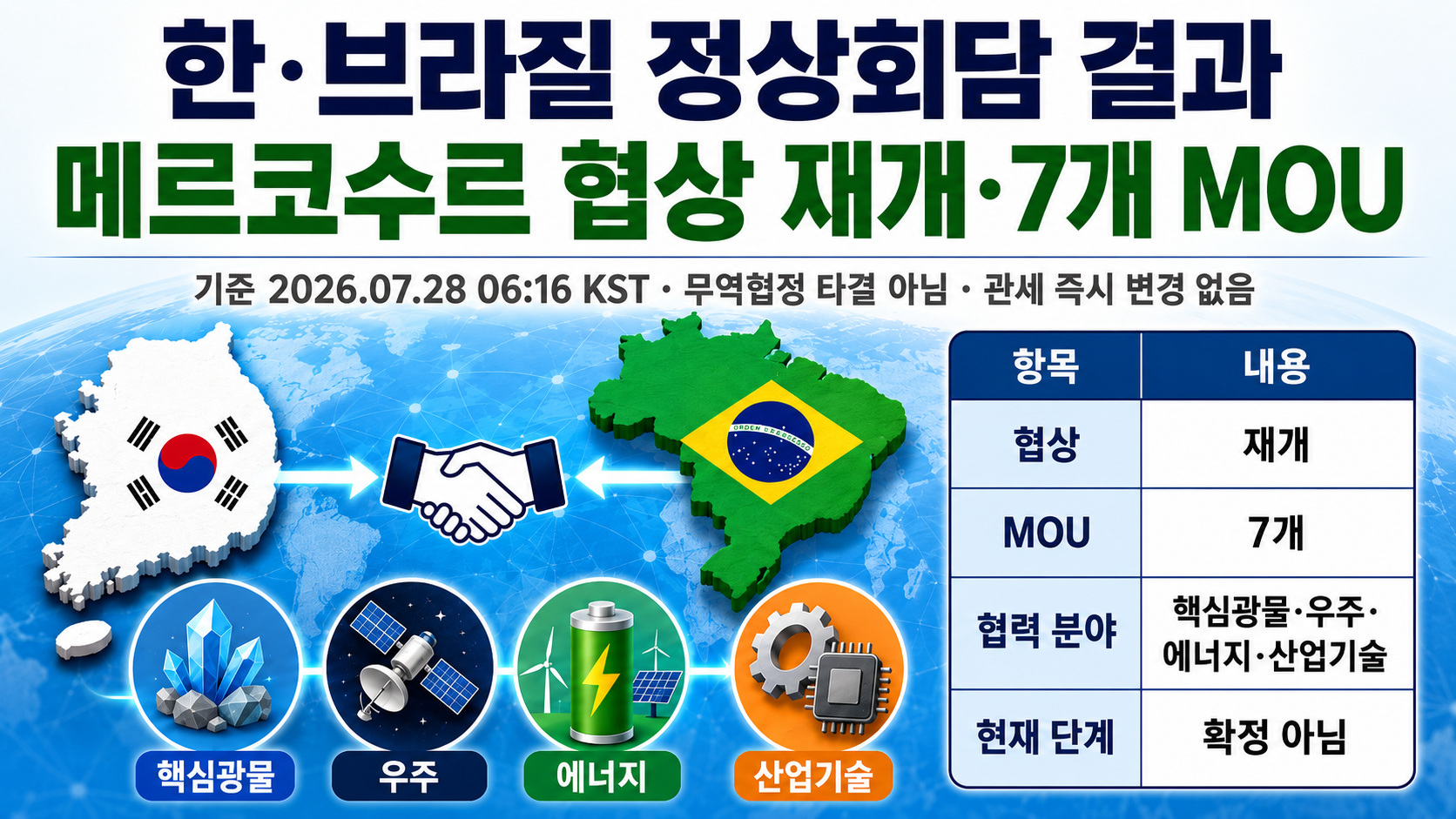
The information is current as of 2026-07-28, at 6:16 a.m. Korea Standard Time. Some schedules may change depending on further details in newly announced joint statements and subsequent government measures.
What Did the Two Countries Actually Agree on at the Summit?
South Korea and Brazil designated 2026 as the inaugural year of a new phase in their strategic partnership and agreed to expand cooperation in economic affairs and trade, critical minerals, defense and space, culture and education, and international coordination.
The most significant development is that the two countries agreed to move beyond declarations and continue follow-up discussions through an economic and trade working group and sector-specific cooperation documents.
| Category | Announcements Made at the Summit | Current Status |
|---|---|---|
| South Korea–Mercosur Trade Agreement | Confirmed the need to resume and accelerate negotiations | Not yet concluded |
| Critical Minerals | Expand cooperation across the supply chain, including mining, processing, and materials | Follow-up consultations between relevant institutions |
| Space | Streamline procedures for using Brazilian launch facilities and cooperate on satellite data | Domestic regulatory revisions required |
| Energy | Cooperate on renewable energy, power grids, and smart grids | Identifying potential joint projects |
| Defense | Establish a joint defense committee and pursue an agreement on protecting classified information | Agreement not yet signed |
| Industrial Technology | Research and development cooperation in AI, semiconductors, automobiles, shipbuilding, batteries, and other fields | Consultations based on MOUs |
| Culture and Education | Expand Korean-language education, film cooperation, and sports exchanges | Projects to be implemented by individual institutions |
What Is Included in the 7 MOUs?
The cooperation documents signed or announced in connection with the summit cover 7 areas, including space, sports, education, energy, industrial technology, film, and cybersecurity.
Some sources describe them more precisely as 6 memorandums of understanding and 1 letter of cooperation in education. Although several news reports refer to them collectively as '7 MOUs' for convenience, distinguishing the document types makes it more accurate to describe them as 6 MOUs and 1 letter of cooperation.
1. Space Cooperation
The aim is to reduce duplicate launch authorization procedures that Korean companies have previously had to complete in both countries when using Brazilian launch facilities.
Cooperation also covers lunar exploration, the space industry, and the sharing of satellite imagery data. However, the simplified procedures will not take effect immediately. The Korean government still needs to revise the relevant administrative notice in the second half of 2026.
2. Energy Cooperation
The two countries will pursue policy and technology exchanges and joint projects in renewable energy, power grids, smart grids, and energy efficiency.
This represents an opportunity to broaden the foundation for Korean companies to participate in Brazil's energy market, but specific project names and contract values have not been finalized.
3. Industrial Technology Cooperation
Industrial technology cooperation covers fundamental supply chain components, the bioeconomy, sustainable fuels, industrial decarbonization, and low-carbon materials, as well as AI, semiconductors, automobiles, shipbuilding, and batteries.
The objective is to expand cooperation beyond simply buying and selling products to include joint research and development and technological collaboration.
4. Education, Sports, and Film Cooperation
The two countries will work to expand Korean-language education in Brazil's regular school system, share AI and digital education policies, and promote exchanges between athletes and coaches.
In the film sector, they renewed a cooperation document signed in 2015 to expand opportunities for co-production exchanges and screenings of each other's films.
5. Cybersecurity Cooperation
Institutions in both countries will pursue cooperation in responding to cyber incidents, joint research, policy exchanges, and professional workforce development.
This could improve opportunities for Korean cybersecurity companies to enter Latin American markets, but it does not automatically provide company-specific support programs or contracts.
Has the South Korea–Mercosur Trade Agreement Been Signed?
No. The South Korea–Mercosur trade agreement was neither concluded nor brought into force at this summit.
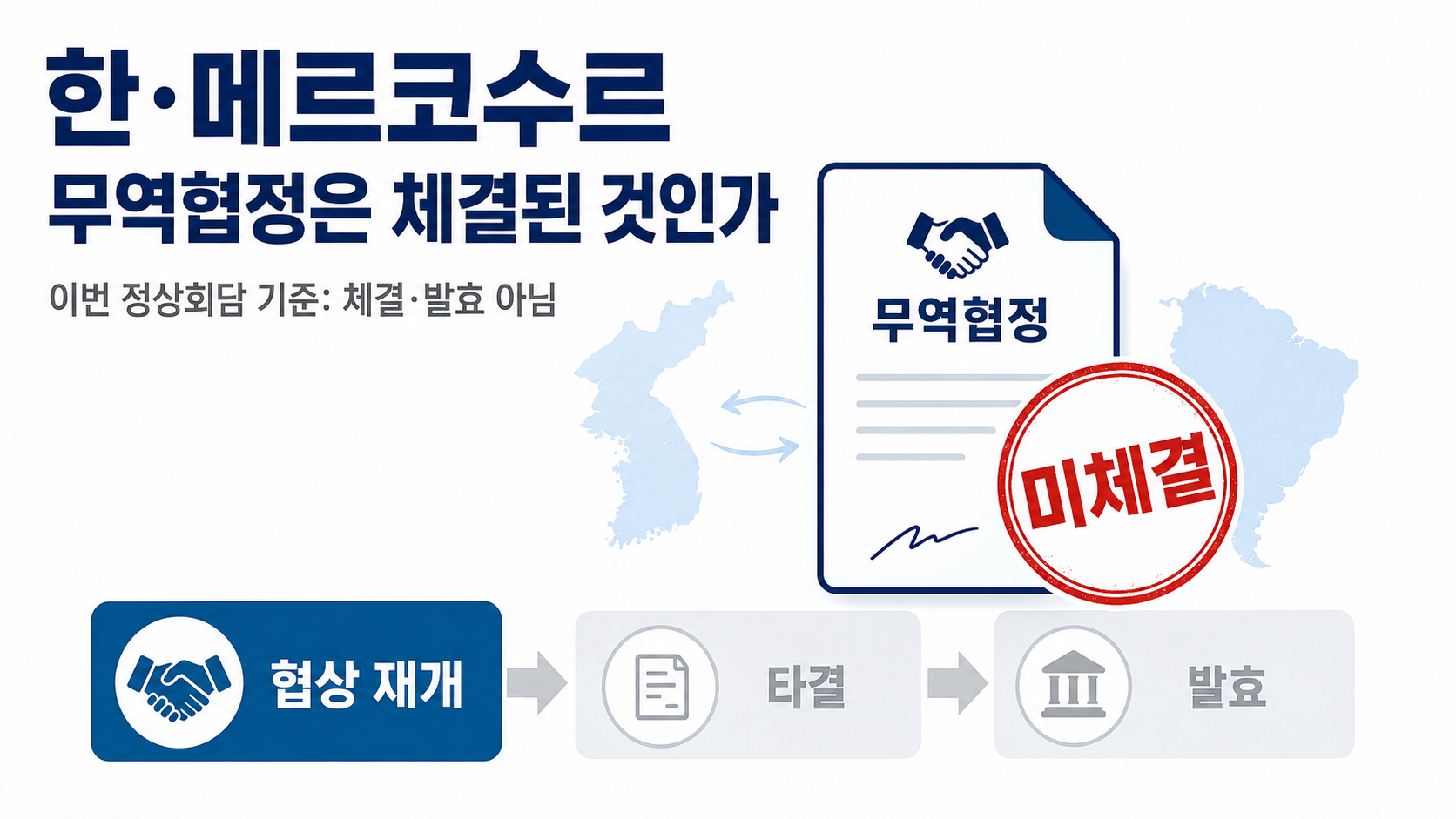
South Korea and Brazil agreed to establish a working group to accelerate negotiations. Because an agreement must be reached with Mercosur as a whole, comprising Brazil, Argentina, Paraguay, and Uruguay, an understanding with Brazil's president alone does not finalize the agreement.
It is therefore important to distinguish between the following statements at this stage.
| Statement | Accuracy |
|---|---|
| The countries agreed on the need for a South Korea–Mercosur trade agreement | Correct |
| They will pursue a working group to resume negotiations | Correct |
| Tariffs between South Korea and Brazil have already been reduced | Incorrect |
| Imports of Brazilian agricultural and livestock products will immediately increase | Incorrect |
| The signing and effective dates of the trade agreement have been finalized | Incorrect |
For the trade agreement to be concluded, further negotiations are required on product-specific tariffs, protection of agricultural and livestock products, rules of origin, and the scope of liberalization in services and investment. Even after negotiations are concluded, signing, domestic procedures, and entry into force will still be required.
Why Is Critical Minerals Cooperation Drawing Attention?
Brazil has abundant mineral resources, including rare earth elements and nickel, that are essential for advanced manufacturing. South Korea has competitive manufacturing industries in semiconductors, batteries, automobiles, and shipbuilding, creating opportunities to connect the strengths of the two countries.
Rather than focusing solely on importing minerals, the agreement aims to expand cooperation across the entire supply chain, from exploration, mining, refining, and processing to materials production.
However, investments in specific mines, the scale of Korean companies' participation, and supply volumes and prices have not been finalized. The commercial viability of actual projects can only be assessed after reviewing subsequent contracts and environmental and permitting requirements.
When Will the Benefits of Space Cooperation Become Tangible?
The first development to watch is the revision of a domestic administrative notice scheduled for the second half of 2026.
The purpose of the space cooperation document is to reduce duplicate approvals and administrative burdens when Korean companies use Brazilian launch facilities. Once the relevant regulations are updated, this could help shorten launch preparation periods and reduce administrative costs.
The two countries are also pursuing an additional launch of a jointly developed launch vehicle from Brazil's Alcântara Launch Center in September 2026. Launch schedules may change depending on weather, technical inspections, and local approvals, so announcements from launch organizations and government authorities should be checked again.
Will Anything Change Immediately for Korean Consumers or Markets?
No new support program has been introduced that ordinary citizens can immediately apply for or receive. The summit primarily established an institutional framework that governments, companies, and research organizations can use to pursue follow-up projects.
Businesses and industry stakeholders should monitor the following developments:
Space companies: Procedures for using Brazilian launch facilities and revisions to Korean administrative notices
Battery and semiconductor companies: Rare earth and nickel supply chain consultations and investment contracts
Energy companies: Announcements of joint renewable energy and power grid projects
Defense companies: Launch of the joint defense committee and an information protection agreement
Content companies: Film co-production and support programs for local screenings

Educational institutions: Expansion of Korean-language education and exchange programs in Brazil
Import conditions for Brazilian food and meat products will not change immediately as a result of the summit alone. They must separately pass sanitary and quarantine assessments and product-specific import procedures.
Why Do Reports Give Different Summit Durations?
Some early reports described the summit as lasting 136 minutes, while others reported 140 minutes.
Calculating directly from the publicly reported start time of 11:8 a.m. and end time of 1:28 p.m. gives 2 hour and 20 minutes, or 140 minutes.
Author's Calculation
1:28 p.m. - 11:8 a.m.
2 hour and 20 minutes
Total: 140 minutes
The figure of 136 minutes may have been calculated using the actual time participants were seated or the time spent conducting the meeting, but the official detailed calculation method requires further confirmation.
Upcoming Developments to Watch
The summit's achievements may be assessed differently depending on whether the announced follow-up measures are actually implemented.
1. Formation of the South Korea–Mercosur trade agreement working group and its first meeting
2. Results of sanitary and quarantine assessments for Brazilian livestock products
3. Revision of Korean administrative notices related to space launch authorization in the second half of 2026
4. Launch schedule at the Alcântara Launch Center in September 2026
5. Whether the South Korea–Brazil joint defense committee is established in the second half of the year
6. Announcements of joint critical minerals projects and Korean companies' participation
Frequently Asked Questions
Will Tariffs Be Reduced Immediately Because of the South Korea–Brazil Summit?
No. The South Korea–Mercosur trade agreement is still in the negotiation stage, and neither the details of product-specific tariff reductions nor the effective date have been finalized.
Are the 7 MOUs Legally Binding?
MOUs generally establish the direction and principles of cooperation. Actual budgets, projects, and corporate contracts require further consultations in each sector.
Will South Korea Immediately Begin Receiving Brazilian Rare Earth Minerals?
The countries agreed to expand supply chain cooperation, but this is not a finalized contract specifying supply volumes, prices, or participating companies. Further announcements from relevant institutions and businesses should be monitored.
The central achievement of the South Korea–Brazil summit was not the conclusion of a trade agreement, but the establishment of a working-level framework to restart negotiations and a foundation for sector-specific cooperation. Tangible progress can be assessed by monitoring the trade agreement negotiation schedule, revisions to space-related regulations, critical minerals investment contracts, and whether the joint defense committee is established.
이 포스팅은 쿠팡 파트너스 활동의 일환으로, 이에 따른 일정액의 수수료를 제공받습니다.