

Do You Have to Pay KRW 285,000 in National Pension Contributions Immediately After Leaving Your Job? You Can Apply for a Contribution Exemption If You Have No Income

Leaving your job does not automatically mean that the KRW 142,500 you paid toward the National Pension at work will immediately become KRW 285,000 and be charged without exception. If you have no income after leaving your job, you can apply for a 'contribution exemption' to temporarily suspend payments, even if you become an individually insured contributor. However, you should also be aware that periods covered by a contribution exemption do not count toward your National Pension contribution period.
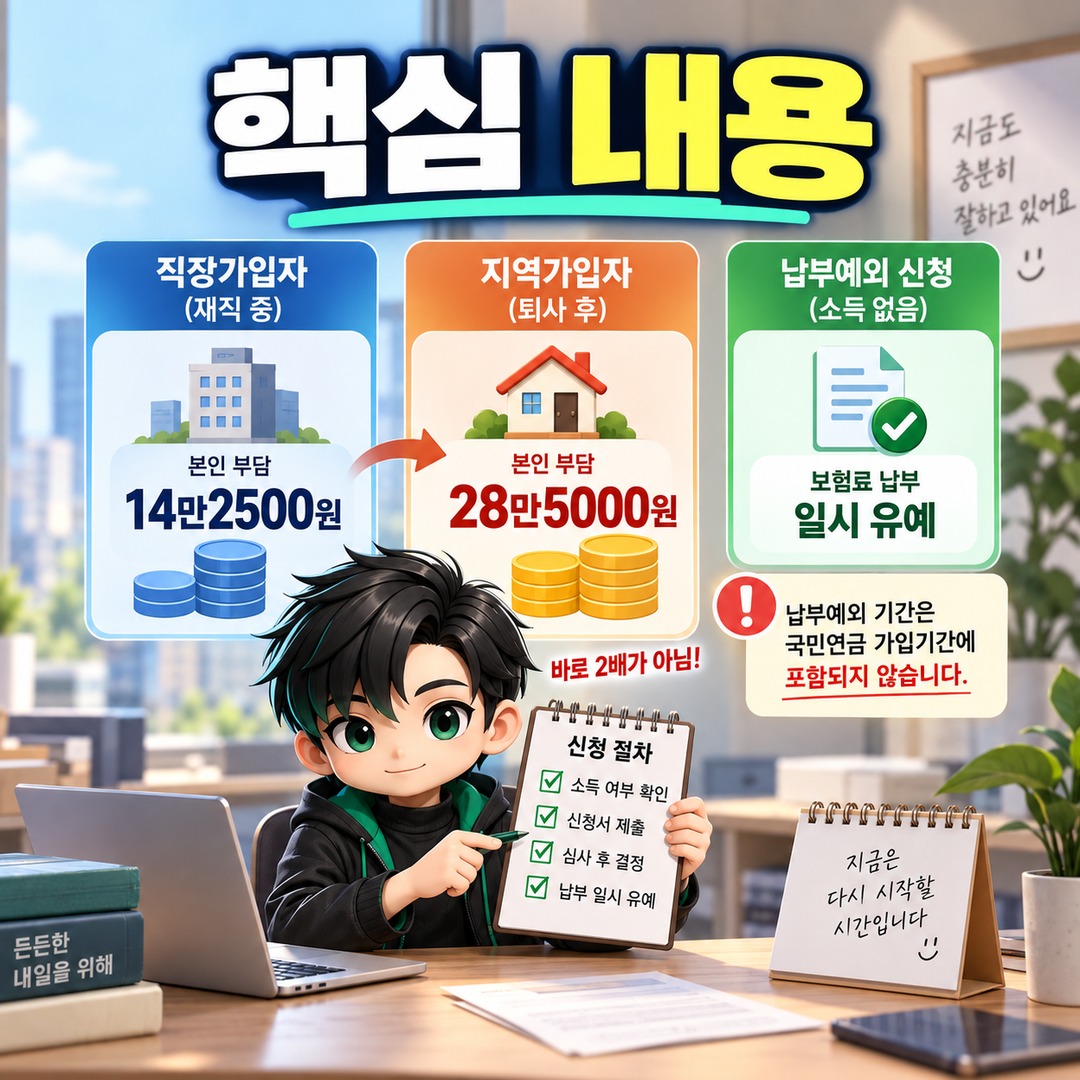
The National Pension contribution rate for 2026 is 9.5%. Employees and employers each pay 4.75%, while individually insured contributors are generally responsible for the full 9.5%. This is why, using a monthly standard income of KRW 3,000,000, the amounts differ between KRW 142,500 and KRW 285,000.
Why Does a Salaried Employee Earning KRW 3,000,000 Appear to Go From Paying KRW 142,500 to KRW 285,000 After Leaving Their Job?
The difference is not caused by the contribution rate doubling. It is because the employer no longer pays half of the contribution.
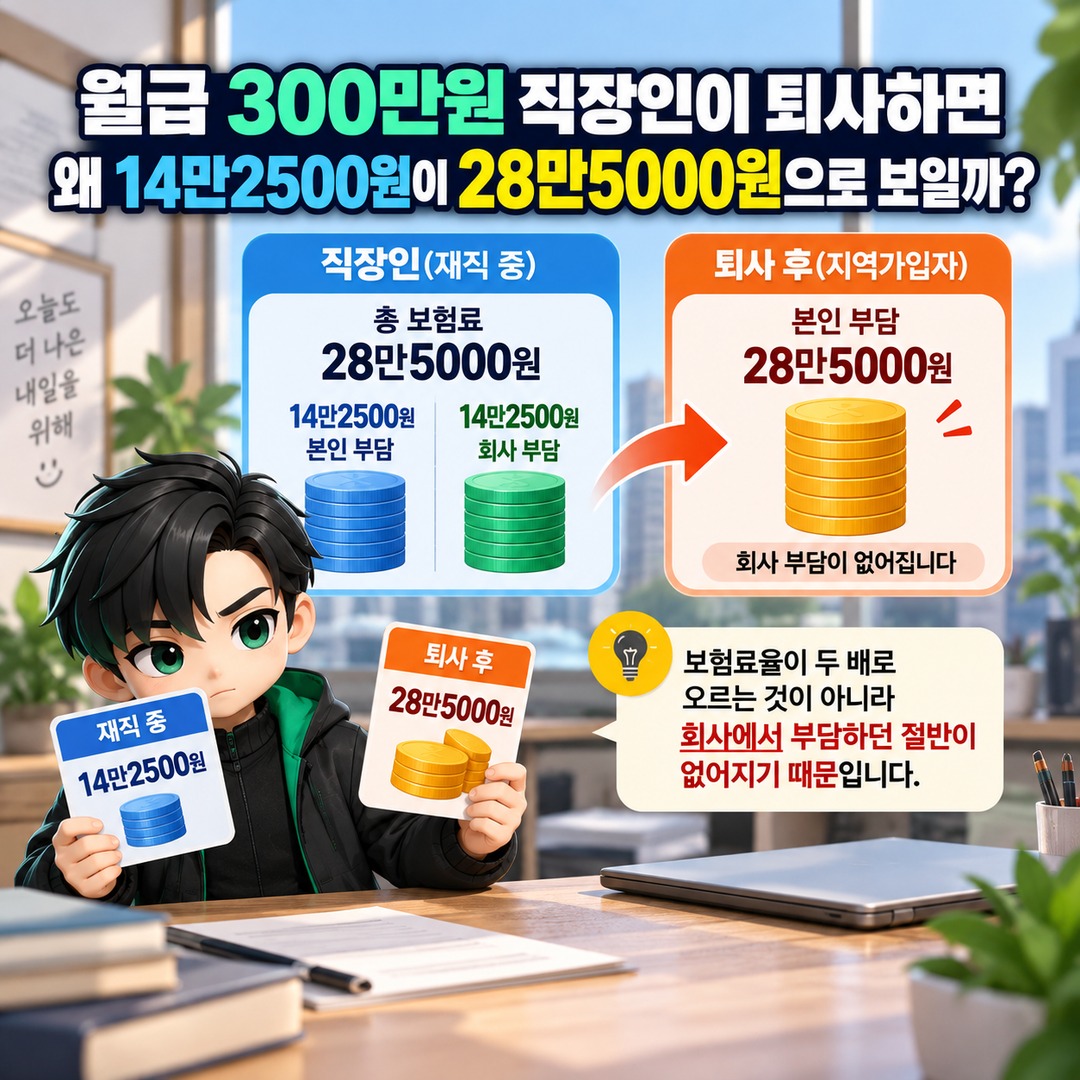
In 2026, the total National Pension contribution rate for workplace-based insured employees is 9.5%. Employees pay 4.75%, and employers pay 4.75%. By contrast, individually insured contributors are generally responsible for the entire contribution.
Assuming a standard monthly income of KRW 3,000,000, the breakdown is as follows.
| Category | Individual's Share | Employer's Share |
|---|---|---|
| Workplace-based insured employee | KRW 142,500 | KRW 142,500 |
| Individually insured contributor | KRW 285,000 | None |
Author's Calculation:
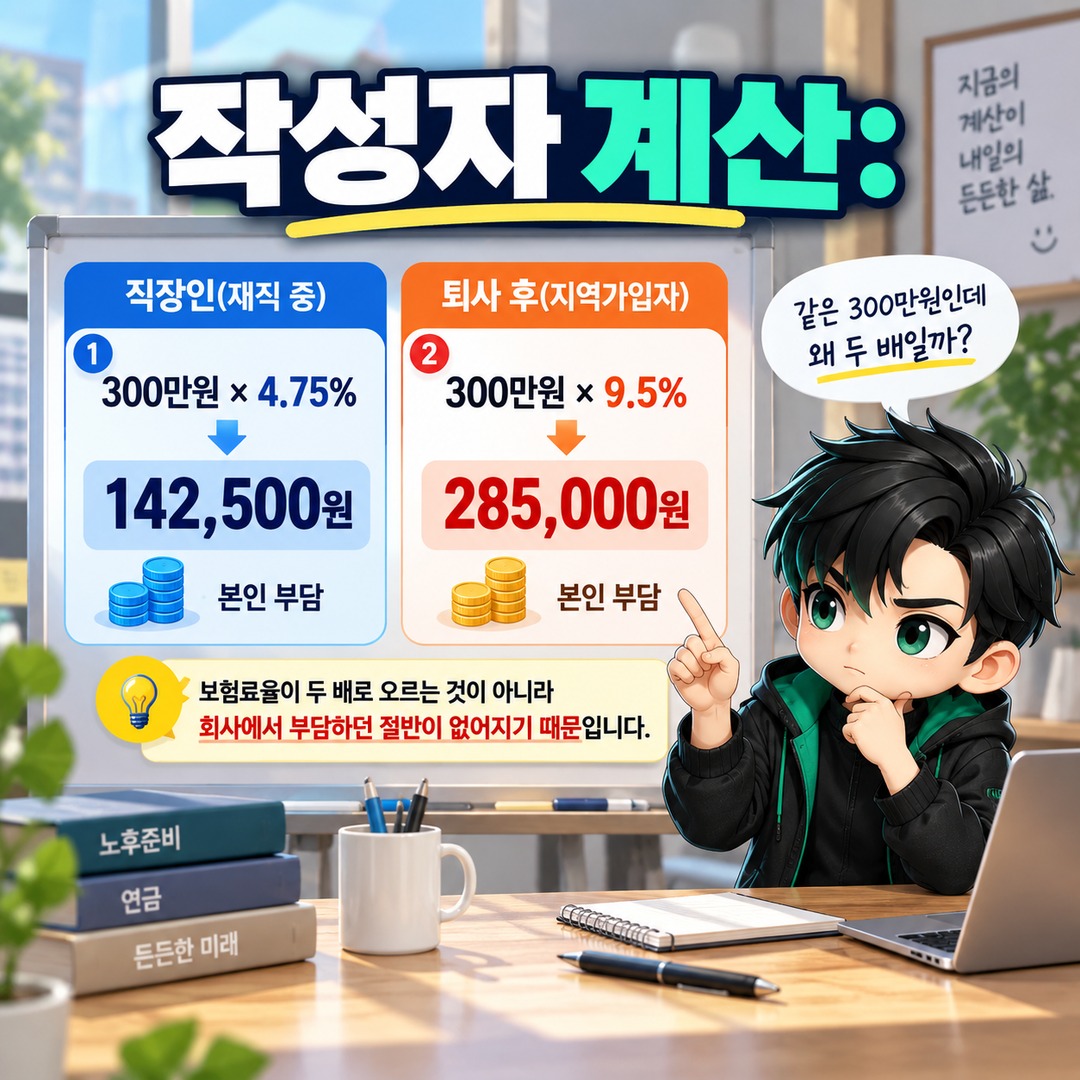
KRW 3,000,000 × 4.75% = KRW 142,500
KRW 3,000,000 × 9.5% = KRW 285,000
Therefore, if we simply assume that the same KRW 3,000,000 continues to apply as the standard monthly income after leaving a job, the individual's contribution increases from KRW 142,500 to KRW 285,000.
However, there is an important condition to consider.
You Should Not Assume That This Calculation Automatically Applies to Someone Who Has No Income After Leaving Their Job.
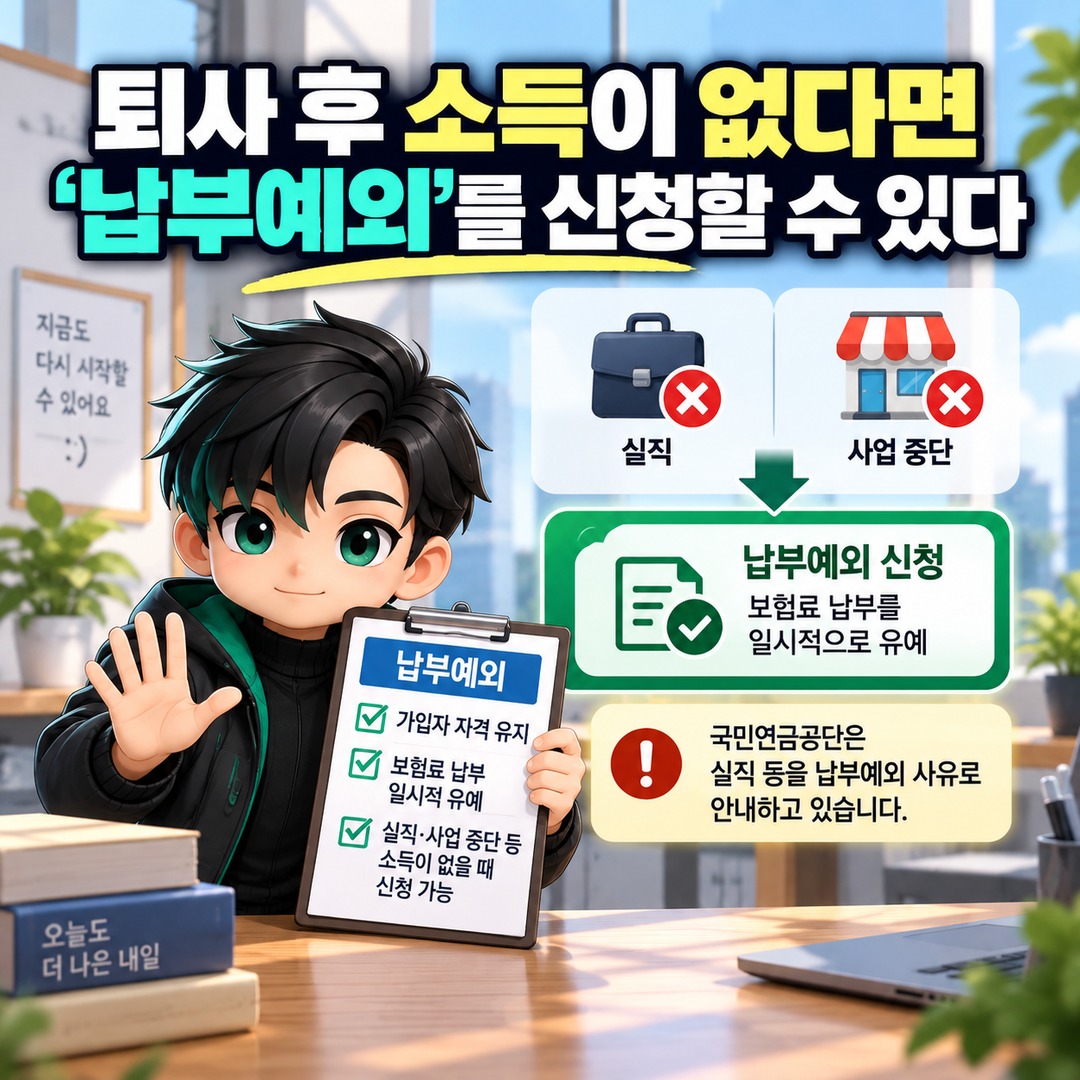
If You Have No Income After Leaving Your Job, You Can Apply for a 'Contribution Exemption'
A National Pension contribution exemption is a system that temporarily suspends contribution payments while maintaining insured status when a person has difficulty paying premiums due to unemployment, business closure, or similar circumstances. The National Pension Service identifies unemployment and related circumstances as grounds for a contribution exemption.
Therefore, if you leave your company and have no other income, receiving a notice about individually insured contributor status does not necessarily mean you must personally pay the entire National Pension contribution previously shared with your employer.
According to the National Pension Service's guidance for 2026, contribution exemptions can be requested online, in person, by mail, by telephone, or by fax. Online applications are subject to eligibility conditions, such as having recently received a notice of enrollment or contribution resumption, or a contribution exemption notice. It is therefore best to check your personal account to confirm whether online application is available to you.
Does a Contribution Exemption Period Count Toward Your National Pension Contribution Period?
No. Although you do not have to pay contributions immediately during an exemption period, that period is not included in the contribution period used to calculate your pension benefits. You should therefore consider both your current contribution burden and your future National Pension contribution period.
For example, if someone with 8 years of National Pension contributions receives a contribution exemption for 1 years after becoming unemployed, their contribution period does not automatically become 9 years.
Because the contribution period is important for National Pension old-age benefits, people who still need to meet the minimum contribution period should pay particular attention to the potential impact of a prolonged exemption.
A contribution exemption is also different from withdrawing from the National Pension system. It allows a person to maintain insured status while temporarily suspending contribution payments for a specified period.
How Are National Pension Contributions Handled in the Month You Leave Your Job?
National Pension contributions are not calculated on a daily basis only up to your final working day. Contributions are assessed monthly, and workplace-based insured employees may be charged contributions through the month in which they leave their job.
In an example provided for 2026, the National Pension Service explains that when an employee with a standard monthly income of KRW 1,000,000 leaves their job on October 7, a contribution of KRW 95,000 is assessed for October, with the employee's share as a workplace-based insured contributor amounting to KRW 47,500.
In other words, when checking your National Pension obligations after leaving a job, rather than simply assuming that individually insured contribution rates apply from that month onward, you should verify both when your workplace-based insured status ended and how your individually insured status has been processed.
Can You Ignore a Notice About Individually Insured Contributor Status?
If you lose your workplace-based insured status due to retirement or resignation and become subject to individually insured contributor registration, it is advisable to check the necessary reporting requirements.
The National Pension Service states that people who were enrolled in the workplace-based National Pension system and subsequently leave their jobs are required to submit an 'Enrollment (Income) Report' as individually insured contributors. The reporting deadline is the 15 of the month following the month in which the relevant event occurred. Depending on the circumstances, reports may be submitted not only in person but also by telephone, mail, or fax.
In particular, if you genuinely have no income, the key is to check whether you qualify for a contribution exemption before automatically paying a bill or leaving it unattended.
The procedures differ depending on whether you have income, and the National Pension Service may request supporting documents depending on the reason for the exemption.
If You Find Another Job, Do You Have to Keep Paying Contributions as an Individually Insured Contributor?
If you become employed again at a workplace covered by the National Pension system, your status changes to workplace-based insured employee. Your individually insured contributor status ends, and National Pension contributions are assessed through your employer.
As of 2026, the total contribution rate for workplace-based insured employees is 9.5%, but employees and employers each pay 4.75%.
For example, if your standard monthly income is again determined to be KRW 3,000,000 after reemployment, a simple calculation puts the employee's monthly contribution at KRW 142,500.
However, National Pension contributions are calculated based on the standard monthly income reported to and determined by the National Pension Service, rather than the actual salary deposited into your bank account. The amount deducted may therefore vary by individual.
Three Things to Check First About Your National Pension After Leaving Your Job
If you receive a National Pension notice after leaving your job, first check your current insured status, then whether you have any other income after leaving your job, and finally whether you qualify for a contribution exemption.
There is no need to immediately conclude, simply from the 9.5% contribution rate for 2026, that 'because my salary was KRW 3,000,000, I now have to pay KRW 285,000 every month on my own.'
For workplace-based insured employees, employers cover half of the contributions, while individually insured contributors generally pay the full amount. However, if you have no income due to unemployment or similar circumstances and find it difficult to pay contributions, you may apply for a contribution exemption. In exchange, the exemption period will not count toward your National Pension contribution period.
Because the applicable rules and amounts may vary depending on your income and insured status, the most accurate way to confirm your final contribution amount and eligibility for an exemption is to check your individual enrollment records with the National Pension Service.
※ This article is provided for reference purposes to help readers understand market trends and does not constitute an investment recommendation for any particular stock or asset. You are responsible for your own final investment decisions and their outcomes.