

How to Make Money with Toss Share Links How to Make Money with Toss Share Links: Answer Buyers' Questions Instead of Just Spreading Links
이 포스팅은 쿠팡 파트너스 활동의 일환으로, 이에 따른 일정액의 수수료를 제공받습니다.

Toss Shopping Share Links are an affiliate marketing method that allows you to earn commissions when purchases are made through links promoting products. 2026-09-15, Toss operates an application page for Share Link participation. However, posting more links does not guarantee earnings. To generate actual revenue, it is important to create content that answers shoppers' questions just before they make a purchase and clearly disclose affiliate relationships.

How Does Earning Money with Toss Share Links Work?
To monetize Toss Share Links, you must first complete the participation process and then use dedicated links connected to the products you want to promote.

Independent websites that promote Toss Shopping products using Share Links are also operating. These websites disclose that buttons directing visitors to Toss Shopping are affiliate links and that their operators may receive a commission when purchases occur.
The revenue model can therefore be broken down into the following steps.
1. Join the Toss Shopping Share Link program.
2. Choose a product to promote.
3. Prepare a Share Link connected to that product.
4. Introduce the product through your own content, such as blogs, websites, or social media.
5. Visitors view and purchase the product through the affiliate link.
6. Commissions are generated based on qualifying purchases.
The most important part here is step 4.
In practice, creating content that explains who would want to buy the product and why is more difficult than generating the link itself.
Start with Shoppers' Buying Questions, Not with Product Selection
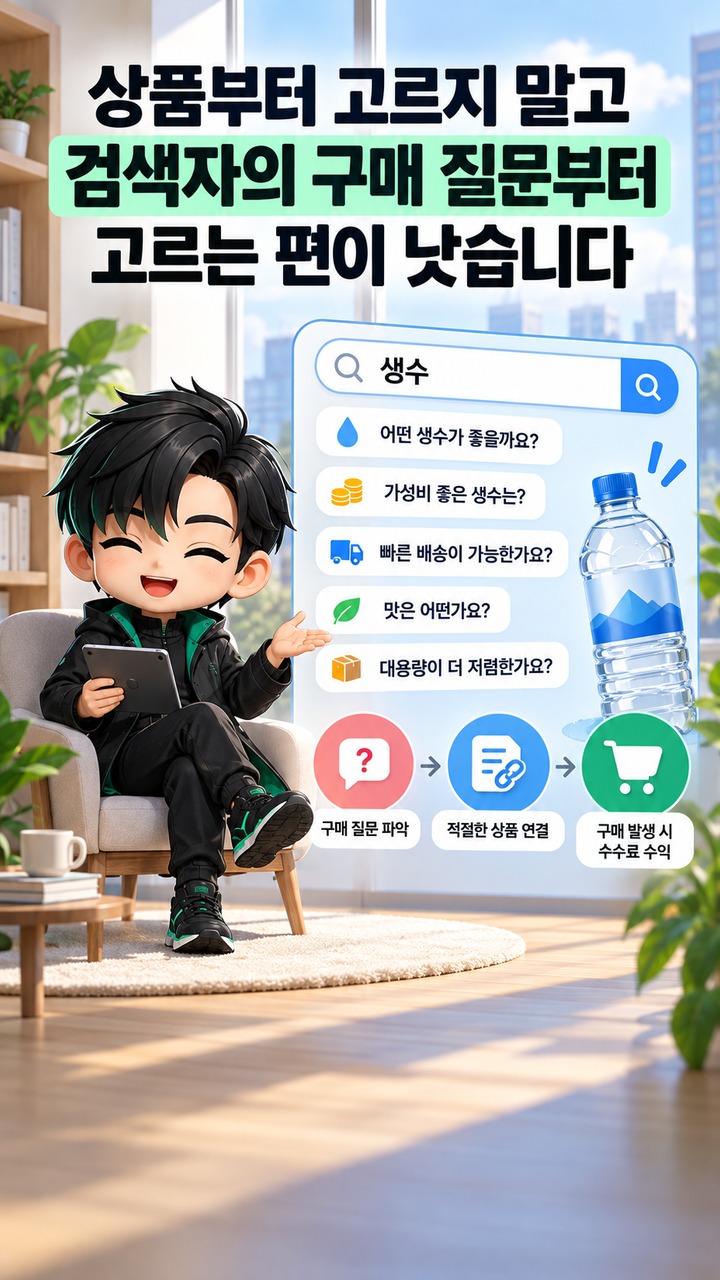
For example, suppose you want to sell bottled water.
If you simply list the product name and price and attach a link, readers have little reason to read your article. That information is already available on the shopping page.
Instead, you can provide information that shoppers actually need to compare before purchasing, such as the following.
Whether 500mL or 2L better suits their lifestyle
How many bottles are included in total
The price per 1 bottle
How much storage space is needed for products purchased regularly
How the product differs from similar packages
For example, if 80 bottles of 500mL water cost KRW 20,000, the price per 1 bottle is KRW 250.
KRW 20,000 ÷ 80 bottles = KRW 250
Rather than simply copying numbers from a product listing, it is much more useful to recalculate them into units shoppers can use for comparisons.
However, actual posts should use the selling price and package details verified on the day of publication. Product prices and discount conditions can change.
To Earn Revenue, Create Decision-Focused Articles Rather Than Product-Name Articles
Content that works well with Share Links targets readers who are already likely to buy something.
For example, when introducing wireless earbuds, you do not need to use only the product name as the article title.
You can compare specifications available in official product information, such as battery life, weight, connectivity, and calling features, and explain specifically who the product is suitable for.
Household essentials require a different approach. For frequently purchased products such as toilet paper, wet wipes, and bottled water, calculating prices per item, per sheet, or per 100mL may be more useful than showing only the total price.
Similarly, multipacks can be evaluated using the following calculation.
Price per item = Actual purchase price ÷ Total quantity
If product sizes differ, you should not compare them solely by price per item. Instead, standardize the comparison using equivalent units such as 100g or 100mL.
This process itself provides information that distinguishes your content from posts that simply contain affiliate links.
Avoid Writing Reviews as If You Have Used Products You Haven't Tried
You do not need to personally purchase every product to earn revenue through Share Links.
However, if you have not used a product, it is important not to invent personal experiences with phrases such as 'After using it,' 'I tried it myself,' or 'When I tasted it.'
Products you have not personally used can still be compared based on the package contents and specifications shown on their sales pages.
For example, you can provide the following kinds of information.
Compare prices and quantities, calculate unit prices, distinguish differences between options, and summarize conditions shoppers should check before purchasing.
Even without firsthand experience, properly calculating, comparing, and organizing purchase conditions can provide readers with new value.
Building Content That Matches Purchase Intent Matters More Than Posting Frequently
When you start using Share Links, you may be tempted to quickly post links to many different products.
However, content that repeatedly attaches product links without providing useful information gives readers little reason to engage with it.
Instead, consider narrowing the focus so that each piece of content helps readers make one purchasing decision.
For example, create content around questions shoppers genuinely need to answer before buying, such as 'What size bottled water is most convenient for someone living alone?', 'Comparing the price per sheet of bulk wet wipes,' or 'Comparing port configurations on compact chargers.'
Then naturally connect relevant products while helping readers solve those problems.
The key is to reverse the order.
Instead of:
Product to sell → Write an article
Use this approach:
Problem the buyer wants to solve → Compare and verify → Connect a suitable product
Include the Date When Publishing Price Comparisons
Prices require particular attention in shopping-related content.
A price checked today may not remain the same next week, and discount rates or coupon conditions may also change. Therefore, if price is a central part of your content, it is advisable to include the date or time when the price was verified.
For example, you can clearly state the reference point with wording such as 'Price verified on 2026-09-15.'
Rather than simply updating an article's date after prices have changed, it is better to recheck the actual prices, package contents, and sales conditions, and revise the article when the information changes.
Clearly Disclose That You May Receive Affiliate Commissions
If you recommend products through Share Links and may receive commissions based on purchases, you should not conceal that financial relationship.
The Korea Fair Trade Commission has established standards requiring economic relationships in endorsements and recommendations to be disclosed in ways consumers can easily recognize. In particular, revised guidelines concerning the disclosure of economic relationships in text-based media took effect on 2024-12-01.
Therefore, rather than hiding affiliate disclosures at the very bottom of an article or presenting them in ways readers may overlook, it is important to display them clearly alongside product recommendations.
Before publishing, it is safer to review the latest disclosure instructions provided by Toss Share Links and the currently applicable disclosure standards.
If You're Just Starting, Test 5 Pieces of Content Before Promoting 100 Products
Rather than registering a large number of products immediately, it can be more efficient to select a few products with different purchase motivations and identify which types of content actually generate responses.
For example, you can divide products into categories such as frequently purchased household essentials, products where price comparisons matter, products where feature comparisons matter, and products needed in specific situations.
If a piece of content receives little engagement, examine whether it lacks comparison information buyers need before adding more links.
What Should You Do First to Increase Toss Share Link Earnings?
Rather than setting your first goal as 'getting more link clicks,' focus on creating content that helps prospective buyers complete their purchasing decisions.
Once you have selected a product, answer the following questions.
'Who is looking for this product?'
'What do buyers compare before making a purchase?'
'What information is difficult to understand immediately from the product listing?'
'What can I calculate or compare for readers myself?'
If you can answer these questions, you can create valuable original content instead of simply rewriting product descriptions.
Toss Share Links are best approached not as a system where links themselves automatically generate money, but as an affiliate marketing method that connects people searching for products with content that supports their purchasing decisions, generating revenue when qualifying purchases occur.
If you are just getting started, instead of choosing a product today and distributing its link across multiple platforms, begin by identifying one final question prospective buyers would want answered and creating one piece of content that addresses it.
※ This article is provided for informational purposes to help readers understand market trends and does not constitute investment advice or a recommendation to invest in any particular security or asset. Final investment decisions and responsibility rest with the individual.
Related Articles
이 포스팅은 쿠팡 파트너스 활동의 일환으로, 이에 따른 일정액의 수수료를 제공받습니다.