

How to Validate Turtle Trading in Crypto Futures: Calculating Fees and Funding Alongside 20-Day Breakouts and 2N Stops
This post contains Coupang Partners affiliate links. We may earn a commission from qualifying purchases.

When applying Turtle Trading to crypto futures, implementing only 20-day high/low breakouts and 2N stops is not enough to validate the strategy’s actual performance. You need to calculate both net profit and loss after entry and exit fees, execution slippage, and funding fees, and the actual risk to the account. Comparing the original Turtle rules with the exchange’s official calculation methods using 2026-11-05 makes it clear what needs to be distinguished during validation.
1. What were the original rules for Turtle Trading’s 20-day breakouts and 2N stops?
Turtle Trading is a trend-following strategy that adjusts position size based on volatility and enters when the price breaks above or below a high or low set over a specific period.
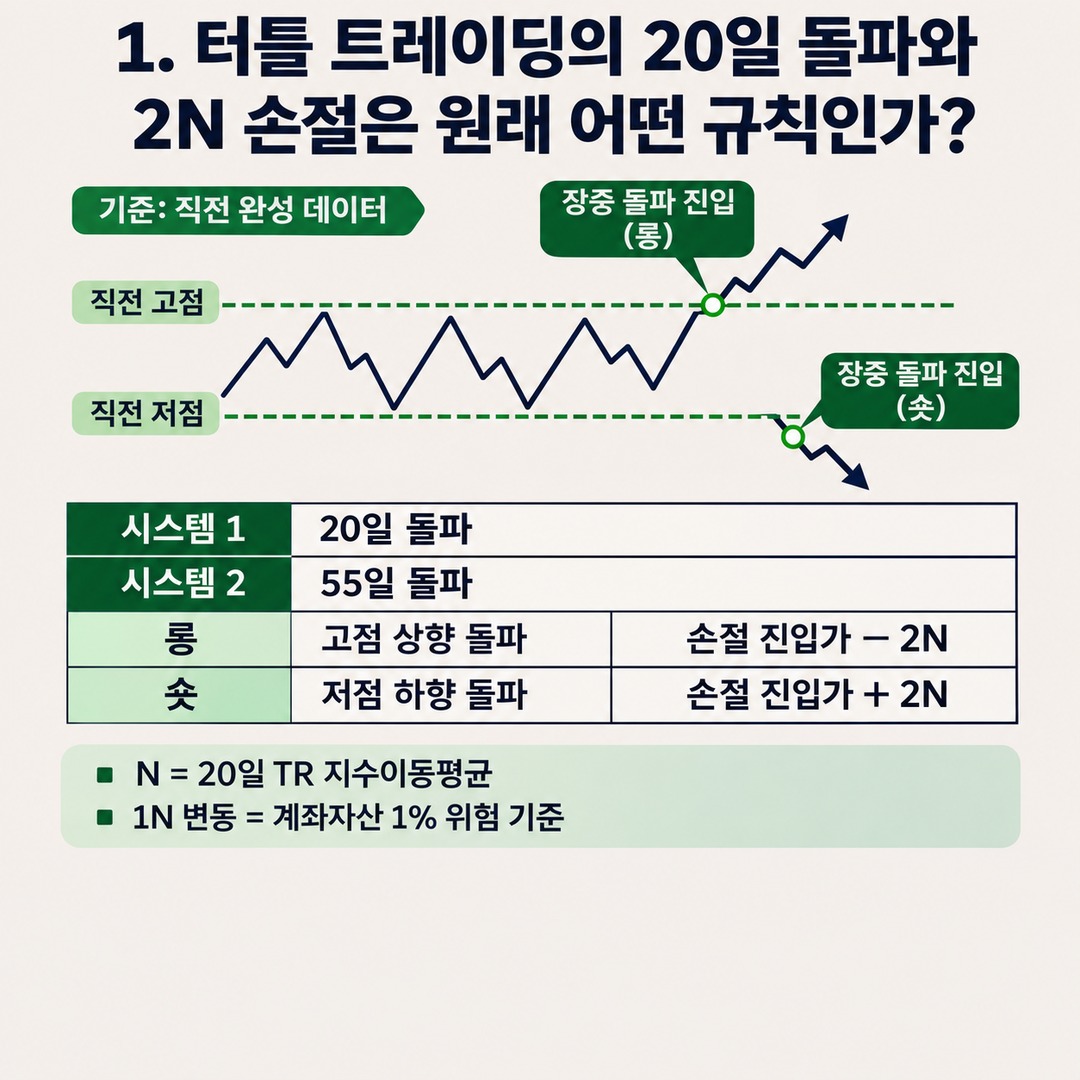
The original Turtle rules include two entry systems.
System 1: 20-day breakout
System 2: 55-day breakout
Thus, the 20-day breakout is the short-term entry method in the original Turtle system.
In its 2003-year published rules document, OriginalTurtles.org defines a 20-day breakout as a price move above the high or below the low of the preceding 20 days.
See the original text of Original Turtle Trading Rules. THE ROBUST TRADER+1
20-Day Breakout Entry
| Category | Entry condition |
|---|---|
| Long | Break above the high of the preceding 20 days |
| Short | Break below the low of the preceding 20 days |
| Reference | 20 days of data completed before the breakout |
| Entry | Attempt to execute at the breakout price |
There is one important distinction here.
The original Turtle rules do not call for entering the day after the daily candle closes. They call for entering when the price crosses the breakout level intraday.
Therefore, these two strategies need to be validated separately.
Strategy A: Enter immediately when the price breaks above or below the 20-day high or low intraday
Strategy B: Enter when the daily close moves above or below the 20-day high or low
Strategy B is not identical to the original rules.
What the 2N Stop Means
N represents the market’s daily volatility, not simply a price difference.
In the original Turtle rules, N is the 20-day exponential moving average of True Range.
True Range is calculated as follows.
TR=max(H−L, ∣H−PC∣, ∣PC−L∣)- H: high of the day
L: low of the day
PC: previous day’s close
N is updated using the following formula.
Nt=19Nt−1+TRt20The initial N is the simple average of the 20-day True Range.
THE ROBUST TRADER The basic stop prices for long and short positions are as follows.
| Position | Stop price |
|---|---|
| Long | Entry price - 2N |
| Short | Entry price + 2N |
However, a price distance of 2N does not automatically mean an account loss of 2%.
In the original Turtle method, position size was adjusted so that a price move of 1N represented 1% of the account equity.
This is the first key point to validate when applying the method to crypto futures.
2. How should you calculate contract size based on N in crypto futures?
The original Turtle method’s volatility-based position sizing can also be applied to crypto futures.
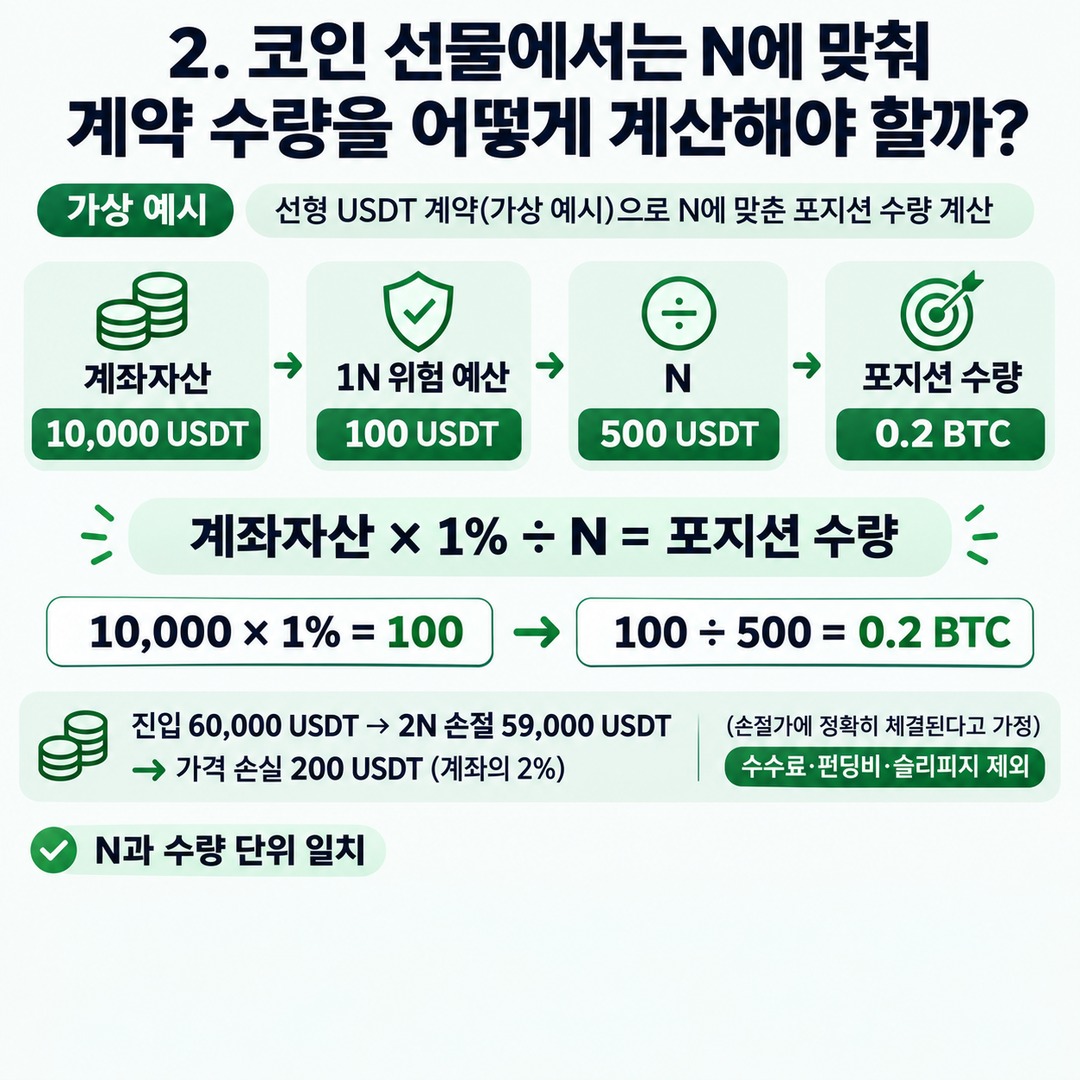
Assuming a USDT linear contract, the calculation is as follows.
Position size=account equity×1%NThe units of N and the position size must match.
For example, if N is in USDT based on the BTC price and the position size is in BTC, the formula above can be used to calculate the BTC quantity.
Hypothetical example: account equity of 10,000 USDT
The following is a hypothetical case to illustrate the calculation structure, not an actual trading result.
| Item | Assumed value |
|---|---|
| Account equity | 10,000 USDT |
| BTC entry price | 60,000 USDT |
| N | 500 USDT |
| 1N risk budget | 100 USDT |
| Stop distance | 1,000 USDT |
| Position size | 0.2 BTC |
Calculation:
10,000×0.01=100100÷500=0.2BTCThe stop price for the long position is as follows.
60,000−(500×2)=59,000Assuming the order is filled exactly at the stop price, the price loss is as follows.
(60,000−59,000)×0.2=200USDTThat is 2% of the 10,000 USDT in account equity.
Hypothetical calculation result
Entry notional
12,000
USDT Price loss at an 2N stop
200
USDT · 2% of account equity
0.2
BTC Stop price
59,000
USDTThis calculation does not yet include trading fees, funding fees, or slippage.
Therefore, the actual loss in the account may exceed 200 USDT.
Leverage also affects the required margin, but it does not reduce the price loss on the same contract size.
3. Entry and exit fees must be calculated separately for futures trading

A common error in crypto futures backtests is to apply the round-trip trading fee only once, or to calculate both entry and exit using the maker fee.
In actual trading, fees vary depending on how the orders are executed.
Binance’s 2026-10-22 updated official fee guidance states the following.
Market orders that execute immediately are taker orders.
Orders that add liquidity to the existing order book and wait to be filled are maker orders.
Actual fees vary by VIP tier and contract type.
Calculating Round-Trip Fees
We’ll use the same hypothetical example as before.
For the calculation, we’ll use the taker 0.05% fee rate from the general-user example in Binance’s official guidance.
This is not a confirmed fee rate that currently applies to all accounts.
| Category | Calculation | Fee |
|---|---|---|
| Entry | 12,000 × 0.05% |
※ This article is for informational purposes to help readers understand market trends and is not an investment recommendation for any specific security or asset. You are responsible for your own decisions and investments.
This post contains Coupang Partners affiliate links. We may earn a commission from qualifying purchases.