

KOSPI Recovers the 6900 Level at 6912.95, While KOSDAQ Plunges 4.63%…Why Did the Two Markets Diverge So Sharply on the Same Day?
▼▼ 제품 구매하러 가기 ▼▼
https://link.coupang.com/a/gojjv4z8YC
이 포스팅은 쿠팡 파트너스 활동의 일환으로, 이에 따른 일정액의 수수료를 제공받습니다.
쿠팡 추천 상품쿠팡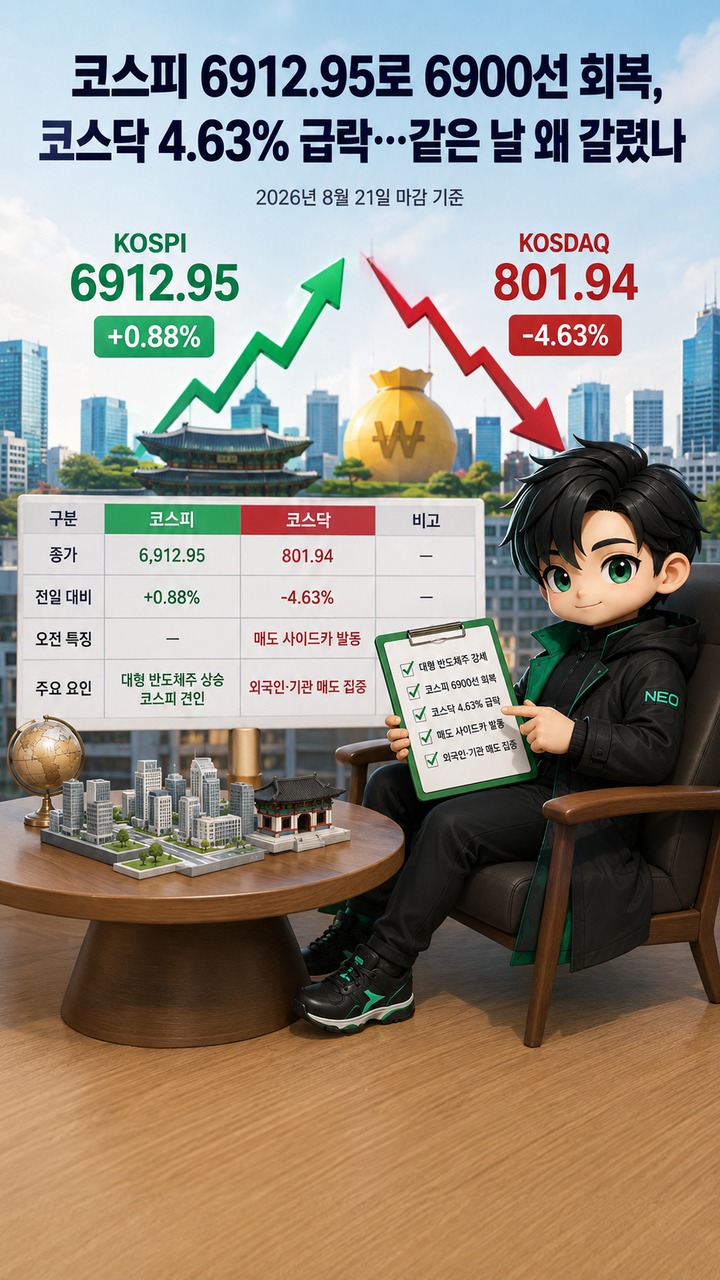
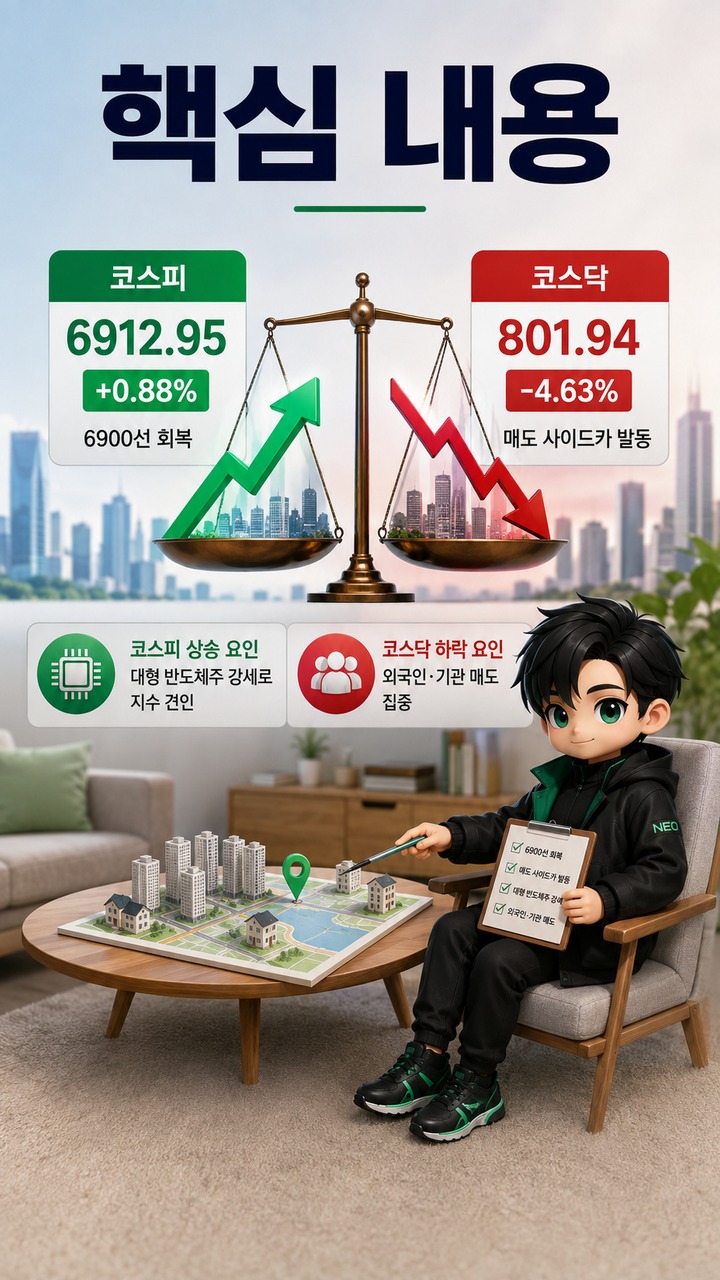
On 2026-08-21, the KOSPI closed at 6912.95, up 0.88% from the previous trading day, reclaiming the 6900 level. In contrast, the KOSDAQ closed at 801.94, down 4.63%, and a sell-side sidecar was triggered during the morning session. Although both indices belong to South Korea's stock market, the trading experience was dramatically different: large-cap semiconductor stocks lifted the KOSPI, while concentrated selling by foreign and institutional investors weighed on the KOSDAQ.
How Did the KOSPI Recover the 6900 Level After Falling as Low as 6742 Early in the Session?
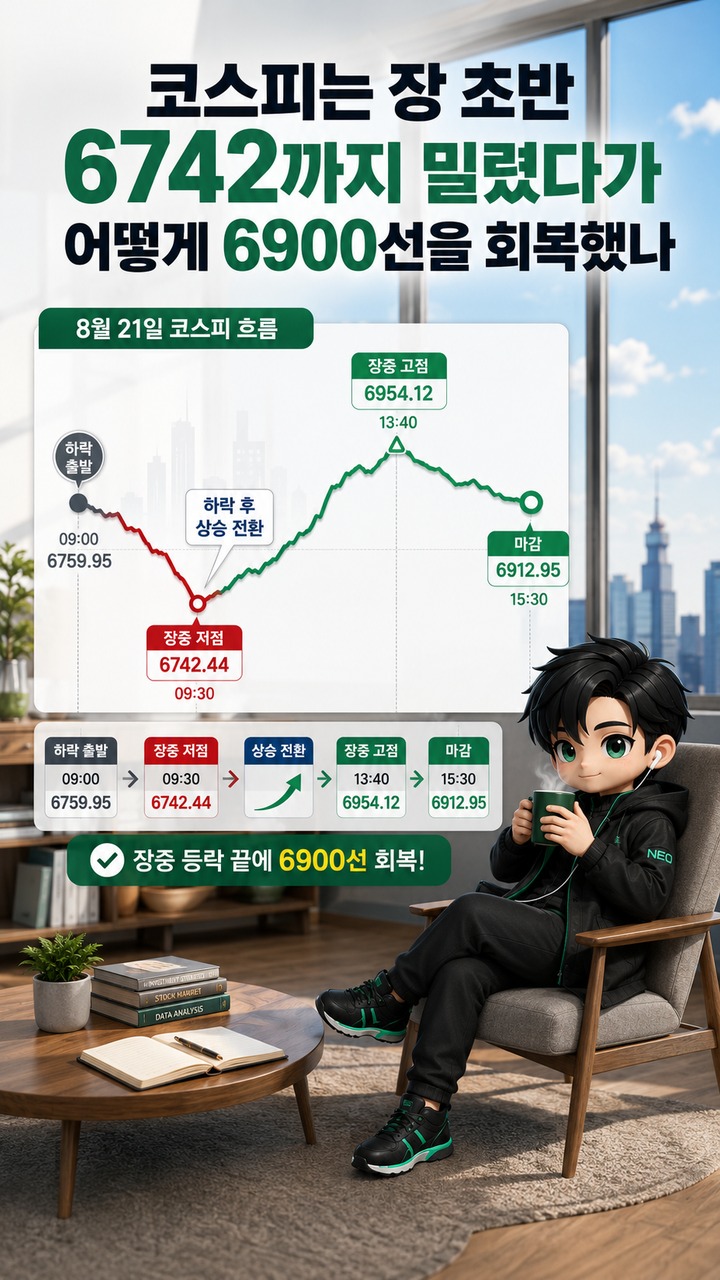
The KOSPI was not strong from the opening bell. On August 21, the index opened lower at 6759.95, fell to an intraday low of 6742.44, then reversed into positive territory. It briefly climbed to 6954.12 before closing at 6912.95.
Looking only at the closing figure, the gain of 0.88% from the previous day might suggest a relatively ordinary positive session. However, intraday price movements were substantial.
According to the author's calculations, the rebound from the day's low of 6742.44 to the closing level of 6912.95 amounted to 170.51 points, approximately 2.53%.
The calculation is as follows.
(6912.95 ÷ 6742.44 - 1) × 100 = approximately 2.53%
Compared with the intraday high of 6954.12, the closing level was 41.17 points lower. In effect, the index recovered most of its morning losses and finished trading above the 6900 level.
Investor flows showed that institutions were net buyers of KRW 248,700,000,000, while retail investors recorded KRW 1,166,200,000,000 and foreign investors were net sellers of KRW 175,700,000,000. Unlike the previous day, when substantial foreign net buying had driven the KOSPI's rebound, institutional purchases supported the index this time.
One particularly important point is that the market did not rise evenly across all sectors. It would be difficult to conclude that most stocks performed strongly based solely on the index's percentage gain.
How Much Did Samsung Electronics and SK Hynix Support the KOSPI?
The strength of semiconductor stocks, which account for a large share of the KOSPI's market capitalization, played a major role in the index's recovery of the 6900 level. Samsung Electronics closed at KRW 281,500, gaining 3.87%, while SK Hynix also rose to KRW 1,730,000.
Samsung Electronics preferred shares climbed more than 8% to KRW 207,000, while Samsung Life Insurance also showed strength.
However, not all large-cap stocks advanced together. Samsung Electro-Mechanics fell 5.73% to KRW 1,316,000, while LG Energy Solution declined 4.05% to KRW 343,500.
Kim Ki-baek, a researcher at Shinhan Securities, analyzed that concerns over long-term U.S. Treasury yields and U.S. consumer conditions weighed on investor sentiment, but export indicators and the strength of semiconductor stocks since early August helped support the KOSPI's rebound.
For this reason, interpreting the day's KOSPI performance requires looking beyond the simple figure that “the KOSPI rose 0.88%” and examining which stocks actually drove the index higher.
Because large semiconductor companies carry substantial weight in the KOSPI, gains in Samsung Electronics and SK Hynix can make the index itself appear relatively strong even when conditions in other sectors feel considerably weaker.
Why Did the KOSDAQ Fall to 801.94?
The KOSDAQ moved in the opposite direction from the KOSPI. It closed at 801.94, down 38.95 points, or 4.63%, from the previous trading day.
Retail investors were net buyers of KRW 623,600,000,000 on the KOSDAQ, but institutions recorded KRW 346,500,000,000 and foreign investors were net sellers of KRW 283,600,000,000, creating selling pressure that pushed the index lower.
Leading stocks by market capitalization were also weak.
Alteogen fell 5.74% to KRW 320,000, EcoPro BM declined 7.45% to KRW 105,600, and EcoPro dropped 7.26% to KRW 81,700. HLB also fell more than 3%, while EO Technics finished lower as well.
Just one day earlier, on August 20, the KOSDAQ had closed at 840.89, gaining 1.99%. However, its decline to 801.94 the following day erased all of the previous session's gains and pushed the index even lower.
The difference becomes clearer when directly comparing the August 19 closing level of 824.46 with the closing level on 21, two days later.
According to the author's calculations, the move from 824.46 to 801.94 represents a decline of 22.52 points, or approximately -2.73%.
In other words, looking only at the 1.99% rebound on 20 might have suggested a recovery. Viewed over two days, however, the KOSDAQ had still failed to return to its August 19 closing level.
What Does the Activation of a KOSDAQ Sell-Side Sidecar Mean?
During the morning of August 21, a sell-side sidecar was triggered on the KOSDAQ amid a sharp decline. A sidecar is a market-stabilization mechanism designed to reduce the risk that abrupt movements in stock index futures and the cash market will spread more rapidly through program trading.
Under the Korea Exchange's KOSDAQ sidecar system, when KOSDAQ150 futures prices and the KOSDAQ index each meet their specified decline thresholds for 1 consecutive minutes, the effectiveness of program sell orders is suspended for 5 minutes.
The important distinction is that a sidecar does not halt all stock trading across the entire market. Rather, it temporarily suspends the effectiveness of program trading orders to cushion the impact of abrupt trading activity.
Therefore, the activation of a sidecar alone does not establish that the KOSDAQ will fall further. It does, however, clearly indicate that intraday volatility had increased substantially beyond normal levels.
Buy-side and sell-side sidecars have also been triggered several times on the KOSPI amid recent sharp market swings, making this a period when investors need to monitor volatility itself, not merely index levels.
Why the KOSPI's 5.89% Surge the Previous Day Matters
The KOSPI's 0.88% gain on August 21 is difficult to interpret separately from the previous day's performance. On August 20, the KOSPI surged 381.41 points, or 5.89%, to close at 6852.58.
During that session, the index had already crossed the 6900 level once, climbing as high as 6904.55. Samsung Electronics rose 9.49%, SK Hynix gained more than 12%, and a KOSPI buy-side sidecar was also triggered.
On 21, the index slipped below the 6750 level shortly after the opening bell, giving back a substantial portion of the previous day's sharp gains. However, it recovered through the afternoon and ultimately finished at 6912.95, above the previous day's closing level.
Rather than treating the recovery of the 6900 level on 21 as an isolated one-day surge, the figures more accurately reflect a continuous period of volatility: a sharp decline on 19 → a 5.89% rebound on 20 → another intraday plunge followed by a recovery on 21.
By contrast, the KOSDAQ gained 1.99% on 20 before falling 4.63% on 21. The difference in resilience between the two markets over the same period was substantial.
This divergence demonstrates why checking the KOSPI alone is insufficient to understand the overall mood of South Korea's stock market.
Which Figures Matter More Than Recovering the 6900 Level on the Next Trading Day?
On the next trading day, investors should not focus exclusively on whether the KOSPI holds above the 6900 level. The day's actual intraday range of 6742.44–6954.12 provides a useful short-term reference.
It is also worth watching whether gains broaden beyond semiconductor stocks while the index remains above 6900, and whether foreign investor flows turn positive again. Foreign investors were net sellers on the KOSPI on 21, meaning the index's upward movement did not align with the direction of foreign investment flows.
For the KOSDAQ, whether the 800 level holds and whether selling by foreign and institutional investors changes direction are more immediate indicators to monitor. The index closed at 801.94, just 1.94 points away from the 800 level.
As of 3:30 in the afternoon, the won-dollar exchange rate stood at KRW 1,386.5, down KRW 6.1 from the previous trading day's daytime-session close. The exchange rate is another variable to monitor alongside foreign investor flows, although a single day's currency movement cannot determine the stock market's next direction.
Especially during periods like the recent one, when daily index movements of around 5% and repeated sidecar activations have become common, it is easier to understand market conditions by examining the magnitude of index fluctuations, foreign and institutional investor flows, the contribution of major semiconductor stocks to the index, and whether the KOSDAQ maintains the 800 level, rather than focusing solely on index direction.
To summarize the August 21 session in one sentence: The KOSPI recovered the 6900 level to close at 6912.95, but the broader South Korean stock market was not uniformly strong. The KOSDAQ fell to 801.94, marking a day of pronounced divergence between large-cap stocks and the growth-stock market.
※ This article is provided for informational purposes to help readers understand market trends and does not constitute an investment recommendation for any particular stock or asset. All final investment decisions and responsibility rest with the individual investor.
▼▼ 제품 구매하러 가기 ▼▼
https://link.coupang.com/a/gojjv4z8YC
이 포스팅은 쿠팡 파트너스 활동의 일환으로, 이에 따른 일정액의 수수료를 제공받습니다.
쿠팡 추천 상품쿠팡