

Why the KOSDAQ Deserves Attention: 5 Things to Check After Its Sharp Drop to the 662 Level
이 포스팅은 쿠팡 파트너스 활동의 일환으로, 이에 따른 일정액의 수수료를 제공받습니다.
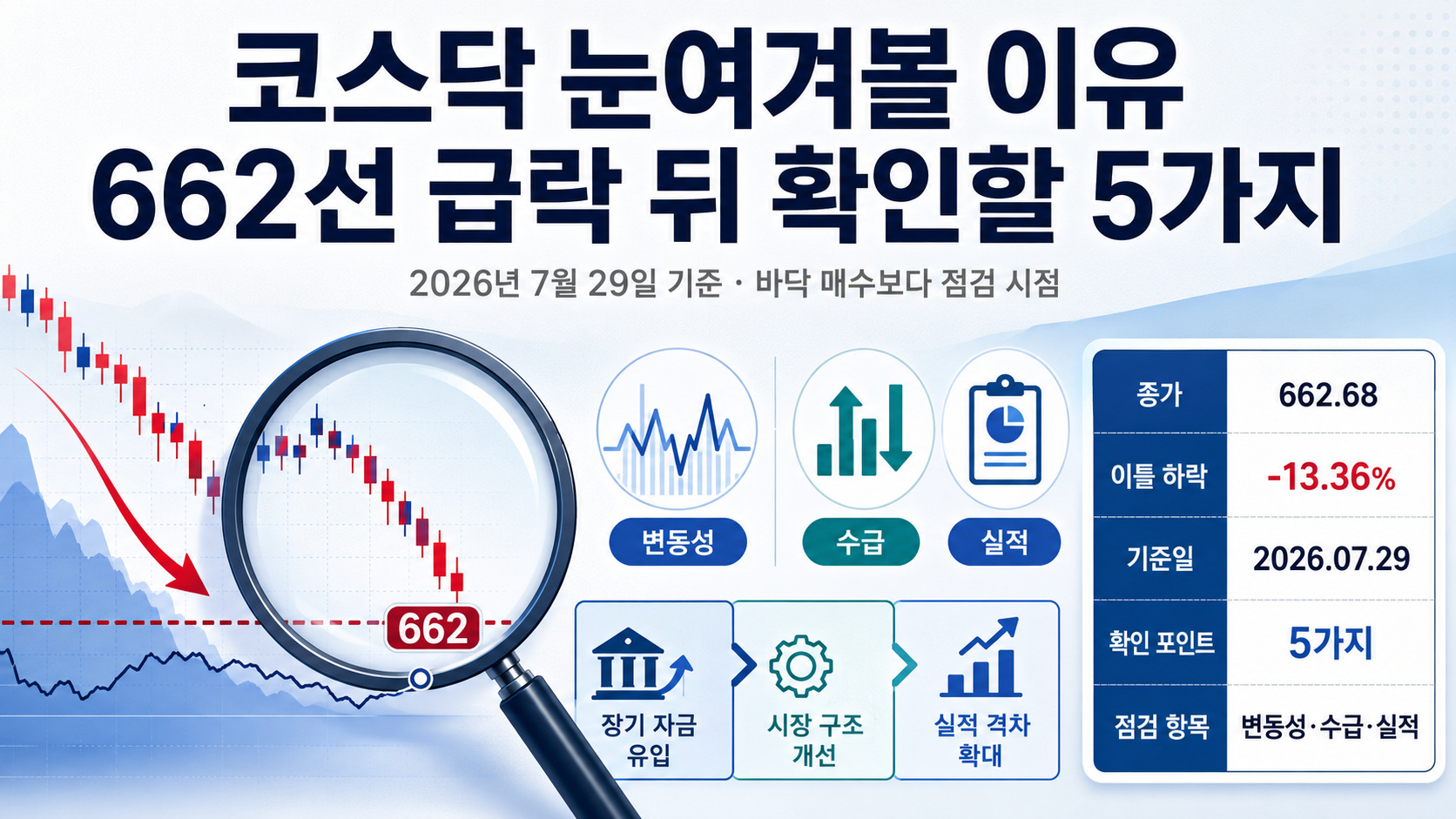
This article is based on the latest reports and official materials available as of 2026-07-29 Korea Standard Time.
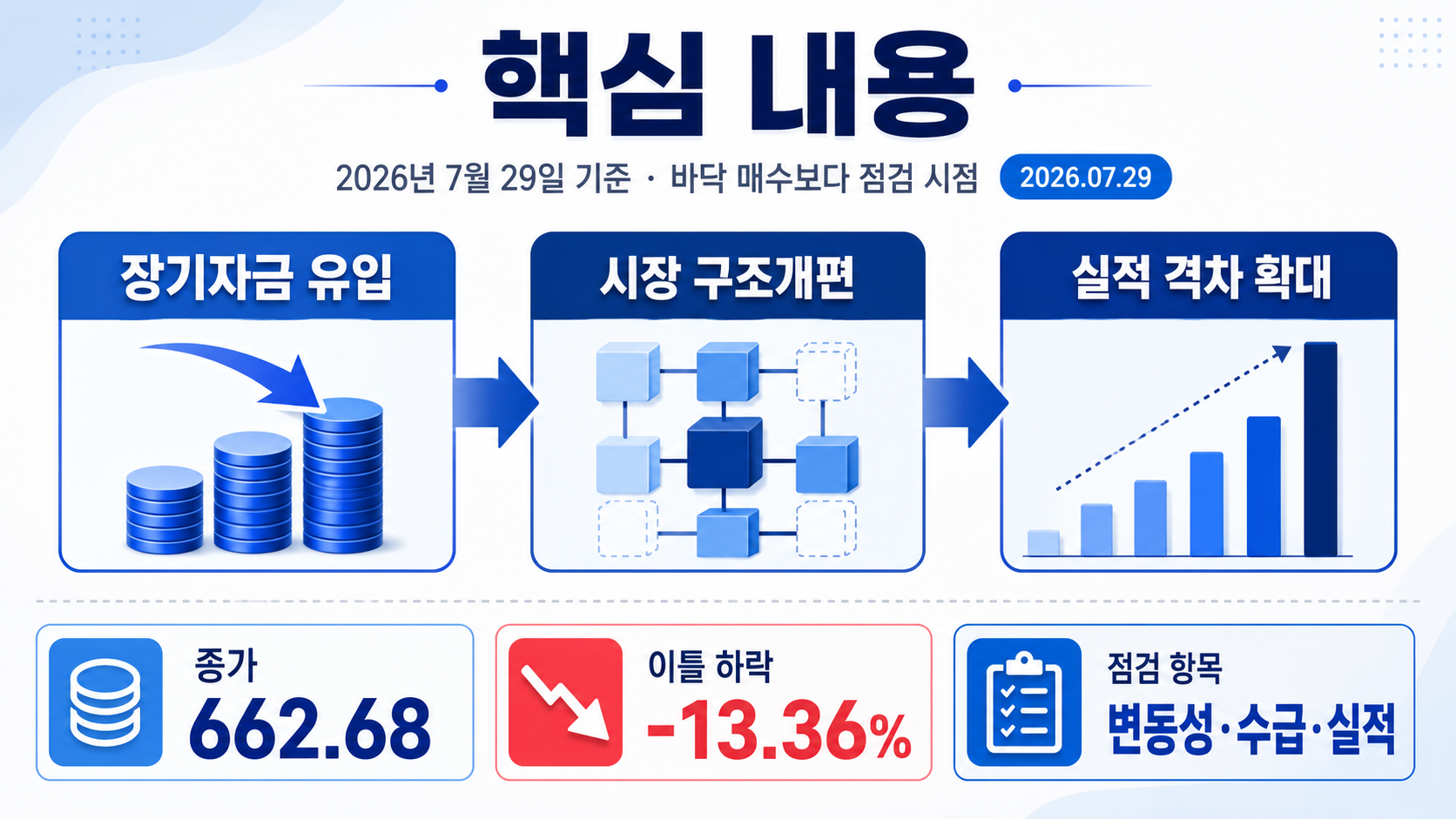
The KOSDAQ deserves attention not simply because it has fallen sharply, but because mechanisms to attract long-term capital and market restructuring initiatives are progressing while earnings disparities among individual companies are widening. However, on 2026-07-29, the KOSDAQ closed at 662.68, having fallen 13.36% over two days. This makes it a time to assess volatility, capital flows, and corporate earnings rather than rush into buying what appears to be the bottom.
The fact that the KOSDAQ index is substantially below its previous high does not automatically mean the market is cheap. If corporate earnings forecasts are deteriorating as quickly as share prices are falling, actual investment attractiveness may not have improved significantly.
Conversely, if companies with solid earnings and healthy financial structures have also declined during a broad market selloff, some may become candidates for medium- to long-term monitoring. The key is to distinguish the causes of the decline from the conditions required for recovery rather than focusing solely on the index level.
How Far Has the KOSDAQ Fallen?
The KOSDAQ closed at 662.68 on 2026-07-29. It fell 6.12% from the previous day. Including the 7.72% decline on July 28, the index dropped 13.36% over two days compared with its July 27 closing level.
Compared with this year's intraday high of 1,229.42, recorded on April 27, the decline is approximately 46.10%. This is the author's calculation, using the formula `(662.68÷1,229.42-1)×100`.
| Category | KOSDAQ Index | Change or Description |
|---|---|---|
| 2026-04-27 | 1,229.42 | This year's intraday high |
| 2026-07-27 | 764.86 | Reference level before the two-day decline |
| 2026-07-28 | 705.85 | Down 7.72% from the previous day |
| 2026-07-29 | 662.68 | Down 6.12% from the previous day |
| Decline from peak | -46.10% | Author's calculation |
| Two-day decline | -13.36% | Author's calculation |
On July 29, the intraday high was 719.39 and the low was 630.99. Volatility was substantial, with a difference of 88.40 points between the day's high and low.
A circuit breaker was also triggered after the KOSDAQ index remained down by at least 8% from the previous day for 1 minutes. A circuit breaker is a safety mechanism that temporarily halts market-wide trading when prices move sharply.
Why Should Investors Pay Attention to the KOSDAQ After Such a Sharp Decline?
The reason to examine the KOSDAQ is not the price decline itself, but the simultaneous changes in prices, government policies, capital flows, and corporate earnings. However, these factors do not guarantee a rebound, and additional confirmation is needed before treating them as trading signals.
1. A Sharp Market Correction Has Created Opportunities to Reassess Individual Companies
When an index falls approximately 46% from its peak, companies that were previously difficult to approach because of elevated expectations may become worth examining again. However, not every company has become equally attractive as an investment.
It is essential to distinguish companies whose revenue and operating profit forecasts remain intact from those experiencing widening losses, rights offerings, clinical trial delays, or declining orders. Even if a share price has fallen by nearly half, the company may still be expensive if its earnings outlook has deteriorated even faster.
Therefore, the following factors matter more than simply asking how far a stock has fallen.
Revenue and operating profit trends over the most recent two quarters
Operating cash flow and cash reserves
Potential issuance of convertible bonds, bonds with warrants, or new shares through rights offerings
Sales of shares by controlling shareholders and termination of major contracts
Whether securities analysts are raising or lowering earnings forecasts
2. Policies to Channel Long-Term Capital into the KOSDAQ Are Underway
Starting in 2026, the government changed the benchmark return used to evaluate pension fund management from the previous KOSPI 100% to a combined benchmark consisting of KOSPI 95% and KOSDAQ 5%. This does not mean pension funds must necessarily hold 5% of their investments in KOSDAQ stocks, but it gives asset managers a stronger incentive than before to consider KOSDAQ investments.
A restructuring initiative is also underway to divide the KOSDAQ market into segments such as Premium, Standard, and a management category. The aim is to distinguish companies with strong growth potential and market credibility while placing companies with financial or operational concerns under closer management.
The National Growth Fund and increased venture-capital financing by major investment banks could also affect funding conditions for innovative companies. However, policy announcements do not automatically translate into immediate share price gains.
What matters is not the wording of announcements but the following implementation details.
Criteria for KOSDAQ market segmentation and implementation dates
Inclusion and removal requirements for Premium companies
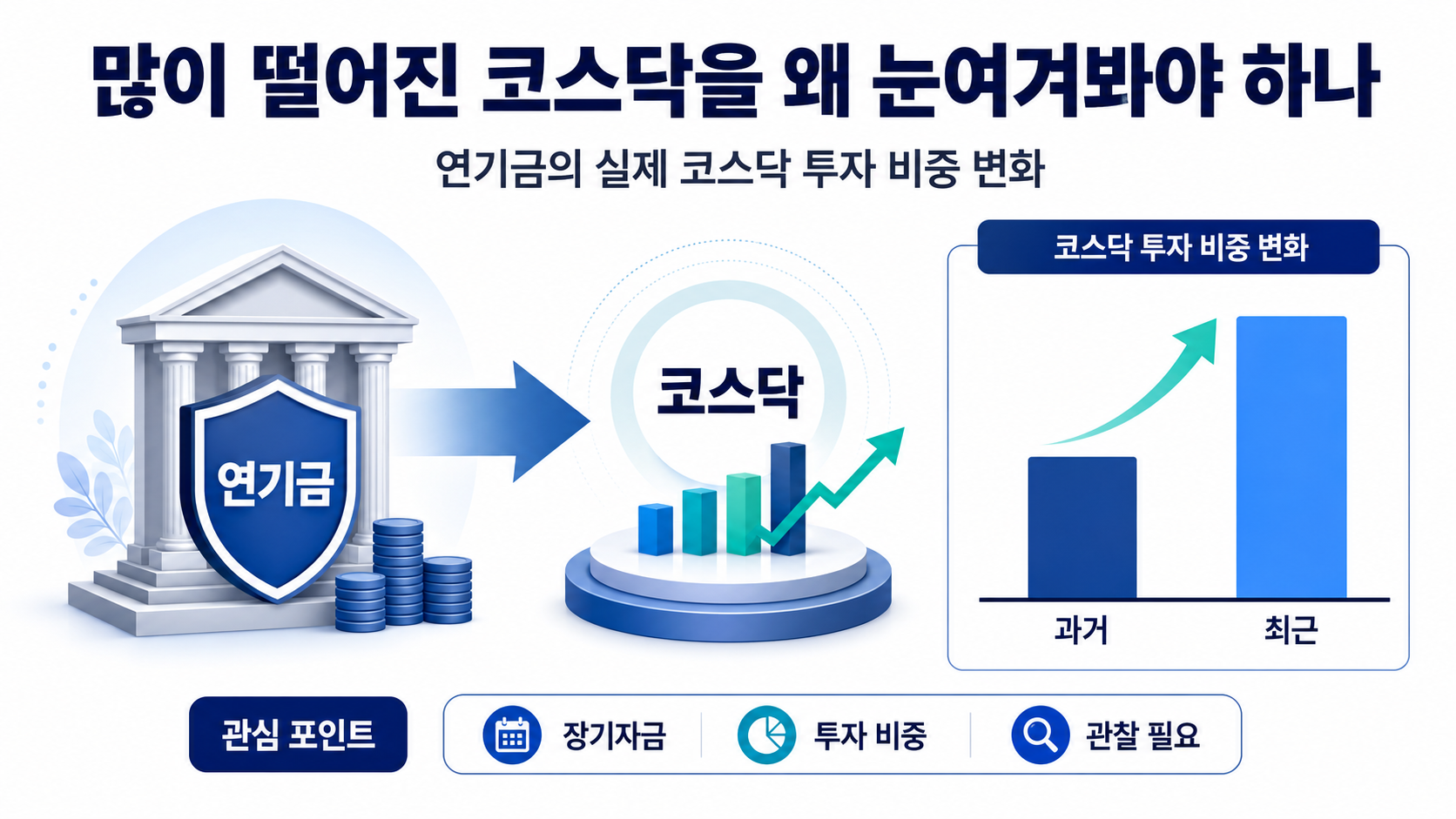
Whether new indices and related ETFs will be launched
Actual changes in pension funds' KOSDAQ investment allocations
How policy funding translates into earnings for listed companies
3. Retail Investors Moved in the Opposite Direction from Institutions and Foreign Investors on July 29
On July 29, retail investors recorded net sales of approximately KRW 457,600,000,000 in the KOSDAQ market. Foreign investors recorded net purchases of approximately KRW 307,100,000,000, while institutional investors bought a net KRW 146,900,000,000.
The fact that retail investors sold while foreign and institutional investors bought during a sharp market decline is worth monitoring. However, a single day's trading flows are insufficient to confirm that the market has bottomed.
To identify a genuine trend reversal, investors should check whether foreign and institutional net buying continues for at least several days and whether purchases are concentrated in only a handful of large-cap stocks. Index futures trading and exchange rate movements should also be considered.
4. The Severe Decline in Trading Value Makes the Return of Capital Particularly Important
From 2026-05-27 through July 24, average daily trading value in the KOSDAQ market was approximately KRW 8,766,000,000,000. Compared with approximately KRW 14,440,000,000,000 from the beginning of the year through May 26, this represents a decline of 39.29%.
The formula is `(KRW 8,766,000,000,000÷KRW 14,440,000,000,000-1)×100`, and the result is the author's calculation.
Declining trading value can be interpreted as reduced investor interest and liquidity in the KOSDAQ. Conversely, if trading value recovers while the number of advancing stocks also increases, it may signal that capital is returning to the broader market.
If trading value rises while the index falls, it may instead reflect increased panic selling or stop-loss orders. Trading value should always be assessed alongside the direction of the index and the number of advancing and declining stocks.
5. Differences Between Individual Stocks May Become More Important Than the Index
On July 29, the KOSDAQ market recorded 1,540 declining stocks, 138 advancing stocks, and 34 unchanged stocks. Approximately 90.0% of the stocks counted declined.
Although the broader market plunged, some large-cap stocks in robotics, biotechnology, and healthcare rose. This demonstrates that gains in selected stocks do not necessarily indicate a recovery across the entire KOSDAQ market.
Going forward, differences in individual companies' earnings and financial structures may become more important than their industry classifications.
| Sector | What to Check First | Key Risks |
|---|---|---|
| Biotechnology and healthcare | Clinical trial stages, regulatory approval schedules, cash reserves | Clinical trial failures and delays |
| Secondary batteries | Order backlog, capacity utilization, capital expenditure | Weakening demand and high debt |
| Robotics and AI | Actual revenue, customers, profitability | Revenue falling short of expectations |
| Semiconductor equipment | Customer investment plans, exports, inventories | Capital expenditure cycles and customer concentration |
| Content and gaming | New release schedules, users, overseas revenue | Launch delays and rising marketing expenses |
5 Things to Check Before a KOSDAQ Rebound
In a market where circuit breakers are repeatedly triggered, a sustained reduction in volatility should be confirmed before placing too much weight on a single day's rebound. When several of the following conditions improve simultaneously, it becomes easier to assess the possibility of market stabilization.
| Indicator | Sign of Stabilization | Warning Sign |
|---|---|---|
| Market volatility | Narrowing gap between intraday highs and lows | Repeated daily swings of around 8% |
| Number of advancing stocks | Gradually increasing proportion of advancing stocks | Gains limited to a few large-cap stocks |
| Foreign and institutional flows | Net buying over several consecutive trading sessions | Buying for one day followed immediately by selling |
| Trading value | Recovery accompanied by more advancing stocks | Sharp increase in trading value while the index declines |
| Corporate earnings | Forecasts maintained or revised upward | Earnings forecasts and target prices both revised downward |
International oil prices, the won-dollar exchange rate, and market interest rates should also be monitored. Many KOSDAQ companies have share prices that reflect expectations of future growth more heavily than current profits, so rising interest rates can negatively affect their valuations.
It is also important to monitor whether factors increasing market-wide risk aversion, such as developments in the Middle East or concerns about semiconductor industry conditions, begin to ease.
Is Now a Good Time to Invest in the KOSDAQ?
It is difficult to conclude that current conditions represent a buying opportunity for every investor. Immediately after a sharp decline, brief technical rebounds and further losses may alternate, making it essential to establish an investment horizon and an acceptable loss limit first.
Step 1: Calculate Your Maximum Acceptable Loss Before Deciding How Much to Invest
It is generally safer to determine the amount to invest based on losses you can afford rather than expected returns.
For example, if a further decline of 20% is assumed and the loss an investor can actually afford is KRW 300,000, the calculated maximum investment amount would be KRW 1,500,000.
`KRW 300,000÷20%=KRW 1,500,000`
This is merely an illustration of the author's calculation. It does not guarantee a projected decline or recommend a particular investment amount.
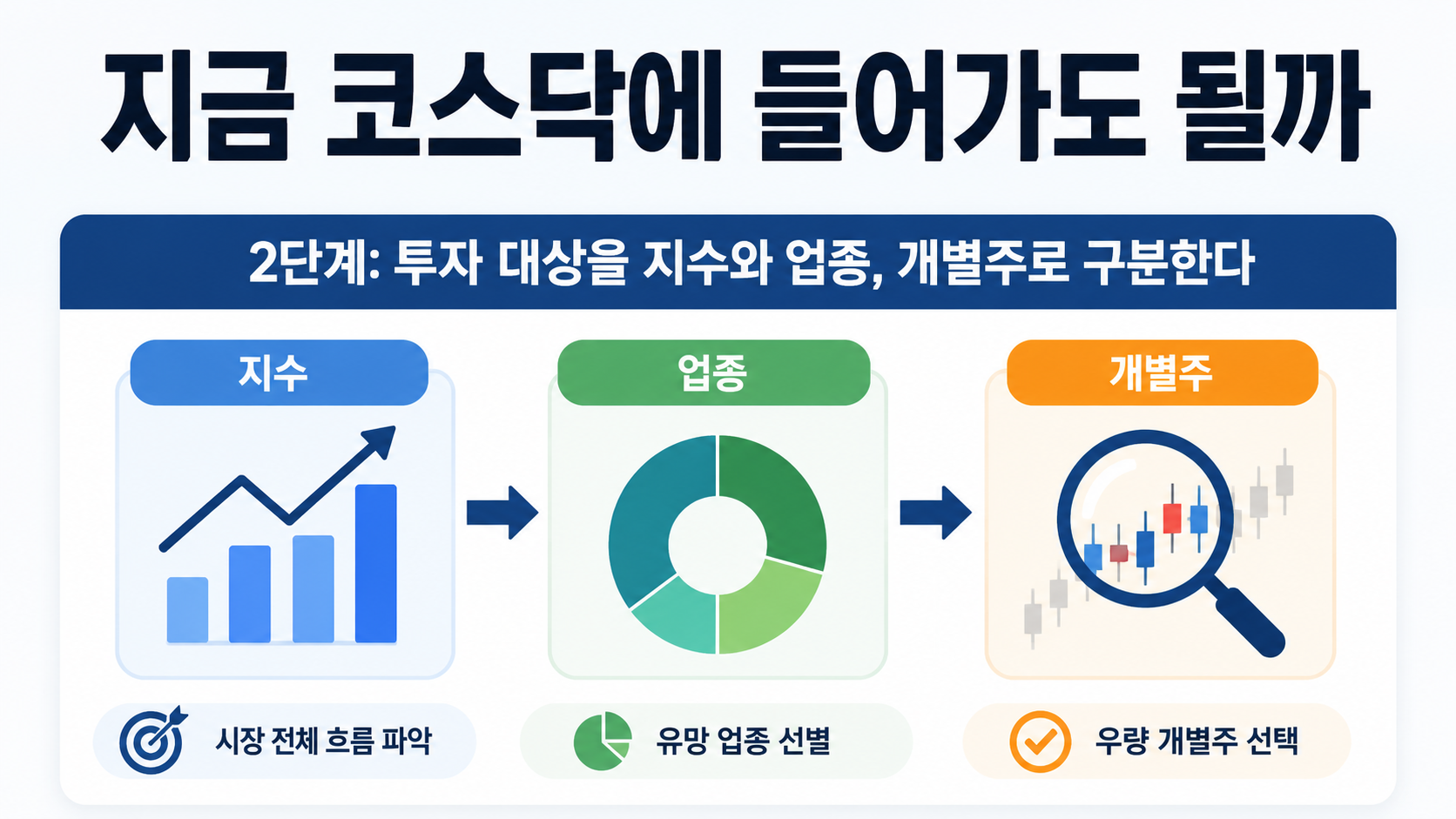
Step 2: Distinguish Between Index, Sector, and Individual Stock Investments
| Investment Method | Suitable Objective | Main Risks |
|---|---|---|
| Broad index ETF | Tracking the recovery of the overall KOSDAQ market | Decline across the entire index |
| Sector ETF | Focusing on the recovery of a specific industry | Sector concentration and volatility |
| Individual stocks | Directly analyzing earnings and company valuations | Disclosure, liquidity, and company-specific risks |
| Leveraged products | Short-term directional trading | Amplified losses and tracking differences during long-term holding |
| Inverse products | Responding to market declines | Rapid losses during rebounds |
During sharp market declines, leveraged and inverse products can generate rapidly increasing losses when prices move in an unexpected direction. In particular, over longer holding periods, the compounding of daily returns can produce significant performance differences relative to the underlying index.
Step 3: Divide Entry Decisions into Stages Rather Than Investing Everything at Once
A staged investment approach does not simply mean dividing the same amount of money across different dates. A more practical method is to reassess the investment decision whenever specific confirmation conditions are met.
Whether the trading session closes without a circuit breaker
Whether foreign and institutional investors continue to record net purchases
Whether the number of advancing stocks increases
Whether earnings forecasts for companies of interest remain intact
Whether there is a risk of shareholder dilution through rights offerings or convertible bonds
If conditions deteriorate, postponing a planned additional purchase is also part of a staged investment strategy.
Common Beginner Mistakes to Avoid in the KOSDAQ Market
The KOSDAQ carries substantial volatility and company-specific risks alongside its potential for rapid gains. Investors hoping to take advantage of a sharp market decline should avoid the following mistakes.
Buying Simply Because the Index Has Fallen Sharply
The percentage decline in an index does not reveal a company's fair value. Companies operating at a loss, facing potential capital impairment, or holding insufficient cash may recover slowly even after the broader market stabilizes.
Comparing Stocks Solely by Their Decline from Previous Highs
If a previous peak reflected excessive expectations, a stock may remain overvalued even after falling 50%. Recent financial results, future earnings, net cash, and peer-company valuations should all be considered.
Chasing Surging Stocks After the Rally Has Already Begun
During a market selloff, some stocks can move dramatically even on relatively low trading value. Stocks rising without supporting disclosures or earnings fundamentals may quickly give back their gains.
Increasing Investment Amounts to Recover Previous Losses
Increasing investment amounts or leverage after suffering losses may amplify account volatility more than it improves the likelihood of recovery. Before buying additional shares, investors should first examine why their original assessment proved incorrect.
Checklist for Deciding Whether to Keep Watching the KOSDAQ
If several of the following conditions improve together, investors may reassess whether the market is stabilizing.
KOSDAQ circuit breakers are no longer being triggered repeatedly.
The gap between intraday highs and lows is narrowing.
The number of advancing stocks increases over several days.
Foreign and institutional investors continue buying on a net basis simultaneously.
Trading value recovers alongside a broader increase in advancing stocks.
Sharp increases in market interest rates and international oil prices begin to subside.
Earnings forecasts for companies of interest are not being revised downward.
There are no risks involving rights offerings, convertible bonds, or share sales by controlling shareholders.
The KOSDAQ deserves attention not simply because the index has fallen to the 662 level. Rather, market restructuring and the potential inflow of long-term capital are creating new possibilities, while the sharp decline has opened a period in which investors can reassess individual companies' prices relative to their earnings.
However, expectations surrounding government policies and a single day's capital flows are not enough to conclude that a rebound is imminent. Investment decisions become better supported when declining volatility, recovering trading value, foreign and institutional buying, and corporate earnings are confirmed together.
---
※ This article is provided for informational purposes to help readers understand market trends. It does not constitute investment advice or a recommendation to buy any particular stock or asset. All final investment decisions and responsibility for their outcomes rest with the individual investor.
이 포스팅은 쿠팡 파트너스 활동의 일환으로, 이에 따른 일정액의 수수료를 제공받습니다.