

Will You Lose Government Contributions If You Can't Deposit KRW 500,000 Every Month Into the Youth Future Savings Account? Missed Payments vs. Smaller Deposits
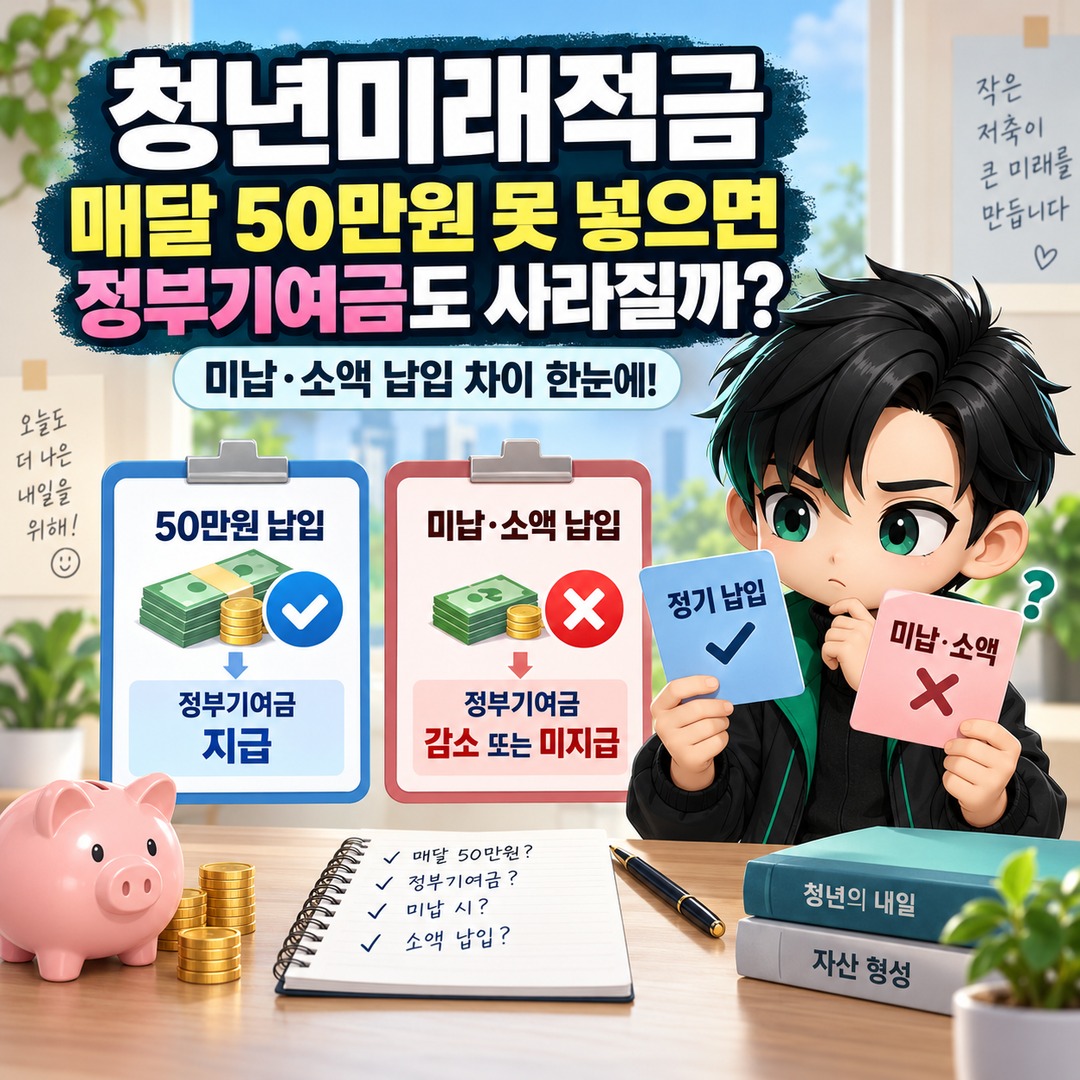
The Youth Future Savings Account does not require you to deposit KRW 500,000 every month. You can make flexible deposits of up to KRW 500,000 per month and keep your account open even if you make no deposit for an entire month. However, government contributions are not provided for amounts you do not deposit, so your maturity payout will be lower.

As of 2026-10-13, this is important information for young people who find it difficult to save the same amount every month because of living expenses.
1. Missing One Month's Deposit Does Not Close Your Youth Future Savings Account
The Youth Future Savings Account is a flexible-installment savings product with a maturity period of 3 years. It differs from fixed-installment savings products that require a predetermined deposit every month.

According to the official product structure announced by the Financial Services Commission on 2026-06-29, you can keep your account open even if you have months with no deposits during your enrollment period.
This means the following deposit pattern is possible:
Deposit KRW 500,000 this month
Deposit KRW 100,000 next month because of living expenses
Make no deposit the following month
Resume deposits when your finances improve
The important distinction is that missing a deposit and terminating an account early are not the same thing.
Your account will not be automatically closed simply because you did not save money for one month. However, if you voluntarily terminate the savings account early, you may face disadvantages involving government contributions and tax-exemption benefits.
2. How Much Government Contribution Will You Receive If You Deposit KRW 100,000 Instead of KRW 500,000?

Government contributions are calculated based on the amount actually deposited. Under the structure in effect as of October 2026, the standard plan applies 6% of the deposited amount, while the preferential plan applies 12%.
The following amounts are calculated on the assumption that all contribution eligibility requirements for each plan are met.
| Monthly Deposit | Standard Plan 6% | Preferential Plan 12% |
|---|---|---|
| KRW 100,000 | KRW 6,000 | KRW 12,000 |
| KRW 200,000 | KRW 12,000 | KRW 24,000 |
| KRW 300,000 | KRW 18,000 | KRW 36,000 |
| KRW 500,000 | KRW 30,000 | KRW 60,000 |
| KRW 0 | KRW 0 | KRW 0 |
*Author's calculations. Actual government contribution payments depend on the enrollment plan, continued eligibility, and product terms and conditions.*
For example, if a standard-plan participant deposits KRW 100,000 this month, the government contribution is calculated as KRW 6,000.
That is KRW 24,000 less than the KRW 30,000 calculated for a deposit of KRW 500,000, but the smaller deposit still qualifies for benefits.
The same principle applies to the preferential plan. A deposit of KRW 100,000 results in a calculated government contribution of KRW 12,000, while a deposit of KRW 500,000 results in KRW 60,000.
In other words, failing to deposit the maximum amount every month does not mean losing all the benefits of the savings product.
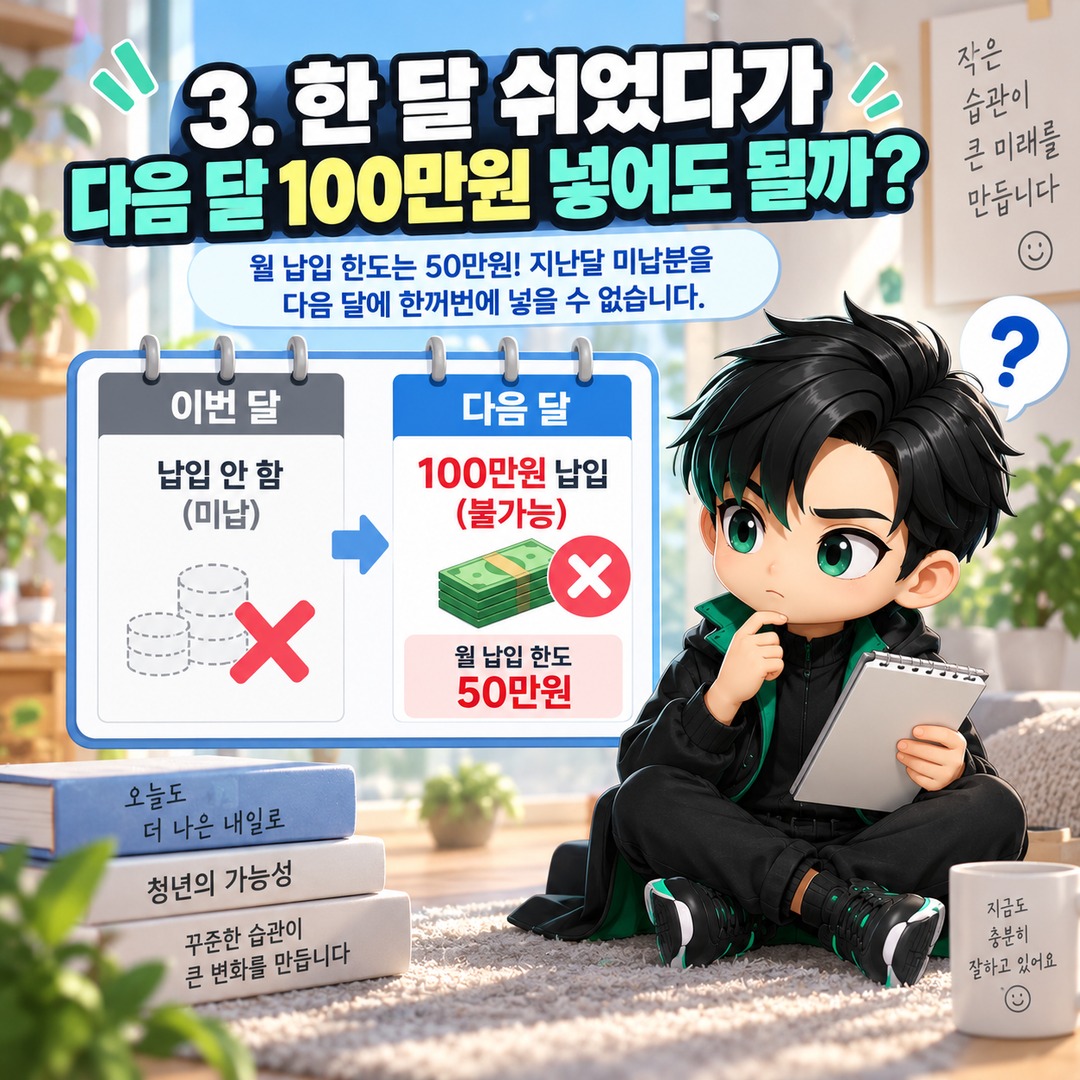
3. Can You Skip One Month and Deposit KRW 1,000,000 the Next Month?
Because the Youth Future Savings Account has a monthly deposit limit of KRW 500,000, skipping one month does not allow you to deposit KRW 1,000,000 the following month to make up for the missed payment.
For example, suppose you make deposits over two months as follows.
| Deposit Pattern | First Month | Second Month | Total |
|---|---|---|---|
| Maximum deposit every month | KRW 500,000 | KRW 500,000 | KRW 1,000,000 |
| No deposit in the first month | KRW 0 | KRW 500,000 | KRW 500,000 |
Comparing government contributions under the standard plan, the first pattern produces a two-month total of KRW 60,000, while the second produces KRW 30,000.
This Means You Can Keep Your Account Open While Skipping a Month, but You Cannot Carry the Unused Monthly Deposit Limit Into the Following Month.
For young people with irregular incomes, it is therefore more practical to deposit an amount they can sustain while accounting for living expenses and emergency savings, rather than stretching their finances to reach the maximum every month.
4. How Much Difference Does Depositing Only KRW 100,000 Every Month for 3 Years Make?
The Youth Future Savings Account matures after 36 months.
Assuming you deposit the same amount throughout 36 months, you can calculate the difference in principal and government contributions.
| Category | Monthly KRW 100,000 | Monthly KRW 500,000 |
|---|---|---|
| Principal deposited over 36 months | KRW 3,600,000 | KRW 18,000,000 |
| Standard-plan government contributions | KRW 216,000 | KRW 1,080,000 |
| Preferential-plan government contributions | KRW 432,000 | KRW 2,160,000 |
*Author's calculations. These figures assume monthly deposits, unchanged contribution rates, and continued enrollment until maturity. Bank interest is excluded.*
Under the standard plan, depositing KRW 100,000 every month results in principal of KRW 3,600,000 and calculated government contributions of KRW 216,000 over 3 years.
Under the preferential plan, the same principal produces calculated government contributions of KRW 432,000.
However, these amounts are not the actual maturity payouts. They do not reflect bank interest, whether preferential interest-rate requirements are met, or government contribution eligibility conditions.
Bank interest rates vary depending on the base interest rate and preferential-rate requirements. Therefore, you should not determine your final maturity payout based solely on government contributions.
5. What Should You Do If an Automatic Transfer Fails?
Even if an automatic transfer fails, you should first check whether you can still make a deposit for that month, provided your account remains active.
This is because a failed automatic transfer and account termination are separate issues.
It is advisable to check the following in order.
1. Check the status of your Youth Future Savings Account in your bank's app.
2. Check whether the automatic transfer failed because of insufficient funds.
3. Check the total amount deposited this month and your remaining monthly deposit limit.
4. If deposits are still permitted, make a manual deposit or set up the automatic transfer again.
5. After depositing, check your transaction history to confirm that the payment was recorded correctly.
One important point is that setting up the automatic transfer again does not automatically make a retroactive deposit for the failed amount.
Because automatic transfer processing times and deposit recognition rules may differ by bank, it is safer to confirm whether a deposit made near the end of the month will count toward that month's deposits.
6. Pausing Deposits and Terminating the Account Early Have Different Consequences for Your Benefits
Early termination of a Youth Future Savings Account can result in more significant disadvantages than temporarily pausing deposits.
According to the Financial Services Commission's official guidance issued on June 2026, ordinary early termination does not qualify for government contributions or the income tax exemption on interest earnings.
| Category | Pausing Deposits | Ordinary Early Termination |
|---|---|---|
| Account status | Can remain open | Closed |
| Contributions for periods without deposits | Not accrued | Subject to early-termination restrictions |
| Existing benefits | Subject to conditions for maintaining the account | Disadvantages involving contributions and tax exemptions |
| Future deposits | Permitted | New enrollment procedure required |
Different treatment may apply if the termination qualifies under special early-termination circumstances.
Therefore, if you suddenly need a large sum of money, it is advisable to determine whether temporarily stopping deposits could resolve the situation before immediately terminating your savings account.
7. How Should You Choose Your Deposit Amount If Your Salary Is Irregular?
The monthly KRW 500,000 for the Youth Future Savings Account is the maximum deposit limit, not a mandatory deposit amount.
Young people whose salaries are inconsistent or whose expenses fluctuate significantly because of job hunting, changing jobs, or rising living costs may consider the following approaches.
First, Set a Lower Base Deposit Amount.
If depositing KRW 500,000 every month is burdensome, you can use a sustainable amount such as KRW 100,000 or KRW 200,000 as your baseline.
Second, Make Additional Deposits During Months When You Have More Money Available.
You can adjust your deposits as long as the total does not exceed the monthly limit of KRW 500,000.
Third, Keep Emergency Savings Separate.
If you put all your living expenses into the savings account to receive more government contributions, unexpected expenses could force you to consider early termination.
Ultimately, what matters is not just depositing the maximum amount in a particular month, but whether you can maintain the account reliably for 3 years.
8. Final Things to Check Before Applying
As of 2026-10-13, applications for the 2 round of the Youth Future Savings Account are underway. Applying and actually opening an account are separate procedures.
The application period for this 2 round runs through October 16, while successful applicants are scheduled to open their accounts from November 16 through 27. The detailed schedule may change depending on the progress of the screening process.
After opening your account, it is advisable to check your enrollment plan, applicable interest rate, and government contribution conditions.
Official product information is available at <Link url="https://fill4young.kinfa.or.kr/yfs/main" title="Korea Inclusive Finance Agency Youth Future Savings Account Website"/>, and detailed inquiries can be directed to the Korea Inclusive Finance Agency's Youth Finance Call Center at 1397.
The key point is simple: You can keep your Youth Future Savings Account open even if you skip a month, but you cannot receive government contributions for a month in which you made no deposit. Rather than focusing on the maximum monthly deposit, it is important to establish a savings plan you can maintain throughout 36 months.
<text color="secondary" size="xs">Information verified as of: 2026-10-13. Government contribution and deposit comparisons are simplified calculations based on the official product structure. Actual payments may vary by individual.</text>