

Changwon City Responds to Spring Tides and Heavy Rainfall, Inspects 178 Billion Gu Port Drainage Pumping Station…Rain Forecast for Gyeongnam Through 20
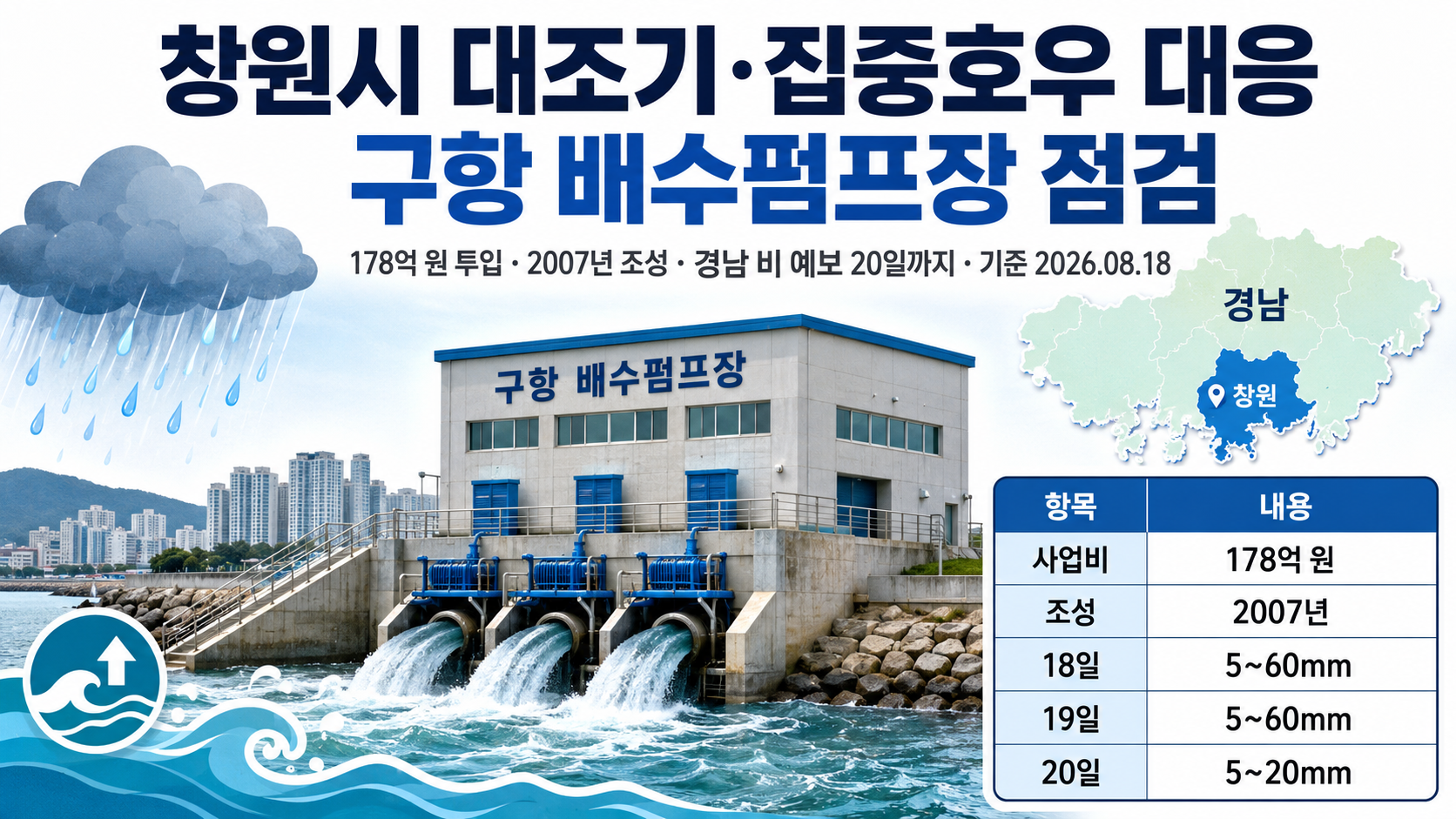
Changwon City inspected the Masan Gu Port drainage pumping station in preparation for a situation in which spring tides and heavy rainfall could coincide on August 15–16. The facility was constructed in 2007 at a cost of approximately KRW 17,800,000,000 to reduce recurring flooding along the coast of Masan's old downtown area and around the fish market. According to the latest forecast issued at 11 a.m. on August 18, showers of 5–60 mm are forecast for Busan, Ulsan, and Gyeongnam on both 18 and 19, with rainfall of 5–20 mm forecast for 20.
The information was verified as of 2026-08-18 at 1:4 p.m. Korea Standard Time. Although the spring tide response scheduled for 16 has already passed, it cannot be concluded that the rain has completely ended. Residents in Changwon's coastal areas and low-lying neighborhoods should therefore continue checking the latest local weather forecasts and disaster information.
Why Did Changwon City Inspect the Gu Port Drainage Pumping Station Again?
The inspection took place when spring tides lasting from August 15 through 16 coincided with a forecast of heavy rainfall on the night of 16. Spring tides occur around the full moon or new moon, when the difference between high and low tides increases and sea levels at high tide can rise higher than usual. If heavy rain falls at the same time, drainage conditions in coastal and low-lying areas require particularly careful monitoring.
Changwon Mayor Kang Gi-yoon visited the Gu Port drainage pumping station along the Masan coast on 16 to check its operational condition. The inspection items consistently identified in related information released on 17 were pump operation, emergency power generation equipment, and the remote-control system.
The city's response also goes beyond inspecting the facility itself. It confirmed a policy of operating a 24-hour situation management system to enable rapid drainage in response to weather conditions and rising sea levels.
An important distinction must be made here. The fact that flood prevention facilities were inspected is different from whether flooding actually occurred or how much rainfall the facilities handled. The publicly available materials reviewed for this article do not establish the final extent of flood damage across Changwon or the Gu Port drainage pumping station's actual hourly processing capacity.
What Kind of Facility Is the Gu Port Drainage Pumping Station, Built at a Cost of Approximately KRW 17,800,000,000?
The Gu Port drainage pumping station is a flood prevention facility constructed in 2007 at a cost of approximately KRW 17,800,000,000 to address recurring flooding along the coast of Masan's old downtown area and around the fish market. Its ability to properly discharge accumulated water is particularly important when heavy rainfall coincides with elevated sea levels.
That is why the latest on-site inspection covered more than just the pumps. Officials also checked the emergency power generation equipment to ensure the facility could operate during emergencies such as power outages. They examined the remote-control system as well, taking into account situations in which the equipment might not be operated directly on-site.
According to the author's calculation, approximately 19 years have passed between the facility's construction in 2007 and 2026.
Author's calculation: 2026 - 2007 = 19 years
However, the calculation that the facility is approximately 19 years old does not, by itself, establish that it has deteriorated or can no longer function properly. Assessing its actual performance would require examining pump capacity, maintenance records, equipment replacement history, and operational test results. Such detailed figures were not disclosed in the materials verified for this article.
Instead, the key confirmed finding from this inspection is that officials rechecked the facility's actual operating condition, emergency power generation equipment, and remote-control system on-site, rather than focusing simply on its age.
Does the End of the Spring Tide Period Mean Flooding Is No Longer a Concern Along Changwon's Coast?
The end of the spring tide period does not mean that subsequent rain forecasts disappear. The Korea Meteorological Administration's short-term forecast for Busan, Ulsan, and Gyeongnam, issued at 11 a.m. on August 18, includes showers on 18 and 19 and rain on 20.
On 18, scattered showers were expected in parts of Busan, Ulsan, and Gyeongnam between 12 p.m. and 6 p.m., with expected precipitation of 5–60 mm.
On 19, scattered showers were also expected from the afternoon into the evening, with the same forecast precipitation range of 5–60 mm. On 20, rain could fall in some areas from morning until late at night, with expected precipitation of 5–20 mm.
However, these figures should not be interpreted as meaning that 'Changwon will definitely receive 60 mm of rain.' The 5–60 mm figure represents a forecast precipitation range for the wider Busan, Ulsan, and Gyeongnam region, not a confirmed rainfall amount at a specific location in Changwon. The latest neighborhood-level forecast should be checked for the actual timing and amount of rainfall in each neighborhood of Changwon.
The forecast also warned that showers on 18–19 could be accompanied by gusty winds, thunder, and lightning. Because the earlier spring tide response and the current shower forecast concern different periods and weather conditions, the situation on 16 should not be treated as identical to the current weather.
What Should Residents of Changwon's Low-Lying and Coastal Areas Check First?
When rainfall intensifies again, checking vehicles, drainage outlets, and evacuation routes before the rain begins should take priority over trying to secure facilities after flooding has already started. People using low-lying areas, coastal locations, or underground spaces should particularly avoid entering dangerous areas to check flooding conditions themselves.
Based on the Korea Meteorological Administration's heavy rain safety guidance, the following sequence of precautions is practical for the current situation.
Before rainfall intensifies, check that sewers and drainage outlets around the home are not blocked.
Prepare sandbags or flood barriers in advance for underground parking garages and other underground spaces at risk of flooding.
Move vehicles parked near rivers, beaches, or low-lying areas to safer locations before flooding occurs.
When heavy rain is already falling, do not allow people or vehicles to enter flooded roads, underpasses, or bridges.
If water begins entering a building, even slightly, move to higher ground or a nearby evacuation site rather than staying behind to move belongings.
Drivers should particularly avoid assuming that they can pass through a flooded road simply because the vehicle ahead managed to do so. It is difficult to accurately assess water depth or road surface conditions from inside a vehicle, and structures such as underpasses and bridges may remain damaged even after floodwaters recede.
The same applies to homes and businesses in low-lying areas. Measures such as installing flood barriers or sandbags and clearing drainage outlets must be completed before water enters. If flooding is already underway, moving to safety should take priority over entering underground spaces to protect property or equipment.
If Flood Damage Is Visible After the Rain Stops, Should Repairs Begin Immediately?
If flooding or structural damage has occurred, the appropriate sequence is to confirm safety first, report and document the damage, and then begin recovery work. Even after heavy rain ends, people should avoid immediately approaching flooded roads, bridges, or weakened slopes.
If a home or business has been damaged, it is advisable to photograph the affected areas before making repairs. Damage to homes, water supply and sewage facilities, retaining walls, roads, and similar infrastructure can be reported to the relevant local authorities.
Electrical and gas safety also require attention in flooded homes. People should not directly touch electrical equipment that has been exposed to water. If a safety inspection is necessary, the equipment should not be used until it has been checked.
Flood-contaminated food or potentially polluted water should not be used as though nothing had happened. Even after visible floodwaters recede, 2-order hazards, including contamination and problems with electrical or gas equipment, may remain.
What Has Been Confirmed About Changwon City's Inspection, and What Remains Unknown?
What the currently available public materials clearly establish is that Changwon City inspected the Masan Gu Port drainage pumping station in preparation for spring tides and heavy rainfall, checked the operation of its pumps, emergency power generation equipment, and remote-control system, and directed that a 24-hour situation management system be operated. Multiple sources also consistently confirm that the Gu Port drainage pumping station was constructed in 2007 at a cost of approximately KRW 17,800,000,000.
By contrast, the original materials reviewed for this article do not establish how many tons of water the Gu Port drainage pumping station actually discharged after the inspection, its maximum hourly processing capacity, the amount spent on recent facility renovations, or the final number of flooding incidents recorded in Changwon during this period of heavy rainfall.
Therefore, conclusions such as 'the inspection eliminated the flood risk' or 'the facility has problems because it is old' go beyond the scope of the verified facts.
The information residents need most now is updated rainfall forecasts for individual areas of Changwon, emergency alert messages, and information on road and underpass closures. In particular, the Korea Meteorological Administration's precipitation forecasts may change with each new issuance, so figures from the forecast issued at 11 a.m. on August 18 should not automatically be applied to subsequent forecasts.