

What Stock and Crypto Investing Beginners Need to Know: Why Loss Limits Matter More Than Returns
이 포스팅은 쿠팡 파트너스 활동의 일환으로, 이에 따른 일정액의 수수료를 제공받습니다.

If you are just starting to invest in stocks or cryptocurrencies, it is better to establish your investment horizon, acceptable losses, diversification strategy, total costs, and custody and security standards before choosing individual assets. As of 2026-09-23, investment products and regulations may change, but comparing returns without understanding these five factors can leave you without a clear decision-making framework when prices fluctuate.
Before Deciding How Much to Invest, Determine How Long You Can Leave the Money Untouched
If your investment horizon is short, you have less time to wait for prices to recover. That is why, before deciding how much to invest, you should first determine when you will need the money again.
Money intended for use several years from now cannot necessarily be managed in the same way as money needed for living expenses next month. A longer investment horizon does not eliminate the possibility of losses, but your investment horizon and risk tolerance are fundamental factors in deciding which assets to hold and how much to allocate to them.
When getting started, writing down numerical answers to the following three questions can simplify your decisions.
How long can I leave this money untouched?
How far could the value of my investments fall before it affects my daily life or financial plans?
If prices plunge, can I stick to my original plan without investing additional money?
If you cannot answer these questions, reconsidering the size of your investment should take priority over selecting individual assets.
As Losses Grow, Recovering Your Principal Requires a Disproportionately Larger Gain
After a 20% loss, a 20% gain is not enough to recover your original investment. This is one of the simplest reasons beginners should establish their loss tolerance before investing.
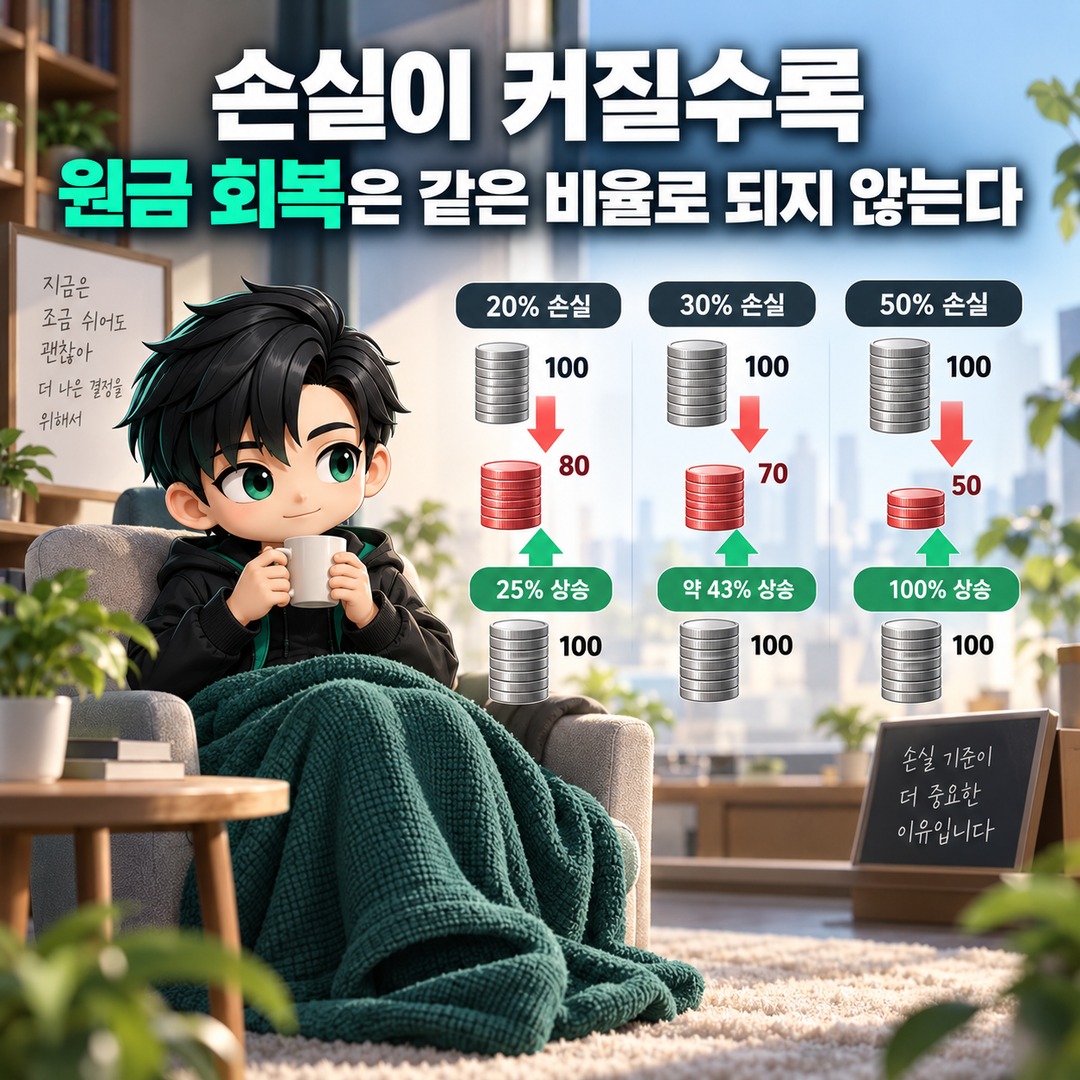
If KRW 1,000,000 falls by 20%, it becomes KRW 800,000. For KRW 800,000 to return to KRW 1,000,000, it must increase by KRW 200,000, equivalent to a 25% gain relative to KRW 800,000.
| Investment Loss | Gain Required to Recover Principal |
|---|---|
| -10% | Approximately +11.1% |
| -20% | +25% |
| -30% | Approximately +42.9% |
| -50% | +100% |
These are the author's calculations, using the formula `1 ÷ (1 - loss rate) - 1`. Trading costs are not included.
The purpose of this calculation is not to establish a rule for when to sell. Rather, it illustrates why beginners should quantify how much they can afford to lose before focusing on expected returns.
Stocks and Cryptocurrencies Have Different Risks, Even When Traded Through Similar Interfaces
Stocks are securities representing ownership interests in companies. Therefore, investing in individual stocks requires more than monitoring prices. You also need to understand the underlying company and review its publicly disclosed business and financial information.
Cryptocurrencies introduce an additional consideration: how assets are stored and accessed. If you use a personal wallet, you need to understand how to manage private keys and seed phrases. Wallets connected to the internet also require consideration of cybersecurity threats.
In South Korea, the Act on the Protection of Virtual Asset Users has been in effect since 2024-07-19. The law includes provisions concerning the protection of user deposits and virtual assets, regulations against unfair trading practices such as market manipulation, and the supervision and inspection of virtual asset service providers.
Actual investigation results also demonstrate the need for market surveillance. According to the Financial Services Commission, as of 2026-07-20, approximately 40 investigations into unfair virtual asset trading had been completed during the roughly 2 years following the law's implementation. Of these, approximately 30 cases had been referred or reported to investigative authorities.
Therefore, when choosing a cryptocurrency, you should consider not only how much its price might rise but also where it is traded, how it is stored, account security, and what information can be officially verified.
Owning Several Investments Does Not Automatically Mean You Are Diversified
Diversification is a way to reduce the risk of having your investment results depend too heavily on a single security or asset. However, diversification does not eliminate losses caused by an overall market decline.
For example, even if you hold several stocks or ETFs with different names, your portfolio may be more concentrated than you realize if their largest holdings and industry exposures overlap. Similarly, an ETF focused on a particular industry or theme is not necessarily sufficiently diversified simply because it is an ETF.
For beginners, it is useful to ask the following question before adding another investment: Are the reasons this asset might decline essentially the same as the reasons my existing holdings might decline?
What matters more than the number of stocks or cryptocurrencies you own is how much your overall investment performance depends on a single company, industry, theme, or cryptocurrency.
Even Small Fees Can Affect Investment Results When They Accumulate
Investment costs should be divided into those incurred when buying or selling and those that continue while holding an investment. The more frequently you trade, the more important it becomes to understand transaction costs.
A hypothetical example from U.S. Securities and Exchange Commission investor education materials helps illustrate the difference. Assuming 10 ten-thousand dollars grows by 4% annually before fees for 20 years, the ending value would be approximately 20 ten-thousand 8 thousand dollars with annual fees of 0.25%, compared with approximately 17 ten-thousand 9 thousand dollars with annual fees of 1%.
Even under the same assumptions, the difference between the two outcomes is approximately 2 ten-thousand 9 thousand dollars. These figures are not projections of actual investment returns. They are intended to illustrate how costs can accumulate over long periods.
For stocks and ETFs, review trading expenses and ongoing product costs. For cryptocurrencies, check the actual terms of the trading service, including not only trading fees but also withdrawal, transfer, and other charges incurred when using the service.
Verify the Source of Information Before Following Investment Recommendations
For stocks, check whether you can directly verify a company's business activities and key financial information through its public disclosures. For cryptocurrencies, a safer approach is to begin with verifiable information, such as issuance and circulation structures and exchange listing details.
Be particularly cautious when someone pressures you to make an immediate decision based on difficult-to-verify claims about future outcomes, such as 'the price is about to rise,' 'there is almost no risk of loss,' or 'you will miss your chance if you do not invest now.' Verification should come before buying.
Social media, group chats, and recommendations from acquaintances can provide investment ideas, but they cannot substitute for a sound investment rationale.
Write Down These Essentials Before Making Your First Investment
Before pressing the order button, writing just six lines on paper or in a notes app can make your investment decisions much more concrete.
1. Purpose and Time Horizon — Why am I investing, and when will I need this money?
2. Available Investment Capital — Can I afford a decline in value without compromising essential living expenses?
3. Loss Tolerance — How much of a loss can I realistically withstand?
4. Concentration Risk — Am I overly exposed to a single stock, industry, theme, or cryptocurrency?
5. Actual Costs — What fees will I incur when buying, selling, holding, or withdrawing assets?
6. Custody and Information Verification — Particularly for cryptocurrencies, do I understand account security, wallets, and private key management?
If you find any of these six items difficult to explain, it is better to clarify that area before searching for another investment opportunity.
The starting point for investing in stocks and cryptocurrencies is not predicting future prices. The priority is understanding the risks you are taking and determining whether you can maintain your original plan even if those risks materialize.
※ This article is provided for informational purposes to help readers understand market dynamics. It does not constitute an investment recommendation for any specific security or asset. All final investment decisions and responsibilities rest with the individual investor.
Related Articles
이 포스팅은 쿠팡 파트너스 활동의 일환으로, 이에 따른 일정액의 수수료를 제공받습니다.