

Today's Stock Market: Just 4.61 Points from KOSPI 6995.39 to 7000…What to Watch Beyond Semiconductors
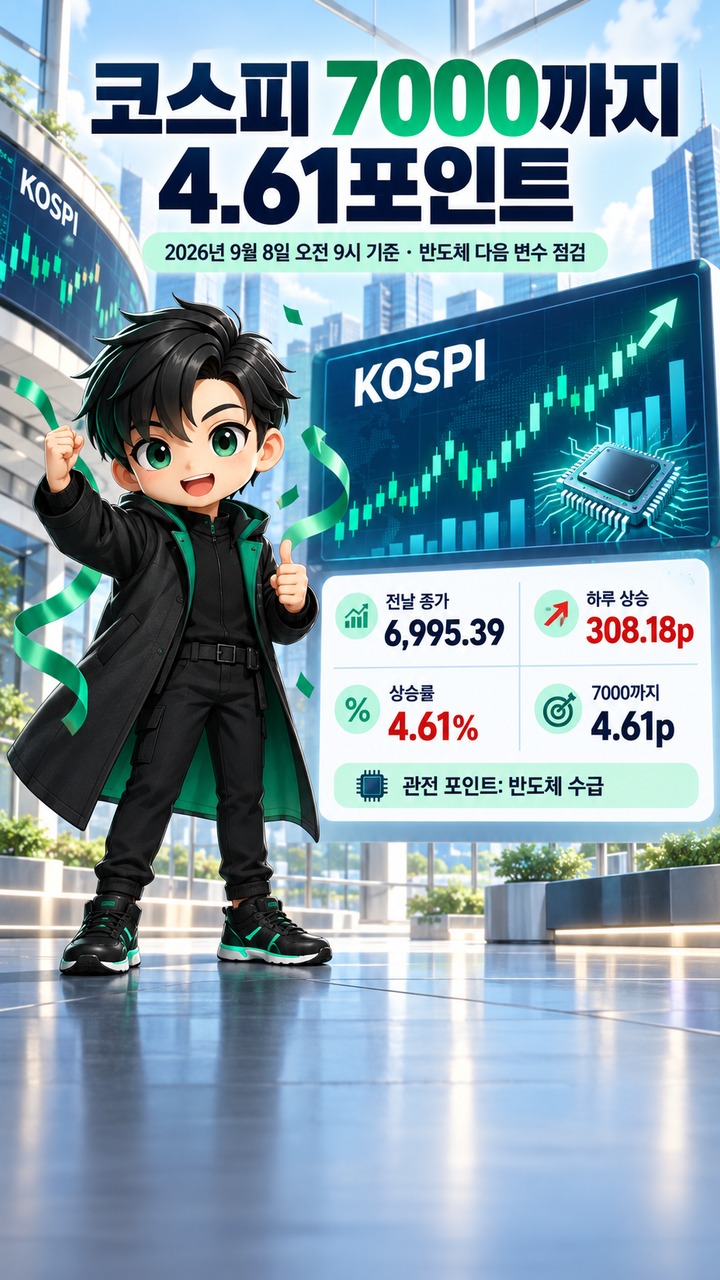
As of 9 a.m. on 2026-09-08, the starting point for South Korea's stock market is the previous day's KOSPI close of 6,995.39. On 7 alone, the index gained 308.18 points, or 4.61%, leaving it just 4.61 points short of 7,000. However, with U.S. markets having just been closed for Labor Day, investors should look beyond whether the index breaks through 7,000. It is also important to monitor whether the semiconductor buying that drove the previous day's sharp rally continues and which direction international oil prices and U.S. interest rates take.
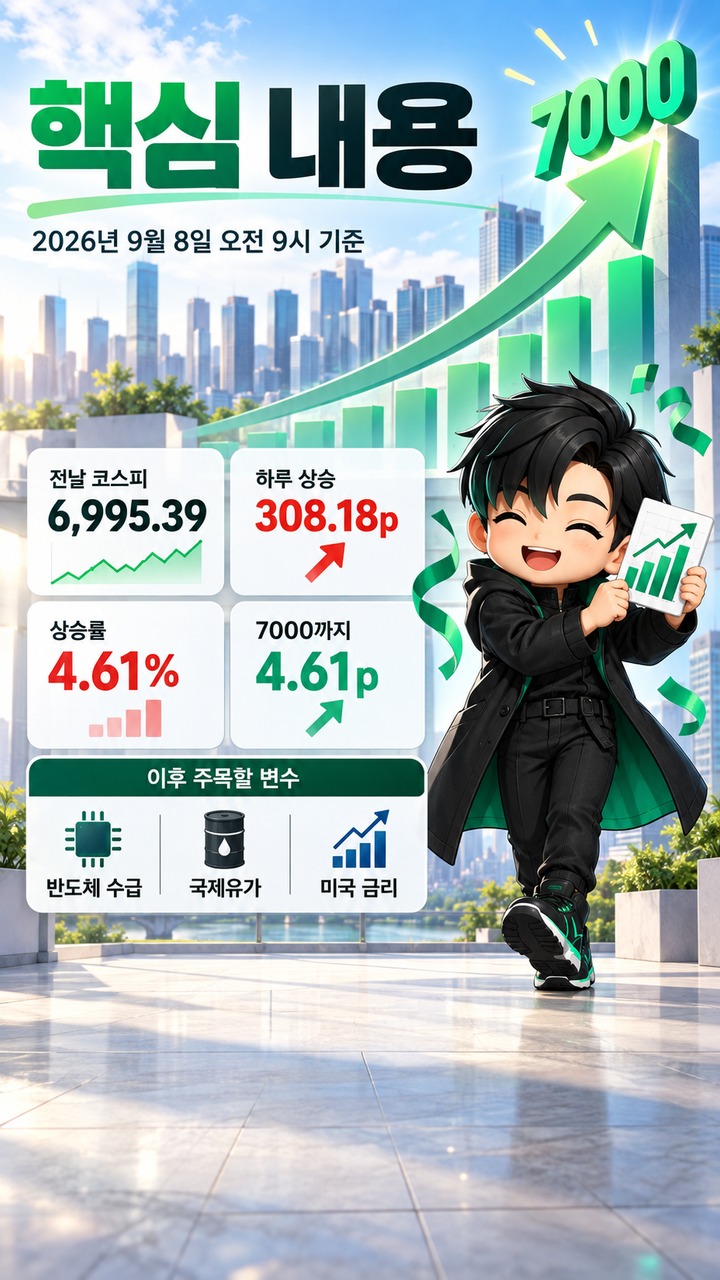
It would be difficult to conclude from the previous day's surge alone that the entire market will rise with equal strength. Major semiconductor stocks, including Samsung Electronics and SK Hynix, were the primary drivers of the KOSPI's gains. U.S. inflation data are also scheduled for release this week, followed by the Federal Open Market Committee (FOMC) meeting next week.
How Close Is the KOSPI Really to 7000?
The KOSPI closed at 6,995.39 on September 7. The gap to 7,000 is just 4.61 points.
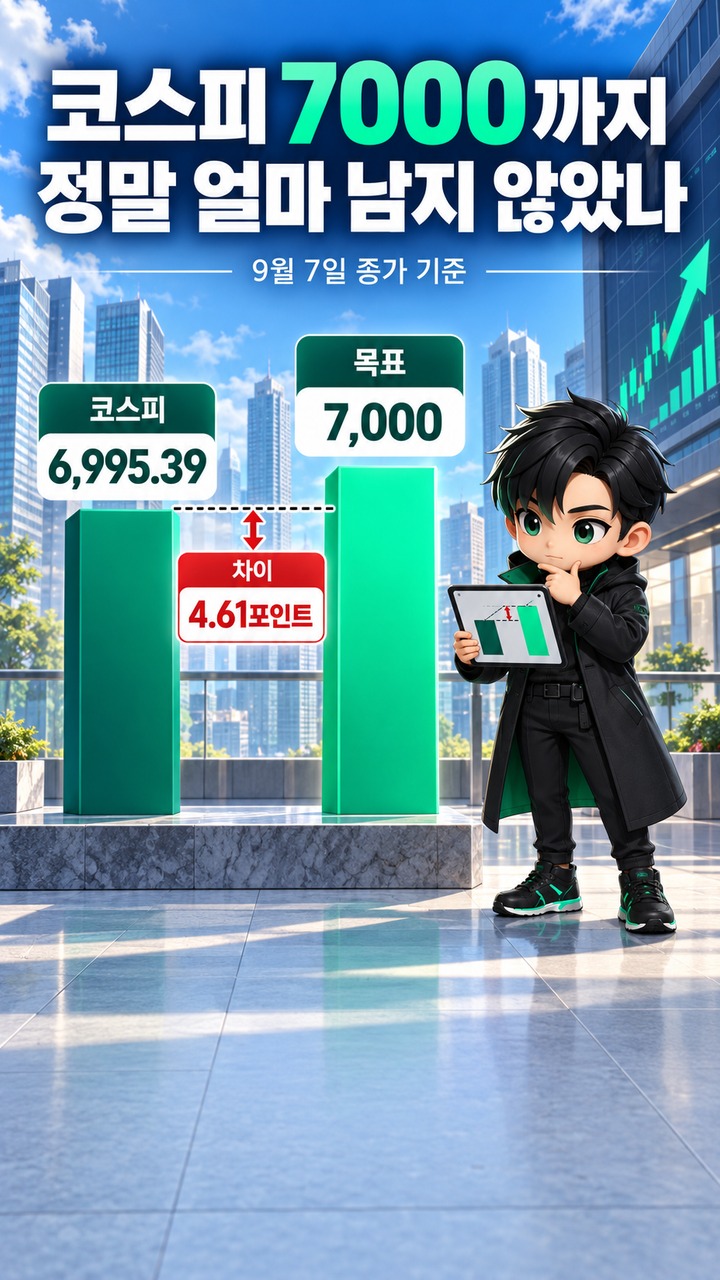
According to the author's calculation, the increase needed to reach 7,000 is approximately 0.066%.
The calculation is as follows:
(7,000 - 6,995.39) ÷ 6,995.39 × 100 ≈ 0.066%
Looking at the numbers alone, the 7,000 level is now extremely close. However, crossing a particular index level and maintaining that level are two different things.
The previous day, the KOSPI jumped 308.18 points from 6,687.21 to 6,995.39. The gain was 4.61%, marking its highest closing level in approximately 5 weeks since July 23 7,096.89.
Therefore, what investors need to check during the 8 trading session is straightforward. Rather than simply watching whether the index touches 7,000 intraday, they should also examine whether foreign and institutional investors continue buying near that level and whether the major semiconductor stocks that lifted the market the previous day maintain their gains.
Semiconductors and Investor Buying Were the Main Drivers of the Previous Day's 4.61% KOSPI Gain
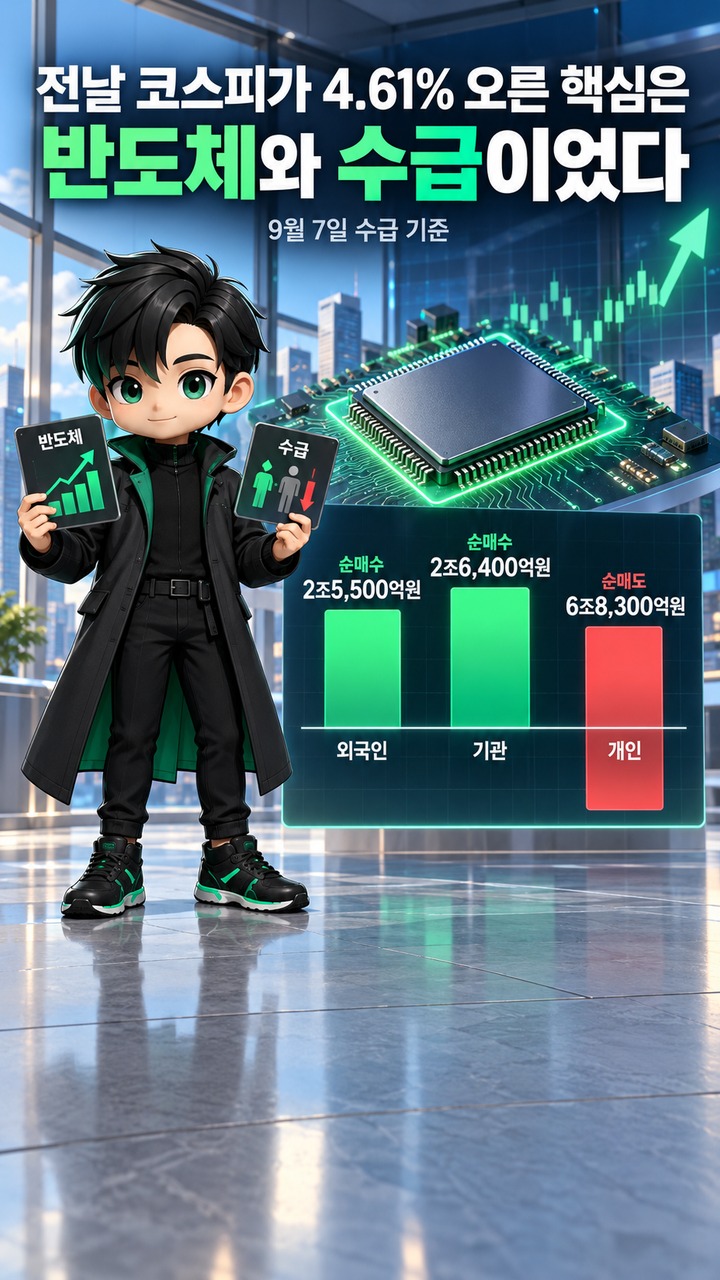
On September 7, both foreign and institutional investors were net buyers in the KOSPI market. Foreign investors purchased a net 2 trillion KRW 550,000,000,000, while institutions bought a net KRW 2,640,000,000,000. Individual investors, meanwhile, sold a net KRW 6,830,000,000,000.
Combined net purchases by foreign and institutional investors amounted to approximately 5 trillion KRW 190,000,000,000. This illustrates why investors should examine who actually bought shares rather than focusing solely on the index's one-day gain.
Samsung Electronics and SK Hynix were particularly influential.
Samsung Electronics closed at KRW 270,000, up 5.68%, while SK Hynix finished at KRW 1,780,000, gaining 8.26%. With both major semiconductor stocks rising sharply, their substantial market capitalizations directly supported the KOSPI index.
On the same day, the KOSDAQ rose 1.07% to 822.19. Compared with the KOSPI's 4.61% gain, the difference in their percentage increases was 3.54% percentage points.
Author's calculation:
4.61% - 1.07% = 3.54% percentage points
In other words, describing the previous day's session simply as 'all Korean stocks rose by more than 4%' would not accurately reflect what happened. The strength of the rally was concentrated much more heavily in large-cap KOSPI stocks, particularly semiconductor companies.
Why Watching Only Whether Samsung Electronics and SK Hynix Keep Rising Is Not Enough
Although Samsung Electronics and SK Hynix clearly posted strong gains the previous day, there is no basis for assuming those same percentage increases will be repeated on 8. After a sharp one-day rally, profit-taking may emerge. Alternatively, buying interest could shift toward industries outside semiconductors.
For that reason, checking whether buying demand continues is more useful than focusing exclusively on the two stocks' percentage changes during today's session.
First, investors can check whether foreign investors remain net buyers of KOSPI stocks after the previous day's purchases. It is particularly important to determine whether foreign buying remains concentrated in semiconductors or broadens into other major industries.
Institutional investors' direction also deserves attention. On 7, foreign and institutional investors both made substantial net purchases. If their trading directions begin to diverge, it would indicate that the market's underlying structure has changed from the previous day.
If semiconductor stocks pause while the KOSPI holds steady, investors can examine whether buying interest is rotating into other sectors. Conversely, if Samsung Electronics and SK Hynix decline and pull the index down with them, it would become clearer just how heavily the previous day's rally depended on large-cap stocks.
Why the U.S. Market Closure on September 7 Matters for Today's Trading
The New York stock market was closed for Labor Day on September 7, local time. Neither the New York Stock Exchange nor Nasdaq held regular stock trading sessions.
As a result, the latest U.S. cash-market closing prices available to Korean investors on the morning of 8 are from the September 4 trading session. This means investors cannot interpret the Korean market in the usual way by directly connecting it to movements in U.S. stocks the previous night.
U.S. markets reopen on September 8, local time. In Korean time, the domestic market trades first, followed by the resumption of actual U.S. cash-market trading.
Consequently, during the Korean trading session, changes in actively traded market prices, such as U.S. Treasury yields, stock index futures, and international oil prices, may be reflected more quickly than the previous U.S. stock market close.
In particular, Brent crude oil rose to around 97.5 dollars per barrel in international trading on 7. Because rising oil prices can influence inflation and interest-rate expectations, they are a separate factor that stock investors should monitor alongside semiconductor-related developments.
Why Investors Should Know This Week's U.S. Inflation Release Dates
U.S. producer and consumer price index reports for August are scheduled for release this week. According to the U.S. Bureau of Labor Statistics calendar, the Producer Price Index (PPI) will be released at 8:30 a.m. local time on September 10, while the Consumer Price Index (CPI) will be published at 8:30 a.m. on September 11.
Converted to Korean time, both indicators are scheduled to be released at 9:30 p.m. on their respective dates.
The CPI, in particular, is a major economic indicator that can influence assessments of U.S. interest rates. The actual inflation figures cannot be known with certainty before their release.
The important point is not to conclude in advance that 'inflation will definitely be high' or 'interest rates will definitely rise.' It is more accurate to examine how stock and bond markets respond after the actual figures are published and their differences from market expectations become clear.
The September FOMC meeting is also approaching. The Federal Reserve's next regularly scheduled meeting will take place on September 15–16, local time. Economic projections are also scheduled to be released in conjunction with the meeting.
Ultimately, South Korea's stock market will not be driven by semiconductor developments alone this week. International oil prices, U.S. inflation, U.S. Treasury yields, and expectations surrounding the FOMC could all influence market movements simultaneously.
A Practical Order for Monitoring the Stock Market on 8
Early in the session, one approach is to examine how Samsung Electronics and SK Hynix trade after the opening bell before focusing on whether the KOSPI crosses 7,000. A stock that surged the previous day but opens higher only to retreat sends a different signal from one that continues attracting buyers throughout the session.
Next, investors can check whether foreign and institutional investors are net buyers or net sellers of KOSPI stocks. On 7, the two investor groups made combined net purchases of approximately KRW 5,190,000,000,000. Rather than directly comparing today's buying volume with the previous day's total, it is better to prioritize whether the direction of buying continues.
The third factor is market breadth: how widely gains are distributed among individual stocks. If most other industries remain weak while two semiconductor stocks rise, the index's performance may differ considerably from what investors experience in their individual holdings. If other sectors provide support while semiconductor stocks pause, the market's underlying strength may have broadened compared with the previous day.
Finally, investors can monitor intraday changes in international oil prices and U.S. Treasury yields. Expectations surrounding semiconductors can coexist with inflation and interest-rate pressures, making it difficult to determine the direction of the entire market from a single factor.
Why What Happens After the KOSPI Breaks 7000 Matters More Than the Breakthrough Itself
The 7,000 level is numerically significant for the KOSPI, but investors do not need to base their decisions on a single index number. With the index just 4.61 points away from that level at the September 7 close, even a small intraday fluctuation could push it across.
What deserves closer attention is how trading develops around 7,000. Whether foreign and institutional investors continue buying, whether gains spread beyond semiconductor stocks, and whether an unusually large number of stocks decline despite an index increase each provide different information.
Investors holding individual stocks should not assume that their holdings will move in the same direction simply because the KOSPI crosses 7,000. Even the previous day, the KOSPI and KOSDAQ differed in their gains by 3.54% percentage points, while sector performances also varied.
A rising index does not mean every stock is rising.
In particular, chasing major semiconductor stocks that gained 5–8% in a single day solely because of their previous day's performance is a separate investment decision. Publicly available market information describes current conditions; it does not guarantee future trading prices or returns.
Key Dates to Remember on This Week's Stock Market Calendar
September 8 is the first domestic trading day following the KOSPI's sharp 4.61% gain the previous day. The U.S. cash market resumes trading on 8, local time, after its Labor Day closure on 7.
The U.S. Producer Price Index is scheduled for release on September 10, followed by the Consumer Price Index on September 11. The Federal Reserve's FOMC meeting will then take place on September 15–16.
Therefore, this week's Korean stock market cannot be assessed solely through the question of whether the KOSPI exceeds 7,000. A clearer understanding of current conditions comes from checking, in sequence, whether semiconductor buying continues after driving the previous day's rally, whether international oil prices and U.S. interest rates stabilize, and how market interest-rate expectations change after inflation data are released.
As of 9 a.m. on September 8, the confirmed fact is that the KOSPI's previous closing level was 6,995.39. Today's closing level and intraday investor trading flows have not yet been determined. After the market closes, comparing foreign and institutional trading activity, the closing prices of Samsung Electronics and SK Hynix, and the breadth of advancing and declining stocks will provide a more accurate assessment of whether today's market sustained the previous day's rally than simply checking whether 7,000 was crossed.
※ This article is provided for informational purposes to help readers understand market developments and does not constitute an investment recommendation for any particular stock or asset. All final investment decisions and responsibility rest with the individual investor.