

Do Ministers Who Also Serve as National Assembly Members Receive Two Salaries? Only the Higher Amount Is Paid

A National Assembly member who concurrently serves as a minister does not receive both the parliamentary allowance and ministerial salary added together. Current law stipulates that only the higher of the National Assembly member's allowance and the remuneration for the concurrently held public office is paid.

As of 2026-08-31, reports that Rep. Yong Hye-in, the nominee for Minister of Gender Equality and Family, may retain her proportional representation seat after her appointment have raised a question: Would she then receive both a minister's salary and a National Assembly member's remuneration? However, Yong is still a ministerial nominee, so the question of actually holding both positions will arise only after her appointment.
Serving as Both a Minister and a National Assembly Member Is Legally Permitted
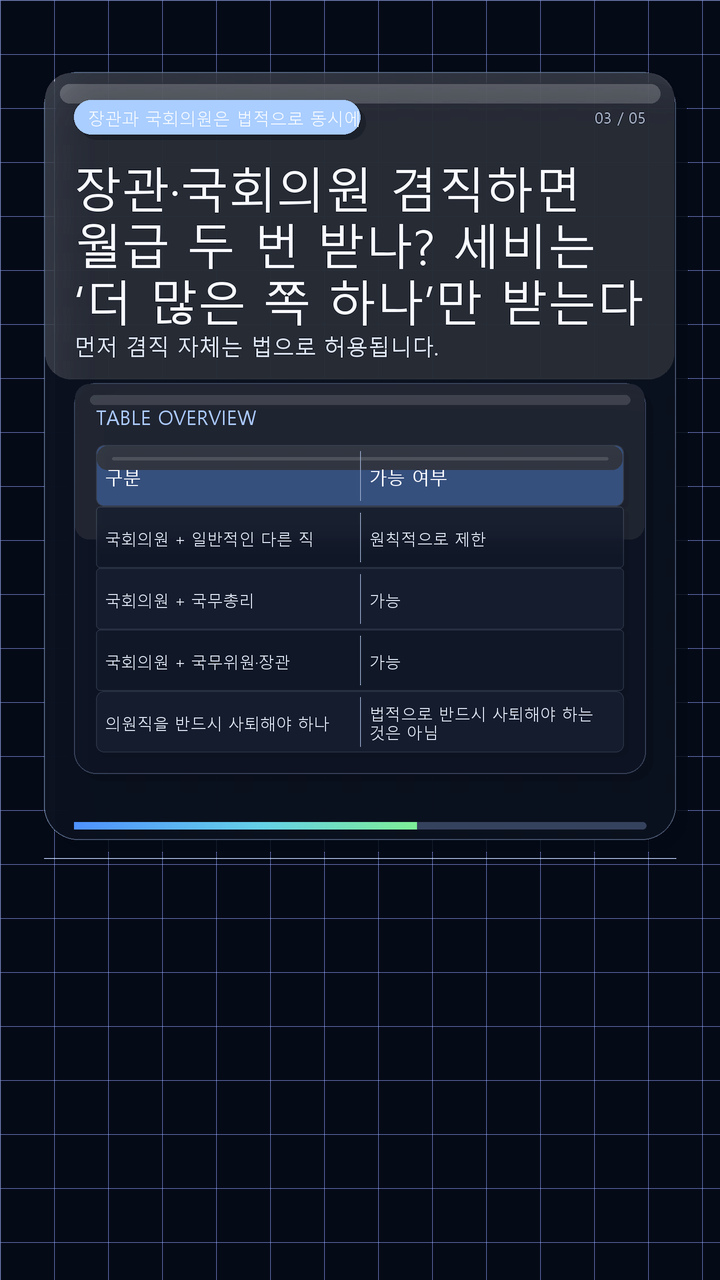
First, holding both positions is permitted by law.

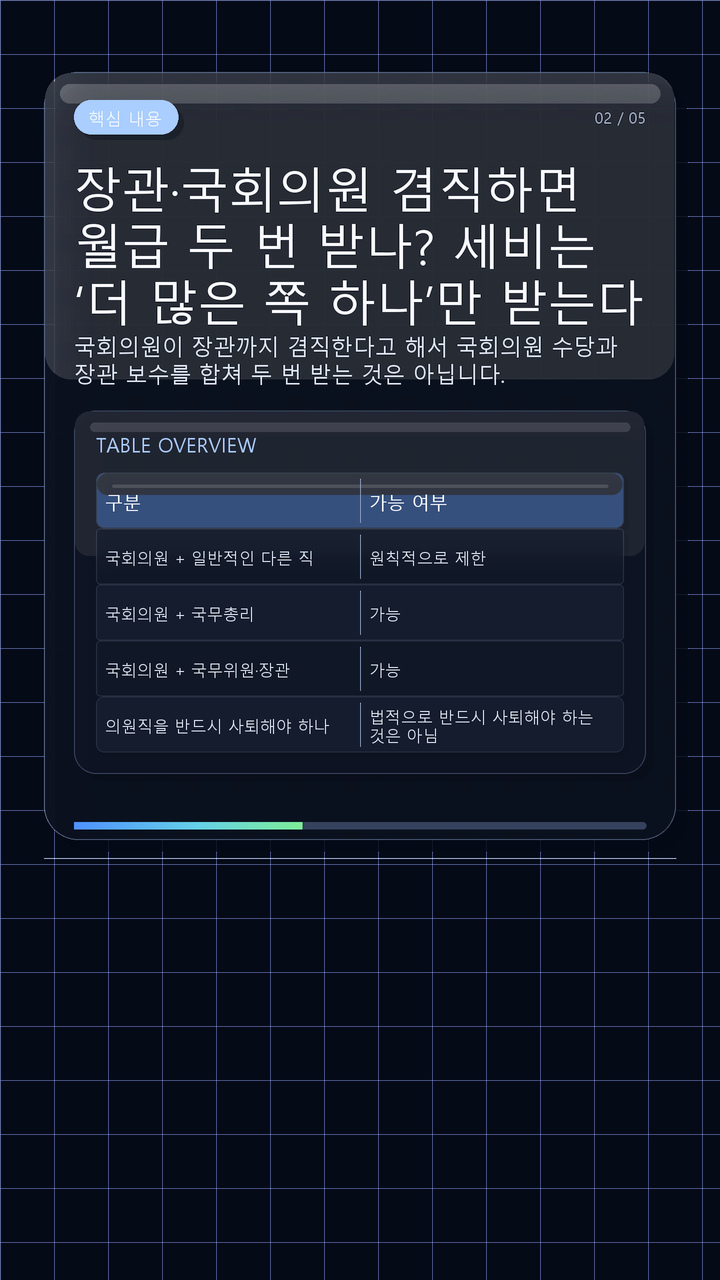
Article 29 of the National Assembly Act, in force as of 2026, generally prohibits National Assembly members from holding other positions but makes exceptions for the Prime Minister and members of the State Council. Because ministers heading government ministries are members of the State Council, sitting lawmakers may legally serve as ministers without relinquishing their parliamentary seats.
In simple terms, the rules are as follows.
| Combination of Positions | Permitted? |
|---|---|
| National Assembly member + ordinary outside position | Generally restricted |
| National Assembly member + Prime Minister | Permitted |
| National Assembly member + State Council member or minister | Permitted |
| Is resignation from the National Assembly mandatory? | Resignation is not legally required |
Therefore, even if many sitting lawmakers have resigned their parliamentary seats upon joining the Cabinet, that does not mean resignation is a legal obligation.
Do They Receive Both a Minister's Salary and a National Assembly Member's Allowance?
The answer is no. The two amounts are not added together.
Article 10 of the Act on the Staff and Allowances of Members of the National Assembly stipulates that when a National Assembly member concurrently holds another public office permitted by law, the member receives whichever is higher: the parliamentary allowance or the remuneration attached to the other position.
For illustration, consider a hypothetical example:
National Assembly member's allowance: A
Minister's remuneration: B
If B is greater than A → B is paid
If A is greater than B → A is paid
That is how the system works.
The payment is not A+B.
Therefore, assuming that someone receives double the salary simply because they hold both a parliamentary seat and a ministerial position would be inconsistent with the actual legal provisions.
Legislative Activity Allowances and Special Activity Allowances Are Also Not Paid
The rules do not simply select one salary while allowing all other parliamentary allowances to continue being added to it.
Article 10 of the same law explicitly states that legislative activity allowances and special activity allowances are not paid to lawmakers who concurrently hold the relevant public office.
The key distinctions are as follows.
| Payment Category | When Serving as Both Minister and Lawmaker |
|---|---|
| Parliamentary allowance + ministerial remuneration | The two amounts are not combined |
| Actual remuneration | The higher of the two amounts is paid |
| Legislative activity allowance | Not paid |
| Special activity allowance | Not paid |
There is another important distinction to keep in mind.
Not every portion of the National Assembly budget associated with a lawmaker should be treated as that individual's personal salary. Some expenditures, such as salaries for parliamentary aides and expenses supporting a lawmaker's office, are fundamentally different from the lawmaker's personal income.
Therefore, when examining the financial arrangements of a lawmaker who also serves as a minister, it is important to distinguish remuneration paid to the individual from budget expenditures used to operate the parliamentary office.
Does This Conflict with the National Assembly Act's Restrictions on Remuneration for Concurrent Positions?
Anyone reading Article 29 of the National Assembly Act may encounter a provision stating that remuneration cannot be received for certain concurrently held positions, which can understandably cause confusion.
However, the remuneration restriction in Article 29 applies to the categories of concurrent positions listed in that article, such as honorary positions serving public-interest purposes or positions to which lawmakers are appointed or commissioned under other laws. The Prime Minister and members of the State Council are separately designated as positions that lawmakers are permitted to hold concurrently.
The actual allowance arrangements for a National Assembly member who also serves as a minister are separately governed by Article 10 of the Act on the Staff and Allowances of Members of the National Assembly.
Reading the two laws together leads to the following conclusion:
A person may legally serve as both a minister and a National Assembly member, but cannot receive the full remuneration for both positions simultaneously.
Do These Rules Already Apply to Nominee Yong Hye-in?
Not yet.
As of 2026-08-31, Rep. Yong Hye-in is still a nominee for Minister of Gender Equality and Family. Because she has not yet been appointed minister, she is not currently at the stage of receiving ministerial remuneration that must be compared with her parliamentary allowance.
If she is formally appointed minister after the relevant confirmation hearing procedures and retains her National Assembly seat at that time, the rules governing concurrent service as a minister and lawmaker will apply in practice.
According to reports available through the morning of August 31, the Basic Income Party has announced its intention to retain her parliamentary seat. However, the nominee herself did not provide a specific position when questioned about the matter on her way to work. Her final decision therefore needs to be confirmed through subsequent official statements.
Why Have Proportional Representation Lawmakers Often Resigned After Becoming Ministers?
Although holding both positions is legally permitted, proportional representation lawmakers have sometimes relinquished their seats upon entering the Cabinet because the next candidate on the party list can succeed to the vacant seat.
When a constituency lawmaker resigns, the question of holding a by-election to fill the vacancy arises. In contrast, a proportional representation seat can be filled by the next eligible candidate on the party list, subject to the requirements established by law.
There have also been previous cases in which the question of whether a proportional representation lawmaker should retain their parliamentary seat became controversial after their nomination as a minister. In Yong Hye-in's case, this helps explain why debate has emerged over whether it is appropriate for her to retain her seat, separately from whether doing so is legally permissible.
However, customary practice and legal obligations must be distinguished.
The fact that many lawmakers have resigned their seats in the past does not itself establish a legal requirement that every sitting lawmaker appointed as a minister must resign.
In One Sentence, How Is the Remuneration Actually Paid?
Even when a sitting National Assembly member is appointed minister and holds both positions, the parliamentary allowance and ministerial remuneration are not combined. Instead, only the higher of the two amounts is paid.
Legislative activity allowances and special activity allowances are also not paid.
Whether these provisions will actually apply to nominee Yong Hye-in can be determined after it is confirmed whether she is appointed minister and whether she retains her parliamentary seat. It is also important to remember that, as of 2026-08-31, she remains a nominee.
※ This article is provided for reference purposes to help readers understand market developments and does not constitute an investment recommendation concerning any particular stock or asset. Readers are responsible for their own final investment decisions and any associated risks.