

USD/KRW Exchange Rate Falls for 5 Consecutive Trading Days: Why National Pension Service Currency Hedging Matters After the Rate Drops to KRW 1,392.6
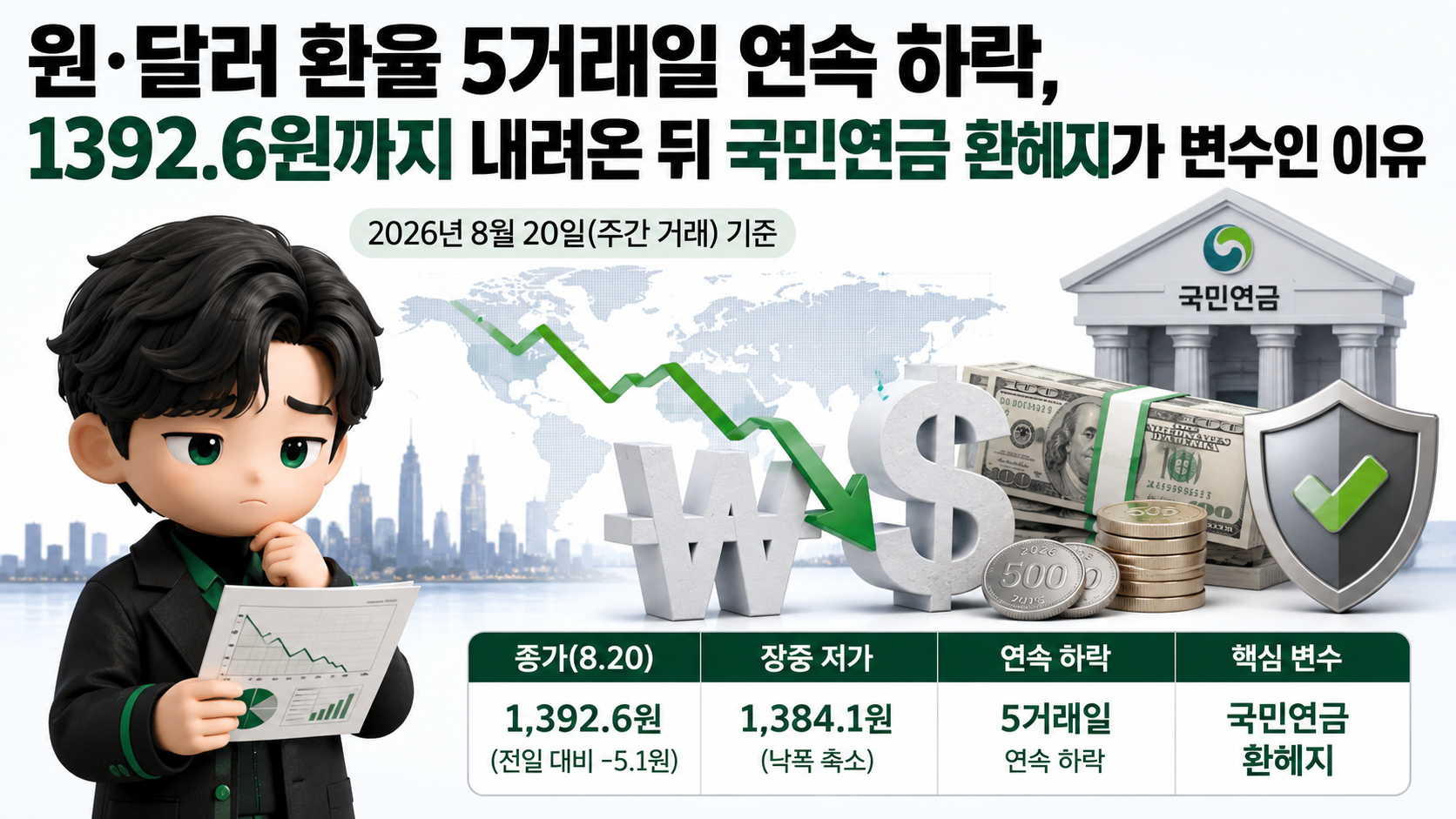
The USD/KRW exchange rate closed at KRW 1,392.6 during the 2026-08-20 daytime trading session, down KRW 5.1 from the previous day and marking its 5 consecutive trading day of declines. The rate fell as low as KRW 1,384.1 during the session but pared its losses as demand emerged to buy dollars at lower prices. With the Korean won strengthening rapidly, the next direction will depend not only on dollar weakness but also on dollar sales by exporters, foreign capital flows, and currency-hedging operations by the National Pension Service (NPS).
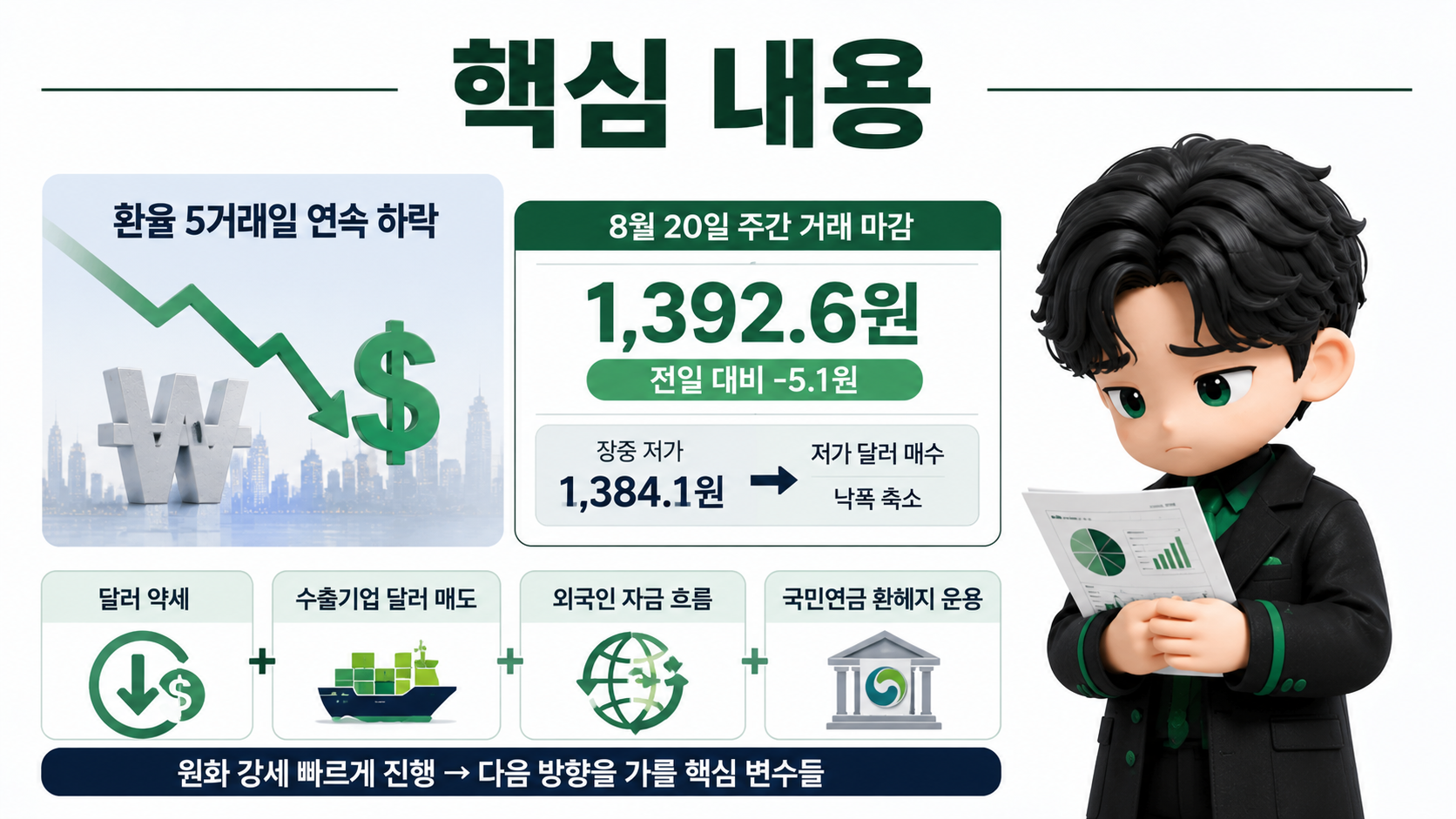
The information is current as of 2026-08-20 Korea Standard Time. Because exchange rates move continuously, the figures below should distinguish between the closing rate for daytime trading in the Seoul foreign exchange market as of 3:30 p.m. and the intraday prices recorded that day.
How Much Did the USD/KRW Exchange Rate Fall on 20?
On August 20, the USD/KRW exchange rate closed at KRW 1,392.6 as of 3:30 p.m. This was KRW 5.1 below the previous closing rate of KRW 1,397.7. The decline extended to 5 consecutive trading days, bringing the exchange rate to its lowest level since September last year.
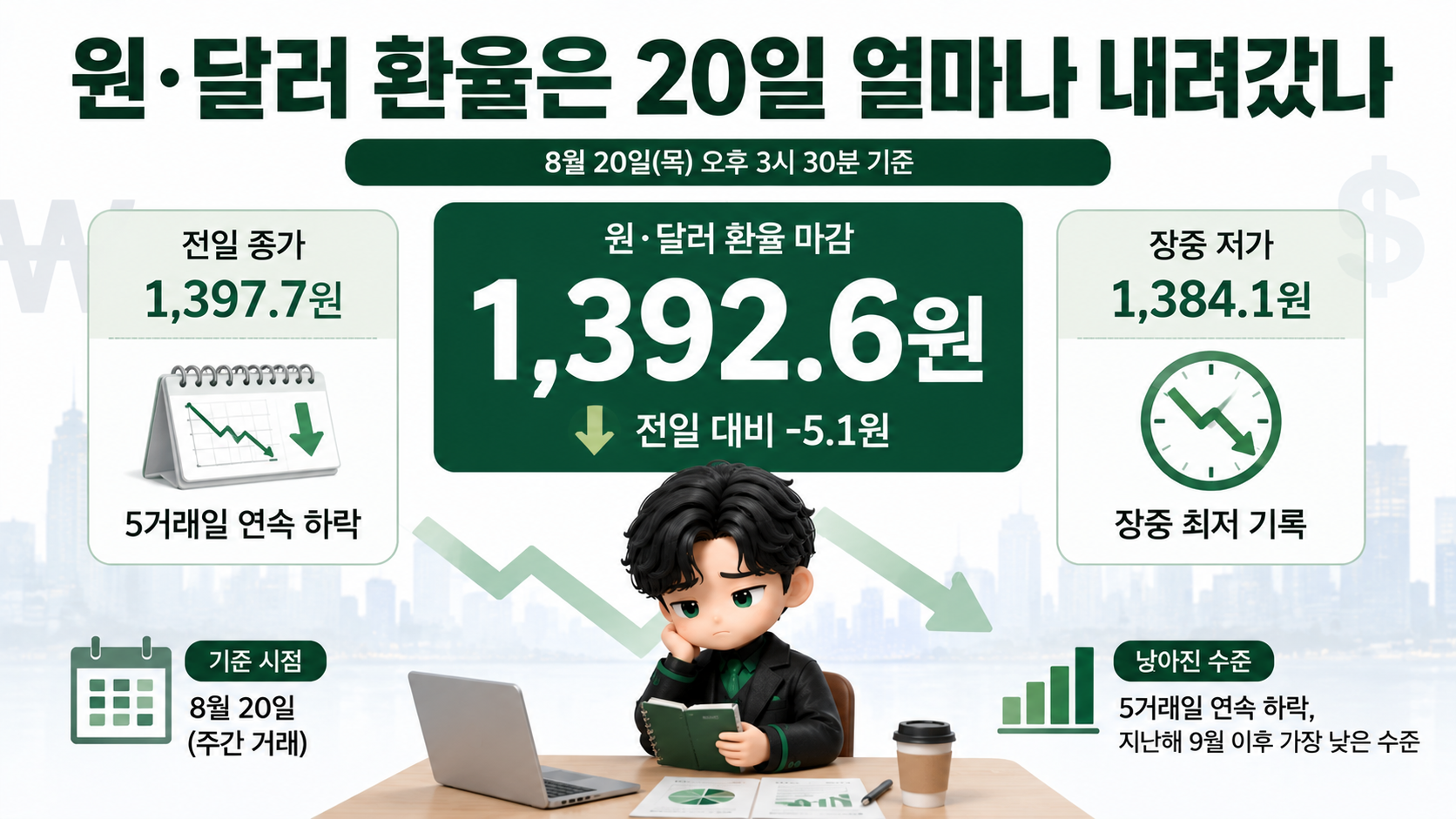
Intraday movements were even more pronounced than the closing figure suggested. The exchange rate fell to KRW 1,384.1 at one point, while its intraday high was KRW 1,399.6. This means the rate moved by more than KRW 15 within a single day. Although the overall direction was downward, trading in the KRW 1,380 range was not a one-way decline.
On the previous day, 19, the exchange rate fell KRW 14.1 from KRW 1,411.8 to KRW 1,397.7, dropping below KRW 1,400. That trend continued on 20, when the rate broke below the KRW 1,390 level early in the session. However, settlement-related demand and other dollar-buying activity subsequently pushed it back into the KRW 1,390 range.
The movement becomes clearer when viewed over a shorter period. Comparing the intraday high of KRW 1,559.2 on July 1 with the intraday low of KRW 1,384.1 on August 20 shows a decline of KRW 175.1.
Author's calculation:
KRW 1,559.2 - KRW 1,384.1 = KRW 175.1
Expressed as a percentage, the decline was approximately 11.2%.
Author's calculation:
175.1 ÷ 1,559.2 × 100 ≈ 11.2%
However, this calculation compares an intraday high and an intraday low recorded on different dates. It uses a different basis from a comparison of the closing rates on July 1 and August 20, so the two should not be interpreted as equivalent.
The Won's Strength Cannot Be Explained by Dollar Weakness Alone
The recent decline in the exchange rate has been driven by a combination of global dollar weakness and domestic dollar supply. Weaker-than-expected U.S. economic data strengthened expectations that the Federal Reserve would not raise its benchmark interest rate further in September. Dollar sales by Korean exporters also continued.
On August 19, exporters sold dollars they held in exchange for won, generating dollar-selling flows known in the foreign exchange market as negotiation or export-proceeds conversion transactions. These sales helped push the exchange rate down KRW 14.1 in a single day. In the past, dollar sales were often concentrated near the end of the month. Recently, however, market analysts have observed a relatively steady supply of dollars, particularly from semiconductor companies and other exporters.
On 20, news that the U.S. Treasury was expanding its buybacks of long-term government bonds provided another reason for the exchange rate to fall, as long-term Treasury yields and the dollar weakened afterward. When the U.S. Dollar Index declines, it can create downward pressure on the USD/KRW exchange rate, assuming other conditions remain unchanged.
The domestic stock market also behaved differently from the previous day. On 20, the KOSPI closed at 6,852.58, up 5.89%, while foreign investors returned to net buying in the main stock market. When foreign investors acquire won to purchase Korean equities, the resulting demand for the Korean currency can support a decline in the USD/KRW exchange rate.
That does not mean the exchange rate always falls when stock prices rise. In fact, on 19, the KOSPI plunged even as the exchange rate declined KRW 14.1. The foreign exchange market is currently pricing in several factors simultaneously, including dollar supply from exporters, expectations for U.S. interest rates, dollar demand for overseas investment, and stock market developments.
Why Did the Exchange Rate Rebound to KRW 1,392.6 After Falling Into the KRW 1,380 Range?
The rebound occurred because demand emerged to purchase dollars at lower prices once the exchange rate entered the KRW 1,380 range. The faster the exchange rate falls, the more attractive it becomes for importers and companies with upcoming dollar payments to secure dollars at prices below those previously available.
The exchange rate's recovery after reaching KRW 1,384.1 during trading on 20 demonstrates that this demand at lower levels is actively influencing the market. A renewed weakening of the Japanese yen during the session was also cited as a factor limiting further appreciation of the won.
For this reason, a brief move into the KRW 1,380 range does not mean the USD/KRW exchange rate has immediately established a stable position below KRW 1,380. The intraday low and the closing rate at 3:30 p.m. are different figures.
The key figures to check as of 20 are as follows.
Daytime trading closing rate: KRW 1,392.6
Intraday low: KRW 1,384.1
Intraday high: KRW 1,399.6
Previous closing rate: KRW 1,397.7
Daily decline: KRW 5.1
People exchanging currencies or making foreign-currency payments should not assume that the KRW 1,380 range mentioned in news headlines is the rate they will actually receive. Banks apply spreads to cash exchange rates and remittance rates offered to individuals, meaning actual transaction prices differ from the benchmark rates quoted in the Seoul foreign exchange market.
Why Is National Pension Service Currency Hedging Becoming an Important Factor Again?
Because the National Pension Service holds substantial overseas assets, changes in its currency-hedging strategy can influence domestic dollar supply and demand. The National Pension Fund Management Committee has extended the temporary adjustment period for its strategic currency-hedging ratio through 2026 and has decided to establish flexible implementation measures to respond to market conditions.
Currency hedging involves transactions designed to reduce gains or losses arising from exchange-rate fluctuations while holding overseas assets. When the NPS hedges the currency exposure of its foreign assets, its transactions can have the effect of selling dollars. Conversely, if it reduces its hedging or increases dollar purchases in the spot market to finance overseas investments, demand for dollars may rise.
The foreign exchange swap arrangement between the NPS and the foreign exchange authorities also deserves attention. The authorities and the NPS extended their foreign exchange swap arrangement, with a limit of USD 65,000,000,000, through the end of 2026. The central purpose of this arrangement is to reduce dollar-buying pressure in the spot market by allowing the NPS to obtain dollars needed for overseas investment through foreign exchange swaps rather than purchasing them directly in the spot market.
However, currently available official information does not establish when or by how much the NPS will increase or decrease its currency hedging in the future. Market participants are watching whether a lower exchange rate could reduce the need for the previously active hedging strategy. Actual implementation decisions, however, will take both fund returns and market conditions into account.
Some market analysts have suggested that additional NPS currency hedging could be limited if the exchange rate remains around KRW 1,390 or below. This is a market forecast, however, not a confirmed schedule announced by the NPS.
What Should Investors Watch to Determine Whether the Exchange Rate Will Fall Further?
At present, it is more useful to assess whether dollar supply or demand is gaining the upper hand than to focus on a single exchange-rate level. Volatility remains substantial, with recent declines accompanied by double-digit intraday movements.
First, it is important to monitor whether exporters continue selling dollars. If exporters maintain their dollar sales while demand to buy dollars remains limited, the exchange rate could decline relatively easily. Conversely, if importers' settlement-related demand and dollar purchases for overseas investment increase significantly in the 1,380–KRW 1,390 range, the pace of the decline could slow.
The second factor is U.S. interest rates and the dollar. Recently, weaker-than-expected U.S. inflation and consumer spending indicators reduced expectations for additional Federal Reserve rate increases in September, contributing to dollar weakness. If subsequent U.S. economic data strengthen again or inflationary pressures intensify, the dollar's direction could change.
The third factor is foreign portfolio investment flows. When foreign investors increase their holdings of Korean stocks or bonds, they may need to exchange foreign currencies for won. Conversely, if they sell substantial amounts of Korean securities and transfer the proceeds overseas, this can generate dollar demand. This is why it is useful to examine foreign investors' cumulative buying and selling over several days rather than focusing solely on a single day's KOSPI performance.
Finally, it is necessary to monitor NPS currency-hedging operations and its use of foreign exchange swaps. Although the NPS strategic currency-hedging framework will remain in place through 2026, the intensity of its actual implementation is not fixed.
Ultimately, the KRW 1,392.6 exchange rate recorded on August 20 represents more than simply a numerical milestone showing that KRW 1,400 has been breached. It is better understood as a range testing how long the dominance of dollar supply over demand can persist. Given that the exchange rate fell to KRW 1,384.1 intraday before returning to the KRW 1,390 range, entering the KRW 1,380 range should be distinguished from establishing a sustained position there.
For those preparing to exchange currency or make foreign-currency payments, checking rates and arranging transactions in several installments based on the required dates and amounts, rather than attempting to identify the lowest point of a single day, can help reduce exchange-rate risk. Particularly during periods of large daily fluctuations, as seen recently, it is difficult to predict the following day's exchange rate based solely on the previous closing rate.
※ This article is provided for informational purposes to help readers understand market developments and does not constitute a recommendation to invest in any particular security or asset. Readers are responsible for their own final decisions and investment outcomes.