

Why Did 150 People Participate Instead of 100?
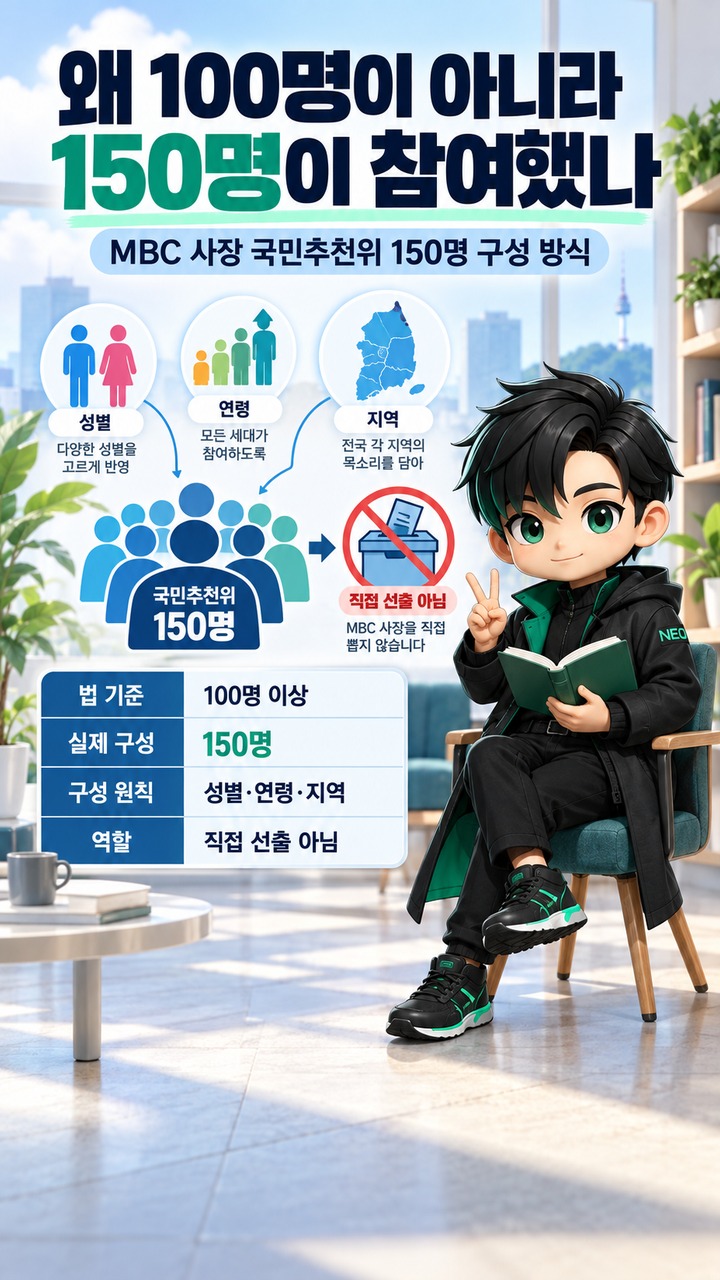
How were the 150 members of the MBC President Candidate Public Recommendation Committee selected? They did not directly elect the president.# How were the 150 members of the MBC President Candidate Public Recommendation Committee selected? They did not directly elect the president.
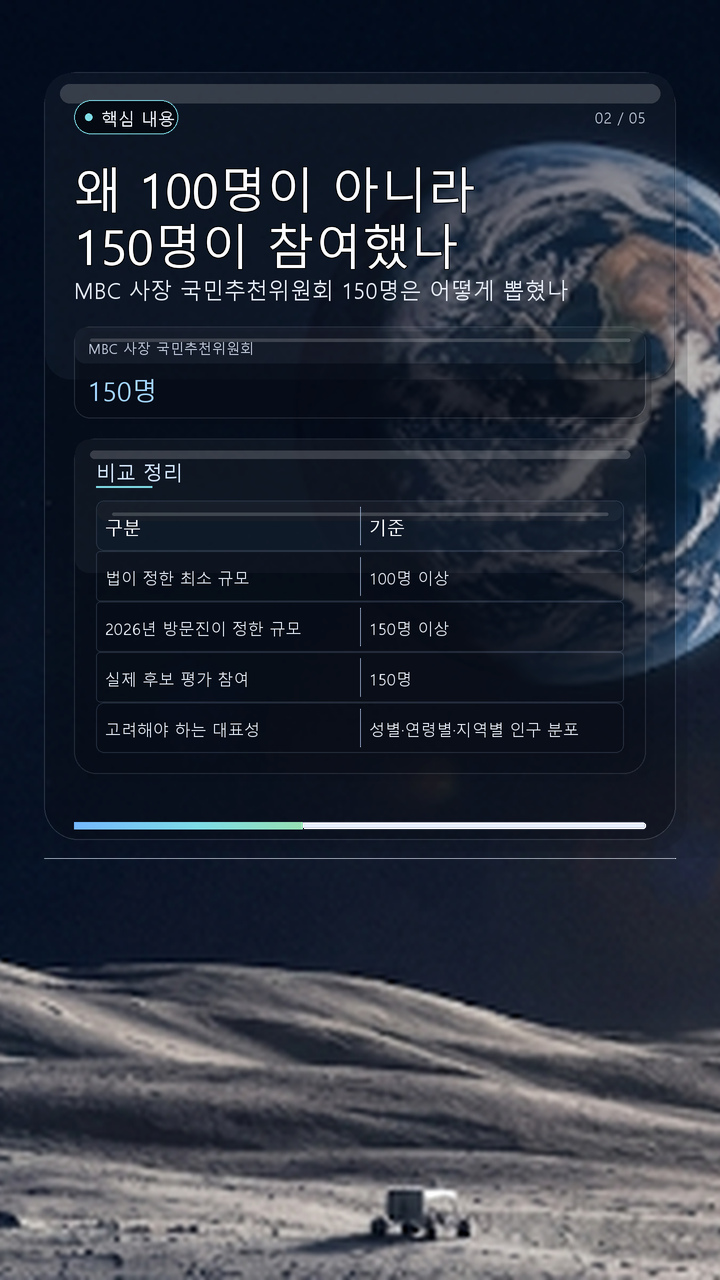
The 150 people who participated in selecting MBC's president were members of the President Candidate Public Recommendation Committee. The law requires at least 100 members, with a composition that reflects the population's distribution by gender, age, and region. For the 2026 selection of MBC's president, the Foundation for Broadcast Culture (FBC) decided that the committee would have at least 150 members. However, these members did not directly elect MBC's president. Their role was to evaluate 4 candidates and recommend 2 finalists to the FBC board of directors.
Following the appointment of Lee Sung-joo as MBC's new president, the fact that '150 members of the public participated' attracted particular attention. So how were these 150 people selected, and how much decision-making authority did they actually have?
Why Did 150 People Participate Instead of 100?
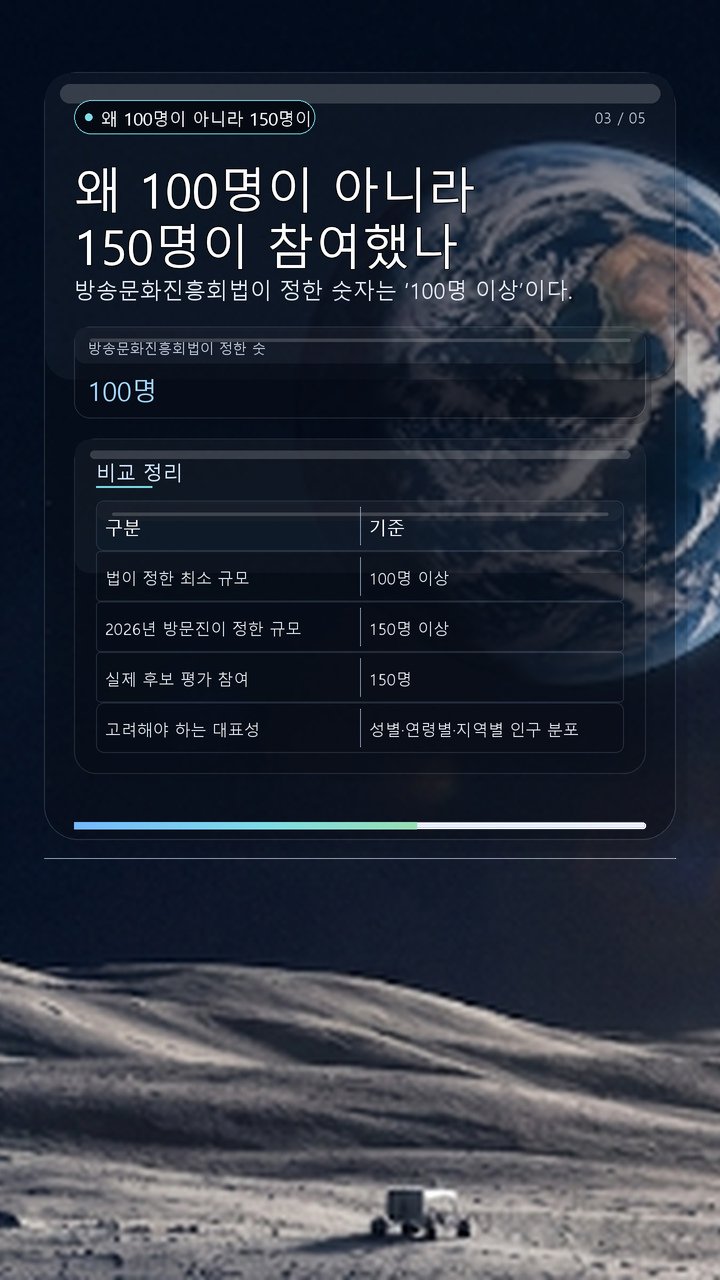
The Foundation for Broadcast Culture Act specifies 'at least 100 members.' It does not fix the committee's membership at exactly 100; instead, it establishes a minimum.

Article 10-3 of the Foundation for Broadcast Culture Act requires the President Candidate Public Recommendation Committee to consist of at least 100 members and to reflect the overall population's distribution by gender, age, and region. The FBC board of directors establishes the detailed standards necessary for the committee's composition and operation.
In preparing for the 2026 selection of MBC's president, the FBC decided to operate the committee with 'at least 150 members,' exceeding the statutory minimum. In the actual September 12 candidate evaluation, 150 citizens participated.
The distinction can be summarized as follows.
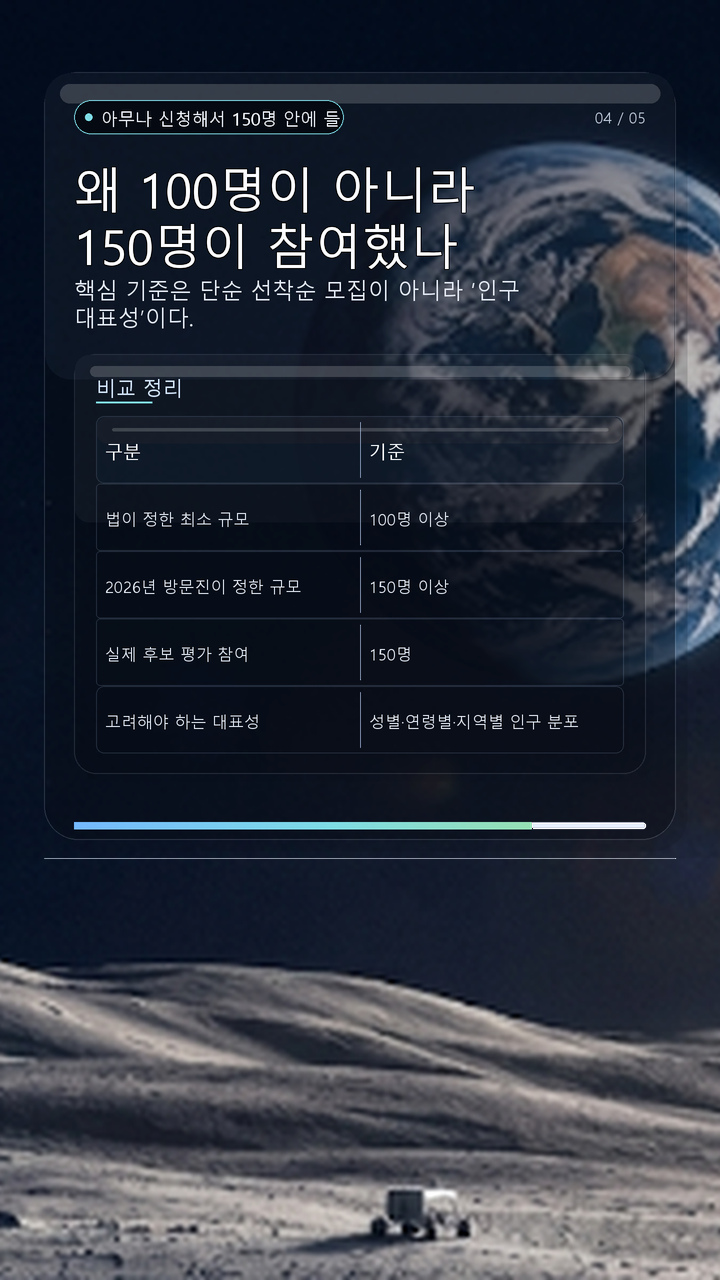
| Category | Standard |
|---|---|
| Minimum membership required by law | At least 100 members |
| Membership set by the FBC for 2026 | At least 150 members |
| Actual participants in candidate evaluation | 150 members |
| Required demographic representation | Population distribution by gender, age, and region |
Therefore, it would be inaccurate to say that 'the law required 150 people to be selected.' The law required at least 100 members, and the FBC expanded the committee beyond that minimum for this MBC presidential selection.
Could Anyone Apply and Become One of the 150 Members?
The central requirement is demographic representation, not simply recruiting applicants on a first-come, first-served basis.
The law requires the committee to be composed in a way that reflects South Korea's overall population distribution by gender, age, and region. It also allows the task of assembling the committee to be entrusted to a polling organization registered under the Public Official Election Act, provided that the organization meets additional qualification requirements.
Polling organizations eligible to perform this work must also meet specific conditions. Rules issued by the Korea Broadcasting Media and Communications Commission require, among other things, a record of conducting nationwide opinion polls every year during the past 3 years, experience conducting nationally approved statistical surveys, and no administrative sanctions or criminal penalties for violations of relevant laws during a specified period.
However, the publicly available legislation and currently accessible FBC and media materials do not make it possible to verify the individual recruitment channels and sampling procedures used to select each of the 150 participants. It would therefore be inaccurate to assert that 150 people were selected through a completely random nationwide lottery or recruited through any particular method.
What can be confirmed is the legal requirement for representation by gender, age, and region and the fact that 150 citizens participated in the committee during 2026.
Did the 150 Members Directly Elect Lee Sung-joo as President?
No. The Public Recommendation Committee did not elect the final president. Instead, it narrowed the candidate pool for the FBC to make the final decision.
Under the 2026 selection process, 20 applicants for the MBC presidency were reduced to 8 candidates after the FBC's initial screening, and then to 4. The Public Recommendation Committee listened to policy presentations from those 4 candidates, conducted deliberative discussions and question-and-answer sessions, and recommended 2 finalists: Lee Sung-joo and Jeon Dong-geon.
The selection process can be outlined as follows.
20 applicants → 8 candidates after FBC screening → 4 candidates after FBC interviews → 2 candidates after Public Recommendation Committee evaluation → 1 final candidate selected by the FBC → Appointment at the MBC shareholders' meeting
This was not a direct election in which the choices of 150 citizens automatically determined the appointment of MBC's president.
How Did the Public Recommendation Committee Evaluate the 4 Candidates?
The process was closer to a 'deliberative evaluation,' in which members listened to policy proposals, discussed them, and then assessed the candidates, rather than a simple popularity vote.
At September 12, the Public Recommendation Committee heard policy presentations from candidates Lee Geun-haeng, Jeon Dong-geon, Lee Ho-in, and Lee Sung-joo. Members then held deliberative discussions, questioned the candidates directly, and conducted their evaluations.
The evaluation criteria included the public responsibilities of a public broadcaster, management capabilities for responding to a changing broadcasting environment, organizational leadership and integration skills, and the ability to promote mutually beneficial relationships with regional affiliates and subsidiaries.
The evaluation scores were not calculated by simply averaging all scores submitted by the 150 members. According to the Journalists Association of Korea's publication, the 7 highest and 7 lowest valid evaluation scores for each candidate were excluded, and the remaining scores were averaged to identify the top 2 candidates. This structure was designed to reduce the influence of unusually high or low scores on the overall results.
Who Ultimately Had the Final Decision-Making Authority?
The authority to recommend the final presidential candidate rests with the FBC board of directors.
Under the amended Foundation for Broadcast Culture Act, when the Public Recommendation Committee recommends multiple candidates, the FBC board must, in principle, select a presidential candidate within 14 days of the recommendation, with the approval of at least 3/5 of its incumbent directors. This is known as a 'supermajority voting system.' The law also provides for a runoff vote between the candidate receiving the most votes and the runner-up if a decision is not reached within the specified period.
In this selection, the Public Recommendation Committee recommended Lee Sung-joo and Jeon Dong-geon. The FBC publicly interviewed both candidates on September 13 and selected Lee Sung-joo as president-designate. Subsequently, at September 14, the MBC shareholders' meeting approved the appointment, officially naming Lee Sung-joo as president. His term is 3 years.
The division of responsibilities can therefore be understood as follows.
150 Public Recommendation Committee members: Evaluate candidates and narrow the final shortlist.
FBC board of directors: Select the presidential candidate from the shortlisted candidates.
MBC shareholders' meeting: Give final approval to the appointment of the representative director.
What Changed Most Compared With Previous MBC Presidential Selections?
The most significant change was the formal introduction of a legally mandated Public Recommendation Committee into a process previously handled by the FBC board of directors from the initial screening through the final selection.
While preparing for the 2026 presidential selection, the FBC operated a Public Recommendation Committee of 150 members on a full scale for the first time under the amended Foundation for Broadcast Culture Act. The law requires the committee to recommend multiple candidates, up to 3, after reviewing their management-plan presentations, conducting interviews, and holding deliberative discussions.
In addition, the FBC's final decision is subject to a supermajority requirement of at least 3/5 of incumbent directors, rather than a simple majority. In other words, both a public participation procedure and stricter board voting requirements were introduced.
Ultimately, the precise meaning of '150 members of the public participated' in this MBC presidential selection is not that 150 people directly elected the president, but that citizens formally participated in the legally prescribed process of listening to candidates' policy proposals, discussing and evaluating them, and narrowing the final candidate pool.
※ This article is provided for reference to help readers understand market trends and does not constitute an investment recommendation concerning any particular stock or asset. Readers are responsible for their own final investment decisions and outcomes.