

Today's Weather August 21: Up to 60mm of Rain in the Seoul Metropolitan Area and Northern South Chungcheong…Showers and Extreme Heat in the South
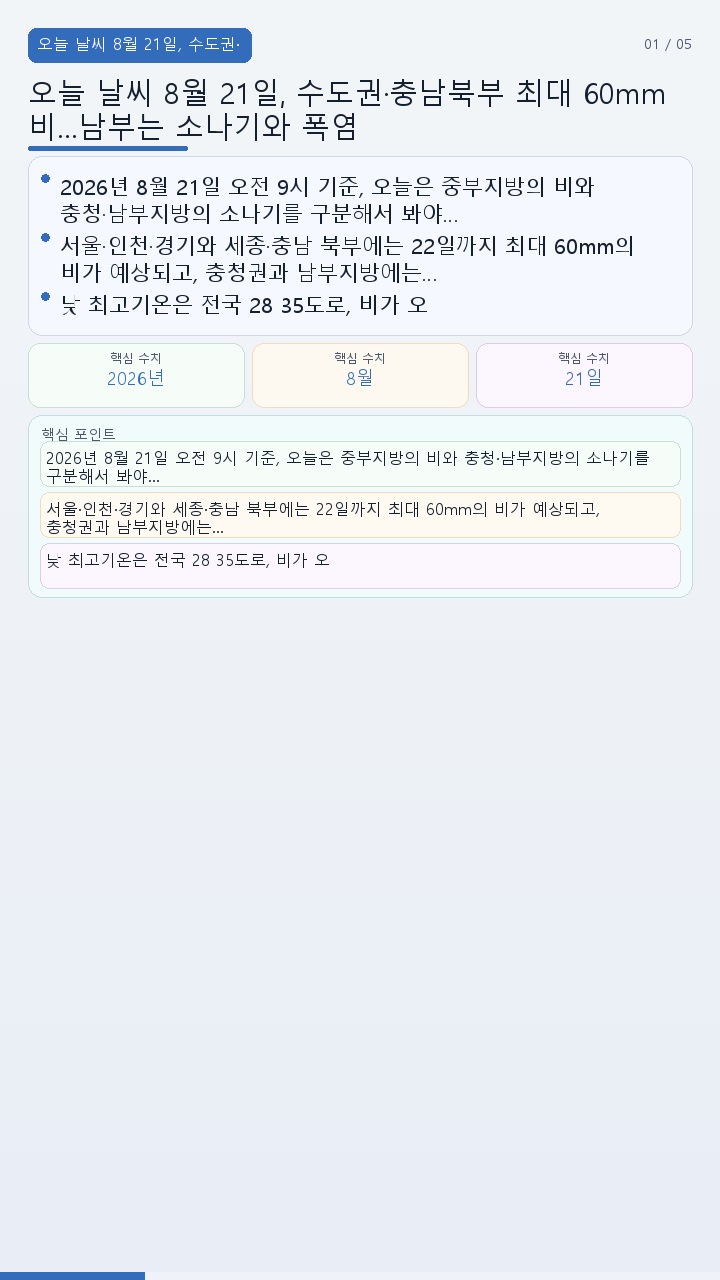
As of 9 a.m. on 2026-08-21, it is important to distinguish between steady rain in central Korea and scattered showers in the Chungcheong and southern regions today. Seoul, Incheon, Gyeonggi Province, Sejong, and northern South Chungcheong Province are expected to receive up to 60mm of rain through 22, while parts of the Chungcheong and southern regions may see showers totaling up to 50mm by this evening. Daytime highs nationwide will range from 28 to 35 degrees, with sweltering conditions continuing in areas without rain.
How Long Will the Rain Continue in Seoul, Gyeonggi, and Gangwon?
Rain is expected across the Seoul metropolitan area and Gangwon Province today, and in some locations, it may continue until tomorrow morning, August 22. Persistent rain in the Chungcheong region and northern North Jeolla Province is expected mainly through this morning, so the timing of when the rain stops will vary by location.
According to the short-range forecast issued by the Korea Meteorological Administration (KMA) at 5 a.m. on August 21, expected precipitation in Seoul, Incheon, and Gyeonggi Province from 21 through 22 is 10–60mm. The 5 islands in the West Sea are forecast to receive 30–80mm, with a higher upper limit than the mainland Seoul metropolitan area.
Inland and mountainous areas of Gangwon Province are expected to receive 5–40mm, while Gangwon's east coast is forecast to receive around 5mm on 21 alone.
Conditions will also vary within the Chungcheong region. Sejong and northern South Chungcheong Province are forecast to receive 10–60mm, Daejeon and southern South Chungcheong Province 5–40mm, and North Chungcheong Province 5–30mm. Parts of northern North Jeolla Province may receive 5–20mm of rain through the morning.
Rather than simply describing the forecast as 'rain in central Korea,' it is important to recognize that the forecast allows for up to 60mm in Seoul, Gyeonggi, and northern South Chungcheong, and up to 80mm on the 5 islands in the West Sea.
Southern Regions Should Focus on the Possibility of Showers Rather Than Steady Rain
The Chungcheong and southern regions, along with Jeju Island, will experience a different precipitation pattern from central Korea. Showers may develop in some locations between the morning and evening of August 21, meaning that whether rain falls and how much accumulates can vary significantly even between nearby areas.
Expected precipitation from today's showers is 5–50mm in Daejeon, Sejong, South Chungcheong, and North Chungcheong, and 5–50mm in Gwangju, South Jeolla, and North Jeolla.
Daegu, North Gyeongsang, and inland South Gyeongsang are also expected to receive 5–50mm, while Jeju Island is forecast to receive 5–40mm.
Showers may be accompanied by gusty winds, thunder, and lightning. If rainfall intensifies over a short period, road visibility may deteriorate and surfaces may become slippery. It is therefore advisable to carry an umbrella when traveling, even if it is not raining at the moment.
Unlike a broad, organized rain system moving across a large area, showers can be highly localized. Even within the same city or county, some locations may receive heavy rain while others receive almost none. Interpreting the upper limit of a regional precipitation forecast as meaning that heavy rain will continue throughout the day may lead to expectations that differ from actual conditions.
Today's Highs of 28–35 Degrees: Rain Does Not Mean the Heat Is Over
Today's nationwide daytime highs are forecast to range from 28 to 35 degrees. Although temperatures may temporarily fall in some areas during rain or showers, persistently high humidity means the perceived heat is unlikely to ease significantly.
Heat advisories or warnings are currently in effect in parts of the country, mainly across the Chungcheong and southern regions and Jeju Island. In some parts of the Jeolla and South Gyeongsang regions, the maximum feels-like temperature is expected to reach around 35 degrees.
Afternoon showers should not be interpreted as a 'sign that the heat is over.' Humidity may remain high after the rain stops, and some locations may experience tropical nights, when temperatures do not fall sufficiently overnight.
According to the KMA's nationwide short-range forecast issued at 5 a.m. on 21, today's high temperatures will range from 28 to 35 degrees. Considering that the nationwide high-temperature range on the previous day, 20, was 27.5–35.1 degrees, the forecast does not suggest that the heat wave will ease significantly across the country in a single day.
What Is the Difference Between Up to 60mm of Rain and Up to 50mm of Showers?
The most easily misunderstood part of today's forecast is that '60mm of rain' and '50mm of showers' refer to different precipitation periods and patterns.
The 10–60mm forecast for Seoul, Incheon, and Gyeonggi Province represents the expected cumulative rainfall from 21 through 22. The 10–60mm forecast for Sejong and northern South Chungcheong Province refers to rain expected on 21.
By contrast, the 5–50mm forecast for the Chungcheong and Jeolla regions, Daegu, North Gyeongsang, and inland South Gyeongsang refers to precipitation from showers that may develop today.
For example, some parts of the Chungcheong region may experience persistent rain through the morning, followed by another round of showers later in the day. This is why the same region may appear in both precipitation forecasts.
When deciding when to go out today, it is therefore more accurate to check 'when the current rain will end' and 'whether showers may return in the afternoon' separately, rather than relying on a single daily precipitation probability.
More Rain in Central Korea and Showers Across the Country Tomorrow, 22
Rain and showers will not completely end today. Rain may continue in parts of the Seoul metropolitan area and inland Gangwon until the morning of August 22, while showers may develop again across several inland regions in the afternoon.
On 22, showers totaling 5–40mm are expected in northern and southeastern Gyeonggi Province and inland and mountainous Gangwon. The same 5–40mm range is forecast for Daejeon, Sejong, inland South Chungcheong, North Chungcheong, inland Gwangju and South Jeolla, inland North Jeolla, Daegu, North Gyeongsang, and inland South Gyeongsang.
Jeju Island has a higher forecast upper limit than other regions, with expected showers of 5–60mm on 22.
Temperatures will not fall significantly either. On 22, morning lows are forecast at 21–26 degrees, while daytime highs will reach 28–34 degrees, meaning the hot weather will continue.
On 23, cloudy skies are expected nationwide before conditions gradually clear from the afternoon. On 24, the forecast calls for partly cloudy skies across the country at times.
What Should You Check Before Going Out Today, Depending on Your Region?
In Seoul, Incheon, Gyeonggi, and Gangwon, it is important to check the hourly forecast to determine whether rain could continue or return through tomorrow morning even after it stops today.
The situation is somewhat more complicated in the Chungcheong region. Some areas will experience rain in the morning, followed by the possibility of showers later. Even if the rain has stopped by the morning commute, it is better to check the afternoon forecast rather than leave your umbrella behind.
The Jeolla region, Daegu, North Gyeongsang, and inland South Gyeongsang need to prepare for both extreme heat and showers. Anyone with outdoor plans should check hourly precipitation forecasts and feels-like temperatures as well as daytime highs.
Jeju Island also faces the possibility of showers today, with up to 60mm forecast for tomorrow. Anyone planning weekend travel or outdoor activities should check for forecast updates.
In one sentence, today's weather can be summarized as rain in central Korea, showers in the Chungcheong and southern regions, and a return to sweltering heat during rain-free periods. Rather than treating the entire country as having one precipitation pattern, the most practical approach is to check the rain and shower forecasts separately for the specific places and times you plan to travel.