

Why Does Nvidia's 75% Gross Margin Matter? How to Analyze Margins in Earnings Reports

One figure that matters just as much as revenue in Nvidia's earnings is gross margin. As of 2026-08-26, Nvidia's previously issued non-GAAP gross margin guidance for the 2 quarter of fiscal 2027 was 75.0%±0.5% percentage points. Whether the actual figure and the following quarter's outlook remain near this level is one of the key indicators of profitability in its AI accelerator business.

This is also why, ahead of Nvidia's latest earnings report, market attention has expanded beyond simple revenue growth rates to include gross margin. During a period when next-generation product transitions, memory and component prices, and system production costs are all changing simultaneously, margins can move in a different direction even when revenue rises sharply.
What Does Nvidia's 75% Gross Margin Mean?
Gross margin measures the percentage of revenue remaining after subtracting the direct costs of producing and delivering products or services.

The formula is straightforward.
Gross Margin = (Revenue - Cost of Revenue) ÷ Revenue × 100
For example, if revenue is USD 100 and the direct costs of producing and supplying products are USD 25, gross profit is USD 75 and gross margin is 75%.
Nvidia recorded a non-GAAP gross margin of 75.0% in the 1 quarter of fiscal 2027. The company's guidance for the 2 quarter was also 75.0%±0.5% percentage points on a non-GAAP basis.
Therefore, rather than simply concluding that '75% is high,' the important question in this earnings report is whether Nvidia can continue maintaining its current high level of profitability.
Gross Margin Can Decline Even When Revenue Increases
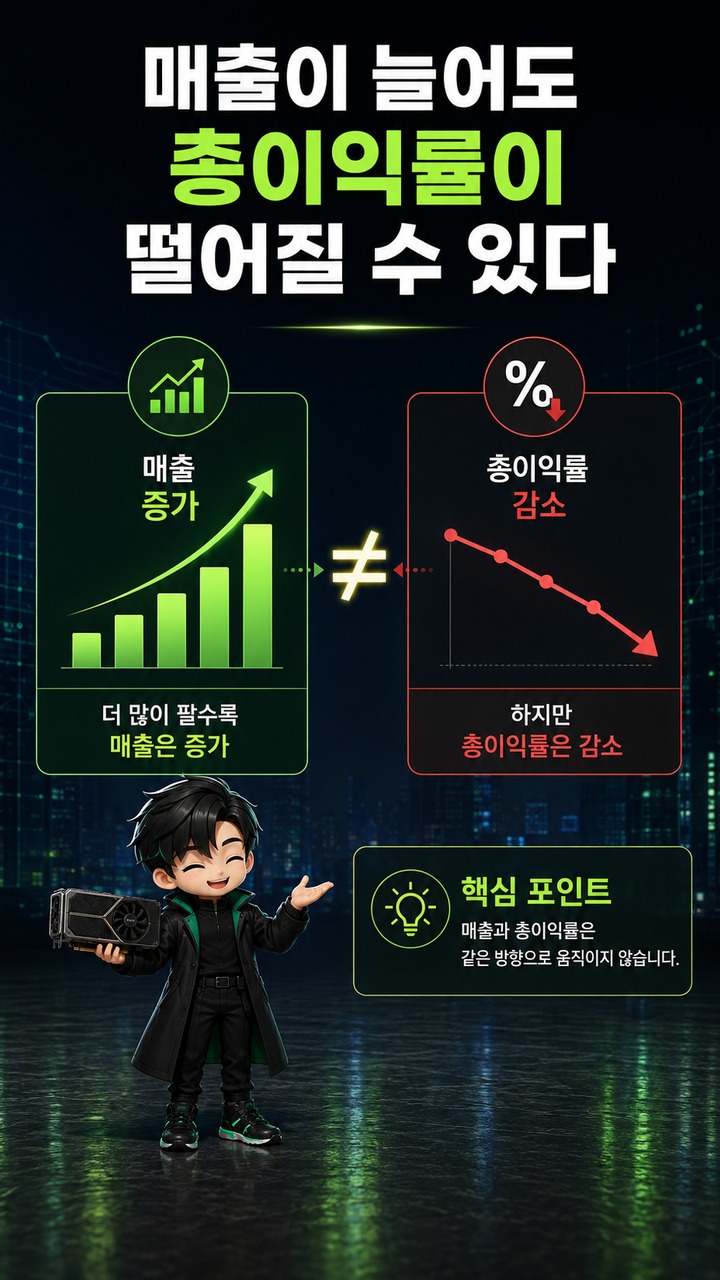
Revenue and gross margin do not necessarily move in the same direction.
For example, even if revenue increases from USD 90,000,000,000 to USD 100,000,000,000, gross margin can decline if the costs required to produce those products rise more quickly.
Consider this simple example.
| Category | Revenue | Cost of Revenue | Gross Margin |
|---|---|---|---|
| Quarter A | USD 90,000,000,000 | USD 22,500,000,000 | 75% |
| Quarter B | USD 100,000,000,000 | USD 27,000,000,000 | 73% |
Revenue in Quarter B increased by USD 10,000,000,000, but because costs accounted for a larger share of revenue, gross margin fell from 75% to 73%.
That is why, when evaluating the earnings of a high-growth semiconductor company, investors should examine both the pace of revenue growth and how efficiently the company converts that revenue into gross profit.
Why Has Maintaining 75% Become More Important Now?
Nvidia is transitioning to its next-generation AI platforms, moving from Blackwell toward Vera Rubin. During the early stages of scaling up new products, changes in component configurations and manufacturing processes can affect production costs.
Costs associated with memory and other essential components used in AI servers may also have an impact. In recent earnings forecasts, memory supply and component costs have been cited among the key factors investors are watching for their potential effects on Nvidia's profitability.
In other words, even if revenue continues to grow, three factors need to be examined separately.
How production costs change as next-generation products account for a larger share of sales
How much of the increase in component and memory costs Nvidia can pass on through product pricing
Whether the company can maintain its existing profitability levels when selling large-scale AI systems
If these conditions remain stable, strong revenue growth is more likely to translate into higher actual profits.
Is a Gross Margin Slightly Below 75% Automatically a Bad Result?
Not necessarily.
Nvidia's own non-GAAP gross margin guidance for the 2 quarter was 75.0%±0.5% percentage points, meaning that a result in the 74.5–75.5% range would fall within the company's stated guidance. Its GAAP gross margin guidance was 74.9%±0.5% percentage points.
Even if gross margin declines temporarily, the underlying cause must be examined.
The implications differ depending on whether the decline results from higher initial production costs for next-generation products, rising component prices, or a change in product mix.
Conversely, even if gross margin exceeds expectations, it would be difficult to interpret the overall earnings report positively if revenue growth slows or the outlook for the following quarter weakens.
Therefore, it is better to avoid judging performance based on a single figure.
Earnings Reports Require Attention to Next-Quarter Margin Guidance, Not Just Actual Margins
The most important part of Nvidia's earnings report is not limited to the quarter that has already ended.
The company's revenue and gross margin expectations for the following quarter indicate the likely direction of future profitability.
Recently, market expectations have placed Nvidia's next-quarter revenue at approximately USD 104,200,000,000, while investors are also watching whether gross margin remains around 75%. However, these are market forecasts that the company has not yet announced as its own guidance, so they must be clearly distinguished from Nvidia's actual guidance.
The possible scenarios can be interpreted as follows.
Higher Revenue Guidance + Stable Gross Margin
This could indicate that both growth and profitability are being sustained.
Higher Revenue Guidance + Lower Gross Margin
Investors should examine whether sales volumes are increasing while cost pressures or product transition expenses are also rising.
Slower Revenue Growth Outlook + Stable Gross Margin
A slowdown in the pace of growth could become a more significant concern than profitability.
Slower Revenue Growth Outlook + Lower Gross Margin
Further examination would be needed to determine whether both growth and profitability are weakening simultaneously.
Other Figures to Check in Nvidia's Earnings
Rather than looking at gross margin in isolation, comparing several additional figures can make the earnings report easier to understand.
The first is data center revenue. Nvidia's total revenue for the 1 quarter of fiscal 2027 was USD 81,600,000,000, of which data center revenue accounted for USD 75,200,000,000. These figures increased by 85% and 92%, respectively, from the same period a year earlier.
The second is next-quarter revenue guidance. Nvidia provided guidance of USD 91,000,000,000±2% for the 2 quarter, and that forecast did not include revenue from data center computing in China.
The third is gross margin guidance.
The fourth is management's commentary on supply and demand for next-generation AI systems, including Blackwell and Rubin. The market is also monitoring intensifying competition, the growing use of custom AI chips, and whether investment in AI infrastructure will continue.
Ultimately, the earnings report can be evaluated in the following sequence.
Revenue → Data Center Growth → Gross Margin → Next-Quarter Revenue and Margin Guidance → Commentary on Demand for New Products
Following this sequence makes it easier to compare the direction of business performance without overreacting to any single figure.
Why Can Nvidia's Stock Move Differently Even When Gross Margin Is High?
Stock prices sometimes react more strongly to what the market had already expected and to the company's future outlook than to its current earnings results.
The fact that a gross margin of 75% is high does not necessarily mean the stock price will rise.
For example, if the market had already expected margins above 75.5% and exceptionally strong revenue for the following quarter, actual results could be viewed as disappointing relative to expectations even if they meet the company's guidance.
Conversely, if gross margin declines slightly because of temporary production costs associated with new products, and the company presents a clear plan for recovery, the interpretation could be different.
Therefore, when evaluating Nvidia's earnings, the key is to compare not only the absolute figures but also the company's guidance, market expectations, and the outlook for the following quarter.
Related Articles
Why Nvidia's Stock Can Fall Even After Strong Earnings: What Matters More Than an Earnings Surprise