

Why Was Yangsan So Hot at 42.5 Degrees? 4 Causes of the Record-Breaking Heat Wave
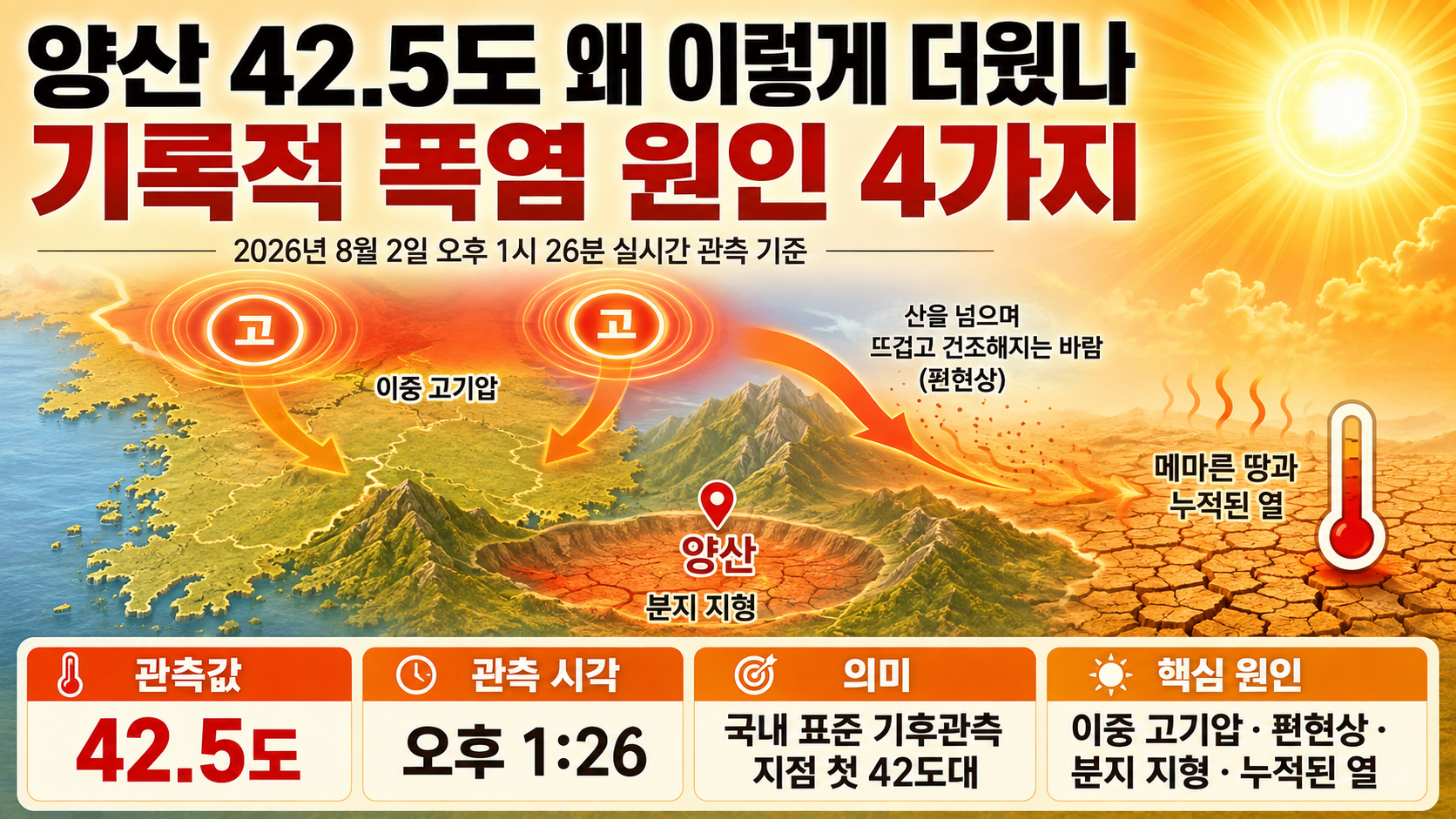
2026-08-02 at 1:26 p.m., a temperature of 42.5 degrees was observed in Yangsan, South Gyeongsang Province. This was the first temperature in the 42-degree range recorded at a standard climate observation station in South Korea, resulting from a combination of overlapping high-pressure systems, the foehn effect, basin-like terrain, and heat accumulated in dry ground.
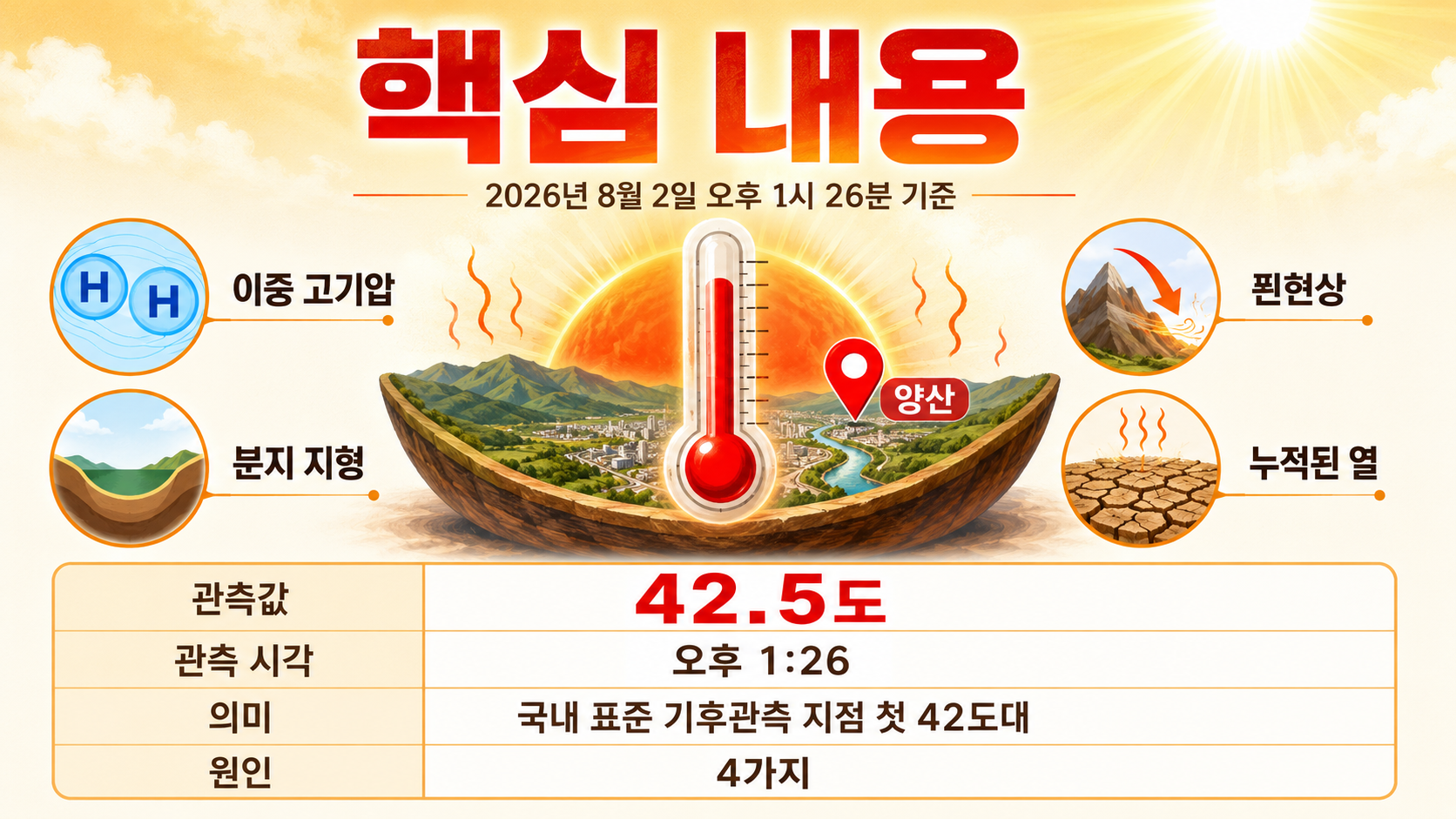
However, 42.5 degrees was a real-time observation recorded as of 1:26 p.m. The day's maximum temperature could rise further, and the final meteorological record must be checked again after the observation data have undergone quality control.
Was Yangsan's 42.5-Degree Reading an Actual Air Temperature?
42.5 degrees was not a temperature measured by a car dashboard or on a road surface. It was the air temperature recorded by Yangsan's Automated Synoptic Observing System, or ASOS.
ASOS measures temperature, humidity, wind, precipitation, and other weather conditions in a standardized observation environment. Its measurements are used to compile official climate statistics. Temperatures around roads and vehicles can be strongly affected by sunlight and engine heat, so they should not be directly compared with ASOS air temperatures.
At 1:25 p.m., Yangsan's temperature reached 42.0 degrees. 1 minutes later, at 1:26 p.m., it had climbed to 42.5 degrees.
| Date | Yangsan's Daily Maximum Temperature | Details Confirmed |
|---|---|---|
| July 29 | 40.3 degrees | Beginning of temperatures in the 40-degree range |
| July 30 | 40.3 degrees | 40 degrees for two consecutive days |
| July 31 | 41.4 degrees | Highest officially recorded temperature in South Korea at the time |
| August 1 | 41.6 degrees | Record broken again just one day later |
| August 2 | 42.5 degrees | Real-time observation at 1:26 p.m. |
Compared with 40.3 degrees on July 29, the observation on August 2 was 2.2 degrees higher.
The author's calculation is `42.5 degrees-40.3 degrees=2.2 degrees`. The temperature was also 0.9 degrees higher than the previous day's record of 41.6 degrees.
Why Did Yangsan, in Particular, Reach 42 Degrees?
Yangsan's record-breaking temperature cannot easily be explained by a single cause. Conditions favorable for extreme heating developed simultaneously, from high-pressure systems in the atmosphere to wind direction, mountainous terrain, and soil conditions.
1. The North Pacific and Tibetan High-Pressure Systems Overlapped
The North Pacific high-pressure system supplied hot, humid air to the middle and lower atmosphere, while the Tibetan high-pressure system occupied the upper atmosphere.
Within a high-pressure system, air sinks. As descending air is compressed, its temperature rises, suppressing cloud formation and allowing clear weather to persist.
These so-called 'double high-pressure' conditions, which trapped hot air between high-pressure systems at different atmospheric levels, persisted for an extended period.
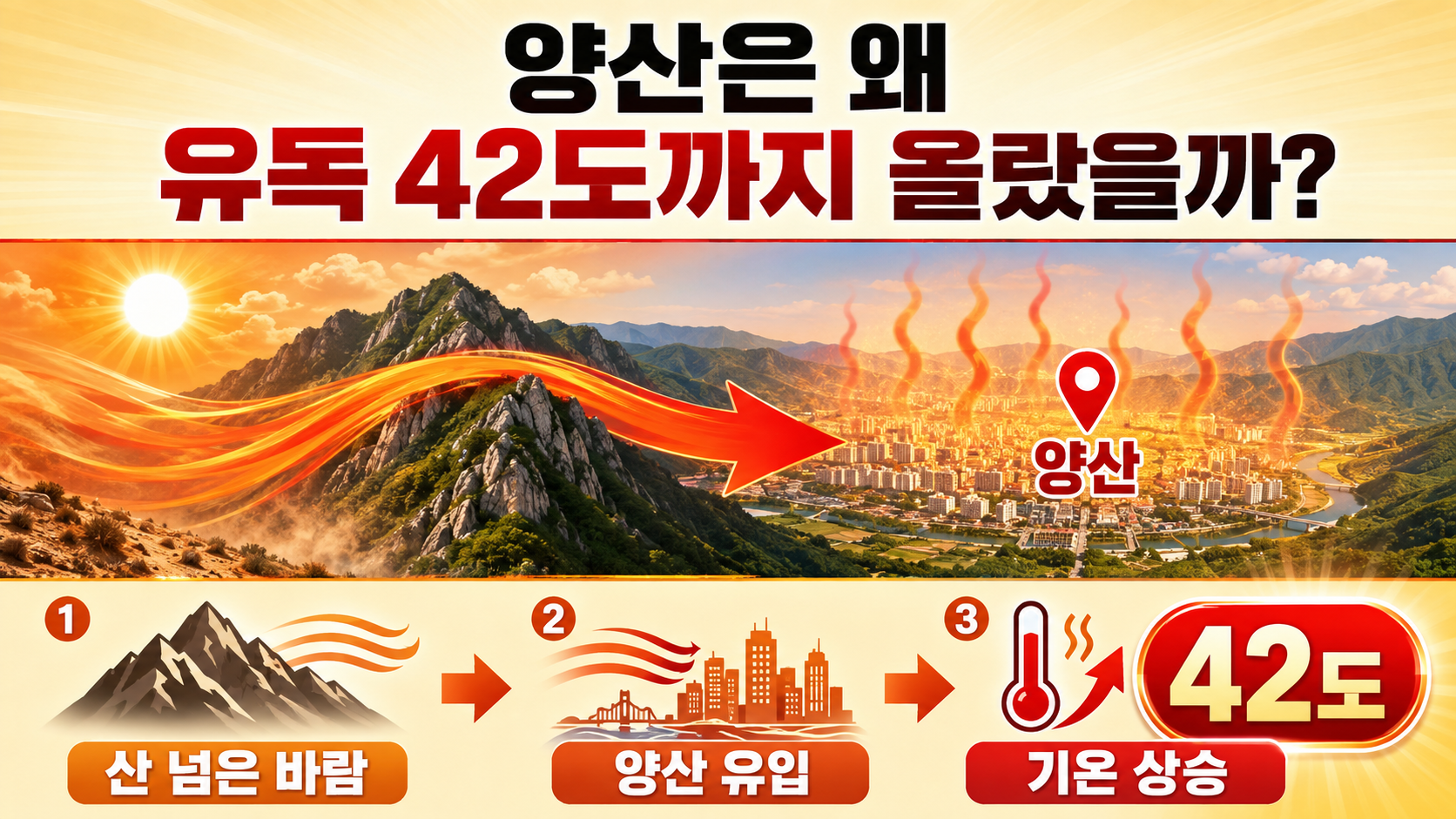
2. Westerly and Northwesterly Winds Became Hotter After Crossing the Mountains
Westerly and northwesterly winds entering Yangsan became hotter and drier as they crossed surrounding mountains, including the Yeongnam Alps. This is known as the foehn effect.
As moist air rises over mountains, water vapor can condense, forming clouds or precipitation. When the air loses moisture and descends the mountains, its temperature rises by approximately 1 degree for every 100m decrease in elevation, turning it into a hot wind.
The continued inflow of these winds toward Yangsan intensified the temperature increase.
3. Heat Accumulated in Terrain Surrounded by Mountains
Yangsan is influenced by several mountain ranges and peaks, including Gajisan, Sinbulsan, Cheonseongsan, and Geumjeongsan. Its geography makes it difficult for incoming hot air to disperse quickly into surrounding areas.
Winds converging toward Yangsan further contributed to the continued accumulation of already heated air within the area.
The fact that temperatures exceeded 40 degrees progressively earlier each day can also be explained by solar heating beginning again the following day before the accumulated heat had sufficiently dissipated.
4. Strong Sunshine Combined With Dry Ground
Yangsan's total solar radiation during July 2026 was 582.49MJ/㎡, approximately 36% higher than the normal 428.7MJ/㎡ during July.
Rainfall was limited across South Gyeongsang Province during the monsoon season, leaving the soil dry. When sufficient moisture is present in the ground, some solar energy is used to evaporate water. When the ground is dry, more energy goes directly into heating the surface and surrounding air.
Several consecutive days of intense sunshine and dry soil prevented heat at the ground surface from dissipating sufficiently.
How Unusual Was This Record?
The observation on August 2 marked the fifth consecutive day that Yangsan exceeded 40 degrees.
There had previously been no case of the same location recording temperatures of 40 degrees or higher for five consecutive days at climate observation stations included in the Korea Meteorological Administration's official rankings.
As of August 1, the official highest temperature was 41.6 degrees, recorded in Yangsan. Even when observations from Automatic Weather Stations (AWS) were included, the previous highest reading was 41.9 degrees, recorded in Chowol-eup, Gwangju, Gyeonggi Province, in 2018.
Therefore, if the 42.5-degree observation on August 2 is confirmed in the final dataset, it will become the first temperature in the 42-degree range recorded in South Korea across both ASOS and AWS observations.
Was Climate Change the Direct Cause?
The 42.5-degree temperature recorded on this particular day cannot be explained by climate change alone. The immediate causes were meteorological conditions involving overlapping high-pressure systems, winds, terrain, solar radiation, and soil conditions.
However, as average temperatures rise over the long term, the likelihood of more extreme temperatures occurring under similar atmospheric pressure patterns also increases.
Determining exactly how many additional degrees were caused by climate change would require a separate climate attribution analysis of this heat wave. The Korea Meteorological Administration's currently confirmed explanation of the weather conditions should be distinguished from the long-term influence of climate change.
What to Do Immediately During a 42-Degree Heat Wave
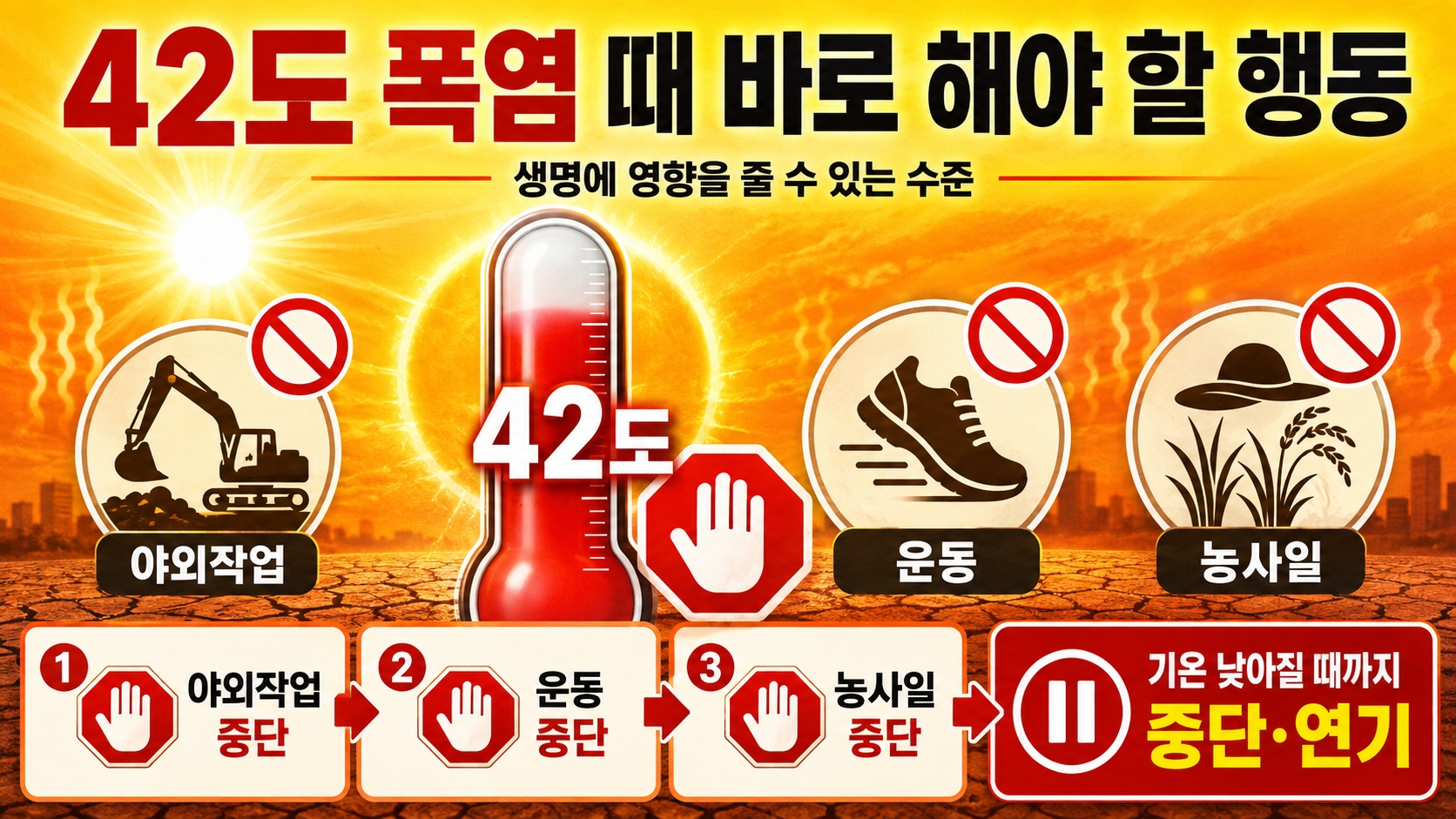
42 degrees represents more than uncomfortable heat. It is a level of extreme heat that can threaten human life. The first priority is to stop or postpone outdoor work, exercise, and farming activities until temperatures decrease.
Drink small amounts of water frequently, even when you do not feel thirsty.
Move indoors to an air-conditioned space or a designated heat-relief shelter.
Frequently check on children, older adults, and people with chronic illnesses such as cardiovascular or cerebrovascular disease and diabetes.
Never leave children or pets inside parked vehicles.
If dizziness, headaches, nausea, or severe fatigue occur, stop your activities and cool your body.
If someone becomes confused or collapses, immediately call 119.
Do not give drinks to an unconscious person, as this could cause choking.
Cooling areas where major blood vessels pass close to the skin, such as the neck, armpits, and groin, with a wet towel or cool water can help lower body temperature.
Frequently Asked Questions
Is Yangsan's 42.5-Degree Reading a Final, Confirmed Record?
It is a real-time observation confirmed as of 1:26 p.m. Temperatures could rise further during the day, and the final daily maximum temperature must be checked after the Korea Meteorological Administration confirms its data.
Does This Mean the Feels-Like Temperature Was Also 42.5 Degrees?
No. 42.5 degrees refers to the actual air temperature measured at the observation station. The feels-like temperature also accounts for factors such as humidity and wind, so it may differ from the actual air temperature.
Why Does Yangsan Keep Experiencing Such Extreme Heat?
In addition to the nationwide heat wave caused by overlapping high-pressure systems, westerly and northwesterly winds became hotter as they crossed the mountains. Yangsan's terrain, which tends to retain heat, further intensified the conditions.
Is Using Only a Fan Instead of an Air Conditioner Safe?
When indoor temperatures are extremely high, a fan alone may not cool the body sufficiently. It is safer to use an air-conditioned space or designated heat-relief shelter and drink water frequently.
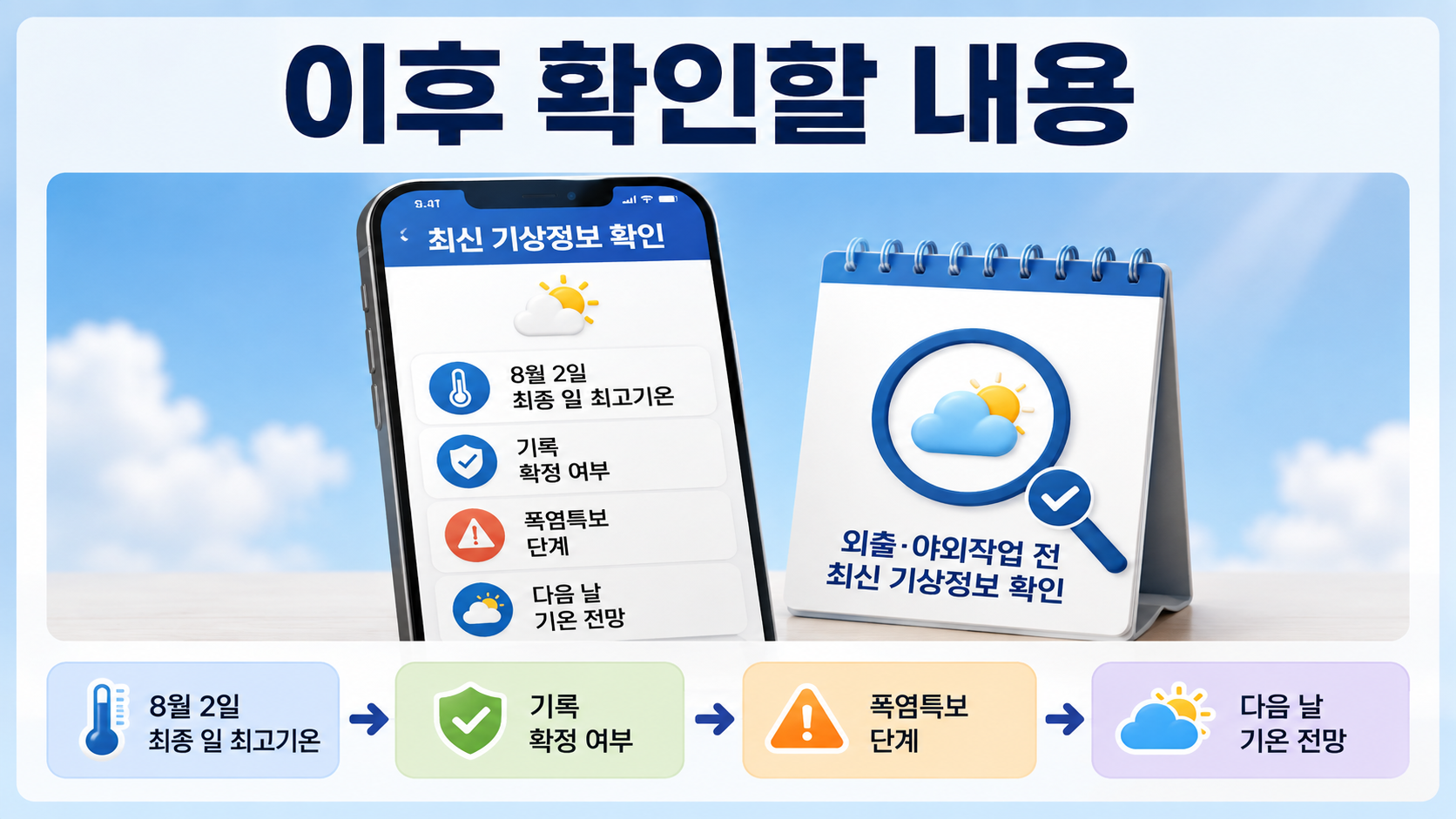
What to Check Next
The final daily maximum temperature for August 2 and whether the record is officially confirmed must be checked again using Korea Meteorological Administration observation data. Heat-wave alert levels and the following day's temperature forecast may also change, so checking the latest weather information before going outside or beginning outdoor work is recommended.