Retail Investors Using Borrowed Money: Margin Loan Balances Plunge to 27.4 Trillion… Forced Liquidations and What to Check Now
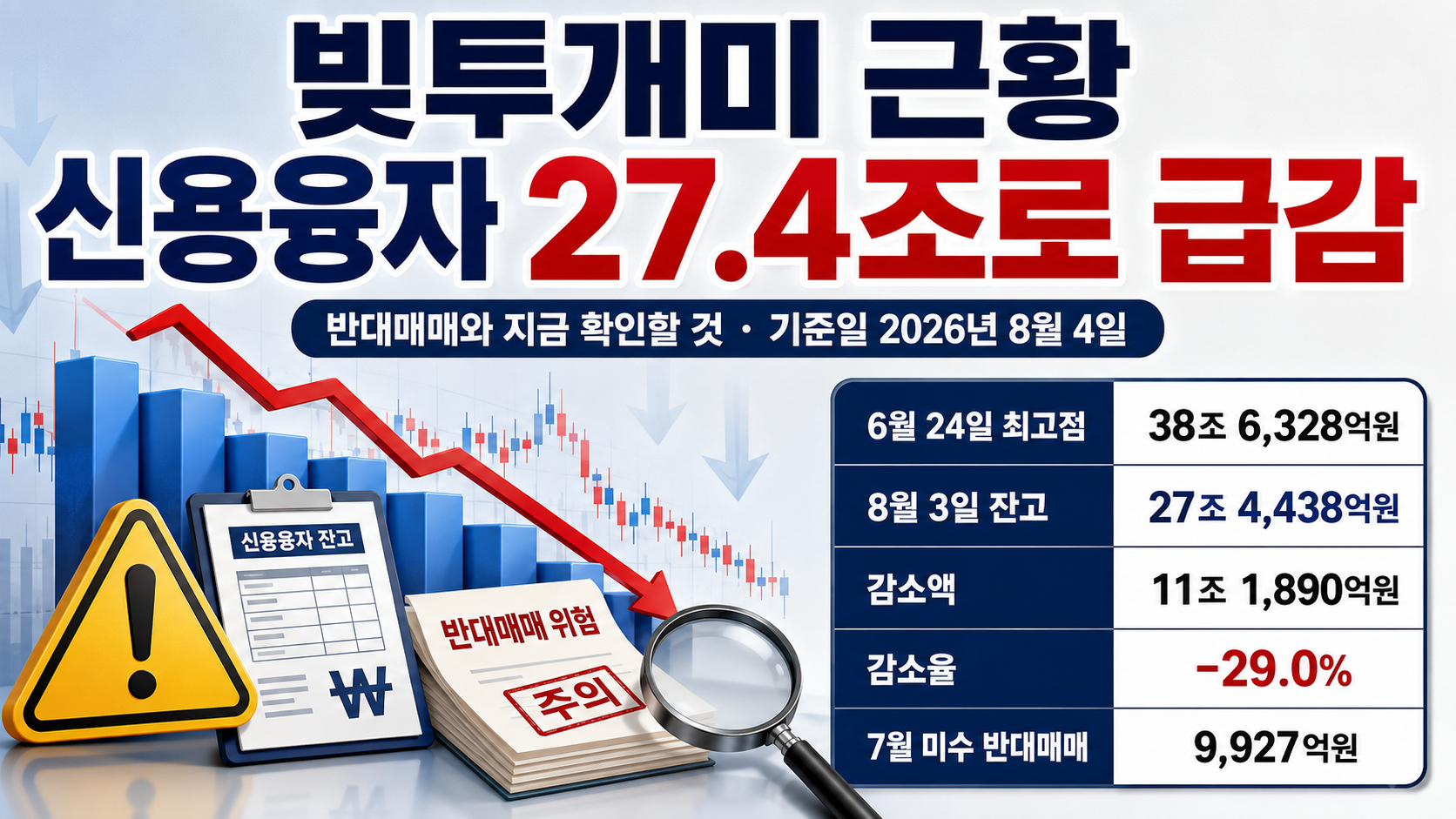
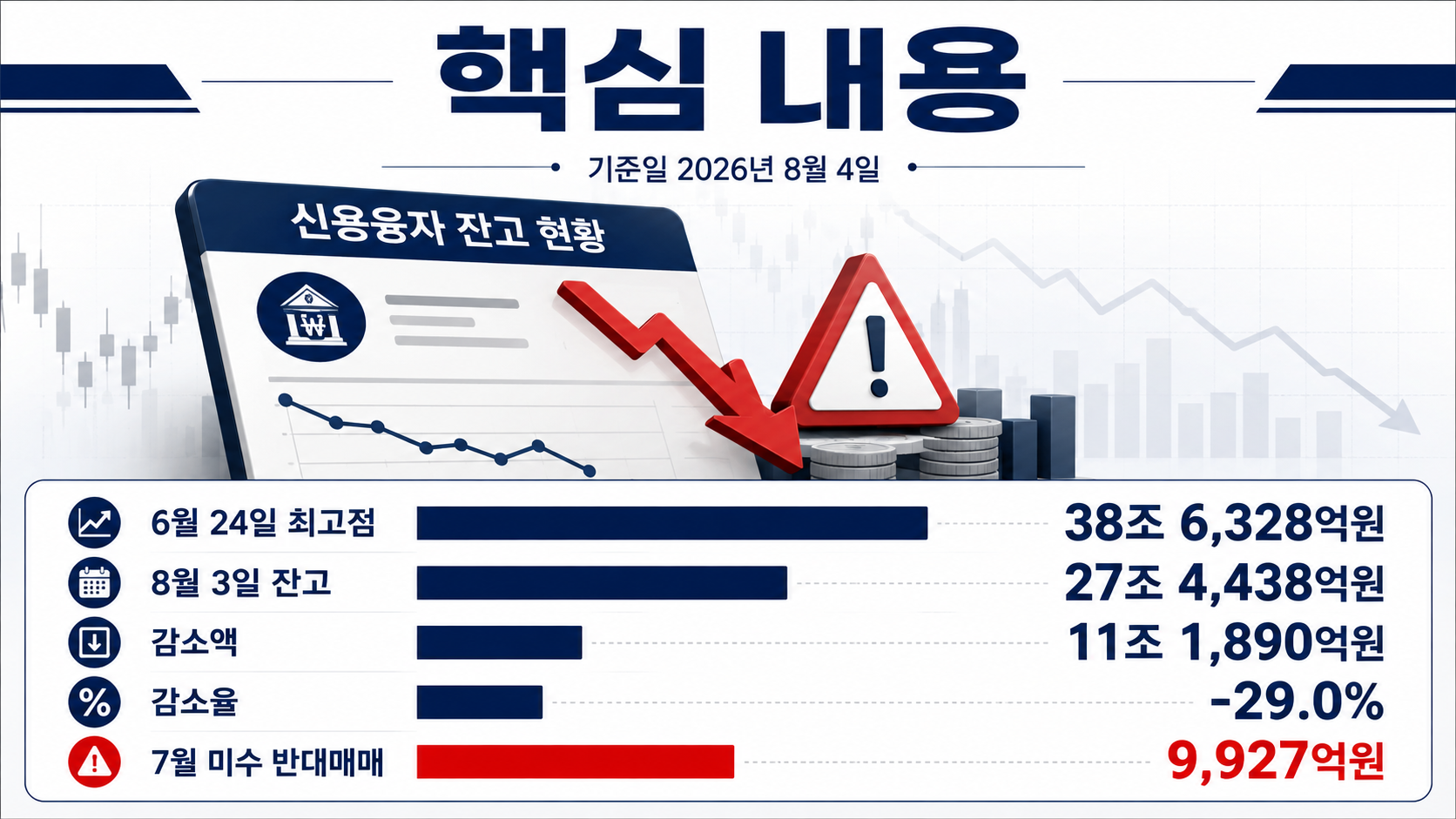
As of 2026-08-04, it cannot be concluded that all retail investors trading with borrowed money have been forcibly liquidated. However, outstanding margin loans stood at KRW 27,443,800,000,000 on August 3, down KRW 11,189,000,000,000, or approximately 29.0%, from their June 24 peak. Forced liquidations related to unsettled trades in July reached KRW 992,700,000,000.
The important distinction is that the decline in outstanding margin loans is not the same figure as retail investors' losses or the amount of forced liquidations.
How Much Has Margin Borrowing Declined?
Outstanding margin loans represent money investors have borrowed from securities firms to purchase stocks in addition to using their own funds, but have not yet repaid. This is one of the main indicators commonly used to measure the scale of stock investing with borrowed money.
| Reference Date | Outstanding Margin Loans | Change |
|---|---|---|
| 2026-06-24 | KRW 38,632,800,000,000 | All-time high |
| 2026-07-31 | KRW 28,934,900,000,000 | Fell below KRW 30,000,000,000,000 |
| 2026-08-03 | KRW 27,443,800,000,000 | Approaching this year's lowest level |
The amount outstanding declined by 11 trillion KRW 189,000,000,000 between June 24 and August 3.
Author's calculation
(38 trillion KRW 632,800,000,000 − KRW 27,443,800,000,000) ÷ KRW 38,632,800,000,000 × 100
= A decrease of approximately 29.0%
Even comparing only July 31 and August 3, the balance fell by KRW 1,491,100,000,000, or approximately 5.2%, in a single trading day.
This Does Not Mean KRW 11,000,000,000,000 Was Lost
A decline of more than KRW 11,000,000,000,000 in outstanding margin loans does not mean individual investors suffered losses of that amount.
There are several reasons why outstanding balances may decrease.
Investors voluntarily repay loans after selling stocks they hold.
New stock purchases financed through margin loans decrease.
Securities firms forcibly liquidate positions because of insufficient collateral or failure to repay loans at maturity.
Securities firms restrict margin trading for certain stocks or customers.
Investors deposit cash to partially repay their margin loans.
Therefore, treating the entire decline in outstanding margin loans as forced liquidations or investment losses would exaggerate the actual situation.
Determining how much an individual investor has lost requires examining the purchase price, amount borrowed, selling or liquidation price, interest, and fees together.
How Extensive Were Forced Liquidations in July?
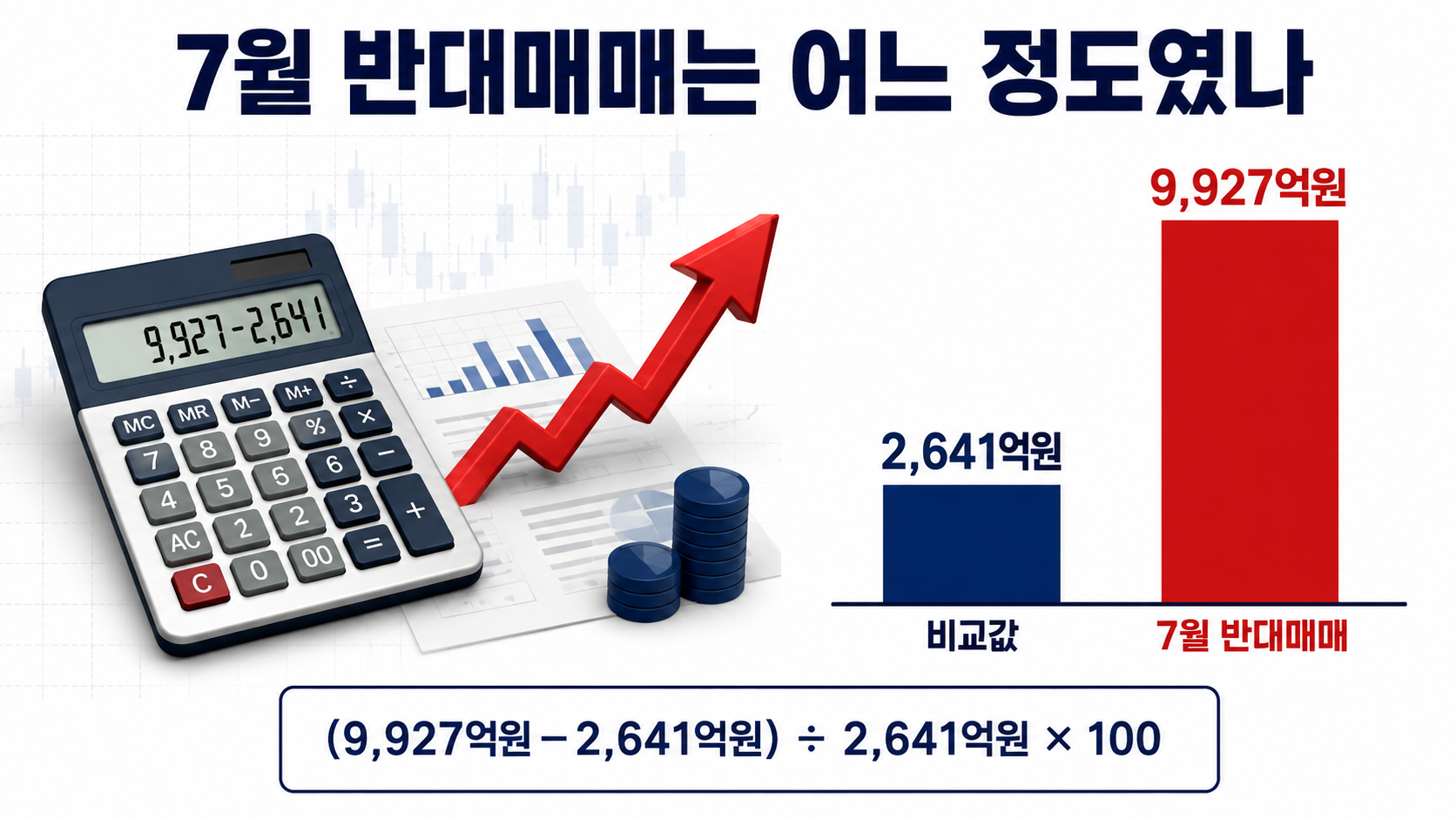
Forced liquidations associated with unsettled brokerage transactions reached KRW 992,700,000,000 in July, approaching KRW 1,000,000,000,000. Although this was lower than June, it remained elevated compared with April or May.
| Month | Forced Liquidation Amount |
|---|---|
| April 2026 | KRW 264,100,000,000 |
| May 2026 | KRW 707,600,000,000 |
| June 2026 | KRW 1,122,800,000,000 |
| July 2026 | KRW 992,700,000,000 |
From June to July, the amount decreased by KRW 130,100,000,000, or approximately 11.6%.
However, compared with April, it increased by KRW 728,600,000,000, representing a rise of approximately 275.9%.
Author's calculation
(KRW 992,700,000,000 − KRW 264,100,000,000) ÷ KRW 264,100,000,000 × 100
= An increase of approximately 275.9%
Another distinction is important here. Daily and monthly forced liquidation figures frequently cited in news reports generally refer to actual forced liquidation statistics associated with unsettled brokerage transactions. They are not the same indicator as the overall decline in outstanding margin loans.
What Is the Difference Between Margin Loans and Unsettled Trades?
Margin loans involve borrowing money from a securities firm to purchase stocks for a specified period. The borrowing period, interest rate, minimum collateral maintenance ratio, and maturity date vary depending on the securities firm and account terms.
Unsettled trading involves purchasing stocks without having enough money to cover the full purchase price and then paying the shortfall by the settlement deadline. If the investor fails to provide the required funds on time, the securities firm may forcibly sell the shares.
Both types of transactions involve purchasing stocks with borrowed funds, but their applicable periods, interest charges, repayment conditions, and forced liquidation procedures differ. Investors should first determine whether their accounts involve margin loans or unsettled trades.
Does the KOSPI Rebound on August 4 Mean the Risk Is Over?
On August 4, the KOSPI closed at 6,358.95, up 1.62%. Although the index rebounded after plunging 5.12% the previous day, volatility continued, including another substantial decline during intraday trading.
A single day's rebound is not enough to conclude that margin trading risks have disappeared.
Margin trading is affected not only by closing prices but also by the prices of individual holdings, the total collateral value of an account, outstanding loans, and the securities firm's collateral valuation methods. Even if the KOSPI rises, an investor's collateral ratio may deteriorate if the stocks purchased on margin decline.
Furthermore, the latest margin loan statistics released on August 4 are based on outstanding balances as of August 3. Subsequent statistics will be needed to determine how the market rebound that day affected margin loan balances.
What to Check in Your Margin Trading Account Right Now
If you use margin trading, it is safer to review your account conditions before focusing on market forecasts.
1. Check Outstanding Margin Loans and Unsettled Balances
Open the 'Margin & Loans,' 'Margin Balance,' or 'Unsettled Amounts' section of your securities firm's app to check how much you have actually borrowed.
If you purchased the same stock using both cash and margin financing, check the number of shares purchased on margin separately.
2. Check Your Current Collateral Ratio
Compare your current collateral ratio with the minimum collateral maintenance ratio required by your securities firm.
The minimum collateral maintenance ratio is not a fixed figure applied uniformly across all securities firms and stocks. It may vary depending on account classification, stock risk levels, and the securities firm's standards.
3. Check the Deadline for Providing Additional Collateral
If you receive a collateral shortfall notice, check not only the amount required but also the deposit deadline and scheduled forced liquidation date.
If stock prices fall further, the additional collateral required may exceed the shortfall initially communicated to you.
4. Check Loan Maturity and Margin Loan Interest
The interest burden on margin loans may increase as the holding period becomes longer.
Check the interest rate currently applied, interest accrued so far, maturity date, and whether an extension is available. Loan maturity extensions are not always possible.
5. Check the Number of Shares Scheduled for Forced Liquidation and How They Will Be Sold
If your account has insufficient collateral or an unpaid loan past maturity, check the number of shares scheduled for forced liquidation in the app or contact your securities firm's customer service center.
Forced liquidations may not be executed at the time or price an investor wants. If the proceeds from selling the shares are insufficient to repay the loan and associated costs in full, an additional amount may remain payable.
What If Living Expenses and Loan Repayment Funds Are Mixed Together?
If you have deposited money earmarked for specific purposes, such as a housing lease deposit, interim property payment, credit card bills, taxes, or living expenses, into your stock trading account, you should assess your investment decisions and cash flow separately.
First, list the amounts you will need and their due dates, then calculate how much cash is available outside your securities account. Using additional loans or credit card loans to cover collateral shortfalls may further increase your total debt and interest burden.
Whether holding or selling is more advantageous depends on the stock and the investor's personal circumstances. However, investors should avoid postponing decisions without understanding their collateral ratio, loan maturity, interest costs, and upcoming expenses.
Frequently Asked Questions
Does an Outstanding Margin Loan Balance of KRW 27,443,800,000,000 Represent Investors' Losses?
No. It represents the total outstanding balance of margin loans that have not yet been repaid. Because the figure reflects voluntary repayments, reduced new borrowing, and forced liquidations, it cannot be directly equated with investment losses.
Does Forced Liquidation Eliminate All Outstanding Debt?
If the proceeds from forcibly selling shares are insufficient to cover the loan principal, interest, and costs, an outstanding amount may remain payable. During a sharp market decline, losses may even exceed the investor's initial capital.
Is the Minimum Collateral Maintenance Ratio Always 140%?
It may vary depending on the securities firm, account classification, and stock. Rather than relying on a general figure found online, investors should check the ratio specified in their securities firm's app and margin trading documentation.
The KOSPI Has Rebounded. Is It Safe to Increase Margin Trading Again?
A single day's index movement is not enough to make that decision. Margin trading involves not only the risk of falling stock prices but also interest costs, loan maturities, collateral requirements, and forced liquidation risks. Investors should first determine whether they have a clearly defined, manageable loss limit and sufficient funds to repay their loans.
In one sentence, the current situation is that stock investing with borrowed money has not disappeared entirely, but it has contracted rapidly from its peak, while forced liquidation pressures remain elevated. Margin trading investors should prioritize checking their securities firm's app in the following order: Outstanding balances → Collateral ratio → Additional collateral deadline → Loan maturity and interest → Scheduled forced liquidations.
※ Figures and market conditions may change from one trading day to another. This article does not recommend buying, holding, or selling any particular stock. Investors should confirm account-specific conditions with their securities firm.
※ This article is provided for informational purposes to help readers understand market developments and does not constitute investment advice regarding any particular stock or asset. All final investment decisions and responsibilities rest with the individual investor.