

Why Bitcoin Funding Rates Differ Across Exchanges: Why the Same BTC Can Have Different Funding Payments
This post contains Coupang Partners affiliate links. We may earn a commission from qualifying purchases.

Even when Bitcoin prices move identically, funding rates displayed on Binance, Bybit, and OKX can differ. This is because exchanges use different funding rate calculation methods, settlement intervals, and futures-to-spot price comparisons. When comparing funding rates, you need to check not only the displayed figures but also the settlement intervals and applicable times.
In particular, even for the same Bitcoin perpetual futures contract, one exchange may have longs paying funding while another has shorts paying. Let's look at why this happens and how to compare funding rates in practice.
Why Do Bitcoin Funding Rates Differ Across Exchanges?
Funding rates are not a single fixed market figure shared by all exchanges. They vary according to the prices formed in each exchange's perpetual futures market and its own calculation rules.
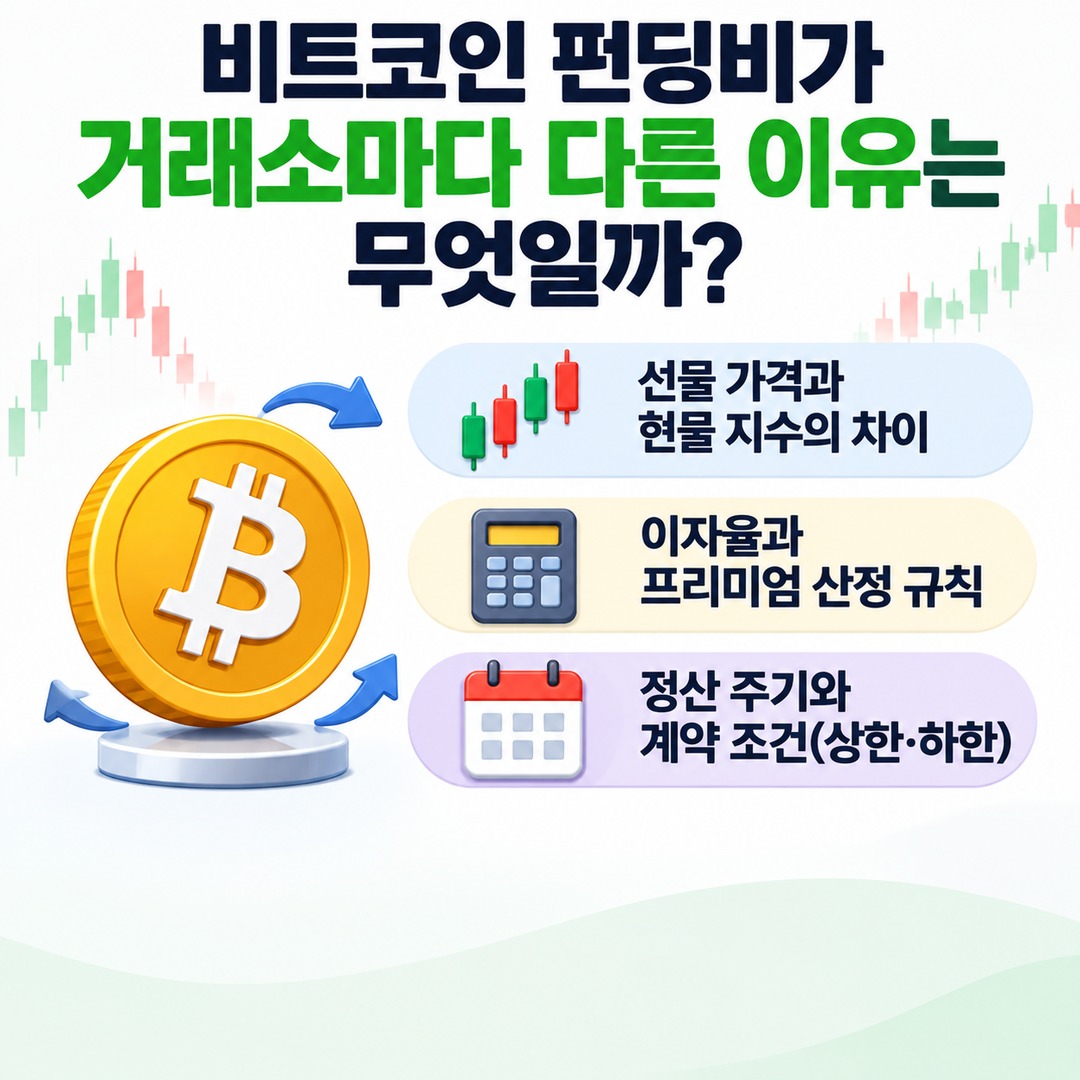
There are three main reasons:
1. The difference between futures prices and spot index prices varies across exchanges.
2. The interest rates and premium calculation rules used to calculate funding rates may differ.
3. Settlement intervals and contract conditions, such as upper and lower limits, may differ.
For example, if buying demand for BTCUSDT perpetual futures is relatively strong on Binance while selling demand is stronger on another exchange, the funding rates on the two exchanges may even have opposite signs.
In other words, the fact that Bitcoin's spot price is the same does not mean its funding rates must also be the same.
How Do Funding Rate Calculation Methods Differ Across Exchanges?
Comparing the official explanations from major exchanges reveals both similarities and differences. Binance and Bybit use interest rates and premium indices as key calculation components, while OKX also incorporates average premiums and interest rates.
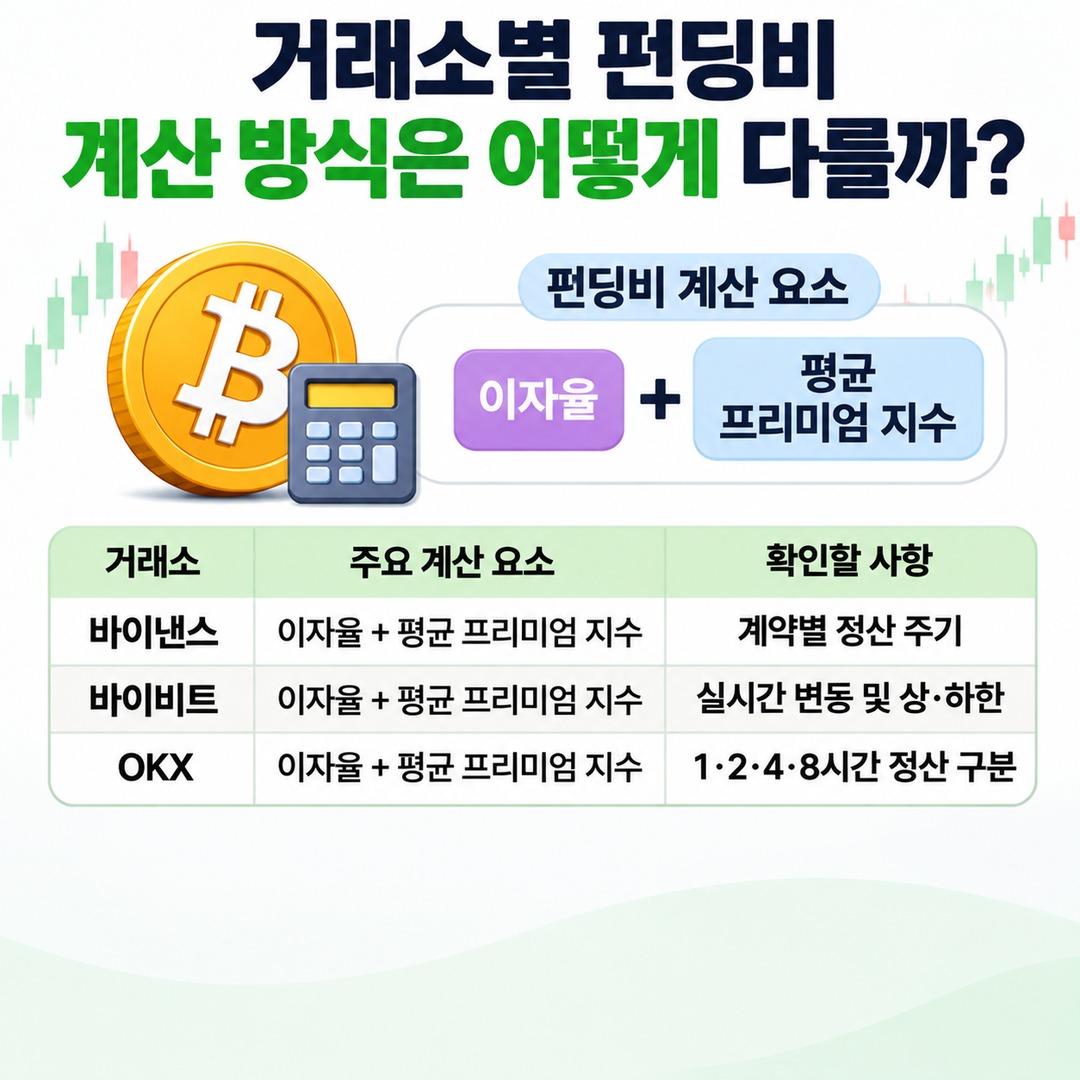
| Exchange | Main Calculation Components | What to Check |
|---|---|---|
| Binance | Interest rate + average premium index | Settlement interval for each contract |
| Bybit | Interest rate + average premium index | Real-time fluctuations and upper/lower limits |
| OKX | Interest rate + average premium index | 1·2·4·8-hour settlement distinctions |
The premium index measures how much more expensive or cheaper perpetual futures trade compared with the reference spot index.
Because order book depth, bid and ask quotes, and the composition of reference spot indices differ across exchanges, the calculated funding rate can vary even for the same BTCUSDT contract.
In particular, in 2026, calculation methods adjusted for settlement intervals must also be considered.
Binance announced a change incorporating a settlement-interval adjustment factor into its September 2025 funding rate formula. OKX also stated in its 2026-05-29 announcement that it would introduce a 8/N settlement-interval adjustment factor. This adjustment applies to the funding rate for each settlement period of contracts that do not settle every 8 hours, aligning it with the settlement time. Binance+2
Therefore, relying only on a calculation formula you memorized in the past may lead to differences between your estimates and the actual funding payments on an exchange today.
Why You Shouldn't Compare 1-Hour and 8-Hour Funding Rates at Face Value
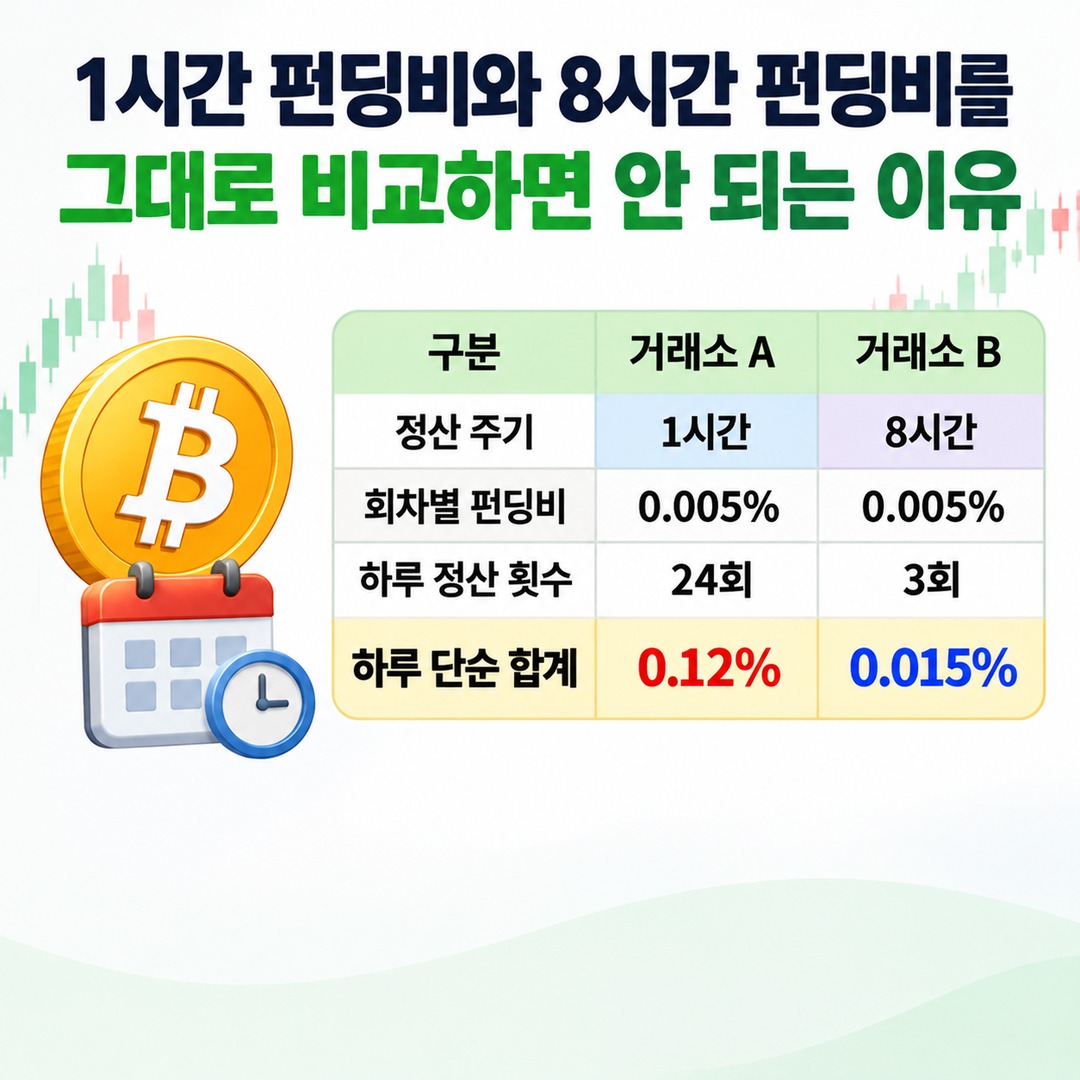
The settlement interval is what beginners most often overlook when comparing funding rates.
A contract that applies 0.005% every 1 hour and one that applies 0.005% every 8 hours may show the same rate, but their total costs over a day are different.
Let's use hypothetical figures to illustrate this.
Hypothetical Calculation Example · Not Actual Exchange Market Prices
| Category | Exchange A | Exchange B |
|---|---|---|
| Settlement interval | 1 hour | 8 hours |
| Funding rate per settlement | 0.005% | 0.005% |
| Settlements per day | 24 | 3 |
| Simple daily total | 0.12% | 0.015% |
The author's calculations are as follows:
Exchange A: 0.005% × 24 = 0.12%
Exchange B: 0.005% × 3 = 0.015%
Even with the same 0.005%, the simple daily totals differ by a factor of 8.
Conversely, when converted to a 8-hour basis, Exchange A is 0.04%, while Exchange B is 0.005%.
However, this is a simple conversion based on the assumption that the current funding rate remains unchanged throughout the day. Actual funding rates can fluctuate before settlement, so this calculation does not establish a guaranteed future payment amount.
5 Steps for Properly Comparing Funding Rates Across Exchanges
For an actual comparison, follow these steps:
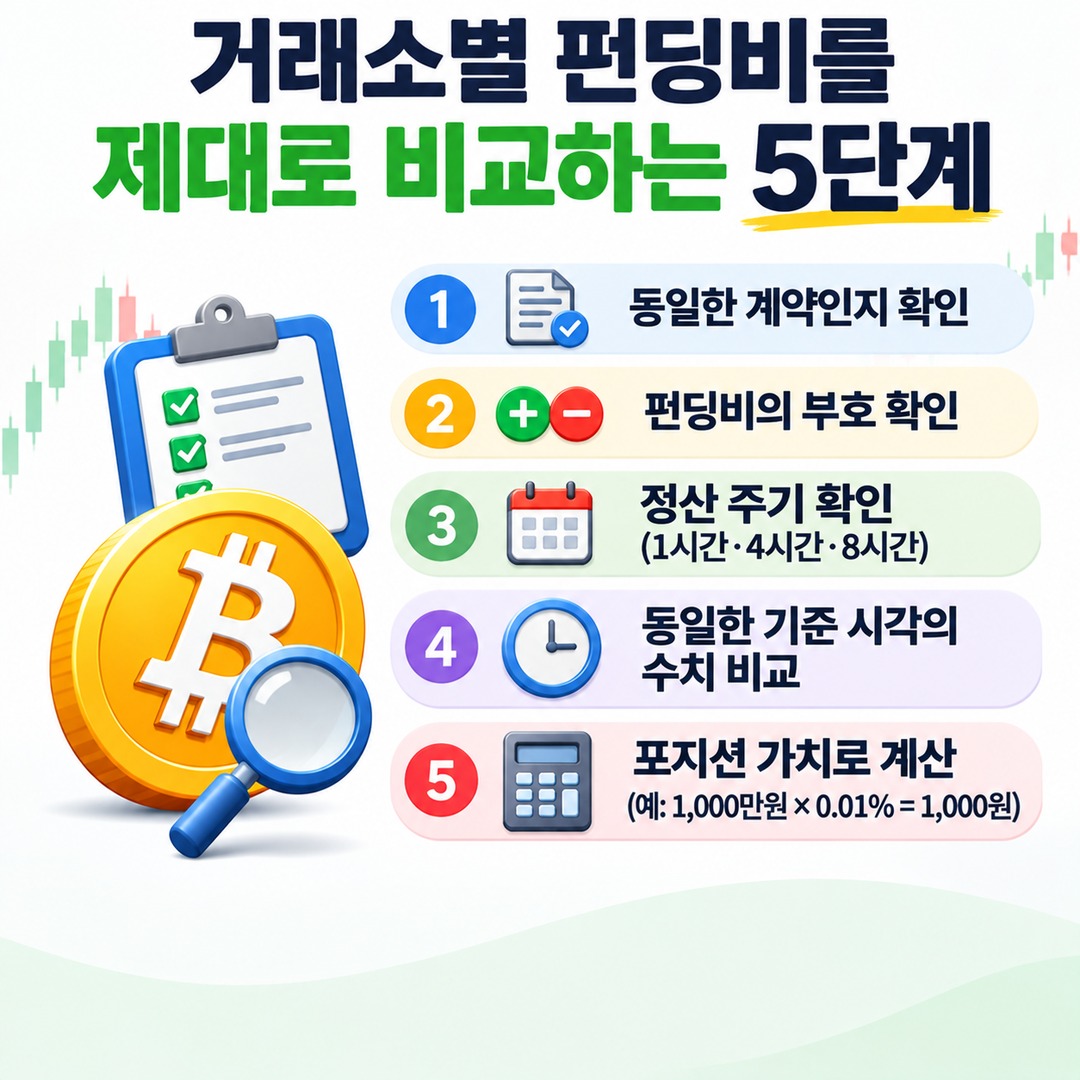
1. Confirm that you are comparing the same contract.
BTCUSDT perpetual futures and BTCUSD inverse contracts may differ in their settlement assets and methods of calculating position value.
Make sure the instruments being compared are consistent before proceeding.
2. Check the funding rate's sign.
Positive (+): Longs pay shorts.
Negative (-): Shorts pay longs.
A negative funding rate does not necessarily mean Bitcoin's price will rise.
3. Check the settlement interval.
Check whether the applicable interval is 1 hours, 4 hours, or 8 hours.
Step 4. Compare figures using the same reference time.
You should not compare one exchange's estimated rate for the next settlement with another exchange's previously confirmed rate.
You must also distinguish between real-time estimated funding rates and funding rates actually settled.
Step 5. Calculate based on the actual position value.
Funding rates are generally applied to the position value, not the margin.
For example, if the position value is KRW 10,000,000 and the funding rate is 0.01%, the funding payment for one settlement is KRW 1,000.
However, the actual amount may vary depending on the contract type, mark price, applicable timing, and exchange rules.

Not necessarily. Even with a lower funding rate, actual trading costs may be higher depending on trading fees, bid-ask spreads, slippage, and liquidity.
Strategies that attempt to profit from funding rate differences between exchanges involve the following risks:
Price difference risk: Futures prices on one exchange may move differently from futures prices on another exchange.
Liquidation risk: Even if you hold positions on both exchanges, differences in margin requirements and liquidation prices could result in only one side being forcibly liquidated.
Fee risk: Trading fees incurred when opening and closing positions may exceed the profit from the funding rate difference.
Settlement timing risk: If exchanges have different settlement times, the expected funding payment conditions may change.
Withdrawal and trading restriction risk: Delays in asset transfers or order execution can make it difficult to respond to price differences.
Therefore, differences in funding rates across exchanges provide information about variations in market supply and demand. They do not, by themselves, represent risk-free arbitrage opportunities.
Frequently Asked Questions About Comparing Funding Rates
Q. Can Binance and Bybit show opposite funding rates?
Yes. This is because the premiums and calculation conditions in each exchange's perpetual futures market differ. One exchange may display a positive rate while another displays a negative rate.
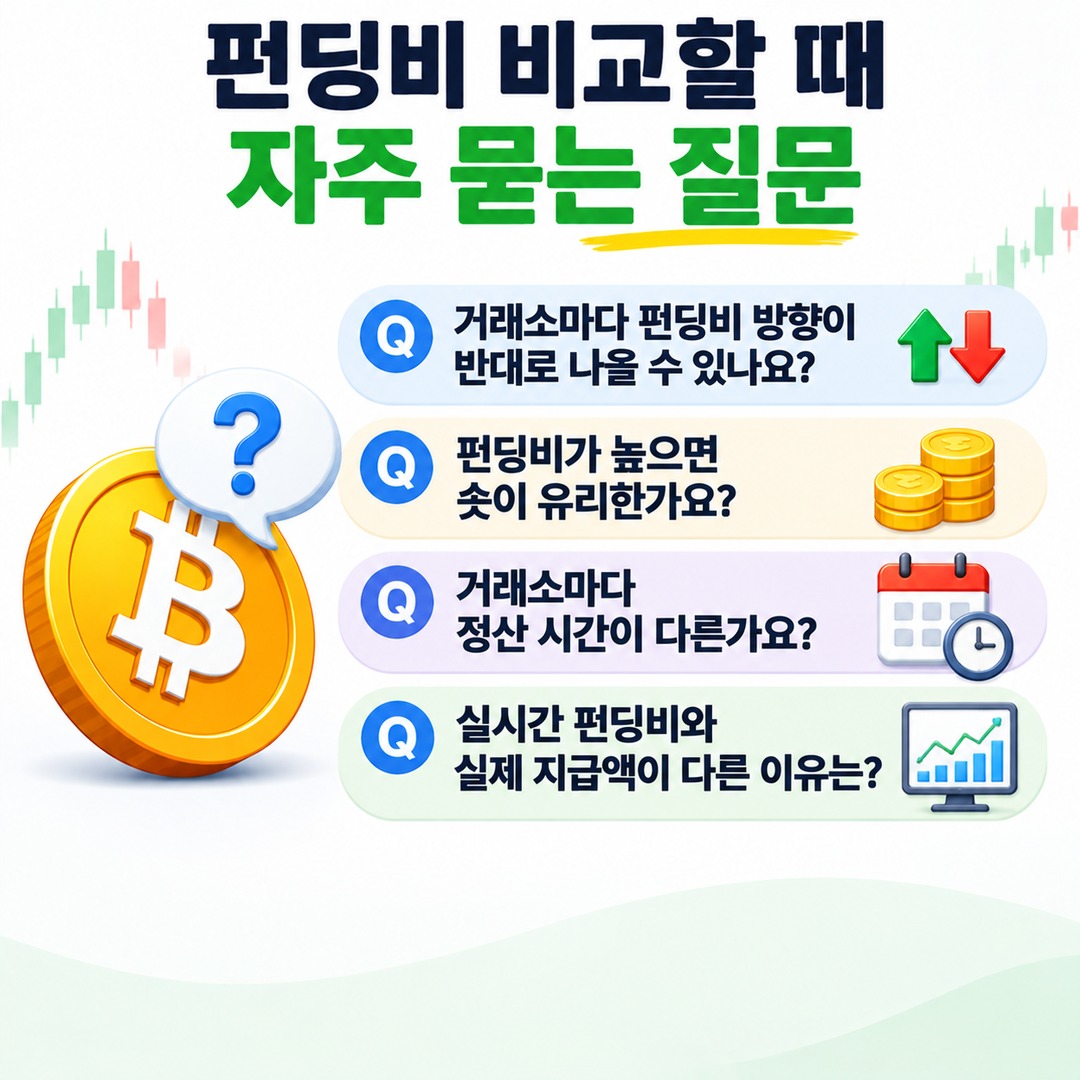
When the funding rate is positive, short position holders may receive funding payments. However, this does not mean Bitcoin's price will fall. Losses on a short position caused by a rising Bitcoin price may exceed the funding payments received.
Q. Do settlement times differ between exchanges?
They can differ. Binance's default 8-hour settlement times are 00, 08, and 16 UTC, corresponding to 9 AM, 5 PM, and 1 AM the following day in Korean Standard Time. However, some contracts may use different intervals, so you should check the individual contract's details. Binance+1
Q. Why does the real-time funding rate differ from the actual payment?
The funding rate displayed in real time may be an estimate for the next settlement. The rate can change with market conditions before settlement, so the actual payment should be checked using the rate confirmed at the settlement time. Help Center+1
When Comparing Bitcoin Funding Rates, the Reference Conditions Matter More Than the Numbers
Differences in funding rates across exchanges are not errors. They occur because each exchange has different market supply and demand conditions and calculation rules.
Keep these three points in mind when making comparisons:
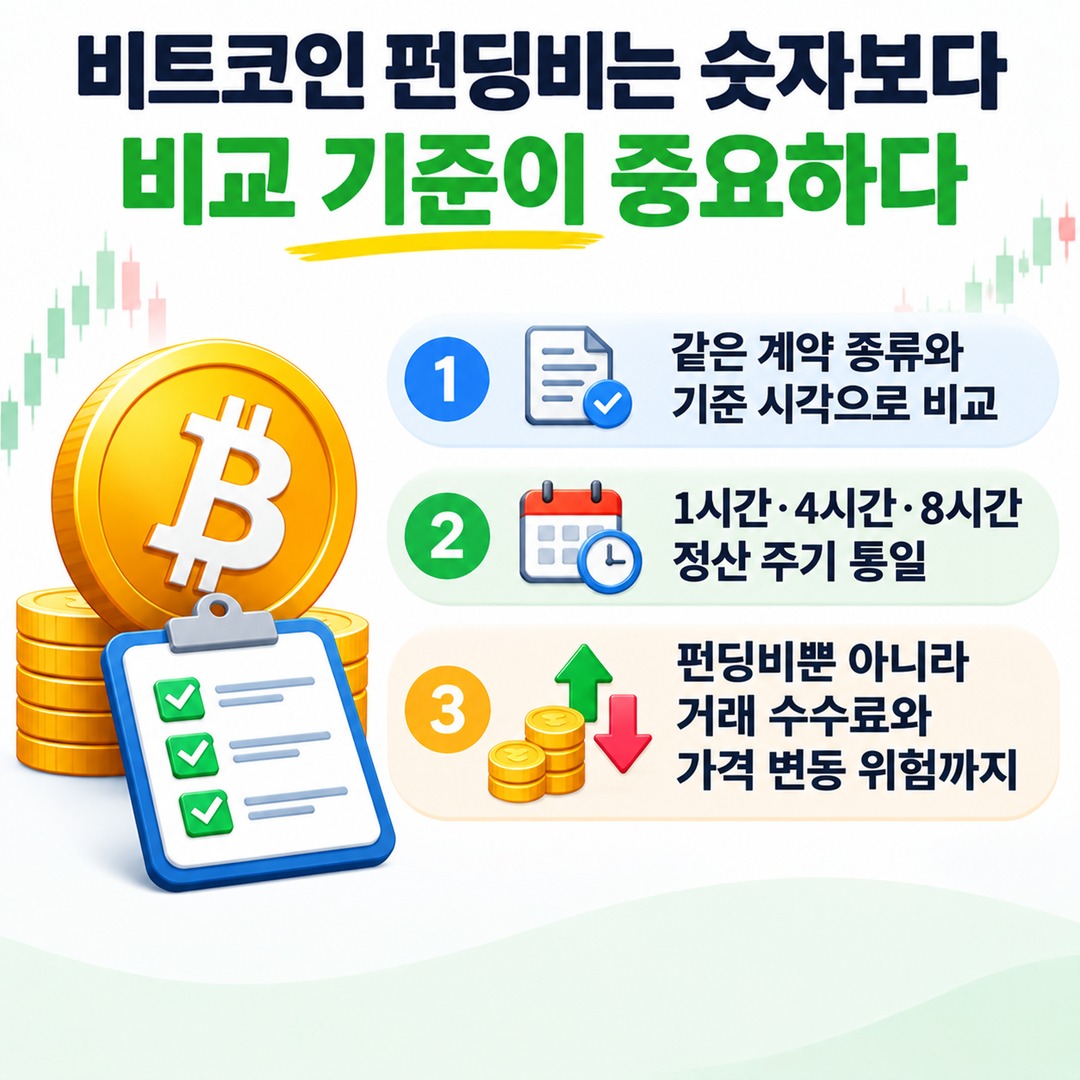
1. Compare the same contract type at the same reference time.
2. Standardize and convert the 1-hour, 4-hour, and 8-hour settlement intervals before comparing.
3. Calculate not only funding rates but also trading fees and price fluctuation risks.
It is risky to decide whether to go long or short solely because the funding rate is high or low. Funding rates are best used as one of several indicators for interpreting the positioning and supply-demand dynamics of market participants.
※ This article provides information for understanding market trends and does not constitute investment advice or a recommendation to invest in any specific security or asset. All final decisions and investment responsibilities rest with the individual.
This post contains Coupang Partners affiliate links. We may earn a commission from qualifying purchases.